Showing posts with label Round Records. Show all posts

Sunday, March 13, 2022

On Tours and Marketing Records

Over at Jerrybase, we have begun grouping events not only by "runs" (consecutive nights at the same venue), but also "tours". It turns out that the notion of a tour isn't quite as crystal clear as one might want it. I wanted it to be at least three out of town gigs in at least two rooms on a single outbound from San Francisco, but, especially in the Garciaverse, this ends up creating some "tours" that lack face validity as such.

Consider Jerry's March-April 1976. The decision rule above would produce the following "tours" that month:

1) Pacific Northwest (Eugene, Portland, Seattle), March 3-6 (3 cities, 3 shows in 4 nights)

2) Midwest College Towns (Evanston, Oberlin, Columbus), March 12-14 (3 cities, 5 shows in 3 nights)

3) Texas (Houston and Austin), March 18-21 (2 cities, 6 shows in 4 nights)

4) the "real" Spring Tour, March 26 - April 5th (9 cities, 13 shows in 11 nights)

My Jerrybase partners have suggested that's a little too granular, and I don't disagree. While they fit the operational definition I offered above, they lack verisimilitude. We'd welcome you to peruse Jerrybase's Tours Page to see what you think.

UPDATE 20220625: correspondent Matt Grady informs that musicians call this little not-quite-a-tour jaunts "runouts" - the perfect word! I am a big fan of words, and when they effectively classify a group of things that would otherwise leave me wordless, well, I like them even more. And, thank you Matt!

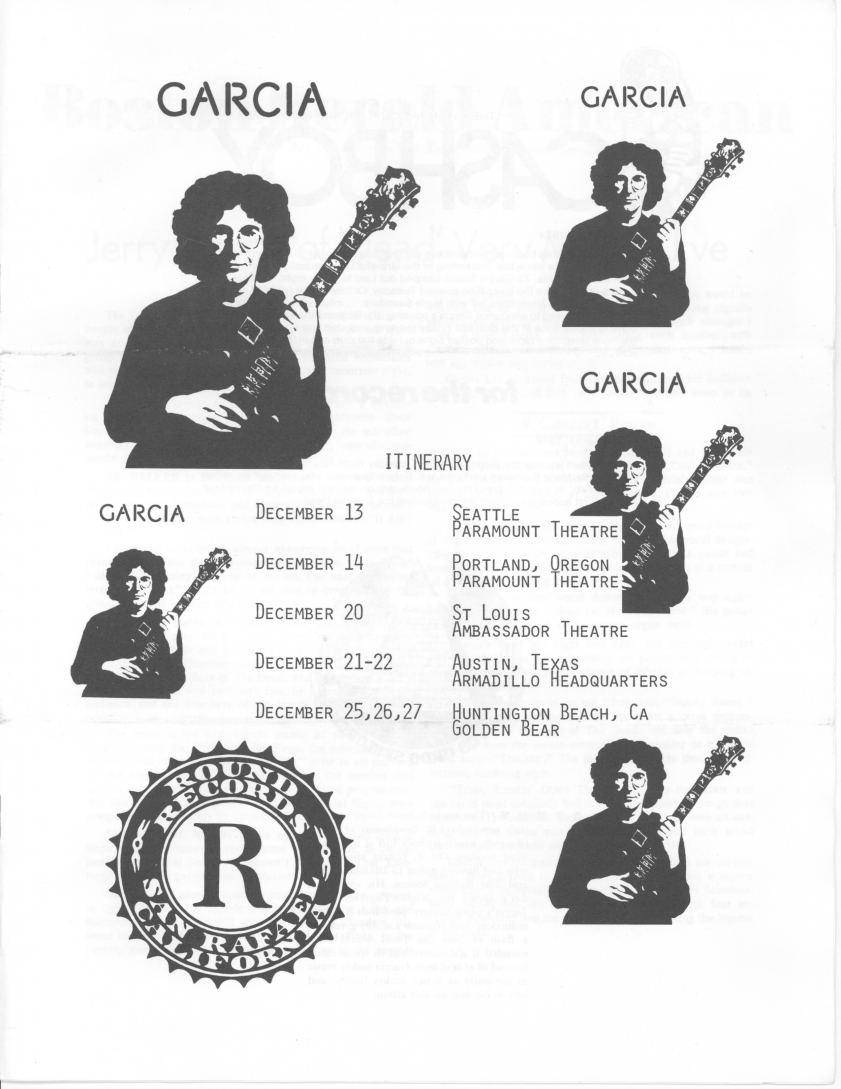
As it happens, this work also allows me to fill in a placeholder post I had been ignoring for awhile, centered on the following image:

Here we have an 8.5" x 11" promotional handbill listing some upcoming Jerry and Merl gigs in various cities in December 1974. I know there is a copy of this in Santa Cruz ("Business: RX-102 - Compliments of Garcia," Grateful Dead Archive, Special Collections, UC Santa Cruz, MS.332.ser. 2, box 17, folder 10), and I know this image is not from there. First, this one seems to have a crease, that one doesn't. Second, they don't allow posting of scans from the collection - a requirement which I respect and I think others do as well. I was about 99% sure I got this from GDAO, but I cannot find it there. So I can't recall how I came into this it. Anyway, I saw it in the GD Archive, and loved it, then found a copy out in the wild which I could reproduce.

Why do I love this?

First, because I love the music this band made. Go get thee to Garcia Live: Volume Three: December 14-15, 1974, Northwest Tour, Legion of Mary (ATO Records, 2013) if you want to hear why.

Second, who doesn't love beardless Jerry?

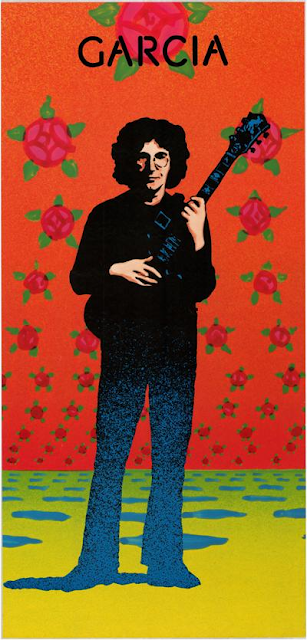
Third, this particular image of beardless Jerry was drawn by Victor Moscoso for the cover of Jerry's second record, Garcia (by which I mean it was his second record, and his second record with that very title), which we all know as Compliments (Round Records, RX-102, June 1974) and I have the very tall, full color poster of the album art at the framer's, and I can't wait to get that sucker up on the wall. It's a beaut.

Fourth, the handbill promotes JGMS gigs --note, still no public use of the moniker Legion of Mary known to me before January 1975-- at the Paramount Northwest in Seattle on December 13, 1974, at the Paramount in Portland on December 14, 1974, at the Ambassador in St. Louis on December 20, 1974, two nights at the Armadillo World Headquarters in Austin on December 21-22, 1974, and then three nights, December 25-27, 1974, at the Golden Bear in Huntington Beach.

Four-A, I love the Pacific Northwest. Four-B, these PNW theaters hosted some killer GD and Jerry over the years. Four-C, the Ambassador, a "landmark of rococo 1920s theater design"? Yes, please. Four-D, I have an original poster from the Armadillo gigs, and it is allegedly the very copy that was hung in the 'dillo lobby at the time of the show. So, there's that. Four-E, the Golden Bear - again, yes, please and thank you. We don't list capacity for it at JB - anyone know? Four-F, the Golden Bear hosted one of my favorite shows from the last eight months of the Garcia-Saunders band, 12/29/74b, partly because of the amazing tape pulled by "Flashback" Charlie Disalvo and partly because I want that version of "Expressway (To Your Heart)" to be my walk-off music as I leave behind my earthly existence. It KILLS.

Fifth, another one of my longtime favorite Garcia-Saunders shows, 12/15/74 in the EMU Ballroom at the University of Oregon, is *not* listed on this handbill, which gives me a sense that it was booked rather later than the others. Who cares? I kind of do, to tell you the truth.

But the BIG takeaway is, Six-A, that I don't know of any other Round promotions for live gigs. Jerry went to NYC on July 1-3, 1974, to play the Bottom Line just a few days after the record came out. The shows sold out in a minute without advertising, but, of course, the record company could also, y'know, have promoted the record. Same goes with the November '74 tour, Jerry and Merl and crew with Martin blowing and the great Paul Humphrey on the drums - no advertising needed for the gigs, but what about cross-promotion with the vinyl? (Yes, I know the record wasn't JGMS. But if we held strict to that, it'd rule out the hints we do have here of a tie between the record and these gigs.)

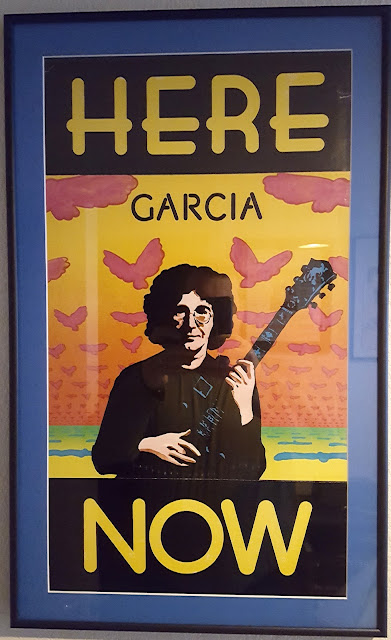
So, here we have the imagery from Moscoso's cover art, the same lettering on 'GARCIA', and the Round Records logo. But, - Six-B - there is no evidence of the record besides this. No title. No note that there even is a record. It doesn't say "buy the new record, and come see the show", or, "come see the show and, if you dig it, buy the record. Oh yeah - tell your friends!" Instead, we see allusions to Compliments, but no direct mention of it. The Jerry heads would already have recognized some of this, of course, but mostly because they probably already had the record or, as Jerryheads, didn't need to be marketed to buy tickets to see Jerry. Maybe your average head would go to the show, and Round man Steve Brown would ply them with the advertising cards, maybe a "Here Now" poster --already framed and on my wall--

or  some other schwag, so maybe that was the idea. Maybe Anton Round was signing autographs.

I guess it just seems like a little bit of a missed opportunity. Oh yeah, one last thing, in full-circle mode: those March '76 jaunts were almost certainly "behind" Jerry's third record, Reflections (Round Records, RX-107, February 1976) - maybe by then the tie-ins were being made more explicit. But, then again, that'd redound to the benefit of United Artists, since Round, as such, had gone belly-up. I wonder why?

Thursday, May 24, 2018

Stinson History

Stinson Beach Music Scene Time Line: 1960s to the Present

The site above was just brought to my attention. I can't find an email for anyone in the organization based on a cursory search, so I thought I post some reactions here.

The prompt for all of this is the newly digitized source for the OAITW gig at the Stinson Community Center on September 30, 1973, same source tape as an older source I have sketchily blogged. I haven't had time to look back at this in detail, but I also want to pin Corry's post on an early OAITW gig at a Stinson Beach bar.

The point of this post is to post some corrections and ask some questions about entries in the Stinson Historical Society page that heads the post. If anyone knows any of the principals and wishes to draw their attention to the corrections, they might be interested.
“Blows Against the Empire” and “Mexico” (1969) - Jefferson Airplane
Recordings for BATE started in July 1970, just to be clear. Not sure what the Stinson connection is supposed to be here.
1970 – Peter Rowan moves to Stinson Beach from Mill Valley, where he had been playing in bands such as Seatrain and Earth Opera. Also recently been spending time playing with bluegrass legend Bill Monroe. He moves into a house on Calle del Ribera and pays $100/month in rent. He ends up writing one song inspired by Stinson Beach: “Riding the Rainbow in the Sky,” which was never released on a record.
The liner notes to Breakdown say PR arrived in Stinson Beach in October 1972.
8/27/71 - Jerry Garcia and others play at the club known as “The Red Whale,” which is located where the current Stinson Beach Water County District is located on Highway One just past the turn off for Calle del Arroyo. It would later be renovated and renamed “The Brigg.” Still later, it would be renovated again and renamed the “Over the Hill Bar and Grill.”
Mmmmm, a specific date which I don't have. I would love to know the source of this information! In the meantime, I will add it to my spreadsheet. I am presuming this would be the NRPS warming up earlier in the day before gigging at the Longbranch this night, but of course I can't be sure.
One rumor has it that the only time Jerry Garcia met John Lennon was during this time period in Stinson Beach.
Sounds familiar, but I will pin this possible crossing here.
Autumn 1972 – Jerry Garcia & David Grisman play bluegrass music several times, with Jerry practicing his banjo whenever he can after they bumped into each other at Ed’s Superette as Garcia was buying cigarettes.
I thought the story of their hooking back up in Stinson was that Pete Rowan walked Dawg (or vice versa) up the hill to Garcia's. This doesn't rule out that they bumped into each other at Ed's Superette, of course.
January 1973 – ... After playing at “Avila's Barn,” Jerry Garcia names David Grisman "Dawg" after he saw dog following Grisman on the beach at Stinson.
Avila's Barn doesn't ring a bell to me, though I bet that if I check Corry's "unknown bar" post it's mentioned there. update: I think the name is not "Avila" but Avella - so, Avella's Barn. I have changed it in my tag.
1973 [sic] - Goldie Rush starts Round Records above Ed’s Superette in 1973
First, the name "Goldie Rush" was new to me, and it shouldn't be, because apparently she was heavily involved in Round Records. Second, though, 1973 is too early, at least for "starts" in any formally institutionalized sense. Round Records was incorporated in the state of California on January 22, 1974.
1977 [sic] – David Jenkins (guitar) and Cory Lerois (keyboards) move to Stinson Beach, both members of the band Pablo Cruise. Lerois buys Mountain Girl/Jerry Garcia’s old house, and does a major remodel.
No. This was early 1978.
1979/1980 – The band “The Edge” is formed by Lorin Rowan, Mark Stein, Jim Dillon, Keith Glanz and Ozzie Ahleve [sic]
Correction: last fellow's name is Ozzie Ahlers.

Thursday, January 14, 2016

Great American String Band - May 5, 1974, Keystone, Berkeley

Sunday, May 5, 1974 found Garcia at the Keystone (typical), but in the background, picking some banjo in the Great American String Band behind its featured front line of Richard Greene (fiddle), David Grisman (mandolin), and David Nichtern (guitar and vocals).

Rather remarkably, we know a fair bit of very interesting stuff about this gig, despite the fact that there is no tape in circulation.

First, the band was billed as Great American String Band (GASB), which wasn't always the case - it sometimes traveled as Great American Music Band (GAMB), and it doesn't appear that things were particularly consistent in that regard. This testifies to the rather fluid nature of the enterprise, always of interest in the Garciaverse, which would become increasingly institutionalized as time went on. Garcia is listed first, natch - capitalists gotta capitalize - but that's pretty standard.

Second, an anonymous commenter at Hooterollin' reports special guest appearances, including, a week after Old And In The Way's abortive swan song --"no sweeping exits"-- at the Golden State Country Bluegrass Festival, the last known stage shared by Garcia and the great Peter Rowan:
I saw Great American String Band show at the Keystone on May 5, 1974 and can attest to the fact that Peter Rowan and Jack Bonus were brought out for two songs - Midnight Moonlight and Hobo Song and the show was recorded professionally for what folks at the gig were hearing would be a future album.
Third, as the commenter said, the gig was being recorded for release, one presumes on Round Records, the "side band" companion company to Grateful Dead Records. While the Dead outfit had been up and running since the previous autumn, Round was incorporated 1/22/74. A review of this show that I have just discovered (Silver 1974) confirms that Bear (Augustus Owsley Stanley III) was recording the show with a female assistant, I presume the same Vickie Babcock who helped him record Old And In The Way the previous October.

Fourth, between the Hooterollin' commenter and Sam Silver's review, we can also reconstruct some of the setlist. The show started around 11 pm with what the reviewer called "Dog's Bone", which I assume was "Dawg's Bull", a Grisman original. They played "Bud's Bounce" ("mistakenly credited to Buddy Emmonds, really belongs to Buddy Spiker"), "Midnight at the Oasis", at least one Carter Family tune, and Django Reinhardt's "Swing '42" (about which Silver raves). Anonymous commenter adds "Midnight Moonlight" and "Hobo Song" to the mix.

update: Anonymous, in comments, adds the David Nichtern compositions "I'll Be A Gambler If You Deal the Cards" and "My Plastic Banana Is Not Stupid" to this night's setlist, and that "there was another Grisman song or two"

Fifth, Silver took and the Barb published a picture of the GASB in action, one of only two of which I am aware (the other from 5/25/74 in Santa Barbara - h/t Bob Murphy).
Sam Silver's photo of the Great American String Band, live at Keystone Berkeley, May 5, 1974. Published in the Berkeley Barb, May 10-16, 1974, p. 17.

Silver is over the moon about the band, with "the best of all possible pickers for the unique job of creating a new music". The review is well worth a read, really capturing the vibe of a show where Garcia is the draw but the other players are the virtuosi, and the audience seemed ready to rock but proved able to appreciate acoustic brilliance.

All of this raises a few essential questions. Are these tapes in possession of the Owsley Stanley Foundation? If so, who can spare whatever it would take to sponsor their preservation? Why didn't the GASB record ever materialize? Most importantly, given the amazing musical direction the band was taking - it was an early germ of Dawg Music, Grisman's brilliantly distinctive alchemical blend of dozens of traditional musical forms - why didn't the String Band last as a Garcia proposition, but morph into the David Grisman Quintet (DGQ)?

! listing: Oakland Tribune, May 3, 1974, p. 30;
! listing: Hayward Daily Review, May 3, 1974, p. 44;
! listing: Oakland Tribune, May 5, 1974, p. 2-R;
! ad: Oakland Tribune, May 5, 1974, p. 2-R;
! Ref: http://hooterollin.blogspot.com/2011/10/april-10-1974-record-plant-sausalito-ca.html?showComment=1329237485261#c7438213843279921015;
! review: Silver, Sam. 1974. Waiting for Jerry Garcia. Berkeley Barb, May 10-16, 17, via Independent Voices.

Jerry and Merl in the studio, 1975

Found this item in the LA Free Press (June 27 - July 3, 1975, p. 14): "Danny [sic] Selwell [sic] has been buzzing 'round the studio scene, putting time in with Art Garfunkle [sic], Steve Marriott ... Jerry Garcia and Merle [sic] Saunders".

Having found nothing on Danny "Selwell", I wrote
So interesting. Jerry and Merl working in the studio, right around the time (like, within a week or two) that GD Records and Round Records call it a day and join up with United Artists, right around the time (like, within a week or two) that Legion of Mary calls it a day. Curioser and curioser.
But Corry points out in comments that this probably refers to the Keith and Donna Godchaux record, to which Denny Seiwell indeed contributed.

Monday, August 10, 2015

On lead guitar and vocals, Mr. Jerry Garcia


Bill Graham:

Good evening. We welcome you, on behalf of the group. We should introduce ... We should thank United Artists and Mr. Ron Rakow. I should make it official. Mr. Rakow is the President of Round Records. He asked if I could be here this evening, and I said 'I'd like twelve dollars and fifty cents', which he paid me at the door, and we flipped double or nothing, and I won, and he wanted to flip again, so I'm being paid fifty dollars for being here. I want to thank him very much.

On the piano we have Mr. Keith Godchaux [electric piano] ... on the drums, on stage left, Mr. Mickey Hart [drums begin] ... on bass and vocals, Mr. Philip Lesh [bah-doomp-bah-doomp bah-doohhhom] ... on rhythm guitar and vocals, Mr. Bob Weir [Bob filligrees a little top knot] ... on the drums on stage right, Mr. Bill Kreutzmann [tss-ts-tss, tss-ts-tss] ... on the vocals Mrs. Donna Jean Godchaux ... on lead guitar and vocals, Mr. Jerry Garcia ... will you welcome, please, the Grateful Dead!

Update: Jesse Jarnow and I are on the same wavelength!

Sunday, June 28, 2015

Reading Notes: Dupree 1974


Zoo World, January 31, 1974. "Cover photo captured by Mario Algaze the afternoon of a Leas Campbell presentation of the Grateful Dead at Curtis Hixon Hall in Tampa, Fla.", December 18 or 19, 1973.

A clean-shaven Jerry Garcia in Tampa, Florida, December 18 or 19, 1973. Photograph by Mario Algaze, published in Zoo World, January 31, 1974, p. 12.

Dupree, Tom. 1974. Grateful Dead: Hipper Than the Average Corporation. Zoo World, January 31, pp. 12-13.

The pictures are from Tampa. As the Thoughts On The Dead guy might say, Billy looks like he wants to kick punch some dicks. Anyway, Donna Jean was back home giving birth, and the band played two kickass shows December 18-19, 1973, really great.

The article draws from December 12th in Atlanta, meetings and interviews with band members, a few expost reax to the show. As the title implies, the main topic of discussion is Grateful Dead Records, and business matters (this appears to have been an industry paper based in Nashville, I should probably know that).


p. 12

booking firm: Out Of Town Tours

Dead inspired travel agency Fly By Night

"Garcia's country group Old And In The Way"

Sparky And The Ass-Bites From Hell

Weir interview

Meeting in the Regency Hyatt House Hotel, not where band is staying. Bob is there to sightsee the tony hotel's glass elevator, architectural emanation of American opulence, on the side of a newspaper interview downtown. Pull-quote paints picture of a wine-snobby Bobby, which is partly true but pretty unfair for a guy who has worked hard for fifty years despite probably sitting on a pile of family money (the Atherton house he grew up in alone would make quite an inheritance). In his seventies as I type this, tonight he's playing the second night of GD50 in Santa Clara.

Weir: the hippie thing was a good time, but we've moved on.

Record company: "the Dead organization picked a network of conventional distribution firms" to get the Wake of the Flood into the stores.

p. 13

Rock Scully is current road manager – when did Cutler leave the road?

Weir says they have reduced their risk by having a less diversified portfolio than most record companies. They don't have to pay for the 6 or 7 Donnie and the Doughnuts records that lose money. They have just the 1 GD record, which they have some idea can sell. "Any fears about the company's success in its initial stages have been quieted: the album is about to go gold, with RIAA certification expected to come in January, just about two months after release" (Dupree 1974, 13).

"The Dead organization … is hoping the LP will provide capital to bolster and expand other aspects of its operation" (Dupree 1974, 13). Interesting – note that at this early stage, no mention of Round Records, Round Reels, etc. I want to triangulate to when we get the first mention of the Round stable of shell corporations.

Ever the anti-businessmen, Rock and others say the album kind of sucks! (Dupree 1974, 13).

"I like it," Garcia says of Wake of the Flood. "I thought the material was very good. And there's no question that we were rushed on it. We did that to ourselves, really, by leaving ourselves too short off time. But, considering, I think it turned out pretty well" (12/12/73, Dupree 1974, 13).

JG: "Phonograph records are misleading … First of all, there's an artificial start and stop, the physical dimensions of an album. … There's only, what, 22 minutes to an album side, and our thoughts are much longer than that" (12/12/73, Dupree 1974, 13).

Odd moment 12/12/73 Garcia to say they now like big rooms because of the WOS: "If we couldn't get off in them, we wouldn't play big halls. But now we understand them about as well as we understood theaters when we were playing them" (Dupree 1974, 13).

Rock 12/12/73 says the band will take five days off, play the Florida gigs, then take a month or two off. "That's the whole band I'm talking about. Garcia has never taken a moment off since he picked up his first guitar. He is playing somewhere every night" (Dupree 1974, 13).

Keith speaks! 4th column, p. 13 "I'm sure there are a lot of relatively honest ways of calling attention to yourself, as long as it's not hype. We are not in a position to be ripped off. We can't afford yet to give $3,000 to a local distributor and then have him forge newspaper receipts on us. Where we're at right now is, we have people on the inside we can trust. Now we're trying to find the people on the outside that we can feel the same way about. But with this operation, we're gonna be honest if we have to beat some ass."

"Or take it in the ass," Weir says. "We've done both. We just are trying to take some of the sleaze out of it, and say that things should be done in an above-board manner or not at all."

At the end of the interview, Keith "Godchaux drags on his cigarette, then leans over purposefully: 'I'm not averse to hustling, either'" (12/12/73, Dupree 1974, 13). 

Monday, March 03, 2014

Grateful Dead Three Ways: December 20, 1975

Selvin (1975c) reviewed the December 19, 1975 Winterland show billing Keith and Donna Godchaux, Kingfish, and the Jerry Garcia Band as "Grateful Dead Divided Three Ways". Hence, my title, even though I am working the crossings through the next night.

Since I have fallen down the rabbit hole of a long post on 10/17/75, and at the risk of dispersing comments and my own thoughts, I thought I could cut and run on a post on 12/20/75. Here are a few takeaways.

First, I don't recall many people talking much about these threeway shows as part of the GD's 1975 revenue model. The first one, 6/17/75, was a benefit, but 10/17/75 and these Winterland shows were intended to be fully paying gigs. I think the results on that score were mixed. For example, here's how it coulda looked for this big weekend:

Grateful Dead Three Ways: JGMF scenario for 12/19-20/75

Friday night would have been significantly undersold, and even Saturday not a sellout, on this scenario. And that notwithstanding the event being a cool happening for teens.


Second, contrary to my expectations, Nicky sounds pretty good, not too slurry. He plays Randy Newman's "Birmingham" for the only known time [JB], does a little "Jingle Bells" for the season, and generally plays well, IMO.

Third, this version of Let's Spend The Night Together -> Edward is top-shelf, grade A JGB #1. Check it out.

More notes, including stuff I didn't bring up top here, below the fold.

Saturday, December 28, 2013

RN Sandy Troy's Captain Trips (1994)


Reading Notes

Troy, Sandy. 1994. Captain Trips: A Biography of Jerry Garcia. New York: Thunder's Mouth Press.

JG devoted to music Troy 1994, xiii

JG was into all kinds of music: folk, bluegrass, country, acid rock, R&B, gospel, jazz. But he never dabbled, he always “plunged in” Troy 1994, xiii

Jose Ramon Garcia emigrated from La Coruna, Spain in 1919 Troy 1994, 1

Ruth Marie Clifford - married 1934  -- 121 Amazon Avenue, San Francisco, in the Excelsior District -- Ca. 1937 Jose’s music career came to an end -- 1937 Jose bought a tavern Four Hundred Club at 400 First Street, corner of Harrison near Bay Bridge (Troy 1994, 2).

8/1/42 JG born at SF Children’s Hospital (Troy 1994, 3)

surrounded by music. Father played clarinet. Mother listened to opera. Maternal grandmother loved country music. Troy 1994, 3

Ruth played piano, JG took piano lessons Troy 1994, 3

87 Harrington Street with grandparents for five years. William and Tillie Troy 1994, 5

Tillie listened to the Grand Ole Opry on Saturday nights. Carter Family, Bill Monroe, Flatt and Scruggs Troy 1994, 6

Ruth marries Wally Matusiewicz 1952. Family moved to Menlo Park, 286 Santa Monica Avenue. Troy 1994, 6:: lived in Menlo Park for three years. Troy 1994, 10

aged 13, move back to SF, attend Denman Junior High School Troy 1994, 10-11

Balboa High School Troy 1994, 11

Turned on to MJ at age 15, with a friend Troy 1994, 11

Attending Saturday classes and summer sessions at the California School of Fine Arts in North Beach (beatniks!) Troy 1994, 11-13

heard and liked Big Bill Broonzy. Troy 1994, 13

JG’s first guitar idol was Chuck Berry Troy 1994, 15

Ca. age 15, moved to Cazadero, attended Analy HS in Sebastopol. Played a gig: piano, two saxes, a bass, and his guitar. Won a contest and got to record a song. Did Bill Doggett’s “Raunchy”. Troy 1994, 15

age 17, enlisted in military. Basic at Fort Ord, then stationed at Fort Winfield Scott in the Presidio. Lasted nine months, discharged 1960. Troy 1994, 16

while at Presidio, met a country guitar player who got him into finger-picking. Troy 1994, 17

“it was not in his nature to have several girlfriends at one time.” ST says this lasted until present. “This is a trait that he seems to have maintained to the present … he has been married three times and has had a number of affairs, but when the relationship has been right, he has stuck with it.” Troy 1994, 25

early girlfriend Charlotte Daigle. Her girlfriend Chris Mann dated Hunter. Troy 1994, 25

Charlotte Daigle: “he really did things on his own terms, the way he wanted to, without a lot of concern about what he should do or what people wanted him to do. He listened to his inner voice.” Troy 1994, 26

February 1961 Paul Speegle death. Studebaker Golden Hawk. Jerry had switched places with Paul just before the accident. P. 27: JG: “That’s where my life began. Before then I was always living at less than capacity. I was idling. That was the slingshot for the rest of my life. It was like a second chance. Then I got serious.” And he got serious about music, giving up art. Troy 1994, 26-27 #1961

“He chose music because he liked the interaction with other people that it provided.” Music had other players and an audience. Later on, Garcia would say that “the symbiotic relationship of band and audience was integral to his musical experience, what made it come alive for him” (Troy 1994, 27).

Marshall Leicester got him back into bluegrass. Introduced him to the New Lost City Ramblers. Troy 1994, 28

NLCR. Early influence on Jerry. Troy 1994, 28 Also influenced by Joan Baez (Troy 1994, 29). Summer 1961 Garcia went to see Joan Baez at Palo Alto HS. Troy 1994, 29: Watching her, Garcia noted that he could play better guitar than her. (Corry: The girlfriend in question is probably Phoebe Graubard. http://lostlivedead.blogspot.com/2011/03/december-12-1981-fiesta-hall-san-mateo.html?showComment=1300209441338#c4828597825817592833; this in response to ““A friend of mine, who was Garcia’s girlfriend in 1961, recalls sitting with him in the front row of Joan Baez’s concert at Palo Alto High that summer. He watched Baez intently, saying ‘I can do that! I can beat her technique.’” Kahn, Alice. 1984. Jerry Garcia and the Call of the Weird. West (SJ Mercury News) (December 30), pp. 14-17, 20-22. reprinted in Dodd and Spaulding 2000, pp. 196-203), quote from p. 202 of the reprint. Dodd, David G., and Diana Spaulding. 2000. The Grateful Dead Reader. Oxford: Oxford University Press.) http://lostlivedead.blogspot.com/2011/03/december-12-1981-fiesta-hall-san-mateo.html?showComment=1300209154277#c7489269821427829383

summer 1961, Garcia met David Nelson at Kepler’s. Troy 1994, 30

September 1961 JG goes to see Monterey Jazz Festival. NB 9/22-23-24/61. JG went two days with Charlotte Daigle. Troy 1994, 34

summer 1962, Jorma meets him at a place called the Folk Theatre, on First Street in San Jose (became the Offstage). Troy 1994, 38

Hart Valley Drifters Troy 1994, 41

another girlfriend, Diane Huntsberger, classmate of Daigle’s. Then Sara Ruppenthal, also Paly HS. Troy 1994, 46

Heather born 12/8/63. Troy 1994, 48

GD split into two camps: Gar and Lesh more improvisational, Weir and Pigpen on the other side, more structured and song oriented. Troy 1994, 119

“to play the music that he had decided on, Garcia formed the group Mickey Hart and the Hartbeats”. Troy 1994, 120

TC: “Mickey Hart and the Hartbeats was a period of time when Garcia and Lesh were into a more extended improvisation trip, which was exactly what Weir and Pigpen were less into.” Troy 1994, 121

“The Hartbeats was an interesting side trip for Garcia, but it wasn’t enough by itself to hold his attention.” Liked the GD dynamics. “However, the short break opened his eyes to the advantages of playing with other musicians when his schedule would allow it, and in 1969 he began doing more of that. This extracurricular performing allowed Garcia to scratch his musical itches in a way – he could play music he liked that the Dead didn’t ordinarily do, and he could try out new instruments and new techniques.” Troy 1994, 121

TC was brought in as part of the GD’s move toward more experimentation. Troy 1994, 122

LAG strike, 8/1/69. Garcia couldn’t cross the picket line because of his union sympathies, inherited from his grandmother. When asked why he didn’t cross, he told McNally: “My grandmother.” Troy 1994, 126

JG credited CSN with helping the GD’s vocal harmonies. Troy 1994, 133

JG: “I play music because I love music, … and all my life I’ve loved music.” Troy 1994, 135

“one of his joys was simply putting together an impromptu group, finding a willing watering hole, and filling the space with music. He explained ‘I’m a total junkie when it comes to playing. I just have to play. And when we’re off the road I get itchy, and a bar’s just like the perfect opportunity to get loose and play all night.” Troy 1994, 141

“he clearly preferred playing with other musicians in front of an audience. ‘Rather than sit home and practice, scales and stuff, which I do when I’m together enough to do it, I go out and play because playing music is more enjoyable to me than sitting home and playing scales.” Troy 1994, 142

Merl signed with Fantasy Records in 1965. Troy 1994, 143

PERRO as cross-pollination. Troy 1994, 145

“Another reason for Jerry to spend time away from the Grateful Dead was that he could work out his own personal musical dreams that the other members of the band might have stunted.” Togotigi. Troy 1994, 146

JG got $10k advance for the Stinson Beach house, paid by the solo album. Troy 1994, 147

6/30/72 was Fred Herrera’s swan song at Keystone Korner. Troy 1994, 153

9/22/72: “Playing with Saunders meant so much to Garcia that he even flew back from New York in the middle of a GD tour to play a benefit concert with him at BCT on September 22 [1972].” Troy 1994, 153

Rakow’s plan in So What papers approved on 4/19/73. “In April 1973 Grateful Dead Records was set up, co-owned by all the voting members of the organization, with Rakow as president and general manager. A second label, Round Records, owned fifty-fifty by Garcia and Rakow, was set up to [156] handle solo projects” (Troy 1994, 155-156)

OAITW Troy 1994, 158

JG quotes (maybe from splendor in the bluegrass or something) early 1973 re OAITW: “we got together a little over a month ago, started playing, and then decided, ‘Shit, why don’t we play a few bars and see what happens?’ We’re thinking about finding a fiddle player and then doing some of the bluegrass festivals this summer. … That’d be a lot of fun.” NB the “Bluegrass at Grisman’s” thing confirms that this is more or less exactly how it happened! Troy 1994, 158

“In 1972 and 1973, the Garcia and Saunders Band did three albums for Fantasy Records –Heavy Turbulence, Fire Up, and Live at Keystone.” Troy 1994, 159

JG is the one who pushed Merl to sing! Merl: “He also got me singing. We’d come off a tour and he’d say, ‘Man, you gotta help me out singing.’ I didn’t think I could sing, but I figured if Jerry could sing, I could sing. … That’s how I started singing.” Troy 1994, 160

re GD hiatus. JG: “It had turned into a thing that was out of our control, and nobody was really doing it because they liked it. We were doing it because we had to.” NB solo stuff would always more or less be in his control. Troy 1994, 167

airport porter: “Oh my God, what kind of band is this? You’ve got a hippie [Garcia], a black guy [Saunders], a white guy [Kahn], an Indian [Fierro] and a Super Fly [Humphrey, who dressed in sharp flashy colors].” JGMS Mention of Golden Bear shows, October 1974: “sold-out house” Troy 1994, 168

The “Imagine” story, per Merl: Fall 1971, “I was at Fantasy Records that fall with Garcia, Tom Fogerty, John Kahn and Bill Vitt to record my album. This guy at the studio had a promotional copy of the record.” This is consistent with them playing it September 1971. Troy 1994, 169

no details on end of LOM: “in the summer of 1975 the two musicians decided to go their own way.” Troy 1994, 169

Deborah Koons. JG had met her in Cincinnati during a tour (December 1973?). Troy 1994, 170

“The majority of Garcia’s third solo LP, Reflections, was also recorded at Weir’s studio in 1975.” I don’t think so – His Master’s Wheels. Troy 1994, 173

Jerry Garcia Band. Troy 1994, 175

Keith and Donna join JGB. Kahn: “Keith lived over on Paradise Drive [in Corte Madera], and we used to play over there all the time. He had a room downstairs that was set up so we could just go in and play … we’d get together just about every night and [176] play. … We had Dylan songbooks and we’d do stuff like play everything from Blonde on Blonde. Then we’d do all sorts of Beatles songs. It was great.” Troy 1994, 175: 1975,

“Playing with this group [JGB] was like sitting in a favorite old easy chair for Garcia. He claimed, ‘I haven’t been as happy with any little performing group since Old and In the Way in terms of feeling this is really harmonious.” Comfort, JGB as harmonious. Contrast with GD: challenge, dissonance. Troy 1994, 176

late 1978, Jerry’s voice ragged, “a condition exacerbated by the three packs of unfiltered Camels he smoked every day and by his chronic use of central nervous system stimulants.” Troy 1994, 190

Reconstruction “played primarily black music – funk, jazz, soul, blues and reggae. … But Garcia’s desire to have his own band as a creative outlet was strong”, so we got the Ozzie JGB. Troy 1994, 193

Seals “was suggested to Garcia by Kahn, who had met Melvin through Maria Muldaur. A Bay Area native, Seals had spent much of his life involved with the music of the black Baptist church. … his roots were firmly in gospel music, and he found inspiration in the music of the church. The gospel influence that Seals brought to the Garcia Band was very much to Garcia’s liking” Troy 1994, 199

“Soon after Garcia completed the drug diversion program”, the GD had their 20th anniversary stuff. Troy 1994, 205

GD played 71 shows, sold out all but six, and grossed $11.5 million in 1985. Troy 1994, 205

Merl says that he was on a beach in the Caribbean, and suffered some kind of heat stroke at precisely the same moment that Jerry was short circuiting (July 10, 1986). Troy 1994, 207-208

more on friends and the coma. David Nelson. Merl: “I started walking with him every day from the house out to the road and back to the house. [211] We started practicing five minutes a day.” Troy 1994, 210

Graham on Garcia wanting to play Broadway: “One month prior [Garcia was] playing five sold-out shows at Madison Square Garden … that’s 100,000 people. For the lead guitarist of that same group to play eighteen shows at a 1,400 seat theater, obviously there’s a desire to do this, not a need to do this. Since the very first day I met him, he has not changed his seemingly unquenchable thirst to just play.” Troy 1994, 223

Blues from the Rainforest began recording March 1989. Troy 1994, 231

Midland “had been fighting a drug problem for more than a year and had been rushed to the hospital when he almost overdosed the prior December [1989].” Troy 1994, 233

Garcia/Grisman earned a Grammy nomination and sold more than 100,000 copies. Troy 1994, 239

JG, ca. 1992: “Ideally I’d have the Dead play two nights a week, play bluegrass two nights a week, and play with my band two nights, and on the other day go to a movie.” That doesn’t seem like too much to ask for! Such simple tastes! Troy 1994, 239

1991, GD grossed $34.7 million. Troy 1994, 245

“for a couple of months in early 1993 Garcia was seeing Barbara Meier … but in the spring he reconnected with Deborah Koons.” Troy 1994, 250.