Probably my last substantial piece for at least three weeks.
A. Background
Once upon a time, twentysomething New Yorker Barry Fey set out to promote rock shows
in Chicago and wound up in Denver. Arriving there in 1967, he would have found
a town built on stuff coming out of the ground –primarily gas and oil, metals
and minerals, and crops-- stuff depending upon stuff coming out of the ground
--cows, the relevant industries-- and stuff emanating from stuff growing out of
the ground –the smell of the Greeley's stockyards as winter's northerlies come
down out of Wyoming. He would also have found an associated superstructure of mores, institutions, and
organized violence. Socially, big money gas- and oilmen, deeply filthy
roughnecks, miners of all kinds, plus farmers, officials, and secretly-nervous
burghers make for a splendid cocktail of piety and sin. He started working out
of the old Petroleum Club building, at 16th and Broadway downtown,
and eventually he made his pile. Pick your pioneer trope, graft it onto the
big-time music business as it played out over four decades in Denver (and
hence, America, and hence, the world), drape it on Barry Fey's sometimes-400
lb. frame, and let 'er rip.
Promoters arrange relative risk, and thus prices; they make
markets. Garcia could play music, but there's very little evidence that he was
ever good at, say, doing paperwork. He had learned a lot from the Dead's record
company experiment, and all of the business that preceded and followed it. So
he was, in a sense, savvy. He just mostly didn't want to have to hassle the
business side of things, and was willing (and could generate the dollars
necessary) to pay specialists, to an increasing degree as his earning power and
wealth expanded. Insofar as we think the value of Garcia's musical production
thereby created, out of whole Pareto-improving cloth, exceeded the number of
dollars privately collected, then we see that even the work of promoters can
create positive externalities, albeit under the heading of "consumer surplus". Axiomatically, they make the world a better
place, a funny thought. Anyway, Fey was that guy for the Dead and Garcia in
Denver.
B. Denver Dog
That fateful year of 1967, two weeks before the historic
Monterey Pop Festival in June, Fey was promoting preppy rock acts and relatively
clean-cut weirdness in our Queen City --nothing as wild as Howard Wales's The Green Men, I don't
think—and decided to check out the San Francisco scene, with a view toward promoting
a Denver group (Eighth Penny Matter) and figuring "out a way to bring that
San Francisco vibe to Denver" (Fey 2011, 20). The twenty-nine year old
right-coaster and former Marine was not a hippie, but he was close to that scene and certainly
had an eye for good business. With his honeymooning wife, he
arranged to meet with Avalon Ballroom impresario Chet Helms at Family Dog
Productions, which was apparently looking to franchise to mid-sized western
cities such as Denver and Portland [Corry email]. Fey recalls getting dressing
in his Penn gear –"blue blazer [
almost!],
blue shirt, pumpkin and blue tie, gray flannel slacks [and] penny loafers"--
to do some business with the anti-businessman.
The Feys must have splurged on the Deluxe Hippie Cliché
package for the occasion. They get the full Chester Helms treatment – meeting
on the floor in the center of the room, sitting in the lotus position -oh, for
a fly on the while to have been working on its documentary, to have gotten film
of Fey in the lotus position-- , a single vase with a single blossom, longhairs
"wearing beads, flowers, robes and what looked like bearskin rugs"
(Fey 2011, 18-19). Later, trying to fit in, Fey swaps in some Jesus sandals,
all else remaining equal. Now he's rockin' grey flannel slacks, blue shirt,
pumpkin and blue tie – and sandals. The Summer of Love cliché-o-rama crew was
also apparently working that day, because the couple caught a free show in
Golden Gate Park ("I think it was either Quicksilver or the Dead" –
wasn't it always?), a scene of "the most beautiful example of mass peace
and harmony I'd ever seen", and then an unnamed band at the Avalon. He
went back to Denver the next day.
Around this time a Denver teenybopper club called The Byrd,
at 1601 West Evans Street [
map], went
belly up. The space had been a supper club called the Sultan's Table, a
Whisky-A-Go-Go franchise, and a previous youth set hopbox, The Posh. Fey got a
call about the room, in a building owned by attorney Francisco Salazar, who
would eventually house his offices there. On September 8, 1967, the Denver Dog
opened its doors. Fey served as "Denver liaison for Family Dog
Productions", booking the local acts to open for the San Francisco and
national bands sent out by Chet and Bob Cohen (Fey 2011, 20). Now, being a Chet
Helms Joint never conduced to sound management, stable finances, or long-term
success. The Denver outfit (which included
Betty
Cantor on staff), seems to have been as purebred a Family Dog operation as
you'll ever find, shambolic, gleeful, deeply weird, and more than slightly out of control.
It's not all Chester
et
al.'s fault: Denver ain't San Francisco (though SF wasn't as friendly as
you'd think—Family Dog was rousted out of the Avalon before the end of 1968!). Colorado's
culture was still more 50s than 60s at the time. (The basic comparison still holds today -- it's Trump Country outside
Denver, the college towns, and the resort areas.) Waking into a suburban Denver
steak house with some of the talent? "You should have seen the jaws drop.
Not only were they gawking at Janis [Joplin], who looked every bit like the
hippie rock star she was, there was Chet Helms, who was tall and with those
animal skin clothes he wore and the long hair and beard; he looked like Jesus.
And of course, big, fat me in my shorts and tennis shoes" (Fey 2011, 23).
The Denver establishment, and especially capitalism's sharp end, its particular
coercive apparatus, the police and prosecutors, didn't just gawk. It fought
back, hard. DPD narcotics squad sergeant John Gray "and his minions
relentlessly harassed the bands … the patrons, and especially the Dog
management" (Parker 2013). Apparently the Dead took a bust in their hotel
(Fey 2011, 23), foreshadowing their much more famous bust the next month at 710 Ashbury. Faced with these very hot and porky headwinds, "Chet and the Dog folks were forced to
split town sometime in January/February '68" (Parker 2013).
[2]
C. Fey Businessman
The Denver Dog went up like a Technicolor gusher, but Barry
Fey made his bones with it and The Dog, the successor operation he ran out of
the same room for another four months (Parker 2013). Unlike Chet (the
comparison isn't fair to either), he was just a great businessman. If he was
the anti-Chet, he was like another great businessman, also one of his
competitors and nemeses (charting at #2 on Fey's list of pricks [Fey 2011,
114]): Successful San Francisco (then world) impresario
Bill Graham.
[3]
Both New Yorkers who made it big out west, each built his thing brick by brick.
He had to fight, cajole, prod, probably bribe, and perhaps even win over city forces
antithetical to a robust musical entertainment industry inviting ascots at one extreme and spittoons on the other. Like Graham, Fey had
to fight fellow promoters who were constantly pressuring his turf, sallying and
checking his defenses in Kansas City, Oklahoma City, Denver itself.
Both of these guys were anti-hippies, but not anti-hippie.
Fey: "I was kind of a narrow-minded Hawk when I moved to Denver in 1967.
I'd see these real pretty girls with these hippies, these ugly guys, and
wonder, 'What don't I know?' But, after I went to San Francisco later
that year and experienced Haight-Ashbury and the Summer of Love, I was adopting
a more tolerant view" (Fey 2011, 160). He almost certainly had different
pharmacological tastes from, say, the Family Dog crowd. His drugs of choice
seem to have been food, soda pop, and maybe cocaine. He partied like, well, a
rock star, with many of the very biggest stars of his time (Stones, Who, etc.).
But it seems like he mostly avoided partaking of anything that would get in the
way of balancing the books at the end of the night. "I was the only one
who wasn't dropping acid," he said of the early days (Fey 2011, 27). Sounds
a lot like Bill.
And so he carved out the middle of the country as his
territory, enjoying remarkable success given that monopolies, exhibiting as
they do what the economists call "positive returns to scale", tend to
like to expand – and he had regional ones on either side. Hemmed in by Graham
to the west and Scher to the east, Fey could have been a road apple, like
Poland ground up between the German Reich
and the Russian bear, around the year of Fey's birth as it had ever been. But
he made it work, promoting some of the biggest shows of the time over a
forty-year career.
II. Side-Tripping at
the Rainbow
If, in a Deadcentric cosmology Fey was Graham, booking the
area's arenas, rinks, and stadiums, in the Garciaverse he played the Front
Range
Freddie Herrera, fulfilling
the same make-business-easy-on-Garcia functions around his side gigs. I don't
know all of the clubs that Fey was involved with, though JGBP mentions the
legendary Ebbets Field (1020 15
th Street, Denver, CO, 80202 [
map].
[4]
His autobiography mostly focuses on the big money gigs. Regardless, in early
1979 Fey and partner Chuck Morris opened the
Rainbow Music Hall at 6358 East Evans Avenue [
map].
It sounds like a funky room – the building had housed a
three-screen cineplex, but when Fey took it over in early 1979 he knocked out
the walls and created an oblong oddity, none of the estimated 1,300 seats of
which was more than 70' from stage[
JGBP].
I think I have heard that the hall's steep stageward cant put the audience
somewhat on top of the performers. The location looks really marginal, though I
confess I don't know it; it looks pretty far southeast of downtown and even
three miles due east from the University of Denver ("DU", in the regional
patois, as the University of Colorado is "CU").
Garcia first played the Rainbow three months after it
opened, in the shows I am narrating here. JGBP's Garcia-at-the-Rainbow list
looks a little iffy to me, so I'll give my list and annotate questions around
slips.
· 4/11/79 Early and late shows Reconstruction
· 4/12/79 Early and late shows Reconstruction
· 4/13/79
Reconstruction—I believe this did not happen. See below.
· 4/22/79
Reconstruction—No idea where this comes from, but the Dead played
Spartan Stadium at San José State this date.
· 7/14/79
Reconstruction—
CANCELED (! Ref: "Jerry Garcia Ill, Shows
Canceled,"
Denver Post, July 13,
1979, p. 62). Note that he was not too ill to try to record some stuff at Club
Front ("Jack-A-Roe" from the
Beyond
Description box set).
· 11/20/81 Jerry Garcia
Band-- No idea where this comes from, but I am doubtful.
· 5/23/85
early and
late shows Acoustic w/ John
Kahn
The history of Denver,
Colorado is of course replete with colorful characters, most notably in the
present context Beat Muse and Merry Prankster Neal Cassady. As ever, during Fey's era Denver intermediated the
economic geography of rock, a recent manifestation of a process beginning with westward
expansion. I need to learn more about how the Transcontinental Railroad ran
through Cheyenne rather than Denver, and how it has overcome the corresponding
disadvantage of being off-the-path in the broader sense to grow larger than it.
I suspect silver and gold. (Can anyone recommend a key book?) Anyway, it's a
linchpin in the linchpin belt binding the US together across the middle.
In the Side Trips sense Denver is small in magnitude. The
Dead came pretty regularly, but the Side Trips rarely did – summed up by what I
list for the Rainbow above. It's probably on a par with San Diego [
JGMF],
such that, partly as a result of the dumb, off-the-path infrequency of Garcia's
visits, tapes tend to be either missing entirely (the 5/23/85 Garcia-Kahn show,
for example) or only sporadically and confusingly present (e.g., these
Reconstruction shows). That makes it interesting, a little mysterious, of course.
But the most important thing about Denver for my work here
is that it packs an inferential punch.
We can see very clearly, in Fey, the Garcia enterprise's
taste for competent, reliable promoters, and its revealed preference for
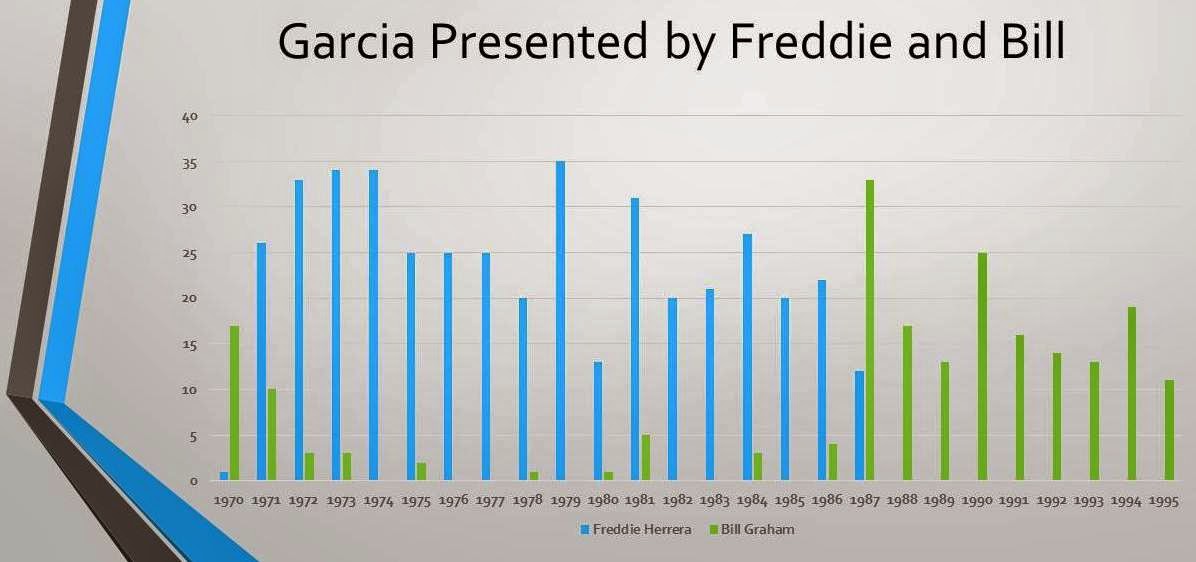
long-term relationships. Freddie fit the bill for local club gigs through '87,
then Bill Graham, augmenting his long and eventually locally monopolistic
relationship with the Dead;
John Scher,
from his first base in Passaic, eventually ran all of the Dead's business east
of the Rockies, sometimes with and sometimes supplanting venerable east coast
promoters such as
Don Law in Boston
and
Ron Delsener in NYC. Fey was
Garcia's man in Denver. So, blogging about Reconstruction at the Rainbow can
tell us some things about not only the Garciaverse, but also, say, the Grateful
Dead in 1991,
when
the band was rock's #1 concert earner, and in which the
only guy besides Graham and Scher who
got a topline taste was one Barry Fey.
We also get some good spatial generalizations, i.e., some
insight into out-of-town gigs. Most directly, Denver is "like" lots
of other places. People sometimes think of it as practically a mountain resort
town, à la Vail, Aspen, Park City, Jackson, really rarefied air. But it's not –
it's a foot-of-the-mountain town, for sure, but it's also the last plains city,
making it like its I-70 neighbors Kansas City and St. Louis; it sounds some of
the Indian and Spanish echoes of Cheyenne and Albuquerque; and it's a western
town, like Salt Lake City, Las Vegas, Reno and San Francisco, all hosts to gold
and silver rushes over the years. Insofar as it is representative of these
places, it tells us about quite a swath of territory, everything west of the
Mississippi around the country's Base Line. But even more importantly that
relentless homogenizer, capitalism, often works to reduce the importance of
place, and, in all kinds of senses, but especially the market sense, Denver is
"like" every other mid-sized city in the country in the market sense,
with its urban, suburban and college bars, clubs, theaters, arenas and
stadiums.
In short, lessons from Denver generalize – they
"travel", in the lingo.
III. Front Range
Reconstruction
On April 11-12, 1979,
Reconstruction played the only out-of-state gigs of its eight-month history, at
Barry Fey's Rainbow Music Hall in Denver. Let me first clear up some
metadata issues around these shows, then just drop some thoughts on the music.
A. Metadata
I am working primarily from a listing, an ad, a review, and a
bunch of tape. On this last, I now
hold three distinct filesets of April '79 Reconstruction at the Rainbow
material. The tapes, as is so often the case, yield some gold nuggets of sound
and color, but also track all kinds of human failure to communicate, confusion
and conjecture. Right up my alley, so I am working from the following:
1.
"4/11/79 early and late shows",
shnid-10140. By my system, this is jg1979-04-11.recon.early-late.aud-unk-jupille.10140.shn2flac
[
source1];
2.
"4/12/79 early and partial late
shows", noshnid; jg1979-04-12.recon.early-partlate.aud.xxxxxx.flac1644 [source2];
3.
4/12/79 late show, circulated as
"4/13/79",
shnid-126161,
jg1979-04-12.recon.late.sbd.126161.flac2448 [
source3].
If you want to listen to Reconstruction at the Rainbow, I'd
direct you to the last of these, which derives from a cassette copy of master
soundboard cassettes made by a Rainbow employee for a visiting Deadhead later
in the year. It's a very good recording of a good show. The other tapes vary in
quality between OK and rotten-sounding. All of them, including the
cleanly-provenanced soundboard tape, bear incorrect (as that tape does) or
questionable metadata. Let me pin them down following Archimedes rather than
Chronos.
1. source3 is
the 4/12/79 Late Show
The source 3 board tape only emerged into the digital realm
within the last year or two labeled 4/13/79. But I am about 95% sure it's the
4/12/79 late show. Why?
a.
I have seen the Garcia office's gig folder for
these shows (though I did not have time to look at the actual contracts), and
it lists April 11-12.
b.
The ad, listing, and review are all very clear
that shows are on Wednesday and Thursday, the 11th and 12th.
c.
The ad tips David Bromberg and John McEuen at
the Rainbow on Friday the 13th and Saturday. It's possible that Bromberg and
McEuen canceled and Garcia filled in, but highly unlikely. Return tickets would
have been booked in advance, and they almost certainly would have had Jerry
coming home right after the scheduled gigs. Things were highly routinized by
this time – Sue Stephens maintained beautiful tour itineraries with *all* of
the key information, great traveling documents – and return tickets had
certainly been arranged. We know from years' of consistent evidence that Garcia
almost always came back the day after the tour ended.
d.
Reconstruction was booked Saturday and Sunday at
Keystone – its first Saturday in front of the *real* home crowd (despite
already being together, in at least some sense, for ten weeks). That doesn't
rule out a Saturday in Denver, of course, but it makes it less likely.
e.
I have an old fileset dated 4/12/79 (source2 in my list above) which
includes the first two songs from this gig, but from an audience recording.
It's a tiny fragment, but triangulation is never to be scoffed at.
f.
We know the provenance of the tape is from the
Rainbow soundman, with two subsidiary consequences.
i.
While in the Garciaverse Betty or whomever
labeled tapes based on when the gig started, it's perfectly possible that the
Rainbow guy labeled it 4/13 once the night was through.
ii.
It's also possible he had messy handwriting and
his 2 looked like a 3.
In short, there is no evidence, where there should have
been, of a Reconstruction gig at the Rainbow on 4/13/79 (points a and b). A
putative 4/13/79 Reconstruction gig is strictly contradicted by the ad, and
other factors augur against it (points c and d). There is a tiny piece of
convergent validation via an alternate piece of tape (point e). Finally,
"outside" tapes might not have been labeled in the ways we have
become so accustomed to as practiced by Bear, Betty and all of the rest (point f).
The fact that this has emerged labeled 4/13/79 on a tape
with such clean provenance is troubling, but I think I have dispensed with it. Perhaps
even less troubling, because tape labels are so unreliable, but also richly
illustrative of the shit that can happen around metadata –again, because tape
labels are so unreliable—is the fact that this same set of material circulates
in degraded form as 4/12/79a. In other words, it's also found on source2. This tells us that the Rainbow
crew member and/or the source of this 1st gen tape also made other
copies, and then supergenerated copies somewhere down one or both of those
paths landed in the digital realm. And why not? Soundboard tape of
Reconstruction was unheard of prior to the arrival of the Betty Boards in 1986-1987 – even audience tape was hard to come by.
So a complete Reconstruction set, from a master soundboard cassette, was a real
gem, if you're into that sort of thing. In fact, I am maybe more surprised that
it didn't circulate more widely, or end up in the digital realm in better shape
far earlier than it did.
2. source2 supplies
4/12/79
If source3 is
4/12/79b, I am inclined to think that the source2 material is 4/12/79, since
it's partly overlapping. source2, then, primarily supplies 4/12/79a. If that's
correct, we have the whole Thursday show, complete.
3. source1 supplies
4/11/79b
source1's
"4/11/79 early show" is a degraded copy of the 4/12/79 early show
just discussed from source2. (Isn't this fun?) But source1's "4/11/79 late
show" embodies material distinct from what I have determined to be either
of the sets from the next night. So, it must be one of the Wednesday night
sets, and we can start the bidding at the late set, since that's what the tape
says (any port in a storm, don't y'know).
The Wednesday night show reviewer (Brown 1979) doesn't
mention whether he saw the 7 PM or 10 PM show. But given that his review was
published the next day I have to figure it was the early show. He probably
doesn't know most of the tunes, but he names three songs, two sung by Jerry and
one an FM radio staple: Jimmy Cliff's "Struggling
Man", the blues "It's Too
Late", and, as an encore, an instrumental version of the Doobies' "Long Train Runnin'". Only
the first of these appears on the distinctive fileset. Furthermore, Garcia
would typically sing only one blues per show with Reconstruction, which would
have been "It's Too Late" in the early show, whereas the "late
show" fileset contains a "Someday Baby". So, while it's possible
that the fileset is just missing the two songs that Brown mentions that it
lacks, this seems very unlikely.
Accordingly, source1's distinctive material probably really
is what it purports to be, the Wednesday, 4/11/79 10 PM show.
4. In sum on the metadata
I feel reasonably confident that I have pinned down all four
Reconstruction at the Rainbow sets with some degree of precision. For the
Wednesday, April 11, 7 PM set we have the Brown review and no tape. For the
other three sets, we have tape but no review. In lieu of a proper review, I'll
gather up some listening notes – you get what you pay for.
B. Some Set-by-Set
Notes
Brown begins by trotting out the hostile-to-indifferent
critic's modal knock on Garcia shows, his adoring fans, cultishly welcoming
their "guru-guitarist". It's true that a lot of frothing-at-the-mouth
Deadheads could be found wherever Garcia was playing, and they could be
annoying; Schadenfraude could lead
the disinterested critic to laugh over their failed calls for that cocaine
song, their never-unfurled (does that make them forever "furled")
twirls around a spacy Dark Star that wasn't. "This band isn't into
jamming. It's all rehearsed and arranged," Kahn explained. The critic says
that "the Denver audience had a hard time accepting Garcia's new role as a
neo-George Benson guitarist left to battle synthesizers and horn
arrangements". In short, the review suggests, Garcia should stick to what
he knows and what his fans want, and should leave aside this "mediocre
jazz unit".
I note Garcia doing some good listening and some stellar
playing. Here are brief listening note excerpts. The first comes from the first
song of the night ("Get Up And
Dance"), in which I find Garcia really listening to Merl, and John playing some of the best music of his
life.
Garcia singing harmonies right up front, then steps into some
KILLER guitar work 2:44ff. Wailing over 3, very fluent and fluid playing. Man,
he sounds great. See my notes in the R field about the Jerrcentric recording –
great // to him just plucking, too. 8:20ish Merl signals return to the GUAD
theme. Garcia hears it, is listening, and sprints to the corner, meeting Merl
on the '1'. Nice. The rest of the band is on it just behind, but tastefully.
Great band. John Kahn really played with Reconstruction.
The second comes from one of my favorite Reconstruction-only
Side Trips tunes, "Nessa",
culminating in some context.
Amazing, amazing, amazing to hear Garcia play this song. Wow.
Neumeister is playing killer lead trombone, Garcia is comp'ing, this tape is
right in Jerry's monitor, so we hear a lot of guitar, but perfectly supporting
the trombone, which is shredding. I have heard a good fair bit of trombone, and
Neumeister is incredible. Jerry steps up for a big solo over 4 and he is
playing this patiently and intently, in perfect mastery of the chart, though I
am about 99.9% certain he wasn't using one. Oh my goodness, right over 5 Jerry
hits some hard-won notes, then signals he's ready to step back, Gaylord Birch
is hitting the shit out of the skins, around 5:30 Rev nudges his head, so over
6 he can be leading some turns. Garcia, loud on this tape, is strumming well, a
killer rhythm guitar player in this jazzy Latin space. It's a good far out
tune. Merl steps up 7:23, but he's not loud enough. I don't know if this is PA
issue, how Jerry monitored things (which would be telling, although I would be
surprised he'd have John so low), whether Merl just has himself turned down, or
what. Occam probably says it involves the technicalities of sound (re) production,
no small things, they. John steps forward 9:11. @ 9:23 "Yeah John!"
Note that these Denver heads know John by name. Now, these could be Bay Area
heads (or New Jersey – see Brown 1979) heads just in town, just happened to
have deck, mics, and fresh tape and batteries -- Deadheads visiting friends,
maybe-- they'd know, too. Whatever, tip o' the hat to the Denver scene.
Note (2) finds Ron Stallings (I think?) mic-checking …
"Denver, Denver".
I mentioned the "Another Star" from this show in
"Risky Reconstruction". Here let me emphasize Jerry as a
supporting player, working with John behind Merl and the horns, and as a good
old fashioned guitarslinger shredding some ear drums, on Nina Simone's
"Do I Move You?":
Garcia's guitar work in the 3-minute range is nothing short
of spectacular. The crowd is yelling, stunned. laughing as Garcia winds down
his piece with a big dig @ 4:04, chunking big ugly chords for the sax and keys
to work over, he's still pretty loud and they aren't very. 4:42 Merl steps up
to a synth solo. Garcia is playing beautifully in support, doing some unwinding
runs while Merl does his thing. Jerry and John locked in with each other. At
6:15 Garcia is again just playing wonderfully. Listen to how high on the neck
he is, searing at 6:39! Putting some raunch on it 6:55 over 7. Working well
with the horns, a little more syncopation in this piece than previously. They
drop back to the verse very nicely around 7:30.
Hearing Garcia play "What
You Won't Do For Love" just tickles me:
This is so lovely. Jerry is playing very carefully and sounds
reasonably well-rehearsed. The crowd can occasionally be heard exclaiming with
glad surprise at hearing this deep groove. @ 3:11 Neumeister takes the first
solo. The arrangement is really tight and everyone plays it nice and tight,
too, nice and close, warming up. Jerry is very fluid and fluent, he's clearly
been running lots of scales at home and hanging around Front Street and John's
place and wherever.
IV. Conclusion
Reconstruction at the Rainbow is exactly how spring 1979
felt. Tight t-shirts, feathered hair, multiracial groups with big flared pant
bottoms, glittery lettering, Corvettes, white dudes rocking curlyfros, disco
balls, champagne and cocaine. Denver's on another energy boom (oil is
skyrocketing, gas is up), skyscrapers not just soaking in the blue, but also ground-
and society- scrapers, replacing
turn-of-the-century watering holes, cathouses, flophouses (not
necessarily separate spaces, natch), and markets and their (sometimes vintage
turn-of-the-century) Irish, Italian, German, Swedish, Slovakian, Mexican, Native
and Other occupants; ten gallon hats, rhinestone boots and blow at $20 a line
(Lindsay 1979) replacing newsboy caps, miner's grit and homebrew gin at 5 cents
a shot. It'd crash soon, but meantime April 13, 1979, chilly day in Denver down
at the Rainbow, would not have been a bad time and place to spend an evening
with Reconstruction.
REFERENCES and
NOTES:
! tape: I now hold three distinct filesets of April '79
Reconstruction at the Rainbow material. The tapes, as is so often the case,
yield some gold nuggets of sound and color, but also track all kinds of human
failure to communicate, confusion and conjecture. Right up my alley, so I am
working from the following:
4.
"4/11/79 early and late shows",
shnid-10140. By my system, this is jg1979-04-11.recon.early-late.aud-unk-jupille.10140.shn2flac.
5.
"4/12/79 early and partial late
shows", noshnid; jg1979-04-12.recon.early-partlate.aud.xxxxxx.flac1644.
6.
4/12/79 late show, circulated as
"4/13/79",
shnid-126161,
jg1979-04-12.recon.late.sbd.126161.flac2448.
! listing: Denver Post,
April 11, 1979, p. 40.
! ad: Boulder Daily Camera,
April 8, 1979, p. 57.
! review: Brown, G. 1979. Reconstruction Gig Not From Dead Catalog.
Denver Post, April 12, 1979, p. 56.
! ref: Fey, Barry, with Steve Alexander and Rich Wolfe. 2011. Backstage Past. Forewords by Ozzy and
Sharon Osbourne and by Pete Townshend [sic]. Lone Wolfe Press.
! ref: Lindsey, Robert. 1979. Upper-Income Users Spur Cocaine
Dealing. New York Times, September 5,
1979, p. A17.
APPENDIX: LISTENING NOTES
~~
Reconstruction
Rainbow Music Hall
6358 East Evans Avenue
Denver, CO 80222
April 11, 1979 (Wednesday) - late show, 10 PM
aud shnid-10140 shn2flac
--late show (11 tracks, 75:14)--
l-t01. Get Up And Dance [10:32] [0:02] % dead air [0:02]
l-t02. //Nessa [#10:51] ->
l-t03. Drum solo [1:24] ->
l-t04. Nessa [1:00] [0:04]
l-t05. Strugglin' Man [6:31] [0:03]
l-t06. //Soul// Roach [#13:#21] [0:03]
l-t07. //I Just Want To Stop [#4:36] [0:03]
l-t08. Someday Baby [8:28] [0:07]
l-t09. //Another Star [#10:33] [0:05]
l-t10. band introductions (2) [0:44]
l-t11. Make It Better [6:27] [0:10]
! ACT1: Reconstruction (January 30, 1979 - September 22,
1979)
! lineup: Jerry Garcia - el-g, vocals;
! lineup: Merl Saunders - keyboards, synthesizers, vocals;
! lineup: Ron Stallings - saxophone, vocals;
! lineup: Ed Neumeister - trombone;
! lineup: Gaylord Birch - drums, vocals.
JGMF
! R: symbols
! meta: Having determined that the putative early set was
actually the 4/12/79 early set, I only include the distinct late show material
here. Below you may find remnants of a time when these notes dealt with both
4/11/79 shows - ignore them.
! data: JGC URL
http://jerrygarcia.com/show/1979-04-11-rainbow-music-hall-denver-co-2/.
! db: http://db.etree.org/shn/10140 (this fileset)
! map: https://goo.gl/maps/HckBP
! venue:
http://jerrygarciasbrokendownpalaces.blogspot.com/2012/10/rainbow-music-hall-east-evans-avenue.html;
! listing: Denver Post, April 11, 1979, p. 40;
! ad: Boulder Daily Camera, April 8, 1979, p. 57;
! R: lineage: MAC > 3CD > EAC > SHN" Final
extraction using EAC, tracking using CDWave, and .shn encoding by Joe Jupille.
Sector boundaries verified using shntool. JGMF shn2flac 11/16/2014.
! note (1): I will not generally address myself with the
early show fileset. Though only one lineage attached the whole
"4/11/79" set of material, instead of an aud the early show is a
degraded copy of the same master that I have also received as 4/12/79 (an old
shn set, currently jg1979-04-12.recon.early-partlate.aud.xxxxxx.flac1644),
which is the same material that I have determined, via sbd tape and deductions,
to be 4/12/79b. I have to analyze a few more things before I can take a
position on all of it. In terms of my "R" category, note that this
runs considerably slower than the less-generated tape. I trust that tape more
than this one, but someone who can hear pitch should probably check both tapes.
! R: earlier note says *For Completists Only, a rough
recording*. This is not entirely untrue. Let's just say the master and its
creation must have been extremely ambient. You feel this tape in the outer
registers. And then it's get that extra treadwear of a few extra generations on
it.
! R: seeder notes: late show: Most tunes cut in w/o much
missing. Normalized to 98% using EAC's process wave function.
! R: l-t01: the horns are a little buried and Garcia's
guitar is way forward in the mix. Since these people were yelling for Jerry, all around the taper, I
take it we are Jerryside, and pretty close at that. Merl is also buried, which
is unfortunate. It's pretty much all Jerry right now in 8, even though he's
just comp'ing. Levels drop @ ca. 5:35.
! P: l-t01: GUAD Garcia singing harmonies right up front,
then steps into some KILLER guitar work 2:44ff. Wailing over 3, very fluent and
fluid playing. Man, he sounds great. See my notes in the R field about the
Jerrcentric recording - great to him just plucking, too. 8:20ish Merl signals
return to the GUAD theme. Garcia hears it, is listening, and sprints to the
corner, meeting Merl on the '1'. Nice. The rest of the band is on it just
behind, but tastefully. Great band. John kahn really played with
Reconstruction.
! band: Reconstruction: Here's a hypothesis: As Jerry lost
hope after the commercial failure of Cats Under The Stars, John Kahn lost hope
when Reconstruction never took hold.
! P: l-t02-l-204: Nessa: Amazing, amazing, amazing to hear
Garcia play this song. Wow. Neumeister is playing killer lead trombone, Garcia
is comp'ing, t his tape is right in Jerry's monitor, so we hear a lot of
guitar, but perfectly supporting the trombone, which is shredding. I heave
heard a good fair bit of trombone, and Neumeister is incredible. Jerry steps up
for a big solo over 4 and he is playing this patiently and intently, in perfect
master of the chart, though I am about 99.9% certain he wasn't using one. Oh my
goodness, right over 5 Jerry hits some hard-won notes, then signals he's ready
to step back, Gaylord Birch is hitting thie shit out of the skins, around 5:30
Rev nudges his head, so over 6 he can be leading some turns. Garcia, loud this
tape, is strumming well, a killer rhhythm guitar player in this jazzy Latin
space. It's a good far out tune. Merl steps up 7:23, but he's not loud enough.
I don't know if this is PA issue, how Jerry monitored things (which would be
telling, although I would be surprised he'd have John so low), whether Merl
just has himself turned down, or what. Occam probably says it involves the
technicalities of sound (re) production, no small things, they. John steps
forward 9:11. @ 9:23 "Yeah John!" Note that these Denver heads know
John by name. Now, these could be Bay Area heads (or New York) heads just in
town, just happened to have their deck, mics, and fresh tape and batteries --
Deadheads visiting friends, maybe-- they'd know, too. Whatever, tip o' the hat
to the Denver scene. If I were tracking this, I might want to track in that
l-t02 9:11-10:52, i.e., 1:41 of time is John lead piece. Gaylord Birch's piece
is tight as, well, a drum.
! P: l-t05 SM I wasn't listening very closely, but it didn't
grab me.
! R: l-t06 Soul Roach cut/splice @ 10:19, then warbling
! P: l-t07 IJWTS, beginning "When I think about those
nights in MOntreal", first makes you wonder why a black guy was ever in
Canada in the 1970s, until you realize that the
guy singing it, xxx, is white, a fact that his record company tried to
disguise to sustain the play the track was getting with black stations and
clubs. It's an improbably great song, but in this setting it is a little
cringeworthy, Ron Stallings in his white suit and shoes and a nightclub croon.
It's a nasty thought, but science can be cruel: I wonder if part of the reason
Garcia stood so far back on some numbers in Reconstruction, really obscured by
shadow, is that he was, maybe, a teeny-tiny bit embarassed. It's exceptionally
interesting to me to hear Garcia playing a contemporary soul and trying to
process the dissonance, but there's no reason you, reader, should subject
yourself to it.
! P: l-t09 Another Star is simply wonderful. Merl takes
first lead, horns tight. @ 1:20 a trombone run, they are doing nice short
pieces, Jerry hinting at and then hitting some scrubbing @ 1:38. Merl another
lead piece. I like how they have this arranged. Merl-horns, twice 'round, now 2
Garcia is taking some beautifully fluent lead turns, multilayered longs scales,
some dropped chords. Nice run up to 3:30, ut now I'd like to hear something
different. He indeed changes it up 3:44, playing the melody of Stevie Wonder's
"Another Star"! Man, this was gold for a minute there. Repeats his
earlier thing 4:15ish, but then digs in a bigger break 4:22, so that's what
he's going to do, halvsies, now 4:45 it's not even sequences, but blended,
scales and decay, decaying scales. @ 5:57 Garcia really steps back with some
galloping strums, Merl takes some nice leads, I still wish he were higher in
the mix, I can barely hear him.
! l-t10 (2) Nice provenance on the tape, Ron Stallings
mic-checking "Denver! Denver!", his usual "hello anybody"
routine. This is Reconstruction. John Kahn on the bass. Merl Saunders on the
organ. Jerry Garcia on guitar. Ron Stallings on tenor sax. Ron Stallings ... Ed
Neumeister." Someone else "Gaylord Birch on the drums." Claps
your hands, try to get a groove goin' on here, etc.
! l-t10 MIB I like this tune a lot, but they don't quite
have the head of the arrangement together.
~~
Reconstruction
Rainbow Music Hall
6358 East Evans Avenue
Denver, CO 80222
April 12, 1979 (Thursday) - early show, 7 PM
82 min aud early + partlate
--early show (8 tracks, 61:33)--
e-t01. dead air [0:03] /Make It Better :04-6:06] [0:14] %
e-t02. Linda Chicana [9:32] [0:10] %
e-t03. /I Just Wanna Stop [4:18] (1) [0:08] %
e-t04. /Welcome To The Basement [4:59] -> bass feature
[1:41] -> Welcome To The Basement [2:17] [0:08] %
e-t05. /The Hunter Gets Captured By The Game [4:50]
[0:08] %
e-t06. Do I Move You? [10:54] [0:04] %
e-t07. Another Star [9:51] [0:06] %
e-t08. Struggling Man [5:59] (2) [0:10] %
--late show (2 tracks, 20:44)--
l-t09. [0:17] What You Won't Do For Love [7:07] (3) [0:32] %
l-t10. Soul Roach [12:42] [0:06] %
! ACT1: Reconstruction (January 30, 1979 - September 22,
1979)
! lineup: Jerry Garcia - el-g, vocals;
! lineup: Merl Saunders - keyboards, synthesizers, vocals;
! lineup: Ron Stallings - saxophone, vocals;
! lineup: Ed Neumeister - trombone;
! lineup: Gaylord Birch - drums, vocals.
JGMF:
! R: symbols
! meta: shnid-10140 has this same material dated 4/11/79
(though missing IJWTS), but I am pretty sure it's 4/12/79a.
! db: none
! JGC: http://jerrygarcia.com/show/1979-04-12-rainbow-music-hall-denver-co/ (early
show); http://jerrygarcia.com/show/1979-04-12-rainbow-music-hall-denver-co-2/
(late show).
! map: https://goo.gl/maps/HckBP
! venue: http://jerrygarciasbrokendownpalaces.blogspot.com/2012/10/rainbow-music-hall-east-evans-avenue.html;
! listing: Denver Post, April 11, 1979, p. 40;
! ad: Boulder Daily Camera, April 8, 1979, p. 57;
! R: source: unknown tape > ?? > shn > flac1644.
! R: provenance: This material derives from some random shn
files I gathered in 2003, just dated 4/12/79 with no early/late designations. I
believe that it was the complete early and late shows, but switched from aud to
degraded sbd source after "Soul Roach". An old post to DAT-Heads
listed "4/12/79 RECONSTRUCTION, early & late, RAINBOW THEATRE-DENVER,
CO, AUD REEL > ? > DAT & SBD REEL > ? > DAT." The shns
correspond, so I presume there's a DAT gen in my lineage, not that it matters.
I have not included the sbd portion here, since it now circulates in much better
shape as shnid-xxxxxx (MSC > C).
! R: Recording is decent. Bass isn't really really distinct,
and there could be crisper high end, but you can hear pretty much everything.
Most tunes clip in, with missing material seeming to range from a note or two
to a few seconds. There is some hiss here.
! P: e-t02 Linda Chicana: Ed Neumeister takes the first solo
in the 2 range, and it is very good. @ 3:30 Garcia steps up.
! e-t03 (1) Ron Stallings: "Thank you. Ed Neumeister on
trombone."
! P: et04 WTTB Garcia is playing some amazing notes as John
is chugging through the front of the song. Merl comes in 0:40, nice tone, but
things maybe sounds a little pitchy? Garcia takes first solo in 2, and his
guitar playing sounds absolutely great.
!P e-t05 THGCBTG is an amazing song choice for Garcia to
sing. Such a great song!
! P: e-t06 DIMY Garcia's guitar work in the 3-minute range
is nothing short of spectacular. The crowd is yelling, stunned. laughing as
Garcia winds down his piece with a big dig @ 4:04, chunking big ugly chords for
the sax and keys to work over, he's still pretty loud and they aren't very.
4:42 Merl steps up to a synth solo. Garcia is playing beautifully in support,
doing some unwinding runs while Merl does his thing. Jerry and John locked in
with each other. At 6:15 Garcia is again just playing wonderfully. Listen to
how high on the neck he is, searing at 6:39! Putting some raunch on it 6:55
over 7. Working well with the horns, a little more syncopation in this piece
than previously. They drop back to the verse very nicely around 7:30.
! P: e-t07 Another Star - @@ wow. This is such a great
composition (Stevie Wonder). Stevie's arrangement makes it a great horn tune,
and the horns can set this chart aflame. These guys are killin' it. Garcia
jumps in for his solo right around the 2 minute mark, and he is playing like a
man possessed -- This is some of the most molten Garcia guitar work you will
ever hear. I cannot recommend this strongly enough. I implore you - listen to
this! The horns take some nice frontward turns, Merl turns himself up 4:42,
Garcia is absolutely shredding, some scrubbing right over the 5, wonderful
guitar work. Now he's alternating tones, low to high, breaking out some chunks
of tempo. 5:33 he steps into a strong chunka chunka vamp for Merl, who steps
forward with some organ lead. Horns now backing Merl, who is spinning it out
like a wizard over a crystal ball, all arcing fingers, allowing a little decay
in, Merl still out front but Jerry is absolutely pushing him, now steps back a
little more 7:15 and Merl drops some more slightly decayed wizardy, like 10
degrees off from center. Horns fronting a few measures I'd like to hear these
guys step out more. Garcia harshly scrubbing 8:22 - homey says "check it
out". The horn guys really signal the end over 9, Merl answers them and
they are back to the straight "Another Star" melody. I bet Jerry's
disappointed they are already bringing an end to it. I bet at some point he
gave them the old "let's stretch that out even more, man". I am sure
they have it charted out, but they are pros and I am sure if we time
"Another Star" we'll see it lengthen out over the course of
Reconstruction's (too-brief) run.
! setlist: at note (2), it sounds like Ron Stallings says
"good night", and you can hear the crowd saying something like
"don't leave us!". Then the tape clips, and then when it re-enters in
front of WYWDFL there's a lot of excitement in the air. I had first thought
these two songs could be an encore, but it now seems pretty clear to me that they
are the start of the late show, from the same taper.
! l-t09 (3) band introductions. The band gives a special
hoot for Garcia, of course. Things sound nice and energetic and positive.
! P: l-t10 Soul Roach is not particularly to my taste. Jerry
starts his feature late 4 over 5, still playing very well.
~~
Reconstruction
Rainbow Music Hall
6358 East Evans Avenue
Denver, CO 80222
April 12, 1979 (Thursday) - late show, 10 PM
late show sbd1 shnid-126161 was "4/13/79"
--late show (8 tracks, 87:37)--
--main set (7 tracks, 76:43)--
t01. [0:02] % What You Won't Do For Love [7:29] (1) [0:29]
t02. [0:08] Soul Roach [13:31] [0:02] % [0:04]
t03. [0:15] Lovely Night For Dancing [12:33]
t04. % Mohican And The Great Spirit [#10:25] % [0:15]
t05. [0:10] Struggling Man [6:26] [0:02] %
t06. Ain't That Loving You? [8:22] [0:18]
t07. [0:58] Long Train Running [14:26] [0:45]
--encore (1 track, 10:54)--
t08. crowd, tuning, talk (2) [1:32], It Ain't No Use [8:54]
[0:27] %
! ACT1: Reconstruction (January 30, 1979 - September 22,
1979)
! lineup: Jerry Garcia - el-g, vocals;
! lineup: Merl Saunders - keyboards, synthesizers, vocals;
! lineup: Ron Stallings - saxophone, vocals;
! lineup: Ed Neumeister - trombone;
! lineup: Gaylord Birch - drums, vocals.
JGMF:
! R: symbols
! JGC: http://jerrygarcia.com/show/1979-04-12-rainbow-music-hall-denver-co-2/
! db: http://etreedb.org/shn/126161, shnid-126161 (this
fileset).
! map: https://goo.gl/maps/HckBP
! venue:
http://jerrygarciasbrokendownpalaces.blogspot.com/2012/10/rainbow-music-hall-east-evans-avenue.html;
! listing: Denver Post, April 11, 1979, p. 40;
! ad: Boulder Daily Camera, April 8, 1979, p. 57;
! R: Cassette master (Rainbow employee, TDK SA) > 1st gen
cassette (Sony TC 158SD deck, TDK AD stock, August 11, 1979) > unknown
process to flac1644.
! R: seeder note: "I recorded this on August 11, 1979
while out for the Red Rocks shows. I was staying with a guy who worked at the
Rainbow."
! metadata: this is given as 4/13/79, but I am pretty sure
it's the late show from 4/12. First, I have seen the gig folder for these shows
(though I did not have time to look at the actual contracts), and it lists
April 11-12. Second, the ad and the listing are both very clear that shows are
on Wednesday and Thursday, the 11th and 12th. The ad tips David Bromberg and
John McEuen at the Rainbow on Friday the 13th and Saturday. A review of the
Wednesday show, published on Thursday the 12th, mentions that night's shows.
It's possible that they canceled and Garcia filled in, but highly unlikely - he
would have had his return tickets home, in all likelihood. That's because,
third, the band would play Keystone on Saturday and Sunday. That doesn't rule
out a Saturday in Denver, of course, but it makes it more likely. Fourth, we
know the provenance of the tape is from the Rainbow soundman and, while, in the
Garciaverse Betty or whomever labeled tapes based on when the gig started, it's
perfectly possible that the Rainbow guy labeled it 4/13 once the night was
through. Fifth, it's also possible he had messy handwriting and his 2 looked
like a 3. Sixth, I have an old fileset dated 4/12/79 which includes the first
two songs from this gig, but on an audience recording. It's tiny, and
undermined further by the fact that the opaque fileset's early show is the same
recording as circulates for 4/11, but in neither case does that augur well for
it being 4/13. When I combine all of this stuff, I am compelled to conclude,
with about 95% confidence, that this must be the Thursday (4/12) late show,
scheduled for 10 PM. xxx see final post
! metadata: "What You Won't Do For Love" and
"Soul Roach" is a puzzling piece of tape. Here's why. First, it
appears here, putatively dated 4/13/79. I have pretty much concluded (see
above) that it is rather what we in the Garciaverse would call 4/12/79 late
show. I am 95% sure about that. That, in turn, is a very key piece of tape,
because of the whistle-clean provenance: the Rainbow sound guy taped it and
made a copy for a Deadhead in town for Red Rocks shows in August. Second, the
same two songs appear on the aud I currently know as
jg1979-04-12.recon.early-partlate.aud.xxxxxx.flac1644 (shns I gathered in 2003
and never processed). There they appear in sequence to be the first two songs
after the end of the early set, i.e., the first two songs of the late show.
That makes me identify this as the late show, which is what for all the world
it sounds like. Third - however - and here's the mildly puzzling part - the
taped dated 4/*11*/79, shnid-10140 xxx never mind, see "Reconstruction at
the Rainbow".
! P: There's some good vibe and playing here, but I think I
have to lean toward what a reviewer of one of these Denver shows suggested, xxx
review xxx. It's pretty good. It's not great.
! P: t01 this is so lovely. Jerry is playing very carefully
and sounds reasonably well-rehearsed. The crowd can occasionally be heard
exclaiming with glad surprise at hearing this deep groove. @ 3:11 Neumeister
takes the first solo. The arrangement is really tight and everyone plays it
nice and tight, too, nice and close, warming up. Jerry is very fluid and
fluent, he's clearly been running lots of scales at home and hanging around
Front Street and John's place and wherever. I am sure he'll want to stretch out
later (that Long Train Running -> Fast Tone later is hard to ignore and
tends to raise expectations. But right now, it's off to a really good start.
! historical: This is exactly how spring 1979 felt, if you
can remember it. Tight t-shirts, bralessness, feathered hair, multiracial
groups all with big flaired pant bottoms, glittery lettering, corvettes, white
dudes rocking curly fros (including the jewfro), disco balls, champagne and
cocaine. The spring that budget cuts (including proposition 8) and demographic
changes --the postwar blue collar GI Bill folks had raised their families, not
yet yuppie 80s commuters to The City and Silicon Valley. Denver's on another
energy boom (oil is skyrocketing, gas is up), skyscrapers not just soaking in
the blue also ground- and society- scrapers, replacing turn-of-the-century watering holes,
cathouses, flophouses (not necessarily separate spaces, natch), and markets and
their (sometimes vintage turn-of-the-century) Irish, Italian, German, Swedish,
Slovakian, Mexican, Native and Other occupants. Ten gallon hats, rhinestoned
boots and how-much??-blow replacing newsboy caps, miner's grit and homebrew gin
at 5 cents a shot. It'd crash soon, but meantime April 13, 1979, chilly day in
Denver down at the Rainbow, would not have been a bad time and place to spend
an evening with Reconstruction.
! t01 (1) @ 5:35 (during song) Stallings gives Ed Neumeister
a shoutout. After song, Gaylord gives Ron Stallings props. Ron Stallings:
"Ed Neumeister on trombone. Merl Saunders on organ. Gaylord Birch on
drums. John Kahn on the bass. Jerry Garcia on the guitar."
! P: t02 SR not my favorite tune, but Jerry plays a very
electric solo ca. 7 min mark. He is playing very well. @ 9:30ff Merl takes a
synth solo.
! P: t03 again @ 4:30 JG is wailing pretty nicely. In the
6 range Garcia is putting some nice wah on it, very much in the space of
contemporary Dead tune "Shakedown Street".
! P: t05 SM good guitar work 4-minute mark. 1979 was a big
change in his style, a lot more similar across the two contexts than
previously.
! P: t06 Merl is definitely in his Full Cleveland lounge act
mode. Jerry walking behind him, definitely has the divorcee's bar feel, some of
those plush, dingy, smoky, smoky, sleazy banquetted 1970s lounges, the tables
with a particularly indescribable kind of stick. Now this is definitely a more talented
group than you'll find at your local smorgie-(or Hofbrau-)near-the-airport, and
Garcia's guitar packs a little more punch than your spongy picker. Over the
4-min mark his tone sears pretty deeply. Yow! Merl does some full B3 work
through 4 over 5, Jerry and the rhythm section holding it tight for him, horns
laying back for the chorus line.
! P: LTR Reverend Ron's first solo starts off-key late 2-min
mark. @ 4:30 Stallings soloing hits a Coltrane note, Naima or something. Garcia
solo 5:15ff. Neumeister @ 7:55ff.
! setlist: t07 was listed as "Long Train Running ->
Fast Tone", but they never play "Fast Tone" here.
! setlist: I am calling IANU an encore, because the tape is
continuous over the whole encore trip.
! t08 (2) Ron Stallings: "Yeah, you didn't get
enough?" Crowd: "Nooo!" Stallings: "You want some more?
Here we come." Yikes.
[1]
See Fey 2011 for most of what follows.
[2]
Fey (2011, 24) says they split in February.
[3] See Fey 2011, 108-114 for some great Barry Fey-Bill-Graham
stories.
[4]
Here are more Ebbets
data,
but have your popup blocker primed and ready.