Sunday, May 17, 2015

New Lost City Ramblers Song Book


Seeger, Mike, and John Cohen, eds. 1964. The New Lost City Ramblers Song Book. New York: Oak Books.


Here's a brief list of tunes in the NLCR songbook that Garcia is known to have played. This does not include the Elizabeth Cotten tunes (I have considered them separately) and has not been carefully vetted, since pre-Dead is beyond my ken. Sharp-eyed readers may spot more.

I Truly Understand
When First To This Country
Red Rocking Chair
Little Maggie
Billy Grimes, the Rover
Nine- Pound Hammer
Walking Boss
Hopalong Peter
Man of Constant Sorrow
Hot Corn
Three Men Went A-Hunting
I'll Roll in My Sweet Baby's Arms
Salty Dog Blues
Shady Grove
Crow Black Chicken
Arkansas Traveler
Ain't No Bugs on Me
White House Blues

Note also:
Lady of Carlisle
Hog-eye
Don't Let Your Deal Go Down

I am not saying the NLCR Song Book, records or combination of them was the only source that Garcia would have encountered for lots of these songs – everybody knew and did a bunch of these. In my rummaging around some, well, folkways, I have come across all kinds of "floaters", fragments of idea, characters, narratives, or scenes that appear and reappear throughout the folk tradition. But an awful lot of Garcia et al.'s pre-Dead repertoire is reflected in the NLCR Song Book, a lot more than the Smith Anthology. Whether it was Hunter, Nelson, Leicester, Pigpen, Garcia, any or all of them together, they were certainly drawing from this source.

They'd continue to do so: David Grisman had a copy handy when he and Jerry were working up the material that would appear on Not For Kids Only (Acoustic Disc ACD 9, 1993): of the twelve songs on that release, one of the finest explicitly white roots engagements of Garcia's career, seven figure in the list above (see Smith 1994 for Grisman discussing this). But, really what we see here is the core of Garcia's acoustic repertoire, as played from folkie days before the Dead through Old And In The Way, Great American Music/String Band, Garcia-Kahn, Jerry Garcia Acoustic Band (JGAB), and Garcia-Grisman.

BTW, love these headings: Old Love Songs, Dance Tunes, Take Warning, News & Occupational Hazards, Lonesome Blues, Bible Tales, Wild Men & Murder, Songs, Whoop 'Em Up, Rave On, The Great Depression.

On Broadway: Act One – October 28th, 1987

http://jerrygarcia.com/on-broadway-act-one-october-28th-1987/

buy it here- --> https://www.garciafamilyprovisions.com/product/JYCD57/jerry-garcia-band--on-broadway-act-one-102887-3-cd-set

On Broadway: Act One – October 28th, 1987
We’re excited to announce the debut of On Broadway, a new archival series celebrating Jerry’s magical 13 night run at the historic Lunt-Fontanne Theatre in New York City’s Broadway theater district. The first installment, On Broadway: Act One – October 28th, 1987, will arrive June 23rd on Round Records as a 3CD set or digital download and is currently available for pre-order in the Official Garcia Store.

On Broadway: Act One – October 28th, 1987 presents three complete sets of music, including previously unreleased matinee and evening acoustic sets from the Jerry Garcia Acoustic Band, as well as the evening electric set from the Jerry Garcia Band. The release was produced from newly remastered two-track soundboard recordings originally captured to digital audio tape and includes previously unpublished live photos, and a liner note essay by author, historian and Grateful Dead publicist, Dennis McNally.

“The (two) Garcia Bands’ – Jerry Garcia Acoustic Band, and the electric JGB – 1987 run on Broadway from October 15th through Halloween was destined to be memorable for many reasons,” as Dennis McNally states in the liner note essay. There’s record setting ticket sale figures, a destiny tied to Jerry’s namesake (Broadway composer Jerome Kern) and of course the sheer visual oddity that is Deadheads descending upon The Great White Way, but what shines brightest is Garcia’s jovial and relaxed mood which sets the stage for the inspiring performances contained within the release.
A few thoughts.

First, glad to see releases happening. Thank you in advance. I look forward to reading McNally, as always.

Second, looks like this will be 10/28/87a JGAB and 10/28/87b complete (i.e., JGAB & JGB).

The early show JGAB set circulates among collectors from line recordings, as tricksy Deadheads spliced into speaker lines out to the hallways, arranged for Deadheads to dance around. Some gratitude - but then again, tapes is tapes.

In terms of the late show, Bill Koucky's orchestra pit Nakamichi 300s tape (shnid-79902) is missing the first three songs of the acoustic set, "I've Been All Around This World", "Ballad Of Casey Jones" and Jimmie Rodgers's "Blue Yodel No. 9", which was a standard in the JGAB rotation and holds the distinction of being the last song Garcia is known to have recorded (7/16/95, for Various Artists, The Songs Of Jimmie Rodgers - A Tribute, Egyptian/Columbia 485189 2, 1997). It's also missing set-ender "Ripple". As far as I know, these songs will be new to circulation, a welcome addition. (edit: looks like the "Ripple" is MIA.)

Third, I have listened to Koucky's tape of the early show electric set (shnid-80044), and the performance didn't knock me out, so I guess I am glad that TPTB didn't pick it for release.

Fourth, the idea of an integral "Jerry on Broadway" collection has been floating around for a long time. Looks like they are not going to release the whole thing, while at the same time there is more to come. They have already released a bunch, per Deaddisc:

info Pure Jerry: Lunt-Fontanne, NYC, 10/31/87, Jerry Garcia Acoustic Band/Jerry Garcia Band, 2004
info Pure Jerry: Lunt-Fontanne, The Best Of The Rest, Jerry Garcia Acoustic Band/Jerry Garcia Band, 2004
info Ragged But Right, Jerry Garcia Acoustic Band, 2010 [certain tracks from Broadway]

Fifth, I am a little dubious about the whole prospect. Jerry was healthy, having fun, playing well, the acoustic band was a hoot and the electric band was fully lined up (JGB #21b had been together for 4 years at this point), but the setlists are very repetitive and the music is more competent than interesting. IMO, YMMV, etc. etc. But I am happy to buy this one and eventually more good ones if they meet expectations.

Documenting the Dead

Nicholas Meriwether's Documenting the Dead is an amazing resource for all of us. Check it out, and make a donation to support the building of a great and true-blue American Archive at UC Santa Cruz.

Meanwhile, I'll be over here "Documenting the JGB" (also in Santa Cruz)!

Friday, May 15, 2015

Deadthinking

http://deadthinking.blogspot.com/

Check it out.

Sole Star at Paul's Mall

For the JGMS gigs November 12-13-14, 1974, Paul's Mall in Boston, two shows a night booked by one Fred Taylor.
MERL SAUNDERS AND JERRY GARCIA CONTRACT RIDER

3. MERL SAUNDERS & JERRY GARCIA shall receive 100% sole star billing in any and all advertising and publicity, including marquee ...
Does this mean that things should be advertised "Merl Saunders & Jerry Garcia"? Because earlier I dragged this out:

Not sure what to make of it.
4. The name GRATEFUL DEAD or the association of JERRY GARCIA as a member of the GRATEFUL DEAD shall not be exploited or used in any manner in any and all advertising and publicity, including marquee and radio advertising.
This kind of provision would be standard fare for Garcia contracts for as long as there were such things, as far as I can tell. I wonder if Hal Kant drafted some stuff up that required this, or otherwise if there was any explicit understanding between Jerry and the members of the Dead that demanded this, or if Jerry alone insisted on it? I doubt Merl Saunders would have insisted, and the money was going straight to him (this was before Kahn became the business end of Garcia, Inc.) It does seem pretty clear that Phil Lesh and a few of the others insisted that Garcia shoulder the risk of his own endeavors with Pegleg Ron Rakow - and wisely so, though they ended up collectively losing hundreds of thousands anyway. Eliminating this provision would probably have generated more dollars, all told, so someone is paying the opportunity cost of not being able to say "Grateful Dead", but there's a there here that I can't quite pin down.

I also love the 14th paragraph of the band rider, back when Garcia couldn't get enough: " Band Rider, p. 2, para. 14: "Employer agrees that MERL SAUNDERS & JERRY GARCIA will be able to perform up to 120 minutes if they so desire". You go, guys.

see also: LN jg1974-11-13.jgms.late.aud-seaweed.121034.flac1644

RIP B.B. King

About whom I have posted exactly once.

Tuesday, May 12, 2015

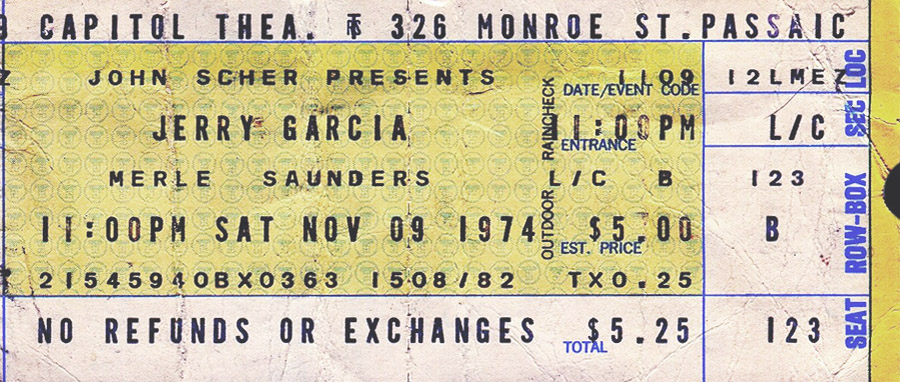
LN jg1974-11-09.jgms.late.aud-slabicky.8661.shnf

I guess I'd say I see that as a rather loose and very good show, maybe above average for the time.


Jerry Garcia and Merl Saunders
Capitol Theatre
326 Monroe Street
Passaic, NJ 07055
November 9, 1974 - 11 PM Late Show
Slabicky shnid-8661 shn2flac

--(9 tracks, 85:20)--
l-t01. band introduction (1) [0:26]
l-t02. Harder They Come [15:21] % -16:53
l-t03. Favela [10:15] %
l-t04. /Let It Rock [#8:29] %
l-t05. //My Problems Got Problems [#10:37] [0:02] %
l-t06. //He Ain't Give You None [#11:24] [0:05]
l-t07. La-La [13:50] ->
l-t08. People Make the World Go 'Round [3:58] [0:02] %
l-t09. //How Sweet It Is [#9:11#] [0:07]

! ACT1: Jerry Garcia and Merl Saunders
! lineup: Jerry Garcia - el-g, vocals;
! lineup: Merl Saunders - keyboards, vocals;
! lineup: Martin Fierro - saxophone, flute;
! lineup: John Kahn - el-bass;
! lineup: Paul Humphrey - drums.

JGMF:

! Recording: symbols: % = recording discontinuity; / = clipped song; // = cut song; ... = fade in/out; # = truncated timing; [ ] = recorded event time. The recorded event time immediately after the song or item name is an attempt at getting the "real" time of the event. So, a timing of [x:xx] right after a song title is an attempt to say how long the song really was, as represented on this recording.

! Jerrybase: https://jerrybase.com/events/19741109-02

! db: http://etreedb.org/shn/8661 (this fileset). Note that the 11/9/74 early show is MIA - no known recordings

! map: https://goo.gl/maps/GSy7A

! venue: http://jerrygarciasbrokendownpalaces.blogspot.com/2011/09/capitol-theater-monroe-st-and-central.html

! R: field recordist: Ihor Slabicky

! R: field recording gear: 2x AKG d190e > Sony TC-152sd

! R: field recording media: Ampex 90min High Frequency Cassette)

! R: transfer: playback on a Nakamichi CR-3A > Lucid AD9624 24-bit A/D converter (44.1kHz) > DAT (Sony R500) > CD. Extraction via EAC, re-tracking via WavMerge and CD Wave, and .shn encoding via mkwACT.

! l-t01 (1) John Scher: "OK, here we go. On saxophone, Martin Fierro. The drummer is Paul Humphries [sic], on bass John Kahn, on keyboards Merl Saunders, on guitar Jerry Garcia. Please welcome [inaudible]."

! P: l-t02 HTC Paul Humphrey is incredible! The vibe of this HTC is fantastically warm, up through 10, come to verse 11:15 and that was a really nice passage. This might have gone a time or two around longer than it needed to, but still in 14 there's lots of really good energy and playing.

! P: l-t03 Favela starts off really hot. Garcia takes a real nice turn 4ff while the band absolutely cooks. This is great stuff. Merl nice turn 7. Things get a little loose 8:45, maybe Martin's fault, not sure, but they right the ship for a bit. Looking ahead, I see the track only times to 10:15 - looks like they're gonna bail out. But here at 9:36 it's still cooking along nicely, down to a tight close - all right, then.

! R: l-t04 Let it Rock cuts in;

! P: l-t04 LIR in the first minute, now continuing 1:14 is playing some great decaying stuff, very country for awhile there. The band is not entirely together at all times.

! R: l-t05 Problems Got Problems cuts in;

! P: l-t05 MPGP in 2 Jerry is playing some very nice bluesy stuff. This band isn't always together, but this is a case where it just sounds wonderful. Jerry's guitar playing is unrushed, expressive, exploratory, soft edges around deep grooves. Merl's long swirls runs in 8 are excellent. He sounds great this night, moaning and growling about how his problems got problems.

! R: l-t06 HAGYN cuts in;

! P: l-t06 HAGYN more really nice playing by Garcia in the 8-minute mark of this song. He sounds great.

l-t09 How Sweet cuts in

Sunday, May 10, 2015

Positively Garcia and the East Coast Deadhead

I. Howard Weiner's Positively Garcia

Howard Weiner's very enjoyable Positively Garcia (Weiner 2014) is like a better-written, more musical, less arcane version of my listening notes, great flashing insights on the same issues that occupy Corry, without the depth. That's not a criticism, by the way: it is light in the sense of being quick and fun to read (if you are seeing these words, I think you'll feel the same), not lightweight. Positively Garcia is the first book on the Jerry Garcia Band, as he would have it (see e.g., p. 3), or, as a stickler would have it, since a couple of the shows are from 1972 and hence predate the JGB, Garcia On The Side. Tip o' the cap to Mr. Weiner for kicking off a print discussion that I really look forward to advancing.

The book is chock full of good stuff, and I decided to engage a piece that caught my eye and drew my ear, its treatment of JGB 11/4/81 at the Palace in Albany, which I guess checks in at #6 of Weiner's list of must-hear Garcia shows. I'll take two slices across his piece, roughly speaking a more meta take focused on the economy of this gig at its particular points in space and time, and then a more micro listening engagement, comparing notes and thoughts on the performance.

II. "Rise of the East Coast Deadhead"

Weiner frames JGB 11/4/81 Albany around this theme, and it works wonders.

Quibbling, I'd say that Arnold (ongoing at Lost Live Dead and Hooterollin Around), Jackson (1999), LIA (ongoing at Grateful Dead Essays and Grateful Dead Sources), McNally (2002), Lesh (2005), Richardson (2014), and all the rest have amply elaborated the phenomenal rise of the East Coast Deadhead, and it's of much older vintage than the 1977 root Weiner taps. (What East Coast Deadhead of this vintage doesn't mention Englishtown?) If, In The Beginning there were Sue Swanson and whatshername, by about the third day He made the East Coast Deadhead, probably via a solid black phone with a rotary dial. The birth year of the East Coast Deadhead sports a '6' in the tens column. In the Garciaverse, the curve first kinks at An Evening With The Grateful Dead and the May 1970 East Coast tour, then again in January 1972 on the Wales-Garcia Hooteroll? tour, the first time Garcia had his name on an East Coast marquee since the birth of the Grateful Dead. A more accurate chapter heading would have been "a slope-change in East Coast Deadheaddom proximally preceding late 1981", but he writes too well for that.

Quibbles aside, Weiner does a great job of colorfully narrating and analyzing a particular, for lack of a better word, economy. The JGB and its East Coast fans sustained, extended, substantially constituted not only the Garciaverse, but also, or rather thereby, the world of the Grateful Dead. Let me start with the GOTS perspective. "More music" catalyzed the Garciaverse, but the money certainly didn't hurt, and naturally the East Coast was a huge part of that, the modal part of that I'd say. That's where the relevant people were in the 1970s and into the 80s. Monetizing his name helped him make his life of music and women and children and men and meetings and highs and hoots and lonely nights in strange rooms and all the rest. It made his life, as he lived it, possible. If Garcia's name-claiming journey began in the comfort of the Bay Area, it really started paying the bills once it followed the silk road, to the east.

"No Jerry = no Grateful Dead" should be emblazoned into the Dead Canon, the band quite impossible without him as long as he breathed (except for 8/1/69 at the Family Dog and, for an hour or so, 6/8/69 at the Fillmore West, of course), and for a long time after he stopped. From the advent of Jerry Garcia as a commodity/man alongside the Dead, and hence, by a kind of natural market gravity, Jerry Garcia as an East Coast phenomenon, the pieces almost always acted as complements, working together and strengthening each other. I can think of one exception, summer 1992, when a hard/hot/rough JGB jaunt to Southern California wrecked Garcia to the tune of several cancelled Dead shows and probably a few hundred thousand dollars. But mostly, they worked together.

After a time, GOTS made "Jerry Garcia" possible. To that extent, it set the conditions of possibility for the Grateful Dead as Garcia aged.

In the making of this Jerry Garcia, the institution of the East Coast tour was a cornerstone social technology, the essence of creative destruction from 1975 until his death. JGB and its acoustic brethren took reasonably long jaunts that year (e.g., October 22 - November 2), and then in the following biggish pieces:

spring 1976: 
fall 1977,
spring 1978,
early 1980,
early and late 1981,
mid-1982,
mid-1983,
late 1983,
mid-1984

[work in progress]

The Dead had assiduously monetized itself amongst this set of fan-consumers from the beginning. Having built that, in 1975 Garcia claimed his name, in that wonderful modern Western sense of property rights, of packaging it up, dba Jerry Garcia Band, and selling it to willing customers, exercising an entitlement to the residual claim (which is the definition of property rights) on a very valuable asset: his name. Weiner does a great service by Polaroiding the East Coast Deadhead as a key ingredient in the alchemy by which Jerry Garcia of the Grateful Dead also became Jerry Garcia, full stop.

East Coast Deadheads loved Garcia, and he played them some great shows. As Weiner describes it, they are "rabid" fans who
attend college at SUNY Albany, or one of the plethora of upstanding schools in the area. One day they’ll be the doctors, lawyers, scientists, and politicians of America. But on this night they are boisterous, stoned, Garcialoving sycophants, escaping the cultural doldrums of the times—new wave, punk, Jordache Jeans, and The Dukes of Hazzard-- ... East Coast Deadheads inspired Garcia by raising a ruckus—hooting and hollering at exactly the right moments. These rowdy cats appreciated the intricacies of improvisation, and Garcia would respond by dialing up the jam—impassioned fret work. Garcia was the embodiment of California culture, yet his creativity thrived in the chaotic environments hovering around New York City, New Haven, Boston, and Philadelphia (Weiner 2014, 68).
This is a standard analysis, supported by statements made by Garcia and other GD members over the years - the East Coast was more intense and often produced diamonds, while the West Coast typically got a more laid-back, home town vibe. Either way, commerce abetted some outstanding art, and it was win-win all around. That's certainly Weiner's claim about 11/4/81, since he places the show in his top twelve. I'll go through the show alongside Weiner, see how our subjective assessments compare. Bottom line of this is that Weiner puts it in his top 6, and I might put it as average for the tour (which was, admittedly, a very good one).

III. Listening Comparison

--set I--

How Sweet It Is
Weiner calls it lackluster, I find nothing of note. Our assessments converge.

Catfish John
Weiner lumps it with HSII (lackluster), but then narrates as follows:" As Garcia strums the climactic finale of the “Catfish John” jam, the Palace Theatre erupts. These overly eager fans are cuckoo for Jerry from the first note" (Weiner 2014, 68).
I note: "@ 2 John's bass sounds great, not sure how much is PA/tape and how much is just that he sounds strong, some combination of both. 7:06 JG symphonic." So I am with the crowd here. Again, I'd say Weiner's sense and my own sense are pretty close.

I Second That Emotion
Weiner likes it.
I systematically dislike this as a Garcia-Kahn tune, which is unfortunate since they played it hundreds of times in just about every band. Songs that stood the test of time in that particular way --start early, stay consistent, never very far from being at hand -- songs Garcia really liked and really liked playing, weren't that common, and if it was good enough for him who am I to say? And here at 3:25 ish I hear why he feels enthusiastic about playing this song, he's is right on it, Mr. Tutt is right on it. Another run 'round the bases for Jerry late 3 over 4, cruising into second on the double, safely ahead of the throw. Garcia sounds great, the whole band sounds great."
So, against my priors (I thought Weiner would be more positive than me), we both converge on liking it.

Simple Twist Of Fate
Weiner does not mention this song. I don't have that much to say, pace a little draggy for me, but nice inflection on "waterfront docks | where the sailors all come in," a classic Dylan palabragraph of Garcia's sailor- and salt air-San Francisco early childhood. It doesn't feel like Weiner and I diverge much on this one.

Mystery Train
Weiner calls it "the transformative performance, the one that really hurtles [it] towards immortality".
I don't make one note. So here I'd say we diverge substantially.

Deal
Weiner: "Once upon a time, this was a onejam pony with a tight instrumental tucked in the middle; but now there's an outrageous ending jam, one that Garcia has been cultivating for the past year" (Weiner 2014, 69). Here's an example of Weiner's really wonderful musical insight: he's absolutely right, I bet, that if we trace back to the handful of summer 1980 East Coast shows (with –ex Family Stone Greg Errico on drums), but especially in the February '81 tour, we'd find the big, hugely layered runs he stacks on the back of little Deal, really making it a rip-snorter all the way through his last good playing late in life.

I have to quote Weiner at length here:
I recommend the final solo from the Albany "Deal." Garcia opens swiftly with screeching twangs that'll burn your brain right out. The crowd is overwhelmed, and the crazed shouting begins …  The music thunders. Kahn and Tutt are the sound and the fury-the Palace walls are shaking. A crazed outburst from Garcia draws a tumultuous roar … Garcia restates the riff, louder, and with more authority. A wave of approval reverberates through the faithful, and the crowd barks for more … An obliging Garcia drops the hammer--same melody line in a higher register, and incrementally quicker, 85 mph ... 90 mph ... 95 mph. Feeding off the loudest roar of the night, Garcia invents exclamation notes born out of the heat of the moment. It's an inspired collaboration, an emotional give and take between a performer and an audience in peak states. … Garcia would play many longer versions of "Deal" featuring mind-bending jams executed with brilliant technique; but few are as stunning as 11-4-81. There's virtuosity within this solo, but the real thrill is hearing how Garcia works the crowd, and how he lets the crowd work him. It's a time out of mind moment, aural transcendence captured on an audience recording (Weiner 2014, 70).
These were the kinds of experiences, a night of world class American music for your $7.50, smokin' hot guitar playing in front of a great band churning out some great rock n roll, by dint of which Garcia earned his audience-for-life.

My notes give it a very good review, but then I conclude a little contradictorily:
You can start to hear Garcia's voice really thinning out in this period. Nevertheless, as I hear him doing some chorus 3:30, I hear him nodding his head to the ladies and signaling that he wants to dig in a little. They step up, and he does step up nicely second half of 3, now stacking and building 4:15 to a nice full peak 4:24, crowd into it 4:32, great notes everywhere, mixing and blending times, scales and excursions trading off at random, then decaying intervals, a nice extension 5:20 when he could have done something else, building it up 5:31, not in the key I want, but he's building it up 5:45, ethereal peaks 5:45, trotting down a scale right over 6. Puts a pedal on it 6:20, Melvin right where he needs to be, Jerry and the ladies rejoin the vocals on cue 6:30ish. He didn't blow the roof off with that Deal, but it was very good, as it often was during this period.

--intermission--

--set II--

Roadrunner
Weiner nicely narrates the hard traveling of 1981, with this particular Jerry Garcia Band tour (October 31 – November 19, 1981, 18 shows in 14 cities) coming less than two weeks after coming back from a European Dead tour for the second time that year, followed by ten days off and then seven more Midwest Dead shows. "Roadrunner", indeed.

I am a little grumpier about things: "Again I notice Garcia's thinning, increasingly nasal vocal delivery".

Mission In The Rain
Weiner loves it, loves it, loves it, drapes it in lots of hyperbole. I think he is mistaken when he says "'Mission in the Rain' is Hunter's portrait of Garcia when they both resided in the Mission District of San Francisco" (Weiner 2014, 73), though it is clearly bound up in the songsters' biographies. It also works well, for older Jerry, who "had lost a lot during the last decade. His bushy black mane and beard had grayed prematurely, and his addiction to smoking Persian had him by the balls" (Weiner 2014, 74).
With expressive and cascading guitar runs, Garcia evokes the pains and pleasures of the human experience as the band backs him in a dreamlike trance. … In the Albany "Mission," his Tiger guitar has the gift of gab as he scurries from scene to scene-everything's poignant and picturesque-brilliant brushstrokes galore. Garcia's phrasing is immaculate. Each riff is a clever idea, complete with its own zestful flavor and texture. There's a brief interlude from Seals, but Garcia's guitar won't be hushed. Just when you think the Bearded One has ended a phrase, he sneaks in a spine-tingling flurry, a little something for us elitists who think we've heard it all. And the way Garcia manipulates the silence is an art form within itself (Weiner 2014, 74).
Weiner notes a miscue that Garcia turns to gold, an extra measure on a Mission chorus compensated by some monstrous guitar work. At 14 and a half minutes, Weiner notes, this is the longest MITR on record (Weiner 2014, 75).

What did I think of the Mission? Heh heh, here's old Grumpy Gus now.
This Mission did absolutely nothing for me. Sounds draggy, and I notice vocal weakness. For a good part of 11 he is not really playing his guitar. 11:45 nice little run over 12. Some envelope late 12 and louder, now doing well over 13, talking himself into putting some oomph into some solos. Not bad, but he hasn't blow the roof off this night. Good picking here 13:36, but for some reason I am wanting more pure decibels and he's not delivering.
Subjectivity is funny, isn't it?

That's What Love Will Make You Do

Weiner: "After such an overwhelming display, on a another night, Garcia might have slowed things down with "Simple Twist of Fate" or "Russian Lullaby," but instead, he almost incites a riot by busting into "That's What Love Will Make You Do," an atypical pick for the third spot of the second set" (Weiner 2014, 75). But he doesn't spend much time on it.

Me: "TWLWMYD I am anxious because I think the one on 11/10/81 (early or late?) is supposed to be the best. This starts off nicely, yeah, in a good groove."

Night They Drove Old Dixie Down ->

Weiner talks about the song, but doesn't have much to say about the performance. I found nothing noteworthy.

Tangled Up In Blue

"Out of the final 'Dixie' chorus, JGB blasts into 'Tangled Up in Blue'. A classic Band anthem precedes a classic Dylan anthem. American history and culture rolls into one" (Weiner 2014, 76). Weiner doesn't like this TUIB as much as he likes the version from Cape Cod on 5/28/83, not as much as I do, apparently: "@ 4:29 Garcia lets loose some very fast and deft picking, very fluid, pulls back again 5:01 like he's got the horse to a good canter and you just keep on going, confident strumming mid-5 to the Montague Street verse. Over 10 this is some exceptionally inventive guitar work, all the way across the 10-minute mark, long cascading scales, digging in a little very end 10 to start bringing things home."

So, sounds like I liked this particular Dylan more than HW.

--encore—

Sugaree
Noting the relative rarity of a JGB encore, Weiner likes this version, which he calls intense and short. So funny. Here's what I said: "It's rather amazing this is the encore, because Garcia is not rushing this too much at all. Around 5:27 I found myself really liking what he was doing; it struck me as patient and inventive. Greatness 7:15 over 7:30 high searing peak." Sounds like we pretty much converge in liking it, though.

In summarizing this listening comparison, I certainly don't put this show anywhere near my top 10, as Weiner does. It's good, it has a lot of good moments, but it strikes me as representative of the tour, which was generally quite strong. I'd need to do more listening to really feel confident about that.

IV. Conclusion

I have been talking a lot about some of the recent and forthcoming books we get to enjoy here in the 50th anniversary of the birth of the Dead and the 20th anniversary year of Garcia's death. Weiner's will never be part of The Canon, but it's a good read and, naturally enough, I am thrilled to see Garcia On The Side getting some love. I recommend it.

Listening notes after the jump.

Saturday, May 09, 2015

Carl Lockett and the Side Trips Social Network

Preface: Reconstruction #2

Jerry Garcia's commitment to Reconstruction never seemed total, a big problem if you're John Kahn, first, and then Merl Saunders, looking to reboot the lucrative Garcia-Saunders-Kahn Fantasy Records franchise. It's no good if the G is wobbly, because "multiracial dance and jazz band with a rotating cast of Bay Area guitarists, including perhaps Jerry Miller or some other hot player who is not Jerry Garcia" may be a fine concept musically --Reconstruction was a frequently hot and risky enterprise-- but a tough sell, not least on evidence of its short, sociometrically-turbulent, falls-off-a-cliff tenure.

Sometimes, and at some point, Reconstruction happened without Garcia. Corry's canonical "Jerry Garcia Band Personnel, 1975-1995" listing (bookmark it!), sociometric data handbook of a big chunk of the historical Garciaverse, catalogs that outfit "Reconstruction #2":

First show-August 4, 1979 Keystone Palo Alto
Last show-September 29, 1979 Keystone Palo Alto

! lineup: John Kahn - bass;
! lineup: Merl Saunders - organ, keyboards, vocals;
! lineup: Ron Stallings - tenor sax, vocals;
! lineup: Carl Lockett - guitar;
! lineup: Ed Neumeister - trombone;
! lineup: Gaylord Birch - drums;
! guest: Jerry Miller - guitar, vocals (for a few shows, presumably in place of Lockett).

Corry notes "It's possible that the last date was actually September 4 in Bolinas, but I am not pursuing that subject in this post", so let me go ahead and ask him for the "short version" in comments. :)

Introduction

My purpose in this post it to drop a few Carl Lockett crumbs I have come across, building up and working around and through a little node in the Side Trips Social Network. Carl Lockett orbits the Garciaverse at one remove, as far as I know. They never shared a stage or an album credit, but they alternated or sequenced as guitar players with Reconstruction. As it happens, they also have a lot of shared ties to others, and I can use this as a case study to map some triadic closure in a little piece of the network topography.

Carl Lockett: Profile

From a little profile I just came across:
Carl Lockett is a Bay Area legend. A musical child prodigy, Carl started out as a drummer, then went to the guitar. By the age of 14, he was playing gigs around the Bay Area, even opening for the legendary Redd Foxx's comedy shows. For over 4 decades, he has made a name for himself in the music industry ... Carl has played live, and on studio albums with Chuck Mangione, Randy Crawford, Jimmy Smith, Joey DeFrancesco, Hank Crawford, Jimmy McGriff, Plaz Johnson, Tammy Terrell, Esther Phillips, The Platters, The Ink Spots, Big Mama Thornton, Jackie Wilson, The Drifters, Papa John Creach, Brook Benton, Dakota Staton, The Coasters, Bill Summers, and David Ruffin. His complete mastery of his instrument and his class and talent, has had him in diverse settings, ranging from a perfect third in a traditional organ trio (touring with Jimmy McGriff and Jimmy Smith), to sitting in for Jerry Garcia when Jerry was unable to make a gig with David Grisman.
In descending order of frequency/intensity of crossings with Jerry this population would sort to Grisman, then probably Papa John (at least a few crossings) and, at the level of shared billings, Big Mama Mae Thornton. Note, at a remove, Jimmy Smith, with whom I believe Merl Saunders studied and/or played. (BTW, note the presumed error in Lockett standing in for Jerry - it was almost certainly not with Grisman, but with Reconstruction.)

Carl Lockett Discography

Discogs identifies 16 credits, which bring out all kinds of stuff. Let me pick some stuff out from across the credit chronology there.

First, Carl Lockett's earliest credit is Walter Hawkins And Selah ‎– Walter Hawkins Selah (Fantasy ‎– 9410, 1972. Merl Saunders and Tom Fogerty produced the record at Fantasy Studios in Berkeley, and Garcia was around - he shares a few credits with Walter Hawkins and the Hawkins Singers (notably on The Group's 1973 Fantasy, Fire Up, catalog 9421).

Second, astute readers will recall that Merl Saunders' ‎ Do I Move You (Crystal Clear Records ‎– CCS-5006, 1979) was mostly comprised of tunes associated in the Garciaverse with Reconstruction, but as Corry has pointed out in comments it did not come after Garcia and Kahn had bailed on the project, but at the front end, recorded just four days after Reconstruction-with-Garcia's debut in late January. So this suggests that Merl brought these tunes into the band, rather than taking them out, as I had surmised.

Recall that John Kahn founded and owned Reconstruction. It meant a lot to him, as I have described in "Risky Reconstruction":
He seems to have had real ambitions for Reconstruction. He saw it as a kind of update to the Garcia-Saunders-Kahn-et-al group which had sold (and continues to sell!) so many records for Fantasy. The outfit would be rebuilt, playing some of the stuff that John had picked out for Jerry's 1974 Compliments of Garcia (Round RX 102, June 1974), notwithstanding that the latter hadn't sold enough to make Round Records viable, some more nightclub numbers and Merl vocals, a beautiful batch of Latin and other jazz, drop some disco danceability and play the black sinner music that John loved so much.  Reconstruction was aptly named, the mixing and mingling of old and new players and materials.... "I want it to last," [Kahn said]. "We're a serious band, and I want it to stay together" (Brown 1979).
Eventually, though, Merl goes from bringing stuff to the table in a partnership to seemingly owning the band. When and how did this happen? I am not really sure. I have a listing for Reconstruction, subtitled "Merl Saunders and Friends", at Frenchy's in Hayward on Monday, 9/3/79; that seems a strange way for John's band to be advertised. The Keystone Berkeley gig on Saturday, 9/22 was demonstrably the original Reconstruction, with Jerry and John, albeit with guest. A week later Reconstruction is booked into the same room, a Saturday night, which means that somewhere Freddie Herrera came to think that Jerry would be present. Yet there are good reasons to doubt he was, since the show never entered The List and the collective memory it inscribes - not impossible, but unlikely. I would infer that around or by 9/29/79 Jerry and John had walked away, and were probably already working stuff up with Ozzie Ahlers (keys) and Johnny D (drums) for the next Jerry Garcia Band.

I pretty much figure that Jerry and John bailed between Saturday 9/22 and Saturday 9/29. John must have assented to Merl taking the name, and he could afford to, given that he had already won the much more lucrative Garcia Loyalty Sweepstakes, a freaking lifetime lottery ticket, John's decisive victory over Merl for control of the Golden Goose. Just a hunch, of course. In November, Merl undertook an east coast tour with a hornless aggregation of name unknown to me (Merl Saunders - keyboards, vocals; Andre Goosland - Guitar; Tony Saunders - Bass; Jay David - Drums; Pamela Rose - Vocals), working a bunch of the same material, but no sign of the name. On 11/29/79 there's a band called Reconstruction playing Rancho Nicasio in West Marin, and then nothing again as far as I can find.

Here are the discog credits for Do I Move You:

Alto Saxophone, Flute – Martin Fierro
Arranged By – Mark Isham, Merl Saunders
Backing Vocals [Background] – Bernetta Rand, Frances Pye, Lynette Stephens Hawkins*, Sherlene Hall, Tramaine Hawkins, Walter Hawkins
Bass – Tony Saunders
Directed By [Technical] – John Meyer
Drums – Larry Vann
Guitar – Carl Locket*
Lead Vocals, Keyboards, Electric Piano, Organ, Clavinet, Synthesizer, Effects – Merl Saunders
Mastered By – Larry Van Valkenburg
Mixed By [Live] – Pat Malonie
Percussion – Kenneth Nash
Producer – Ed Wodenjak, Merl Saunders
Producer [Associate] – Tom Wiggins
Tenor Saxophone – Pee Wee Ellis
Trombone – Ed Neumeister
Trumpet – Mark Isham

Third, after more funk and soul, Lockett again worked for Walter Hawkins on I Feel Like Singing (Light Records ‎– LS-5789, 1982), which includes a couple of Tony Saunders credits (A3-"Do Your Best"; B4-"Try What You May") and rhythm tracks by future 14-year Garcia Band keyboardist Melvin Seals.

Wow.

So, into the Garciaverse, through this node and at this resolution, enters Melvin Seals, who enjoyed the third-longest continuous musical relationship with Garcia, after the Grateful Dead and John Kahn. We also cross Martin Fierro (many dozens of shows with Garcia 1973-1975, and once again on 7/16/88), Tom Fogerty (a few dozen shows with Garcia 1971-1972), Tony Saunders (played with Garcia probably at least a handful of times ca. 1974-1975), Larry Vann (probably shared a stage a time or two with Garcia at The Generosity in 1975, in Merl's band), and Mark Isham (suspected but not established shared stage and probably some shared credits lurking around). The Side Trips Social Network is a small world.

Fourth, Elvin Bishop makes an appearance on Lockett's credits in 1995.

Bishop was present at the Big Bang of the Garciaverse, the Dawn of a particular Man, the portal that opened to become Garcia's name-claiming journey, the 5/21/68 Carousel Tuesday Night Jam, on a cheap handbill on which, right in the eye's spot, we find "Jerry Garcia" billed, an sich, for the first time in the Grateful Dead Era.
Bear recorded it, and, amazingly, the recording circulates freely among fans (shnid-22727). According to Rhoney Stanley (2013, 157-163), Elvin, nicknamed "Pigboy", also provided visual inspiration for the purple pig that Stanley Mouse used to advertise the Carousel Tuesday Night Jams. update: Stanley Mouse says that the visual inspiration for the purple pig was none other than LBJ.


You'll recall that Elvin sat-in with the Hartbeats at the Matrix on October 30, 1968, subbed for him with the Grateful Dead on June 8, 1969 --which, along with August 1, 1969, present the only known times that the Grateful Dead played without Garcia-- and called Garcia onstage for a number to soothe a sunstroked crowd in the football stadium of beautiful UC Santa Barbara on June 4, 1978 . I am sure it's just a coincidence that this was a decade to the day since the June 4, 1968 Tuesday at the Carousel when they jammed together into the night and entered the light of day witness to the assassination of Bobby Kennedy, and a man found his country "fated to keep spinning out of control, down some grim spiral to madness".

Speaking of which, Jerry Garcia and the aforementioned Melvin Seals, who played many hundreds of times together, first did so on that same sunny Santa Barbara afternoon in 1978, when old pal Elvin induced an already opiated-coked-hermetic Garcia to step out and play on his call-to-fun "Right Now Is The Hour" (not, I do not think, as some reports have it, "Goin' Fishin'"), one of the very few times Garcia sat-in with anyone in the hazy decade that bounced lazily and weaved wildly out from the Bicentennial. (Warren Zevon was apparently little better off, guzzling Stoli, heckling the crowd as a bunch of acid casualties, and reportedly booed off that same stage not long after.) I don't have the personnel down, entirely. There were three guests on this tune: Garcia, Chuck Cochran, talented lead guitarist of the Santa Barbara reggae band called Wha-Koo, which had opened the show,and that same band's singer Dave Palmer, joining Elvin band members Jerry McKinney on saxophone, Johnny Vernazza ("Johnny V") on guitar, plus a bassist, Elvin and, perhaps, Melvin Seals. (Keyboards could have been manned by Bill Slais during the Garcia sit-in, but it is not clear -- see Corry.)

Conclusion

Well, here we are. This began as a question about Carl Lockett, and it became a little stroll through aspects of Georg Simmel's notion of triadic closure in social networks, here that two people who have crossed (or nearly done), are also more likely to have crossed some of the same others. It's amazing how bound up these networks really are, so that even though Lockett and Garcia never formally crossed, they are still woven from, into and through patches of the same cloth.

Horses, cocaine and, 231

So many books. Took my Kreutzmann 2015, no time to really engage it, but wanted to commune with it a little bit, form some expectations. Glad there is an index, just opened to the back and my eye drew to the entry "horses, cocaine and, 231".

"hotels, destruction at, 314" sounds promising, too.

Sounds like this is going to be entertaining, at the very least.


Thursday, May 07, 2015

Deal

Kreutzmann 2015 has landed. When will I be able to give it the time? Not sure, but at some point (if the FSM wills it).

I haven't even opened it, because no time. I don't know if I expect it to enter The Canon (Jackson 1999, McNally 2002, Lesh 2006, Richardson 2015, Arnold ongoing-A, ongoing-B, LIA ongoing-A, ongoing-B, perhaps eventually Browne 2015), but I hope it does.

So many words, so little time.

Arnold, Corry. Ongoing-A. Lost Live Dead. URL http://lostlivedead.blogspot.com/.
Arnold, Corry. Ongoing-B. Hooterollin' Around. URL http://hooterollin.blogspot.com/.
Browne, David. 2015. So Many Roads: The Life And Times Of The Grateful Dead. Boston, MA: Da Capo Press [a member of the Perseus Books Group.
Jackson, Blair. 1999. Garcia: An American Life. New York: Penguin Books.
Kreutzmann, Bill, with Benjy Eisen. 2015. Deal: My Three Decades of Drumming, Dreams, and Drugs with the Grateful Dead. New York, NY: St. Martin's Press.
LIA. Ongoing-A. Grateful Dead Essays. URL http://deadessays.blogspot.com/.
LIA. Ongoing-B. Grateful Dead Sources. URL http://deadsources.blogspot.com/.
McNally, Dennis. 2002. A Long Strange Trip: The Inside History of the Grateful Dead. New York: Broadway Books.
Richardson, Peter. 2014. No Simple Highway: A Cultural History of the Grateful Dead. New York: St. Martin's Press.


Tuesday, May 05, 2015

Lossless Legs Garcia Lists

Lossless Legs Garcia Lists

http://www.shnflac.net/jerrysources.php

I just wanted to point out how essential the Lossless Legs Garcia Lists have become to me lately. Tip o' the cap, as always, to everyone involved in bringing such lovely resources together.

Saturday, April 25, 2015

JGMF RSS feeds

You know I have significant complaints with Blogger, but as Corry keeps insisting, you get what you pay for.

Given its imperfections, but also because I found this useful, I thought I'd spotlight how to follow JGMF posts and comments.

JGMF Posts RSS feed URL: http://feeds.feedburner.com/JerryGarciasMiddleFinger
JGMF Comments RSS feed URL: http://www.blogger.com/feeds/18366371/comments/default

Saturday, April 11, 2015

JGB: Halloween 1981 - LN jg1981-10-31.jgb.early-late.aud-levene.88958.flac1644

Late Jerry loved playing on Halloween. In the last fifteen years of his life, the only years he is not known to have gigged on Halloween are 1982 and 1994.
Table xxx. Garcia on Halloween, 1980-1994. Orange is GD, blue is GOTS.
As indicated in the table, things were distributed across the GD (6 dates/shows) and JGB (7 dates, 9 shows). From 1985 forward Garcia played Warren Zevon's "Werewolves Of London", and a good time was generally had, as at the 1989 (a very good JGB show) and 1990 (a raggedy Dead show) iterations, which I attended.

On October 31, 1981, the Jerry Garcia Band played two Halloween shows to open its 18-show-in-20-night "Return of Ron Tutt" tour. Since Garcia had actually been in London at the start of the month, it seems plausible that he might have given "Werewolves" a shot, but it was not to be.

Nevertheless, any start-of-tour is interesting to examine, and this one has some of the telltale signs, including a burst of adrenaline in the early show followed by a shorter and more uneven late show. I have not directly A-B'd his vocals here against vocals later in the tour (I have addressed myself to 11/10/81b Palladium, 11/13/81 Boston, 11/15/81 Provy, and 11/17/81 Chicago), but my unsurprised sense is that they sound better here at the front end than they do at the back end. Update: 11/19/81 has a bone to pick with this idea. Obvious enough, but aAnyway, always nice to see how they sound, take JGB #14b's temperature.

The Tutt angle is especially rich. In 1981-1982, as he descended deeper into a drug haze when not playing, Garcia nevertheless, rather ironically, started getting his business affairs in order. It seems that one early order of business was to square up with Ronnie Tutt, one of the three principals dba Jerry Garcia Band from the very beginning of the JGB and who  for many years faced liens earned by Jerry and John well after Tutt's 1977 departure from the touring band. In later years, as his income grew, Garcia expanded this practice of engineering a payday or few for a collaborator he had done/allowed to be done wrong -- see Saunders, Merl and Grisman, David. Here, in late 1981, both Peter Rowan (who opened a number of shows on the tour) and Ronnie Tutt get to set the precedent. I don't hear anything that seems particularly emotionally resonant here - more typically, I hear Jerry and the band, perhaps particularly Tutt, getting themselves together a little bit.

Two more small pieces of preface. First, I grabbed this to put some context around 11/4/81, which I have revisited pursuant to Weiner (2014, pp. 67-76), and on which I hope someday to report. Second, in terms of tape archaeology, this is the only tape in circulation as of this writing (4/11/2015). I figure several masters must have sauntered into the Philly morning, but this is the only one to have come into the digital light. Thanks to John Levene and all involved in bringing these very nice tapes forward.

Anyway, a few bullets, in no particular order.

1. The tapes sound great.
2. The early show is very long (over 90 minutes), and is outstanding.
3. The late show is much shorter (just over an hour and a 10-minute encore, still not bad), but more importantly, it just doesn't light me up, finding Garcia having to pull the e-brake on as both "Valerie" and "I'll Take A Melody" fall apart. The one exception is "Russian Lullaby", which is stellar, a smoky sensorial mix of Django Reinhardt and Irving Berlin.
4. Jimmy Warren sounds absolutely fine. People have been way too hard on the guy.
5. "Valerie" is not quite together, but boy oh boy do I love this song.
5. Late 1981, JGB #14b, is a fascinating period. Garcia's voice is still present here at the start of the tour, but with just enough weary crackle to give songs like "Simple Twist Of Fate" and "I'll Take A Melody" the ballast they really need.

Listening Notes follow.

Jerry Garcia Band
Tower Theatre
19 S. 69th Street
Upper Darby, PA 19082

October 31, 1981 (Saturday)
Levene shnid-88958

--early show (8 tracks, 93:53)--
e-t01. How Sweet It Is (To Be Loved By You) [9:15] [0:08] %% [1:08]
e-t02. Catfish John [11:29] [0:10] % [0:58]
e-t03. That's What Love Will Make You Do [10:48] [0:36] % [0:14]
e-t04. [0:21] Simple Twist Of Fate// [13:22#] %% [0:29]
e-t05. Knockin' On Heaven's Door [16:20] [0:10] % [0:18]
e-t06. (I'm A) Road Runner [9:01] [0:15] %
e-t07. [0:14] Deal [8:17] [-0:05] ->
e-t08.  Tangled Up In Blue [+0:05] [10:08] (1) [0:06] %

--late show + encore (8 tracks, 73:57)--
--late show (7 tracks, 64:44)--
l-t01. //The Way You Do The Things You Do [#7:28] [0:08] % [0:08] %
l-t02. They Love Each Other [6:56] %% [0:15]
l-t03. [0:10] Valerie :11-7:04 [0:04] % [0:36]
l-t04. I'll Take A Melody [11:47] %% [0:21]
l-t05. Russian Lullaby [10:14] [0:04] %% [0:30]
l-t06. The Night They Drove Old Dixie Down [8:02] ->
l-t07. Dear Prudence [10:40] (2) [0:12] %% [0:16]
--encore (1 track, 9:12)--
l-t08. Sugaree [9:07] [0:05] %

! ACT1: Jerry Garcia Band #14b
! lineup: Jerry Garcia - el-g, vocals;
! lineup: John Kahn - el-b;
! lineup: Jimmy Warren - electric keyboards;
! lineup: Melvin Seals - organ;
! lineup: Ron Tutt - drums;
! lineup: Julie Stafford - vocals;
! lineup: Liz Stires - vocals.

JGMF:

! Recording: symbols: % = recording discontinuity; / = clipped song; // = cut song; ... = fade in/out; # = truncated timing; [ ] = recorded event time. The recorded event time immediately after the song or item name is an attempt at getting the "real" time of the event. So, a timing of [x:xx] right after a song title is an attempt to say how long the song really was, as represented on this recording.

! Jerrybase: https://jerrybase.com/events/19811031-01 (early), https://jerrybase.com/events/19811031-02 (late).

! db: http://etreedb.org/shn/88958 (this fileset).

! map: https://goo.gl/maps/IBjq9

! venue: http://jerrygarciasbrokendownpalaces.blogspot.com/2012/12/tower-theatre-19-s-69th-street-upper.html

! band: JGB #14b (http://lostlivedead.blogspot.com/2012/01/jerry-garcia-band-personnel-1975-1995.html)

! seealso: 11/10/81b, Palladium, NYC (http://jgmf.blogspot.com/2014/03/ln-jg1981-11-10jgblateaud.html);  11/13/81, Orpheum, Boston (http://jgmf.blogspot.com/2014/03/ln-jg1981-11-13jgbearly-lateaud.html); 11/15/81, Provy (http://jgmf.blogspot.com/2014/03/ln-jg1981-11-15jgballaud.html); 11/17/81, Uptown, Chicago (http://jgmf.blogspot.com/2015/03/ln-jg1981-11-17jgballaud.html).

! data: Billboard, 11/21/81, p. unk, via Google Books: two sellouts, gross $58,276 on 5,960 tickets sold.

! R: field recordist: John Levene

! R: field recording gear: 2x Nakamichi 300 (cp4 shotgun) > Marantz CD330

! R: field recording location: taper: "I seem to recall that I taped the early show in the back of the floor seats, but no recollection of where I was for the late show?  I think it was the balcony."

! R: Transfer: Yamaha K-1020 > Sony SBM-1 > Nomad JB3 > Creative Play Center > Soundforge v6e > CDWav. reative Play Center software used to copy to laptop. Soundforge used to prep file for tracking. CDWave used to track and flac at level 8 compression.

! P: historical: Cognitively, we are drawn to variation, a point I discussed in "James Booker,  Classified". Methodologically, my day-job sistren and brethren like large random samples, and preferably Randomized Control Trials under asymptotically-approaching-the-experimental ideal conditions. Given the impossibility of that kind of construction in re my study of the Garciaverse, we'll have to select strictly *unrepresenentative* moments, informed by strong priors. For example, I am listening to this show precisely because it's got some unusual features from which I hope I might learn some things. Most obviously, this is the first night of the "Return of Ron Tutt" tour, 18 shows in 20 days on the road. In 1981-1982, as he descended deeper into a drug haze when not playing, Garcia nevertheless, rather ironicallym, started getting his business affairs in order. It seems that one early order of business was to square up with Ronnie Tutt, one of the three principals dba Jerry Garcia Band from the very beginning of the JGB and who  for many years faced liens earned by Jerry and John well after Tutt's 1977 departure from the touring band. In later years, as his income grew, Garcia expanded this practice of engineering a payday or few for a collaborator he had done/allowed to be done wrong -- see Saunders, Merl and Grisman, David. Here, in late 1981, both Peter Rowan and Ronnie Tutt get to set the precedent. Beyond that historical context, there's just the chance to hear the first night of the tour, see how they sound, take JGB #14b's temperature, and also to put some context around 11/4/81, which I have revisited pursuant to Weiner (2014, pp. 67-76). Oh yeah, one more thing: this is the only tape in circulation as of this writing (4/11/2015). I figure several masters must have sauntered into the Philly morning, but this is the only one to have come into the digital light. Thanks to John Levene and all involved in bringing these very nice tapes forward.

! EARLY SHOW NOTES

! R: this is a really nice tape - outstanding! There are some singers around, there's lots of ambience. There's also someone nearby who is quite knowledgeable, cheering John by name during his STOF feature.

! P: early show: I don't recall being lit up by the first three tunes when I listened to them spring break 2015. In returning 4/10/2015, a couple weeks later, I find this to be absolutely smokin. The band sounds great, everybody - Melvin a little buried in the mix but ethereal, Jimmy Warren playing well, the ladies singing powerfully for white chicks.

 ! P: e-t01 Weird little "ooh-ooh" backing vocal in HSII, a little arrangement variation to start the tour, but I think they'd drop it - wonder if they were asked to do so, or instructed to do so by Melvin?

! R: e-t01 HSII @ 3:48-3:56 real time gap. Listening to the crowd clap is just a joy - this tape sounds great.

! R: e-t04 STOF cuts in

! P: e-t04 STOF I am picking this back up a month or so after the notes from the first three tracks. Here I note Tutt sounding totally in the pocket, and Garcia singing well. The tape is great. Around 2:10 he hits a nice vocal thing, letting himself sound world weary, in a delivery that really suits the song. Huge long phrasings over 4. More long Jerry passages. John picks up his feature at 8.

! P: e-t05 KOHD Jimmy Warren takes a totally respectable solo late 7 to 8. Kahn sounds great, the whole band sounds great. As this songs ends after 16 minutes, I find myself reminded why I love this song during this era. Unlike the dirge of 1976 (which admittedly could clock in over 20 minutes, IIRC), this just hops really nicely along. I love how they arranged this with the organ, giving it a nice little lilt that it never had before. Awesome.

! P: e-t06 IARR so great! He doesn't get the lyrical progressions right, but it pops pretty nicely. Note that this is a real punchy tape and I find the music sounding punchy.

! P: e-t07 Deal this is real nice as Jerry takes another turn late 1 over 2, and he is playing very creatively and enthusiastically. 2:30ish "since you poured the wine for me", then a little vocal flub before "composin' loneseome blues". Big long 1981 vintage pull as he starts ramping Deal up ... that's a good thing. Nice feedback 4:15, great sustain, now picking up his action, characteristically great 1981-Deal-guitar. Pedals in some more raunch, dials up a little, 4:55 and over 5 he's starting to get his wail on. I can't believe he's going to play TUIB after this. Recall that 11/17/81 Chi and maybe 11/19/81 Denver are long. No shortchanging the early show ticket holders here on the opening night of the tour. 6:10 they are being treated to some serious rock and roll guitar, way up the neck 6:25 ish, mixing up long sustains and fast descending scales. Very nice guitar late 6. Doing a little Carlos thing start of 7.

! P: e-t08 TUIB first solo right from 2. Nice, sounds great. Very stringy (that's a good thing) 2:27. Another go 2:40ff, excellent. @ 2:57 Tutt hits a high hat that is perfection itself. Mid-7 just some great long TUIB expressions, very fluid and fluent. 7:58 big rock chord, faster rounds 8:07, huge feedback 8:15, wow, that is a keeper piece of feedback right there.

! e-t08 JG: "Thanks a lot. See ya later on."

! LATE SHOW NOTES

! R: late show: I suspect stage right/house left a little bit. Organ more audible late show than early show. It's very nice instrumentally, bass a little indistinct to start, now coming in l-t04 ITAM. As of ITAM I'd say the bass is still overloaded a little bit, unfortunate. This is the only circulating pull of a night that must have seen at least several tapes saunter out of both shows. Overloading again on "Sugaree".

! R: l-t01 TWYDTTYD cuts in. It sounds a little oversaturated, levels come down 0:17. Jimmy's piano very forward, way more present on the than Melvin's organ playing.

! P: l-t01 TWYDTTYD Jerry's first solo 1:44 he has turned up a little, comes in with enthusiasm and the tape picks up the crowd, pleased.

! P: l-t02 TLEO not my favorite choice, but I can be surprised sometimes. Here, because the tape has Jimmy Warren's electric piano so far forward, you can really hear what he could do, and I will say here that I think he sounds absolutely fine. It sounds like Jerry hasn't quite pinned down all of these arrangements with his band out on its first night of a very long tour. On TLEO, Tutt and Jerry don't seem sycn'd up to start, easy to say since it's just the two of them to start. But Jimmy picks up his part right on time. Melvin follows and they are providing a nice bass of support for the rhythm section to get together. I can't really hear John very well, so maybe he was responsible for the thudding start. It gets more together, but it never really goes any where for me.

! R: l-t03 Valerie taper has his levels way up and things overload until 0:16, when taper dials down.

! P: l-t03 Valerie, by contrast to TLEO, is a song I love, and this is a very early version that I look forward to hearing. On this tape, so from wherever we are in the room, we'll get a nice perspective on the early take of a great song in its too-brief place in the Garcia Band repertoire. My take is that it's what you'd expect for a new song on opening night of the tour in Philly. They are clearly pinning it down, but it's mostly fine and at times very good. Late 4 Jerry has stacked up some nice guitar and the crowd perks up its ears. Jerry delivers this song, with its shoulder shaking, finger-wagging, mane-shaking defiance, with the appropriate attitude. But then, whoops, early 6 he mumbles through a forgotten verse and is pulling the rip chord ... run away! John became audible there for a moment. So, it's a mixed bag, but interesting to hear. I love this song and you can already tell it has great promise from the get-go.

! P: l-t04 ITAM: This song sounds great in late 1981. Jerry can still sing, but he's already taking on and making good use of a weary scratch. He can still, just barely, sustain his notes, and he warbles his weariness with just enough remaining lung and force to get it a great swinging groove. He sounds confident, he's still moving ontstage with some swagger. Soon enough, heroin would trump cocaine and place the swagger with mooby, withdrawn stationarity, but not yet. On 10/31/81 in Philly Garcia can still bring it. Late 10 there is a nice scrub that sounds promising but then, in 11, and like Valerie, it just falls appart at some point ca. 11, and Jerry leads the close, preempting other trouble.

! P: l-t05 Russian Lullaby: "Russian Lullaby", how do I love thee? I love thee lots. I am really looking forward to hearing this, based on the start. Jerry and John are have constructed a bar scene in a Django Reinhardt - Irving Berlin suspensorium, to the drinker's soaked delight and amazement. This is careful, attentive music, totally respectful of the traditions, standing with and bheind them, spinning threads 3:20 and after 3:30, Tutt all gentle highhat, Melvin was playing so beautifully in this period, calm and spacious. Jerry 4:20 breaks off a shard, Jimmy feature 4:30ff and he sounds just fine, still fine over 5 and sounding great, with a glissando 5:11, cool and sounding very nice as he hands it off to John, 5:33ff. Tasteful piece. By 8:10 Jerry has bent in a little minor urgency, everything takes on a different color, John skipping lightly, Melvin and drums super tasteful.

! P: l-t06 TNTDODD This works well in this late 1981 Jerry voice. I worry about hearing this at the end of the tour, but here at the start it works well.

! l-t07 (2) JG: "Thanks a lot. See ya later."


Just Play

Going through some scratched up old CDs, I found a copy of the Crosby, Stills and Nash release Carry On (Atlantic 7567804872, 2006). Entering some dates to trace Croz's whereabouts in the various periods in which he frequented the Garciaverse (most intensely, fall 1969-fall 1971 and again March-September 1975), I am reminded that Crosby, Stills, Nash and Young's "Ohio" was released as a single on June 4, 1970 [see also wiki].

Passing thought that Garcia could never have dropped a true protest song. On June 4, 1970, he played an amazing night of acoustic tunes (including two gospel numbers), country music on pedal steel guitar, and loud electric rock and blues.

Enjoy this incredible audience recording by Gerry Olsen (shnid-123798) that will put you into the comfy-as-home Fillmore West on a Thursday night. Yeah, "Darkness, Darkness", but sometimes it's better just to play.


Friday, March 27, 2015

Benefits

Does anyone happen to have or know of a list of benefits played by the Dead/Garcia?

Perhaps more realistically, does anyone have or know of a list of Rex Foundation concerts the Dead played?

Update: I have constructed and posted my own list of benefits.

Looks interesting ...

https://homesweetjeromedrapaport.wordpress.com/tag/brian-rohan-grateful-dead-brian-rohan-fillmore-management/

Thursday, March 26, 2015

Books post updated

jgmf.blogspot.com/2014/12/books.html

I did manage to get some reading done, have updated the post with some very brief thoughts on some recent books.