Showing posts with label business. Show all posts

Sunday, March 13, 2022

On Tours and Marketing Records

Over at Jerrybase, we have begun grouping events not only by "runs" (consecutive nights at the same venue), but also "tours". It turns out that the notion of a tour isn't quite as crystal clear as one might want it. I wanted it to be at least three out of town gigs in at least two rooms on a single outbound from San Francisco, but, especially in the Garciaverse, this ends up creating some "tours" that lack face validity as such.

Consider Jerry's March-April 1976. The decision rule above would produce the following "tours" that month:

1) Pacific Northwest (Eugene, Portland, Seattle), March 3-6 (3 cities, 3 shows in 4 nights)

2) Midwest College Towns (Evanston, Oberlin, Columbus), March 12-14 (3 cities, 5 shows in 3 nights)

3) Texas (Houston and Austin), March 18-21 (2 cities, 6 shows in 4 nights)

4) the "real" Spring Tour, March 26 - April 5th (9 cities, 13 shows in 11 nights)

My Jerrybase partners have suggested that's a little too granular, and I don't disagree. While they fit the operational definition I offered above, they lack verisimilitude. We'd welcome you to peruse Jerrybase's Tours Page to see what you think.

UPDATE 20220625: correspondent Matt Grady informs that musicians call this little not-quite-a-tour jaunts "runouts" - the perfect word! I am a big fan of words, and when they effectively classify a group of things that would otherwise leave me wordless, well, I like them even more. And, thank you Matt!

As it happens, this work also allows me to fill in a placeholder post I had been ignoring for awhile, centered on the following image:
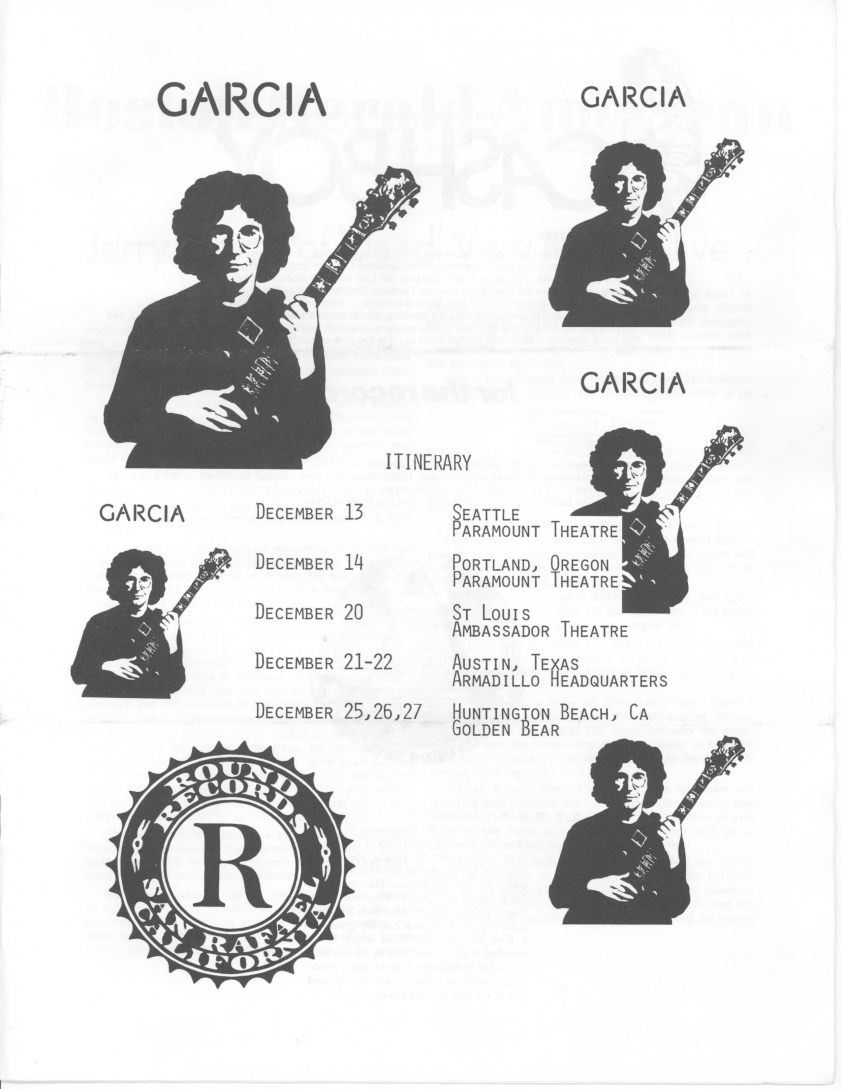
Here we have an 8.5" x 11" promotional handbill listing some upcoming Jerry and Merl gigs in various cities in December 1974. I know there is a copy of this in Santa Cruz ("Business: RX-102 - Compliments of Garcia," Grateful Dead Archive, Special Collections, UC Santa Cruz, MS.332.ser. 2, box 17, folder 10), and I know this image is not from there. First, this one seems to have a crease, that one doesn't. Second, they don't allow posting of scans from the collection - a requirement which I respect and I think others do as well. I was about 99% sure I got this from GDAO, but I cannot find it there. So I can't recall how I came into this it. Anyway, I saw it in the GD Archive, and loved it, then found a copy out in the wild which I could reproduce.

Why do I love this?

First, because I love the music this band made. Go get thee to Garcia Live: Volume Three: December 14-15, 1974, Northwest Tour, Legion of Mary (ATO Records, 2013) if you want to hear why.

Second, who doesn't love beardless Jerry?

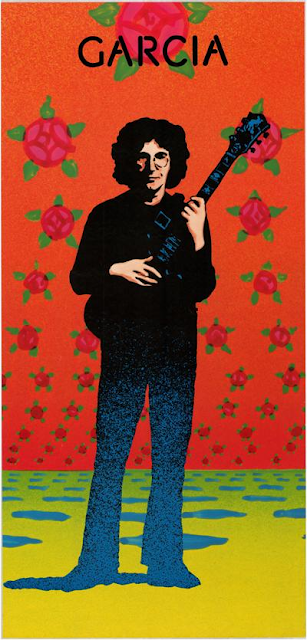
Third, this particular image of beardless Jerry was drawn by Victor Moscoso for the cover of Jerry's second record, Garcia (by which I mean it was his second record, and his second record with that very title), which we all know as Compliments (Round Records, RX-102, June 1974) and I have the very tall, full color poster of the album art at the framer's, and I can't wait to get that sucker up on the wall. It's a beaut.
Fourth, the handbill promotes JGMS gigs --note, still no public use of the moniker Legion of Mary known to me before January 1975-- at the Paramount Northwest in Seattle on December 13, 1974, at the Paramount in Portland on December 14, 1974, at the Ambassador in St. Louis on December 20, 1974, two nights at the Armadillo World Headquarters in Austin on December 21-22, 1974, and then three nights, December 25-27, 1974, at the Golden Bear in Huntington Beach.

Four-A, I love the Pacific Northwest. Four-B, these PNW theaters hosted some killer GD and Jerry over the years. Four-C, the Ambassador, a "landmark of rococo 1920s theater design"? Yes, please. Four-D, I have an original poster from the Armadillo gigs, and it is allegedly the very copy that was hung in the 'dillo lobby at the time of the show. So, there's that. Four-E, the Golden Bear - again, yes, please and thank you. We don't list capacity for it at JB - anyone know? Four-F, the Golden Bear hosted one of my favorite shows from the last eight months of the Garcia-Saunders band, 12/29/74b, partly because of the amazing tape pulled by "Flashback" Charlie Disalvo and partly because I want that version of "Expressway (To Your Heart)" to be my walk-off music as I leave behind my earthly existence. It KILLS.

Fifth, another one of my longtime favorite Garcia-Saunders shows, 12/15/74 in the EMU Ballroom at the University of Oregon, is *not* listed on this handbill, which gives me a sense that it was booked rather later than the others. Who cares? I kind of do, to tell you the truth.

But the BIG takeaway is, Six-A, that I don't know of any other Round promotions for live gigs. Jerry went to NYC on July 1-3, 1974, to play the Bottom Line just a few days after the record came out. The shows sold out in a minute without advertising, but, of course, the record company could also, y'know, have promoted the record. Same goes with the November '74 tour, Jerry and Merl and crew with Martin blowing and the great Paul Humphrey on the drums - no advertising needed for the gigs, but what about cross-promotion with the vinyl? (Yes, I know the record wasn't JGMS. But if we held strict to that, it'd rule out the hints we do have here of a tie between the record and these gigs.)

So, here we have the imagery from Moscoso's cover art, the same lettering on 'GARCIA', and the Round Records logo. But, - Six-B - there is no evidence of the record besides this. No title. No note that there even is a record. It doesn't say "buy the new record, and come see the show", or, "come see the show and, if you dig it, buy the record. Oh yeah - tell your friends!" Instead, we see allusions to Compliments, but no direct mention of it. The Jerry heads would already have recognized some of this, of course, but mostly because they probably already had the record or, as Jerryheads, didn't need to be marketed to buy tickets to see Jerry. Maybe your average head would go to the show, and Round man Steve Brown would ply them with the advertising cards, maybe a "Here Now" poster --already framed and on my wall--
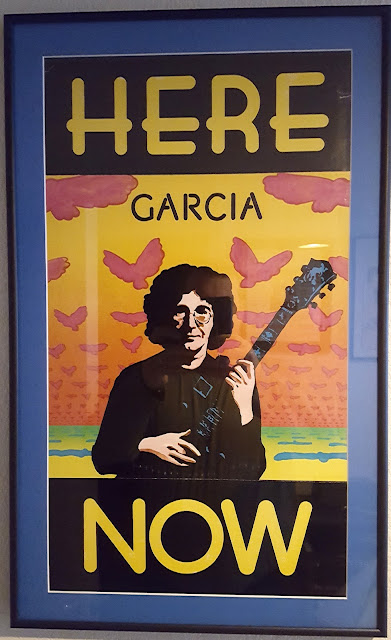
or  some other schwag, so maybe that was the idea. Maybe Anton Round was signing autographs.

I guess it just seems like a little bit of a missed opportunity. Oh yeah, one last thing, in full-circle mode: those March '76 jaunts were almost certainly "behind" Jerry's third record, Reflections (Round Records, RX-107, February 1976) - maybe by then the tie-ins were being made more explicit. But, then again, that'd redound to the benefit of United Artists, since Round, as such, had gone belly-up. I wonder why?

Monday, May 28, 2018

Enter Tom Fogerty

update 20230712

I have no idea why I inferred Tom Fogerty saw JGMS at Keystone Korner on 5/20/71. It seems more likely to have been 5/22/71, and his arrival may mark why they made tapes of the next two nights.

Further, I have no idea why I inferred he first joined in Berkeley on 5/26/71, when Tuesday 5/25 is even more likely, based on the "off-night" clause of The Iron Law of Breaking in New Band Members.

So, as of 7/12/2023, I am calling 5/22 the visit and 5/25 Tom's debut.

/update 20230712

A couple of years ago I discovered this youtube content called "Goodbye Media Man", featuring video of Tom Fogerty, Merl Saunders, Bill Vitt, various studio engineers and others unknown to me, working on a track by that same title.


Here is the description (published October 9, 2013):
Tom was the original singer of the Blue Velvets and the Golliwogs, both of which evolved into Creedence Clearwater Revival. Tom Fogerty had the chops to be a star in his own right. Within the band (Doug, Stu, Tom and John), Tom was overshadowed by younger brother John, who's talent was clearly evident. "Goodbye Media Man", recorded in 1971, was Tom's first solo single after leaving Creedence. A great track with solid musicianship and hooks. To my knowledge, this is the first time this video has been posted. Tom left us far too soon, passing on September 6, 1990. Back in the day, he was a friend, and I miss him - Ken Levy, Brooklyn NY / Addlestone, Surrey England
Wow.

I continue to be amazed at the material that continues to crawl out of the woodwork. It gives me hope for the Golden State Country Bluegrass Festival (GSCBF) film, among many other things. This post will pin down the metadata but also talk about how remarkable is the wealth of material we have available to study, across many different media - and why we get to enjoy that wealth.

Metadata
Location

Appears to be Berkeley, both at Fantasy Studios and at Tom Fogerty's professorial manse with a bunch of kids running around.

Date

The video is only dated 1971. Recall that Tom Fogerty had announced on February 2, 1971 that he was leaving the lucrative Creedence Clearwater Revival over differences with the band's dominant force, his little brother John, and to spend more time with his four children.[1] We also know that the House That Creedence Built, the new Fantasy Studios facility at 10th and Parker in Berkeley, had come online right around this time. Local journo students Kathie Staska and George Mangrum ("KG") ran an amazingly rich column in the Hayward Daily Review starting in February, and got a tour of the new facility from the one and only Ralph Gleason, now working full time for Saul Zaentz at Fantasy.[2]

KG reported on March 11 that Tom had started work on his solo album.[3] Just after the solstice, on June 24th, KG reported that the record was done and was set for release the next week,[4] also noting that he'd be part of Merl Saunders's band for a release on the same label. On June 29th, Robert Hilburn noted in the LA Times that "Goodbye Media Man" was set for imminent release. So the video presumably features material from this late-winter to early-summer span. Intriguingly, a youtube posting of the "Goodbye Media Man" single associates a date of "the 17th of June 1971" with it:


With all of this, the studio film could come from anywhere between March and June, but I strongly suspect that the home material is from closer to June, as the single neared or achieved completion. Update: John Wasserman mentioned that Tom was cutting "Goodbye Media Man" in his Chronicle column of June 21st, so this is very much in the nearing-completion stage - right around the solstice.

Forging The Garcia-Fogerty Connection

Our Hero comes up in the interview, and I think this comment sheds some light on the Tom Fogerty version of the Garcia-Saunders band.[5] Tom says
I only want to jam around right now and perform with as many people as possible. I’ve learned more about music this last month [i.e., May-June] from meeting other people than during the whole time while I was with Creedence ... One night, I just happened to go over to Keystone Korner. Merl Saunders had invited me over to hear him and Bill Vitt and Jerry Garcia, and within a week I was up on the stage with 'em. And, uh playin' with 'em, and at that point I decided that that was ... the kind of music that I wanted behind the song. It was within about three days that the thing came together with Merl.
When might this have been, exactly? Let's investigate. Jerry and Merl had played the following Keystone Korner gigs from the first Freddie Herrera - Jerry Garcia Joint through mid-1971:

Table xxx. Garcia at Keystone Korner, 11/25/70-6/16/71. Follow this link for a more complete table of Garcia's Keystone Korner gigs. Click image to enlarge.

Tom's narrative and the overall evidence best fits Tom having seen JGMS on 5/20/71,[6] and sitting in with them on Wednesday 5/26/71. This frame fits "within a week" from Tom's filmed reckoning, and I am pretty confident about the interval, if not the specifics. "Three days" from Tom is a little unclear to me, certainly could suggest it was other nights than the ones I pinpoint. So, why these?

This is going to get really convoluted, and, despite my best efforts, I assume it will be somewhat hard to follow. You can just take my word for it, or you can try to follow me into the data.

First, there is tape of 5/20/71 and 5/21/71, the first out of the Garcia Vault and the second locked away there until its 2020 release. May 11, 1971[7] and these tapes represent the earliest-audible Garcia-Saunders performances (perhaps as many as eight months after they started gigging![8]), and they precede a four-month gap that audibly ends when Lou Judson becomes the second Marin County soundman to run PA tape of The Group in late September. The 5/20/71 tape escaped into the world because Garcia had it amongst his stuff when, ca. Christmas 1975, MG threw him out of Sans Souci --on which the couple had closed on ... May 5, 1971!-- and he shuffled off to Deborah's for the first time. Debbie took possession of the tape, someone found a way to copy it, and now anyone can hear it.

Second, I submit that the fact that Jerry had this tape amongst his personal stuff is not innocent with respect to the very question we are considering. I think he had the tape "pulled", either initially recorded or pulled out of wherever most of his tapes were kept, or both, precisely so Fogerty could give it a listen. We know the Dead were in the habit of pulling recent tapes to prepare their incoming members, e.g., the "Houseboat Tapes" of August 1971 that they gave Keith Godchaux to listen to. I think Jerry lent it to Tom or dubbed it for him so he could come up to speed with the band and its material.

Third, and with respect to the late boundary, I glean one other possible tidbit of information from the table above, in the advertising patterns. I am almost certainly over-reading this, but the Thursday-Friday-Saturday 5/20-22 run looks like Big Nights - advertised in the Chron, weekend shows, some real buzz. Even Tuesday 5/25 gets a Wasserman mention, which may well have been enough to sell the gig out. But 5/26, Wednesday, gets a measley mention in the Trib's "Bay Sounds" items, which usually ran more toward jazz and soul. Probably a much quieter night for Tom to step up and play some for the first time, dontcha think? I can't adduce all of the evidence here, but it is as close to an Iron Law as exists in the Garciaverse that new players are broken in off-nights, off-the-beaten-path, or both.

Art and Commerce

For Garcia of this vintage, the aesthetics of any musical choice should go without saying. He wanted to play more music with good players than the Dead could afford him (especially in this very fallow period between the closing of the Fillmores East and West). As Corry and I have elaborated, Tom Fogerty advened alongside huge changes in The Group's approach and repertoire, from spacey organ jazz to all kinds of Americana, white (The Band's "Dixie Down", Jesse Winchester's "Biloxi", some good ol' rockabilly), black (Stevie Wonder, Motown, etc. etc.) and everything in between, mostly more or less contemporary stuff. In short, I think Fogerty came in because Jerry wanted to sing some tunes, wanted to bring in more white contemporary, and Fogerty could sing, play rhythm guitar, and bring in some new material. [update: the release of the pre-Tom 5/21/71 Garcia-Saunders gig gives the lie to the idea that it was all space jazz pre-Tom, with white-roots-flavored stuff coming in with him. Dixie Down, Mystery Train and arguably a few others were already in the repertoire. This is a case where fragmentary tape evidence led us {at least me} a little astray.]

But there were almost surely also commercial logics operating here, too. Whether they came from Jerry, from Merl, from Tom, from Saul Zaentz (or Ralph Gleason), and/or others, I can't know. But Fantasy Records stands at the center of this.

Indeed, I want to revise my conjecture above about why the May 20-21, 1971 JGMS tapes were made (and recorded in 4-track, no less). This was long before Rex and then Betty started taping Jerry, so why is there this one pair of shows? I said a few paragraphs ago that it was so Tom could bone up. I think that's half-right – it was so Tom could bone up, and Tom joining this operation cannot be separated from Tom making records for Fantasy, Merl making records for Fantasy, etc. etc. Remember that Merl invited Tom down to the club. He might have had a purpose in mind - say, to make a Group for Jerry that would record on Fantasy and make them all rich, what already wasn't, and them richer what already was. Corry and I have concluded that Fogerty's arrival served a sea change in the Garcia-Saunders aggregation, taking it from space organ to Dylan, Band and Motown numbers. (update: we overstated the discontinuity here. The 5/21/71 show has "Dixie Down", for example.) Why this big artistic shift? Quite possibly, to work up some more commercially viable material than the "out-there" jams they had been doing. Hooteroll? (Douglas 5, December 1971) would cover the space-organ piece of the market for the jazz heads, while The Group could do some white and black contemporary tunes for the dormitory set. It's all made to order, including an eager press. Indeed, two days after writing about Fogerty's upcoming release, our intrepid collegians K and G found themselves at the New Monk in Berkeley, where Tom, Merl and Jerry were holding forth for a standing-room-only crowd, just blocks from Fantasy.[9]

Conclusion

I feel quite confident, though not certain, that Tom Fogerty first sat in with JGMS on May 26, 1971. I also think Fantasy Records was the Prime Mover behind this partnership.

Now, Garcia and Tom did end up on Merl's Heavy Turbulence (Fantasy 8421, 1972), which looks to me like it could have been recorded in 1971, and Fogerty's Excalibur (Fantasy 9413, October 1972) which, though seemingly released later, feels roughly contemporary. Merl's Fire Up (Fantasy 9421, 1973) feels more like 1972, though of course it's pretty hard to say. But Fantasy's big golden goose feast, 1973's Live at the Keystone (Fantasy F-79002), featured the Fogertyless quartet of the aforementioned goose plus Merl and the Kahn-Vitt rhythm section. As best we can tell, Tom left the fold at the end of 1972 after eighteen months with The Group. What happened? I dunno, but I welcome your speculations in comments.


[1] “Tom Fogarty [sic] Leaves Creedence,” San Francisco Chronicle, February 3, 1971, p. 42.


[2] See also Staska and Mangrum 19710225.


[3] Staska and Mangrum 19710311.


[4] Staska and Mangrum 19710624.


[5] I have written at length around all of this. See "Jerry Garcia and Merl Saunders at the Matrix - A Dialogue" (with Corry Arnold), URL http://jgmf.blogspot.com/2014/09/jerry-garcia-and-merl-saunders-at.html; "Jerry Garcia & Merl Saunders & Tom Fogerty Sat-Sun, New Monk", URL http://jgmf.blogspot.com/2014/09/jerry-garcia-merl-saunders-tom-fogerty.html; and "Tom Fogerty, Merl Saunders and Friends - June 25, 1971 Keystone Korner", URL http://jgmf.blogspot.com/2014/09/tom-fogerty-merl-saunders-and-friends.html.


[6] See "'JGMS 5/20/71' is probably really JGMS 5/20/71," URL http://jgmf.blogspot.com/2014/09/jgms-52071-is-probably-really-jgms-52071.html.


[7] See "JGMS: Matrix, May 11-12, 1971," URL http://jgmf.blogspot.com/2014/09/jgms-matrix-may-11-12-1971.html; "'Hey Merl, you wanna do that tune in 'G'? Get spaced out a little?' LN jg1971-05-11.jgms.partial.aud.28784.flac1644," URL http://jgmf.blogspot.com/2014/09/hey-merl-you-wanna-do-that-tune-in-g.html.


[8] "When did Jerry Garcia and Merl Saunders first play together?" URL http://jgmf.blogspot.com/2010/11/when-did-jerry-garcia-and-merl-saunders.html.


[9] Staska and Mangrum 19710701.

Tuesday, April 17, 2018

Twenty-Seven Performances in Twenty-Four Days: April 6-30, 1973

update 20240414: we now know that the Four Nights at the Boarding House were all two-show nights. Math may have to be updated. I am also dinging the uncertain 4/28 at the Plant, as recently discussed here. I now believe this was spurious.

Yup: I now count 27 performances in these 24 days. Edit title yet again.

update: commenter RoG has brought two more gigs to my attention, Wed-Thurs April 25-26 with JGMS at Keystone, so the title has changed from "Twenty-Two" to "Twenty-Four". All the more remarkable.

update2: oh yeah, I forget to mention another little detail from this period: on April 19th, the Dead decided to start up their own record label (Perry 1973, 50; Troy 1994, 155). Because Garcia didn't have enough going on.

I got to commune with more Chronicle microfilm a few days ago, and managed to spin through January 1, 1973 through August 10, 1973. I didn't gather every last listing, just too little time, but I gathered a bunch. These first eight months of 1973 yielded three New-to-The-List gigs, all Garcia-Saunders: April 10-11, 1973 at the Orphanage, and May 24, 1973 at the Keystone.

SFC19730409p45, listing for 4/10/73 JGMS at the Orphanage

SFC19730410p36, Datebook listing for 4/10/73 JGMS at the Orphanage
SFC19730411p41, listing for 4/11/73 JGMS at Orphanage
SFC19730523p58, listing for 5/24/73 JGMS at Keystone
Ah, Garcia, you amaze me.

The last entry lets us see that Jerry played with three bands, three different styles, over three days in May '73: Jerry and Merl on the 24th, plus already-known shows with Old And In The Way at Bimbo's on the 25th, and of course the Dead, with NRPS and Waylon Jennings also playing, at Kezar Stadium on the 26th.

Even more strikingly, these new-to-The-List April shows, Tuesday-Wednesday gigs, fill in a remarkable run from that month. I have already written about OAITW in Santa Barbara on the 12th, a four night run at the Boarding House right after these gigs, two with Merl playing inter alia black contemporary, and two with Dawg and Pete Rowan and the rest playing white roots music, taking a deep dive into Friday the 13th, which got a review in the Stanford Daily (Harlow 1973), and also some listening notes from the 16th. But with these shows, we see a truly insane month of shows once the Dead got back from the east coast.

April 6-8: JGMS at Keystone
April 9: off night (Monday - slacker)
April 10-11: JGMS at Orphanage
April 12: OAITW at the Granada in Santa Barbara (2 shows)
April 13-14: JGMS at Boarding House (4 shows)
April 15-16: OAITW at Boarding House (4 shows)
April 17: off night (Tuesday)
April 18: OAITW session at the Record Plant (uncertain)
April 19-21: OAITW at Lion's Share
April 21: afternoon FM broadcast live from the Record Plant
April 22: off night (Sunday)
April 23: OAITW at Orphanage
April 24: OAITW at the Inn of the Beginning
April 25-26: JGMS at Keystone off nights, only consecutive nights off since this run started, and since 3-4-5 after Dead flew back home
April 27-28: OAITW at Keystone
April 29: night off (Sunday)
April 30: OAITW at Orphanage

Now, there are a few uncertain dates in there. But if my reckoning is correct, and without counting thigh dubious 4/18 session in Sausailo, this is 272422 performances in 24 days, 

I note that Selvin referred to the Orphanage as a "cocaine speakeasy" (Selvin 1996, 37). This which might have come in handy given the unprecedentedly hectic pace of the month's musical pursuits.

Sunday, July 02, 2017

A JGB drum solo by Bill Kreutzmann - Cape Cod Coliseum, June 18, 1982

LN jg1982-06-18.jgb.all.aud-craigl.138576.flac1644

For about a minute-twenty in "Don't Let Go," Billy K. solos. It's a little surreal.

I have historically loved this show, but nothing much jumps out at me on this listen.

JERRY GARCIA BAND
Cape Cod Coliseum
White's Path off Route 6
South Yarmouth, MA 02664
June 18, 1982 (Friday) - 8:30 PM
Craig L MAC flac1644 shnid-138576

--complete show (8 tracks, 85:36)--
--main set (7 tracks, 78:33)--
t01. [0:26] How Sweet It Is (To Be Loved By You) [9:46] [0:02] %
t02. Valerie [7:10] [0:03]
t03. Dear Prudence [13:42] [0:02] %
t04. Mississippi Moon [9:58] %
t05. Don't Let Go [18:31] [0:19] %
t06. Simple Twist Of Fate [12:15] ->
t07. Run For The Roses [6:12] [0:05] %
--encore (1 track, 7:03)--
t08. They Love Each Other [6:57] [0:06] %

! ACT1: Jerry Garcia Band #14a/c
! lineup: Jerry Garcia - el-g, vocals;
! lineup: John Kahn - el-bass;
! lineup: Bill Kreutzmann - drums;
! lineup: Melvin Seals - keyboards (organ);
! lineup: Jimmy Warren - keyboards (electric piano);
! lineup: Liz Stires - backing vocals;
! lineup: Julie Stafford - backing vocals.

JGMF:

! Recording: symbols: % = recording discontinuity; / = clipped song; // = cut song; ... = fade in/out; # = truncated timing; [m:ss] = recorded event time. The recorded event time immediately after the song or item name is an attempt at getting the "real" time of the event. So, a timing of [m:ss] right after a song title is an attempt to say how long the song really was, as represented on this recording.

! Jerrybase: https://jerrybase.com/events/19820618-01

! JGC: http://jerrygarcia.com/show/1982-06-18

! db: http://etreedb.org/shn/18065 (MSC, shn); http://etreedb.org/shn/34071 (variant of shnid-18065); http://etreedb.org/shn/76599 (inferior of this source tape, deprecated); http://etreedb.org/shn/108318 (Rolfe Nak 700s MAC flac1644); http://etreedb.org/shn/119077 (Morrone-Friend MAC flac2448); http://etreedb.org/shn/119095 (Morrone-Friend MAC flac1644); http://etreedb.org/shn/138576 (this fileset).

! band: http://lostlivedead.blogspot.com/2012/01/jerry-garcia-band-personnel-1975-1995.html.

! map: https://goo.gl/maps/phdAsu6ouRP2

! JGBP: http://jerrygarciasbrokendownpalaces.blogspot.com/2011/09/cape-cod-coliseum-whites-path-off-route.html.

! historical: little tour with Bobby and the Midnites. This gig sold out 7,200, grossing $82,581 (Billboard, July 3, 1982, p. 39).

! seealso: JGMF, "Music Mountain Is All That," URL https://jgmf.blogspot.com/2020/05/music-mountain-is-all-that.html.

! seealso: JGMF, "Long Ago and Far Away: JGB at Cumberland County Civic Center, Portland, ME, June 20, 1982," URL https://jgmf.blogspot.com/2019/08/long-ago-and-far-away-jgb-at-cumberland.html.

! seealso: JGMF, "Lizless Sextet: JGB at the Stanley Theater in Pittsburgh, June 23, 1982," URL http://jgmf.blogspot.com/2013/03/ln-jg1982-06-23jgbs1s2paud.html.

! R: field recordist: Craig L.

! R: field recording gear: 2x Nakamichi CM300/CP4 shotguns > Sony TC-D5

! R: field recording location: mics secured to a railing in the side riser.

! R: field recording media: Maxell XLII

! R: Transfer: MAC > Nakamichi CR-5A > Edirol FA-66 > Wavelab 2448 > R8Brain > CD-Wave > TLH > FLAC 1644 tagged. Transfer by Andrew F. 06/2017.

! R: seeder note: "Upgrade to shnid-76599 sourced from the master. Several songs clipped-in abruptly, covered with small patches from ID-119077."

! P: I have loved this show in the past, e.g., from the soundboard. On this listen, it doesn't move me. Billy K. provides perhaps the only drum solo in the history of the Jerry Garcia Band.

! P: t02 Valerie Garcia in a grungy space for so early in the show, a little bit of big chording happening.

! P: t05 DLG has a drum solo - Billy K! - 15:35-16:50. How weird - don't recall this.

! P: t06 STOF very brief Kahn solo, though I wasn't necessarily listening that closely.

! P: t07 very GD wah sounding guitar, round notes.

Wednesday, May 10, 2017

Kicking off the January '86 Garcia/Kahn acoustic tour

LN jg1986-01-24.jgjk.all.aud-CC.138168.flac1644

A huge bulge of heretofore elusive Garcia tape from the late 70s and especially the 80s has been hitting cyberspace. I don't have much time for this, just a few scattered notes laying down some markers for eventual discussion of the tour.

First, a tour snapshot.

Snapshot of the January '86 Garcia/Kahn acoustic east coast tour

Then, listening notes from newly-circulating closet call material from the first night out. For some reason, two short sets for JGJK seems fine - it's not always easy to listen to.
Jerry Garcia and John Kahn
D.A. R. Constitution Hall
1776 D St NW
Washington, DC 20006

January 24, 1986 (Friday) - 8 PM
CC shnid-138168

--set I (7 tracks, 37:13)--
s1t01. /Deep Elem Blues
s1t02. Friend Of The Devil
s1t03. When I Paint My Masterpiece
s1t04. Little Sadie [4:19] ->
s1t05. Spike Driver Blues [4:26] ->
s1t06. Jack A Roe
s1t07. Run For The Roses

--set II + encore (6 tracks, 38:52)--
--set II (5 tracks, 31:07)--
s2t01. Dire Wolf
s2t02. To Lay Me Down
s2t03. I've Been All Around This World
s2t04. Bird Song
s2t05. Ripple//
--encore (1 track, 7:45)--
s2t06. Goodnight Irene [7:37] (1) [0:08]

! ACT1: Jerry Garcia and John Kahn [JGJK]
! lineup: Jerry Garcia - ac-g, vocals;
! lineup: John Kahn - ac-b.

JGMF:

! Jerrybase: https://jerrybase.com/events/19860124-01

! db: http://etreedb.org/shn/138168 (this fileset). Nothing in digital circulation prior to 4/17. Probably very few copies of this show were traded.

! JGBP: http://jerrygarciasbrokendownpalaces.blogspot.com/2011/09/constitution-hall-311-18th-st.html. Notes the following gigs in a room in which "every president since Calvin Coolidge has attended events": 11/2/75 Jerry Garcia Band; 11/27/83 Jerry Garcia Band; 8/8/84 Jerry Garcia Band; 11/20/84 John Kahn (acoustic); 1/24/86 John Kahn (acoustic).

! map: https://goo.gl/maps/8FVYgH5QiCK2

! ref: Billboard, February 8, 1986, p. 37.Ticket I see went for $14.50. Show did well, selling out 3,741 for reported gross of $53,288.

! R: AUD (marked 2nd Gen) kindly provided by wk & http://jgmf.blogspot.com/

! R: transfer: TDK SA90 > Nakamichi CR-5A > Edirol FA-66 > Wavelab 2448 > R8Brain > CD-Wave > TLH > FLAC 1644 tagged. Transfer by Andrew F. 04/2017

! R: s1t01 DEB enters in progress, not much missing. PA mix improves about a minute in, and tape follows.

! historic: The January 1986 Garcia/Kahn acoustic tour --seven shows in nine days for John Scher in interesting, core northeast halls-- was a lucrative proposition for the two partners. Billboard reported this show as a 3,741 sold sellout grossing more than $50,000.

! song: "Little Sadie" (s1t04): Every Deadhead of this era knew the tune from the amazing and massively circulated 2/13/70 Fillmore East tapes, but of course it's draws in several great American song forms and traditions. See http://www.deaddisc.com/songs/Little_Sadie.htm.  "Sadie" presents a character fragment of the sort that avowedly drew Garcia in, illiterate antihero Lee Brown having shot the titular girl in the street for no apparent reason, slept soundly, and rather ineffably turned himself in to get "41 years to wear the ball and stripes".

! P: s1t04 LS @ 1:20, 1:35 very good guitar work at these instances and around. Very solid. There are moments here that sound as engaged as the later work with Grisman, very nice acoustic guitar, John also holding things down well. @ 3:30 Garcia revisits the first verse, then closes the song. There was a little fumbling around the end, but he was decisive and mostly hit it. This was an *excellent* Little Sadie.

! song: "Spike Driver Blues" (s1t05): Garcia didn't do many work songs, but this one is fun.

! P: s1t05 SDB: The acoustic setting is really good in letting him just sing vocals without too much strain. That helps him give more expression. "This is the hammer | that killed John Henry" is done with great around-a-fire-in-a-holler feeling and movement.

! P: s1t06 JAR here's another one that the show-attending Deadheads would have known, from Reckoning. But, yikes, the vocals are too much, first half of 2.

! R: s2t05 Ripple cuts out at "there is a fountain".

! P: s2t06 GI I am coming to this after having FF >> from Jack A Roe to here, not necessarily compelled to hear set II. 

! song: "Goodnight Irene" (s2t06): This is a favorite of mine. "Gonna take another walk downtown" is Garcia alchemizing New Orleans and his beloved San Francisco, and of course "jump overboard in the river and drown" is a mighty close reference to his own father's death. He played it with the Dead on 12/31/83, the night he and MG finally married after 17ish years.

! P: s2t06 GI @ 2:37 he does "sometimes I live in the country" -- but did he miss the "ramblin | stop all that gamblin'" verse? A little voice scratch early 3. I expect he'll want to play his guitar. He digs in with gusto, fluid and dextrous and with great energy. Good stuff. The vocals are too rough to really make this one to recommend to a novice. @ 4:20 he hits ramblin' / gamblin' ... "come home to your wife and children" all given great feeling. Shaky vocals late 4. 5:10ff he really swings and digs into his guitar pieces here, which I really like. 5:35ff drops into a jazzier swing, John not all there with him. Now John walking it up over 6, but I find him mostly not quite where I want him.

! s2t06 (1) JG: "Thanks a lot. See y'all later."

Sunday, July 24, 2016

From the Picky Deadhead Department

Nice to see people reading around some old posts. My writing is so tortured, but I do still love some of the ground we have covered together. Thanks for your support.


From the Picky Deadhead Department

I happily bought 7/5/73 (Jerry Garcia and Merl Saunders, GarciaLive 6: July 5th 1973, Lion's Share [Round Records, JGFRR1009, 2016]), knowing more or less exactly what I was getting. I love the aesthetics, I will give the much-appreciated liner notes a good, close read, and the music is well-chosen and sounds nice.

Two complaints.

First, the CDs fit too snugly on the plastic center rings - 2 of 3 cracked when I lifted out the discs. Yes, I am hard on things, but they're too tight.

Second, more delicate, but said with love and admiration for the social compact that has always bound the Dead and its fans, and in the hope that the Garcias might honor it, too. Here's a little "open letter" for your consideration.

Thanks for the music, Round Records. Now, let's talk about your promise that "every effort was made to prepare this performance for release in a manner that honors the spirit of its creation."

GarciaLive 6 is lovely in many ways, but let's recognize that you have repackaged and sold to your customers what we already had - copies of Rob Eaton's 1996 DAT transcriptions of Betty's master reels. Yet, as the Dead have shown with the smash hit July 1978 box set, arrangements truer to the spirit of things were available, and we might have heard fresh transcriptions from those beautiful master reels.

Please consider, in the future, that your fans support you carrying forward Jerry's musical legacy - which, let's face it, is really the heart of the matter. I will buy the musical product that you put on sale, conditional only on not being ripped off.

I don't think Round has crossed the line -- this isn't Steal Your Face, after all, heh heh --  but it's actually pretty close. When Fantasy resold me the same July 10-11, 1973 Keystone material for the fourth time -- vinyl, cassette, CDs, CD boxset -- I confess to having felt a little burned, a case where the Saunders folks advertised wrinkles as creases [Barlow]. I have only myself to blame, I guess I knew, but it was still pretty unfortunate.

I know you aren't getting rich on any of this. I am happy to pay a fair price for a fair product. If that means I pay a little more because the miraculous market demands a little price for those original reels, from my perspective, so be it. I am no audiophile, but I appreciate the beautiful sound of beautiful music, well -recorded and optimally-preserved and -presented.


Thanks, overall, for good product. Again, I love the look, feel, sound, substantiveness of the Round Records releases. I remain a loyal customer. Let's take it to the next level of openness and respect. Use the jazz model for dating - I want every information on every fragment. Don't use a picture of 11/26/77 in a release of 3/22/78 without making a note of it. Tell us about the tape diameter (e.g., 10"), stock (e.g., Scotch ?207?), the speed at which it was recorded (e.g., 15 ips), the record deck (e.g., Betty's Nagra, serial number SL11183), etc. Include it all, make it correct, please & thank you.

Looking forward to 11/8/76, and to more to come.

Sincerely Yours,

JGMF

Saturday, April 09, 2016

Investing in Marmaduke

Some notes-to-self.

Corry:
The Grateful Dead family was interested in turning John Dawson into a recording artist as early as 1968, and willing to spend their own studio time to do it, even though nothing ever came of it, so the New Riders project can be seen as a solution rather than a random idea.

I do think this slips a little into "functional fallacy", of postulating as the cause of some beneficial thing the mere fact that it is beneficial, ergo, folks must have wanted it and caused it to be produced. It might have been that they loaned him a bunch of money as friends, and then contributed so as to increase the probability of future repayment. So that would be "money -> idea" rather than "idea -> money" (in which case we are 180 degrees from our usual positions).

LIA seems to agree that the idea of Dawson as a "solution" doesn't follow from what we know: "we don't know what the purpose of the Dawson demo was, if Garcia himself had any plan or record-label in mind, or if Dawson just wanted to shop around various companies, or if there was thought to be any leverage from Dawson's 'Dead connection'."

Either way, cool insight: this is "as if" it were an early investment in a more diversified portfolio of commercializable music - absolutely fascinating.

updates

LIA comments "If indeed the Dead were giving some of their studio time to an old buddy, it strikes me as a precursor to the Round Records idea", an interesting thought. JGMF, in comments:
I agree with LIA (in comments) and you that Round becomes the formalized expression of some basic elements of the Garciaverse: he wanted to help out his friends with paying gigs, and the world demanded that he monetize himself (in addition to giving time, effort and layers of skin) to achieve that. For all of his other flaws, Garcia was an unusually generous friend. Think about how many lives were "made," how many properties in Marin and Sonoma made affordable, by professional involvement with Jerry. Man had the Midas Touch.

JGMF, in comments, where apparently I have already had the same urge to think through the titular proposition. At least I agree with myself that this is interesting!

[Corry says] "I find it strange that no record company was interested in John Dawson's demos." Here's a flyer: maybe the record companies insisted on some demonstrable GD/Garcia connection, e.g. a playing contribution from Jerry, as a condition of signing on his friends? This necessity drove (at least to some extent) Garcia's constitutive role in the NRPS, which is consistent with your idea that the NRPS was a solution (a band with Garcia, i.e., one that could sell records) to a problem (Jerry's desire to help his ol' pal Marmaduke).

Thursday, March 24, 2016

JGB at Freeborn Hall, November 12, 1976


Sometime in the afternoon or thereabouts of Friday, November 12, 1976, Garcia, John Kahn, Keith and Donna Jean Godchaux, probably Richard Loren hopped into sedans being driven by monitor mixer Harry Popick and roadie Bill 'Kidd' Candelario to Davis, California, about a hundred miles east of San Francisco on I-80. Thus began a little weekend jaunt that strikes me as more pleasant than one they'd do in August '81 (billed as the "1st Northern California Tour"), if only because the latter passed through Stockton in August, while this one offers foggier temperatures and a cooler implicit psychology.

It had already been a busy week, Sunday-Monday for Freddie Herrera in Berkeley and Palo Alto (I don't think a note of these shows circulates among collectors), then Tuesday through Thursday at Elliot Mazer's His Master's Wheels studio, in the space formerly operated by, variously, Pacific High Recorders and Alembic. The band gives every appearance of trying to use these sessions to work up some old favorites, sort of like a second version of Compliments, a few more fonky gospel numbers, maybe a few not so fonky, but a nice eclectic mix, for some ready-to-sell vinyl. This is the...

 ... Abortive 1976 Garcia Band album

At His Master's Wheels (HMW) Elliot Mazer had put together a space that Garcia really liked, singling it out when asked about the tastiest rooms in the Bay Area in June of 1974, right after recording Compliments (mostly at Columbia) and using it for Reflections, recorded second half 1975 and released early 1976, itself involving some abortive components (see Corry). That involved the payoff of the summer 1975 United Artists bailout. In late 76, Jerry played for Clive, and Arista paid the HMW studio time, as Davis, Garcia, Weir and the Grateful Dead (the latter three not at all the same thing as these men make their respective journeys) enter into a deal to further find fates. It’s impossible to say whether Davis fronted the studio time as an act of good faith, or whether, more likely, the time would eventually come out of Garcia’s advance. Despite its aesthetic promise, I can't say why this project gwas shelved. Eventually, after long battles with demons in the studio --recorded in earnest August-November 1977 and released around April 1, 1978-- Cats Under The Stars replaced it as the first, and in many ways the only, Jerry Garcia Band studio album.

The Abortive 1976 Jerry Garcia Band Album would differ from its predecessors, not a Jerry Garcia record, but a Jerry Garcia Band one, a false step in the institutionalization of Jerry Garcia. Bringing Nicky on board in summer 1975 was certainly a touring proposition - Nicky is contractually obligated to mention his 1975 Mercury record No More Changes (see my WIP "Hiatus Garcianomics"), and the band took xx tours (involving out of town flights) in its three-and-a-half months together. But having the Session Man in the house was almost certainly also a recording proposition: the timing with the recording Compliments is too strong suggestive. But it fell apart, for reasons unknown, and became a little bit of a Garcia-GD Frankenstein, incoherent even if it has its moments.

After August 1976 sessions paid by Round Records - perhaps the last good checks that outfit ever wrote, if they didn't bounce, October and November found Arista paying the bills, leaked to the cognoscenti no later than November 20th.[i] Conceptually, take 2 of the first JGB album resonated with the "Americana Jerry likes" feel of Compliments, but with the band of Garcia-Kahn-Tutt-Godchaux (Keith) and at least some of the material drawing from cooler, stiller depths. Garcia tried Elizabeth Cotten's "Freight Train" and "Oh Babe It Ain't No Lie" on for size for the project, about which I wrote at some length, noting that the ancient songstress found pulp-and-glue permanence in the New Lost City Ramblers Songbook (1964), through which, I surmise, Garcia might have learned the tunes. An undated OBIANL features on All Good Things, disc 3, track 11.

The Band also drew heavily from the gospel well with which Jerry, Keith, Donna and the rest had spent so much time in the Godchaux's living room in 1975 (for Keith and Donna), sometimes quite literally accompanied by a Samarian woman and a "Strange Man".  telling her every sinful thing she'd done, and setting her free. After a shambolic January, the bicentennial live act came to feature more upbeat gospel, as well, from the celestial choir of  “My Sisters And Brothers” to the hot-to-trot show closer “Ride Mighty High”. (Another angelic boogie, “Magnificent Sanctuary Band” [released on the 2004 box set All Good Things] never made it out of Stinson.)

Beyond gospel we find a Dylan (“Visions Of Johanna”, on the bonus disc All Good Things Redux), some black--and-white rockers “Bo Diddley” and “Not Fade Away” (11/9/76), a little R&B on November 10th (“Don’t Let Go”, “The Way You Do The Things You Do”), "The World Is Waiting For The Sunrise" (11/10/76), “Matilda” (calypso on both 11/10/76 and 11/11/76!) and the pure train “Streamlined Cannonball” (11/11/76). To travel to the places to which these various tunes were established, among the people who established them, would drive across every route and byway east of the Mississippi, lots of cities and hollers and plains, and a few on the other side; to do so by the means that conveyed them would bring you to ambient voice, boat, ship, raft, rail and automobile. Aesthetically, the collection would make a fine record.

The Weekend "Tour"

After laying down some tracks, the tour looks take draw a long, deep, weekend breath through some gigging and green spaces, the late Friday night show in Davis, it culminated in a pair of Saturday night shows at verdant Humboldt State.
Table xxx.

I have notes from the front end below. In terms of the back end of the "tour", Jerry has some land up in Mendocino, that Laird Grant lives on - maybe Garcia checked in, said hello and stocked up on the local fare --still autumn, harvest season-- for the rides back home.

Garcia at Freeborn

Depending on where they were coming from, this crew crossed a bridge (Richmond-San Rafael from Marin, or the Bay Bridge from the City), hooked up with I-80 east bound, crossed another bridge (over the Carquinez Strait), went up over the coastal ridge and dropped into the Great Central Valley. "Jerry Garcia has always liked this town," wrote the California Aggie reviewer about Davis. Campus gym Freeborn Hall would have been a drafty, smelly basketball arena at this time, all echo, but the college kids, many of them from the Bay Area, were enthusiastic, and the show shimmered. "Never before," wrote his seasoned reviewer, "have I seen Garcia dance, nor have I ever seen him smile so much".
Table xxx.

So nice to hear. In terms not of the visuals of Jerry (and Donna) swaying in a sweet groove, but of the audio, we are blessed to have Betty Cantor Jackson's 4th reel of the night (reels 1-3 are AWOL, and may have returned do dust), and it holds just a 30 minute "Don't Let Go" and a show-closing "Might High", the crème de la crème of 1976 JGB repertoire, just about (LAALWFH wants a word with me).

LN jg1976-11-12.jgb.s2p-end.sbd-wise.132401.flac1648

A few highlights of the Davis show, based on the tape evidence.

John Kahn does a bass feature in DLG, which is actually interesting, not his usual feathery fluttery tickling thing – actual bass playing. He could do this in earlier years, and occasionally later on, but to hear John Kahn play with some power in November 1976 is a revelation.

Keith is noodling around some classical tunes after DLG.

"Mighty High" is nothing short of amazing. I love Donna Jean Godchaux.

Jerry Garcia Band
Freeborn Hall, University of California
Davis, CA 95616
November 12, 1976 (Friday) - 8 PM
BCJ reel #4 wise DAT flac1648 shnid-132401

--end of show (3 tracks, 2 songs, 38:17)--
reel04-t01. crowd and tuning [0:19]
reel04-t02. Don't Let Go [28:53] (1) [2:46]
reel04-t03. Mighty High// [6:19#]

! ACT1: Jerry Garcia Band #3
! lineup: Jerry Garcia - el-guitar, vocals;
! lineup: John Kahn - el-bass;
! lineup: Keith Godchaux - piano, vocals;
! lineup: Donna Jean Godchaux - vocals;
! lineup: Ron Tutt - drums, vocals.

JGMF:

! Recording: symbols: % = recording discontinuity; / = clipped song; // = cut song; ... = fade in/out; # = truncated timing; [ ] = recorded event time. The recorded event time immediately after the song or item name is an attempt at getting the "real" time of the event. So, a timing of [x:xx] right after a song title is an attempt to say how long the song really was, as represented on this recording.

! db: http://etreedb.org/shn/15850 (same source reel, probably different source DAT and definitely more primitive DAT > CD transfer - deprecated); http://etreedb.org/shn/132401 (this fileset - best source).

! review: Krane, Matt. 1976. Garcia & Company: Phenomenal Crowd Pleasers. California Aggie, November 15, 1976, p. 3. positive review of 11/12/76. Under subtitle "Fabulous Crowd Pleasers" starts by getting out his Webster's: "mellifluous (me-lif-loo-es, adj. (L. /mellifluus: mel, mellis-honey, fluete-to flow), flowing sweetly and smoothly; honeyed; said of words, sounds, etc. … Jerry Garcia has always liked this town, Davis", gave a memorable performance. Not's the JGB has played Crabshaw Corner in Sacto. Freeborn  Freeborn usually sounds like ass, but the reviewer says the band's gear sounded great." Kane praises "Garcia's magnificently mellow, fluid blues progressions". "Never before have I seen Garcia dance, nor have I ever seen him smile so much. But he had a lot to smile about, and so did a crowded Freeborn." "He appeared very warm and comfortable. His music was doubly so."

! R: recordist: Betty Cantor-Jackson

! R: media: 7" reel master @ 7.5ips 1/2 track (reel #4 only). As far as I know, reels 1-3 are not in the Garcia Vault, which might mean they are still out in the world somewhere. They are known not to be among the Betty Boards (TM). Given the water damage to this reel, though, it's strongly possible that the first three reels were among the miles of rotted spaghetti and distingrated vinyl and oxide, silt and pulp and goat piss. As of this writing (3/24/2016), my best sense is that they are gone forever, but that could be wrong.

! R: gear: Betty's Nagra reel to reel deck (serial #SL11183)

! R: lineage: Playback on Otari MX5050-Meyer VX-1 signal processor-Sony PCM R-700 DAT @ 48KHz (circa 1999). Original zero gen DAT played back on a Sony PCM R-500-Digital Audio Labs Card deluxe-16 bit 48KHz. Editing (Adobe Audition CC) - Mastering & Processing (iZotope Ozone 6) - FLAC encoding (dBpoweramp) - Tagging (Tag & Re-name - Digital Transfer, Editing & Processing By JW:February 2015.

! R: note: 16 bit 48Khz file set formatted for music servers"

! R: note: "This reel was old & brittle and there is some tape squeal present."

! R: reel04-t02 DLG @ 15:43 ran past a place where the oxide wasn't, some squeal. Again late 22, ca. 22:50.

! P: reel-04-t02 DLG 12ff John Kahn is taking a bass solo, and for 20 seconds he's on it, a little too fluttery at 12:20, some great bass soloing by John Kahn -- yeah, I said it. @ 14:43 the band comes back, John gets a nice round of applause from the crowd. This is building to a very nice crescendo, all involved, Garcia high up 15:18, all the rest is percussion, now he puts some blue on it 15:39. Garcia in a very interesting space 16:13, a little more speed. 25ff is Garcia's vocale-guitar duetting, some good moaning and scowling. Jerry gets real strong wid it to come to an end, everyone lands right.

! reel04-t02 (1) Keith is playing a classical piece late 29. 29:49 - sounds like something definable. 30:20 for sure, that Parisian Waltz. more at 30:35. another quote 30:53, more than a quote. He wants to play it. Garcia strums for Mighty High @ 31:04.

! P: reel04-t03 Mighty High is incredible. Donna is bringing it early 5ff, everyone singing hard, she is belting! You guy, girl! Even Keith is yelling, in his nasally way, making the tape squeal. Man, that is some good time music for the Aggies!

! R: reel04-t03 squeal somewhere in 4. 5:38 squeal. Reel ends, maybe 30 seconds of music missing.


[i] McDonough 1976 11/20/76.