Showing posts with label reading notes. Show all posts

Sunday, May 29, 2022

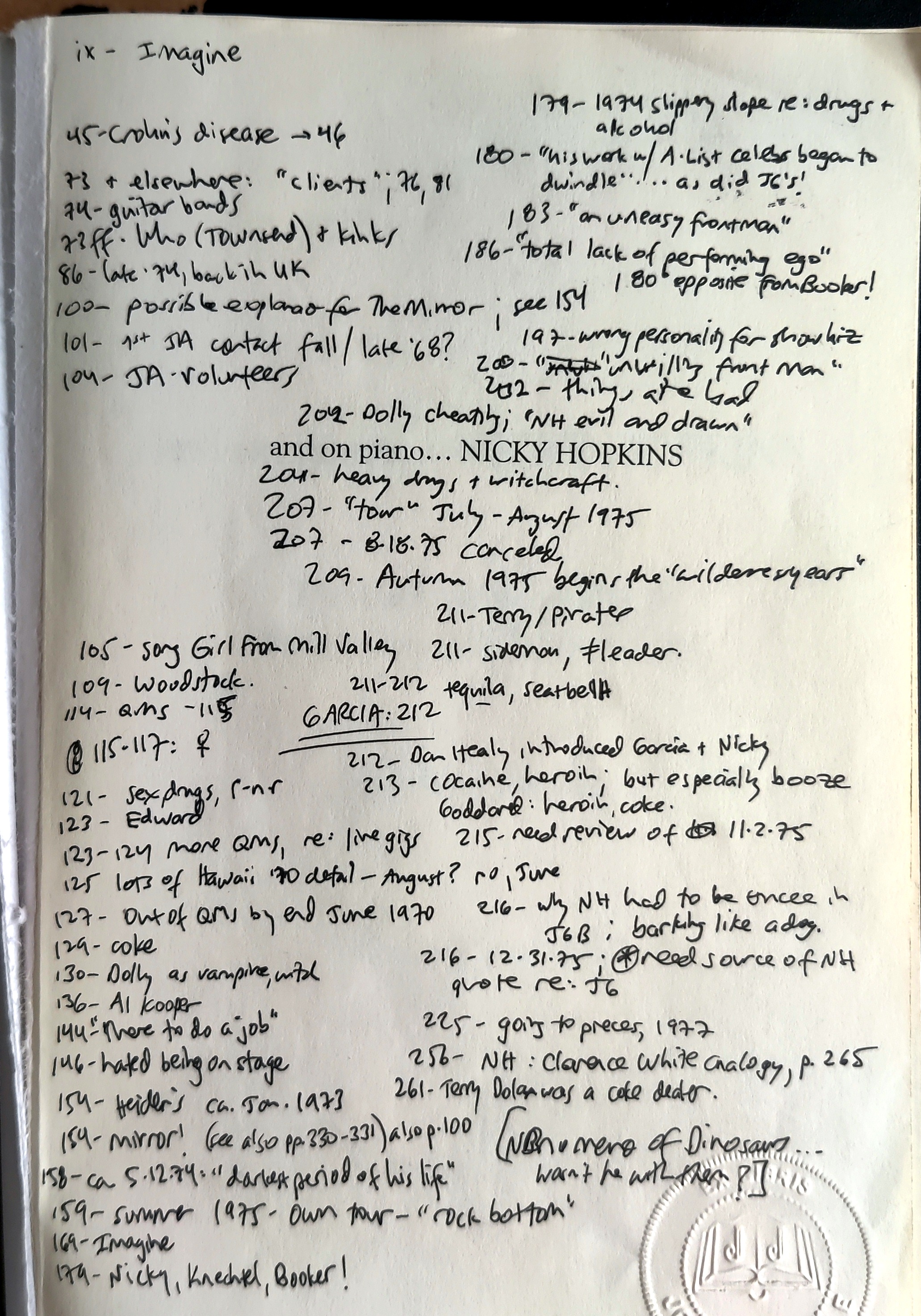
Reading Notes: McNally 2002

McNally, Dennis. 2002. A Long Strange Trip: The Inside History of the Grateful Dead. New York: Broadway Books.

What a book. This, and Jackson's Garcia: An American Life have set a bar that I can only see from far below.

Yes, my original copy is in six pieces, so well-loved has it been.

But you also see that I bought a second copy just to make sure. You're welcome, Dennis!

Obviously, Dennis's focus was the GD, while Blair's was to provide a biography of Garcia, while mine is even narrower, to account for his musical life beyond the GD. One of the things that this will allow me to address is the dramatic historical imbalance in many of the existing sources. Dennis, for example, clocks in at 479 pages up to the hiatus (a decade in GD life), 131 for the remaing 20+ years. This is not a criticism. The early stuff is interesting. It's important. It's when things were fluid and still taking shape. Once things become institutionalized (regularized, routinized, etc.), there's clearly less of interest to say (unless one's interest is precisely in institutionalization, heh heh). But I do hope to provide a balanced look at the whole arc of Garcia's musical life 1965-1995, because I think there's a lot that's of interest in the later years as we try to understand the arc of a man's time on Earth, the nature of "the good life" (and the tradeoffs involved in trying to live it), the different rhythms of young vs old.

As you might imagine, given the painstaking nature of my methodology with a book like Long Strange Trip, part of me has been resisting sitting down and executing this task. But it's obviously essential, and I have done it. I am tackling Jackson next. And what I know the exercise shows with respect to McNally, and what I know it will show with respect to Jackson, is that some huge percentage of what we know about all of this stuff comes from these guys, either originally or in codified / interpreted form. They faced different opportunities and challenges of course. Dennis had the benefit of inside access, and did amazing work in nevertheless giving an honest assessment of the thing, warts and all. Blair was able to strike a little more distance, but had less access to materials. And both are simply marvelous, incredible scholars in putting together what they did in a mostly pre-internet era. I may have the opposite problem - there is so much material now, and my OCD is so exacting, that I face the challenge of how to honor the embarassment of empirical riches while still writing a narrative that reads.

We shall see how I do. We know how Dennis did, and it gets five stars, my highest recommendation.

So, lots and lots and lots of reading notes - below the fold.

Reading Notes: basic method

I have my research methods. They are time-consuming, but I think they work well. For long written works, they involve several layers of activity.

1) reading, marginal notes, etc.

2) going back through and a) typing direct quotes, with Author, Year, Page reference [for hard copies], or b) copying and pasting direct quotes, with Author, Year, Page reference.

3) this may involve tagging with topics like #drugs or #women or #togotigi or whatever

4) sort these quotes into their thematic buckets, such as a document called "drugs.docx" or "women.docx". Highlight them yellow in the basic document to show they have been "processed".

5a) Eventually, paste these thematic quotes into the relevant part of the overal manuscript outline. So, for example, in the current outline of Fate Music, chapter 2 has a major heading B. "1969 not all that peachy, either: Center on 8/1/69", with a level 2 heading "3. Light Artists' Guild, Wild West Fest", and a level 3 heading "a. LAG strike".  So anything I have on the LAG strike will just get pasted, quote and reference, into that part of the document. Then, when I am actually writing in that part of the document, I will organize them at even deeper levels. All of this corresponds to an "architecture of complexity" a la Simon, or Arthur Koester's rendering of hierarchical systems.

5b) In the alternative, I may just write up prose within the thematic document. So, for the LAG strike, I probably have a document that narrates it all.

6) for redundant references to the same fact or claim or whatever, I string the references together à la brochette, as my grandparents' compatriots would have had it. I don't want to just claim one cite and leave the others aside. I want to document every claim as exhaustively as I possibly can, especially when it comes to the canonical sources. So, in Fate Music, you may see some basic claim noted with multiple references, e.g., to Jackson 1999, McNally 2002, Browne 2015, Gans & Jackson 2015, etc. etc. That way, Fate Music also serves as a reference, which can be checked against as many other sources as possible, to maximize reliability, etc.

7) Then I need to write the words, in plain and preferably attractive English. That's the hardest part for me. The rain man is good at stringing together 27 sources after 20 years of research. He may also be an excellent driver. But writing for other brains, in an idiom other than political science? That's like dancing about architecture, my friends.

Saturday, July 28, 2018

Reading Notes: Greenfield 1996

I have read this book a few times, and it has clearly informed my thinking about a lot of issues without my really being aware of it. So I finally got around to transcribing some notes in the way that I do.

I guess this book was controversial (and maybe still is), but to me it reads like Greenfield was able to get people to be open and honest about a lot of things that generally went unspoken, and for that I am grateful. Too much dark is too much, of course. But more truth, understanding, clarity is very helpful to me as I try to understand this very complicated fellow whose name adorns the banner above.

So, reading notes below the jump.

Friday, January 13, 2017

Reading Notes: Jackson and Gans 2015


Jackson, Blair and David Gans. 2015. This Is All a Dream We Dreamed: An Oral History of the Grateful Dead. Flatiron Books.

Blair Jackson and David Gans, like Dennis McNally and David Browne earlier in my reading year, exceed my very high expectations. I don't generally do book reviews, and won't here, either, but I did want to spotlight just how foundational these guys have been in helping us understand the Grateful Dead's world just a little bit more.

Jackson and Gans are to writing about the Grateful Dead as, say, TC is to the band's music. I mean that as a compliment of utmost seriousness. In thinking about Garcia's musical life, I consider the players, those musicians who shared a stage or room with Jerry, to stand at the closest, inner ring of the social Garciaverse. TC was around 14 months and made an essential contribution to the Dead's most essential music, Live/Dead (1969). You can't understand the Dead if you don't understand TC.

Same goes for Jackson and Gans with respect to the written word (to say nothing of Gans's many contributions via the radio and otherwise). But it's more than just the authenticity and aesthetic – we would have been lost without them. From the second half of the 1970s forward, as the Dead grew more insular, Jackson and Gans became increasingly central informational nodes linking the goings on in Marin to the wider world, sometimes even all the way out to far-flung Contra Costa County. J Through inter alia Dennis Erokan's Bay Area Music (BAM), they brought us the little tidbits of gossip and the long form journalism. Jackson and Gans were the indispensable Deadhead journos in an era before the internet, when information was scarce. In 1981, they teamed up to interview the band and BAM covered Garcia across two issues,[i] as Adam Block had done a few years before.[ii] Blair and and Regan McMahon launched the fanzine the Golden Road (1984-1993) not long after, and with it helped define what such a publication can be, marrying art, erudition, great writing and lots of substance to the Deadhead experience. Gans's first book, 1985's Playing In The Band: An Oral and Visual Portrait of the Grateful Dead was the first of several to decode and re-encode the whole trip.

I won't narrate the rest of their story, but it underscores the creative efflorescence that the Dead tapped into and nurtured. Many talented people engaged many acts of genuine human creation around the whole scene, and the many wonderful writers and journalists certainly took, and continue to take, pride of place in my own text-centric little world. The semicentennial of 2015 was such a bounty of books, for example, that I am only now finishing up some transcriptions, first of Dennis McNally's shimmering personal text-collage Jerry on Jerry, then of Browne's rather stunning chronological retiling, reshuffling the deck and turning up aces, abundant fresh thoughts and material to consider.

In This Is All a Dream We Dreamed (TIAADWD), Jackson and Gans amaze me once again. I once briefly praised their work (with Steve Silberman) in curating the Dead's 1999 retrospective boxset So Many Roads, including the controversial (among picky Deadheads) but, IMO, correct choice to edit the 7/9/95 version of the titular swansong. The 2009 Let It Rock release of November 17-18, 1975 exemplifies their contributions to the Garciaverse: stellar music that is well-chosen, skillfully curated, sounding fat and fine from Betty's tapes and including Gans's excellent liner notes, featuring the rare chance to read drummer Ron Tutt's take on the Nicky Hopkins-era Garcia Band. I could go on and on.

I think Corry praised TIAADWD as oral history, and, as always, I can only second Corry's emotion. Communing with Jackson and Gans found me dusting off Greenfield (1996) and realizing that, not only have I never annotated it, but most every page either tells me something that I didn't know or tells me where I learned something that I do. Listening notes TBD. Talk is beautifully rich, and when it is thoughtful, well-considered, skillfully engaged and curated, manuscripting it reveals facets that may not become visible in similar material, but sourced from the human brain via fingers to text. Jackson and Gans have done lots of interviews, they live and breathe the substance and have come to master the various media in which they work, and it all comes together in a book that will remain an essential resource in any self-respecting Deadhead's library. If you haven't, yet, you should go buy it.

Various annotations and reading notes below the fold.

Friday, December 30, 2016

Reading Notes: Browne 2015

Browne, David. 2015. So Many Roads: The Life And Times Of The Grateful Dead. Boston, MA: Da Capo Press [a member of the Perseus Books Group].

I stand by my initial assessment - this book is the real deal, chock full of great tidbits, fluently written. This is a great addition to the canon, standing alongside Jackson, McNally and the rest.

Browne's method involved lots of interviews and access to materials with and from just about all of the key survivors at the very center of the Grateful Dead world. As a scholar, I lament that the move to improve the transparency of work done using qualitative methods underway in various scientific fields, which is a very good thing, could never work for this kind of writing. I will treat specific facts given by Browne as correct, unless I can find something to raise doubts. I rarely do.

The usual reading notes methodology. I know the endnotes don't format properly on blogger - one gets that for which one has paid, and I need to do it this way for my own purposes. Notes below the fold.

Saturday, December 17, 2016

Reading Notes: McNally 2015


McNally, Dennis, ed. 2015. Jerry on Jerry: The Unpublished Jerry Garcia Interviews. New York: Black Dog and Leventhal Publishers.


I didn't quite know what to expect. On a read, it felt like this was all material that I already knew. From a strictly informational perspective I didn't feel like I got anything I didn't know out of Jerry's mouth. But when I went back to transcribe some key things, so engaged the book a second time, I felt like it really painted an intimate picture of Jerry by Jerry. McNally did a great job in using his own creative talent to let Jerry --a Jerry, a version of Jerry-- paint a lovely little posthumous self-portrait.

This is sort of like my "in praise of editorial judgment" thing --no reader here could possibly disagree-- Dennis McNally obviously knew Garcia well, was blessed to have spent a lot of time talking about everything under the sun with him, and he creatively arranges a lot of the material that I know (of), but hadn't really understood. It's nicely paced, a nice easy afternoon conversation, plenty of room to breathe, unlike so many of the Garcia interviews we get to hear. It's a nice piece of work, and it'll be on my shelf (or wherever I put it) for the long haul. (It's so nice that I won't even lament that absence of spatiotemporal identifiers for the quotes.)

A note on "reading notes": this is just my selective culling of quotes of particular interest to me. There's nothing representative about this stuff, I don't imagine. I pick up different stuff from LIA (who can remember it all without the contrivance of "reading notes"). The method is to sort these quotes into their respective topic buckets  (with little tags like #why and such), then put the book aside and move on to the next thing.

Raw notes below the fold. I lost steam with bolding the names at some point ...

Sunday, March 20, 2016

Reading Notes: Arthur Koestler, Act of Creation

This book has had tremendous impact on me.


  • Single logic of creation comedy, science and art
  • Blurb: "bisociative thinking" – the creative leap which connects previously unconnected frames of reference and makes us experience reality on several planes at once.
  • "there are no frontiers where the realm of science ends and that of art begins, and the uomo universale of the Renaissance was a citizen of both".[1]
  • "I shall call a matrix 'blocked' when its 'rules of the game' prove inapplicable to the existing situation or problem in hand; when none of the various ways of exercising a skill, however plastic and adaptable that skill is, leads to the desired goal."[2]
  • AK's version of "luck favors the prepared mind": "the bisociative act … depends in varying degrees on assistance from fringe-conscious and unconscious processes".[3]
  • "The creative act of the humorist consisted in bringing about a momentary fusion between two habitually incompatible matrices. Scientific discovery … can be described in very similar terms – as the permanent fusion of matrices of thought previously believed to be incompatible".[4] AK is not consistent with this latter piece, which is important. He generally says the matrices had previously to be orthogonal, but here he says they need to have been incompatible, meaning they had already been crossed in some way. Saying they are believed incompatible is saying that their connection is already known. So I think this line is an error.
  • Unifying formula of creation: "matrices with fixed codes and adaptable strategies".[5]
  • "The creative act, by connecting previously unrelated dimensions of experiences, enables [one] to attain a higher level of mental evolution. It is an act of liberation – the defeat of habit by originality".[6]
  • The bisociation becomes permanent: "when to matrices have become integrated they cannot again be torn asunder. That is why the discoveries of yesterday are the commonplaces of today".[7]
  • "Discovery often means simply the uncovering of something which has always been there but was hidden from the eye by the blinkers of habit".[8] Actually, that's kind of what it actually does mean.
  • Why we should all be polymaths, like AK: "the statistical probability for a relevant discovery to be made is the greater the more firmly established and well exercised each of the still [109] separate skills, or through-matrices, are."[9]
  • Discussion of certain ideas being ripe, ripeness, pp. 108-109.
  • Multiple discoveries, p. 110.
  • "fortune favors the prepared mind" AK attributes to Pasteur.[10]
  • "The creative act is not an act of creation in the sense of the Old Testament. It does not create something out of nothing [Mingus to Leary: "You can't improvise on nothing, man"]; it uncovers, selects, re-shuffles, combines, synthesizes already existing facts, ideas, faculties, skills".[11]
  • Hadamard: "The Latin verb cogito for 'to think' etymologically means 'to shake together'. St. Augustine had already noticed that and also observed that intelligo means 'to select among'."[12]
  • "The greatness of the philosophers of the scientific revolution consisted not so much in finding the right answers but in asking the right questions; in seeing a problem where nobody saw one before; in substituting a 'why' for a 'how'."[13]
  • "The evidence for large chunks of irrationality embedded in the creative process, not only in art … but in the exact sciences as well, cannot be disputed".[14]
  • Paradox of science: "A branch of knowledge which operates predominantly with abstract symbols, whose entire rationale and credo are objectivity, verifiability, logicality, turns out to be dependent on mental processes which are subjective, irrational, and verifiable only after the event."[15] I think John Meyer would agree with this!
  • On variation: "static vision does not exist; there is no seeing without exploring".[16]
  • "visual exploration and mental exploration are actually indistinguishable".[17]
  • "When a situation is blocked, straight thinking must be superseded by 'thinking aside' – the search for a new, auxiliary matrix which will unblock it, without having ever before been called upon to perform such a task. The essence of discovery is to hit upon such a matrix – as Gutenberg hit on the wine-press and Kepler on the sun-force".[18]
  • Why unconscious mentation is so important: "the temporary relinquishing of conscious controls liberates the mind from certain constraints which are necessary to maintain the disciplined routines of thoughts but may become an impediment to the creative leap".[19]
  • pp. 170-171 drugs madness art science
  • pp. 172-173 move from verbal thinking – too limited – to visual or auditory thinking.
  • Under heading "the snares of language", he notes that "words are a blessing that can turn into a curse".[20]
  • "in some forms of intellectual activity language is not only an indispensable tool, but … the stream of language actually carries the thought, so that the processes of ideation and verbal formulation become indistinguishable."[21]  What is so useful about this to me is that I often think everything is linguistically constructed. The statement only applies to some forms of intellectual activity.
  • Language can parameterize thought.[22]
  • "The rules of the game, however absurd, cannot be altered by playing that game". "True creativity often starts where language ends."[23] Hmmm, this guy never played "King Beer" in Isla Vista. Or "Calvinball".
  • Dreaming: "Without this daily dip into the ancient sources of mental life we would probably all become desiccated automata. And without the more spectacular exploratory dives of the creative individual, there would be no science and no art".[24]
  • To me this is the clearest statement of AK's perspective on the Creative act: "new synthesis of previously unconnected matrices of thought".[25]
  • In the waking state 'side-stepping', 'shift of emphasis' and related expressions signify a change-over from one frame of reference to another. [i.e., we are serial processors; one other possibility – such expressions can just seem "off", or orthogonal {which they are!}] But while we dream, the coherence of these frames is so much loosened that the change is not experienced as such, and side-stepping becomes almost the normal way of the dream's progress. It is by virtue of its freedom from restraint that the 'dreamy' way of thinking can benefit the creative person."[26]
  • "To undo wrong connections, faulty integrations, is half the game. To acquire a new habit is easy, because one main function of the nervous system is to act as a habit-forming machine; to break out of a habit is an almost heroic feat of mind or character".[27]
  • "The prerequisite of originality is the art of forgetting, at the proper moment, what we know. … Without the art of forgetting, the mind remains cluttered up with ready-made answers, and never finds occasion to ask the proper questions".[28]
  • "The essence of discovery is that unlikely marriage of cabbages and kings—of previously unrelated frames of reference or universes of discourse—whose union will solve the previously insoluble problem"[29]. And the unconscious is the "ultimate matchmaker".[30]
  • pp. 224ff very Kuhnian view of scientific progress, normal science punctuated by creative discovery
  • "All decisive advances in the history of scientific thought can be described in terms of mental cross-fertilization between different disciplines".[31]
  • AK's version of "all observation is theory-laden": "the collecting of data is a discriminating activity".[32]
  • We would call this a Lakatosian view of the relationship between evidence and insight: "What we call 'scientific evidence' can never confirm that a theory is true; it can only confirm that it is more true than another".[33]
  • "Controversy is the yeast which keeps science in lively fermentation".[34]
  • "It has been said that we know more and more about less and less".[35]
  •  Artist-Jester-Sage is his key triptych
  • An "oceanic feeling of wonder is the common source of religious mysticism, of pure science and art for art's sake; it is their common denominator and emotional bond".[36]
  • #music "Contemplation of the 'divine dance of numbers', which held both the secrets of music and of the celestial motions, became the link in the mystic union between human thought and the anima mundi. Its perfect symbol was the Harmony of Spheres – the Pythagorean Scale, whose musical intervals correspond to the intervals between the planetary orbits".[37]
  • "the serious research scholar in our generally materialistic age is the only deeply religious human being".[38] and "the equation of science with logic and reason, and art with intuition and emotion, is a blatant popular fallacy".[39]
  • "To derive pleasure from the art of discovery, as from the other arts, the consumer –in this case the student—must be made to re-live, to some extent, the creative process".[40] All of 265-267 is on teaching.
  • "Art is a form of communication which aims at eliciting a re-creative echo. Education should be regarded as an art, and use the appropriate techniques of art to call forth that echo".[41]
  • "every member of a living organism or social body has the dual attributes of 'wholeness' and 'partness'."[42]
  • "A living organism or social body is not an aggregation of elementary parts or elementary processes, it is an integrated hierarchy of semi-autonomous sub-wholes, consisting of sub-sub-wholes, and so on."[43]
  • "The single individual represents the top level of the organismic hierarchy and at the same time the lowest unit of the social hierarchy."[44]
  • "incongruity—the confrontation of incompatible matrices—will be experienced as ridiculous, pathetic or intellectually challenging, according to whether aggression, identification, or the well-balanced blend of scientific curiosity prevails in the spectator's mind".[45]
  • "our remarkable responsiveness to rhythmically patterned stimuli and our readiness 'to become patterned ourselves' arises from the depths of the nervous system, from those archaic strata of the unconscious which reverberate to the shaman's drum."[46]
  • "The emergence of order from chaos is a leitmotif of all mythologies".[47]
  • "The surest symptom of decadent art is that it leaves nothing to the imagination; the Muse has bared her flabby bosom like a too obliging harlot—there is no veiled promise, no mystery, nothing to divine".[48]
  • "man is a symbol-making animal".[49]
  • "The belly of the whale cannot be made into a permanent residence".[50]
  • "eternity is a pretty meaningless notion—unless it is made to look through the window of time. 'Immensity' is a bore—unless it is 'cloystered in thy deare wombe'. The absolute becomes emotionally effective only if it is bisociated with something concrete – dovetailed, as it were, into the familiar."[51]
  • "This interlacing of the two planes [Tragic and Trivial] is found in all great works of art, and at the origin of all great discoveries of science. The artist and scientist are condemned –or privileged—to walk on the line of intersection as on a tightrope. At his best moments, man is 'that great and true amphibian, whose nature is disposed to live, not only like other creatures in divers elements, but in divided and distinguished worlds'."[52]
  • The liminal spaces get all the interesting traffic: "The great innovators all stand at draughty corners of world-history, where air currents from different culture-climates meet, mix and integrate".[53]
  • Virtuosity is mastering a technical skill. "Genius consists not in the perfect exercise of a technique, but in its invention".[54]
  • "the principal mark of genius is not perfection, but originality, the opening of new frontiers; once this is done, the conquered territory becomes common property".[55]
  • "laughter is sparked off by the collision of matrices; discovery, by their integration; aesthetic experience by their juxtaposition".[56]


[1] Koestler 1975 [1964], 28.
[2] Koestler 1975 [1964], 92.
[3] Koestler 1975 [1964], 93.
[4] Koestler 1975 [1964], 94.
[5] Koestler 1975 [1964], 96.
[6] Koestler 1975 [1964], 96.
[7] Koestler 1975 [1964], 105.
[8] Koestler 1975 [1964], 108.
[9] Koestler 1975 [1964], 108-109.
[10] Koestler 1975 [1964], 113.
[11] Koestler 1975 [1964], 120.
[12] Koestler 1975 [1964], 120.
[13] Koestler 1975 [1964], 126.
[14] Koestler 1975 [1964], 146.
[15] Koestler 1975 [1964], 147.
[16] Koestler 1975 [1964], 158.
[17] Koestler 1975 [1964], 161.
[18] Koestler 1975 [1964], 163.
[19] Koestler 1975 [1964], 169.
[20] Koestler 1975 [1964], 173.
[21] Koestler 1975 [1964], 174.
[22] Koestler 1975 [1964], 176.
[23] Koestler 1975 [1964], 177.
[24] Koestler 1975 [1964], 181.
[25] Koestler 1975 [1964], 182.
[26] Koestler 1975 [1964], 189.
[27] Koestler 1975 [1964], 190.
[28] Koestler 1975 [1964], 190.
[29] Koestler 1975 [1964], 201.
[30] Koestler 1975 [1964], 201.
[31] Koestler 1975 [1964], 230.
[32] Koestler 1975 [1964], 233.
[33] Koestler 1975 [1964], 242. The connection is especially to Lakatos 1970.
[34] Koestler 1975 [1964], 246.
[35] Koestler 1975 [1964], 252. "Althea" would agree.
[36] Koestler 1975 [1964], 258.
[37] Koestler 1975 [1964], 260.
[38] Koestler 1975 [1964], 262.
[39] Koestler 1975 [1964], 264.
[40] Koestler 1975 [1964], 265.
[41] Koestler 1975 [1964], 266.
[42] Koestler 1975 [1964], 286.
[43] Koestler 1975 [1964], 287.
[44] Koestler 1975 [1964], 289.
[45] Koestler 1975 [1964], 305.
[46] Koestler 1975 [1964], 311.
[47] Koestler 1975 [1964], 327.
[48] Koestler 1975 [1964], 342.
[49] Koestler 1975 [1964], 342.
[50] Koestler 1975 [1964], 364.
[51] Koestler 1975 [1964], 364.
[52] Koestler 1975 [1964], 365.
[53] Koestler 1975 [1964], 395.
[54] Koestler 1975 [1964], 402.
[55] Koestler 1975 [1964], 402.
[56] Koestler 1975 [1964], 408.