Showing posts with label methodology. Show all posts

Sunday, February 15, 2026

AFM6 San Francisco Sessions Dataset, 1967-1972

Tony Orbasido was running the American Federation of Musicians' Local No. 6 in San Francisco when I started asking him about researching in whatever papers they had. What they had was two 4-drawer filing cabinets stuff with studio recording contracts. I think the union didn't keep gig contracts in hard copy beyond 3-4 years for space reasons, and there were no gig contracts relevant to me.

This was before I could take legible cellphone pictures. I had to run Xerox copies of what I wanted. In later years, I progressively digitized these paper copies. The sample is biased with respect to anything in the Garciaverse, because I was explicitly looking for and only gathering out to Spudfactor = 1 musicians, in addition to Garcia himself. As I have reported, the Jerry Garcia and Grateful Dead contents of these files was dramatically light. I think Tony O said someone had come through and gathered them up. This could well have been the Jerry Garcia Estate, but I do not know that. Anyway, within the limits of the media I was working with, I was able to go through 1967-1972 pretty thoroughly.

I published the Garcia-relevant stuff in batches. By way of making an index, here they are.


San Francisco Sessions, 1972 (November 18, 2017)

Altogether, this is my AFM6 San Francisco Sessions Dataset, 1967-1972

Monday, October 30, 2023

Thursday, July 13, 2023

Three vast corpora, to start

As I am writing and looking at the things I may have to leave undone, it strikes me that we have some amazing sources of oral history, which can and should be systematically converted to text for close study by humans and pattern extraction by machines. I have in mind the following sources:

Jake Feinberg, The Jake Feinberg Show, various episodes.

David Gans and Gary Lambert, Tales From the Golden Road, Sirius XM Satellite Radio, Grateful Dead Channel, various episodes.

Steve Parrish, The Big Steve Show, Sirius XM Satellite Radio, Grateful Dead Channel, various episodes.

For both the Feinberg and Big Steve shows, I have played around with grabbing audio, converting to text using otter.ai, and editing in the otter.ai interface (which is quite good). These transcripts have much to teach us. 

Feinberg has interviewed literally several dozen Garcia collaborators, many on more than one occasion totally a few hours. He has a great jazz head and draws great stuff out of his guests.

Big Steve's is mostly his recollections, with interviews not uncommon. He has a very good memory, and some of these stories are pure gold. I have found many factual errors in them, but can you blame the guy for not getting 54 years of memories from roadying for the Dead and Garcia Just Exactly Perfect? There are absolute golden nuggets throughout the show.

But you have to pan for them.

In both cases, the transcriptions emerge from the machine *very rough*. A 45 minute Feinberg interview can take me 90 minutes or two hours to clean, maybe even more. And he's doing these for broadcast, so care is taken to speak somewhat clearly. Big Steve is talking around giant Grizzly Peak doobies and, for some reason, juggling a mouthful of rocks. Polishing these transcriptions is more like 3:1 time ratio. The machine isn't the first not to know what to make of Big Steve, and we humans just process too fucking slowly.

So, it hurts me to know how much I am probably missing from these and countless other sources. I am glad the Good Ol Grateful Deadcastis making transcriptions - awesome stuff.

But these three shows alone have been running for *years*, and have generated probably millions of words altogether. These currently exist as sound data, and we need to get them transcribed.

Bottom line: the voice-to-text process is where the time/energy bottleneck still is. Once we have text, the machines can do their things, and we can do ours, and there are many opportunities to apply digital humanities kinds of methods to our corpora. I think it will yield great results. But someone other than me is going to have to get that ball rolling!

Wednesday, June 07, 2023

On Accuracy

The recent June 5th brought out more than a tiny number of people to recognize the Oregon State Penintiery show on the anniversary of its performance -- June 5, 1982 -- rather than on the date given by the old bootleg tape. Because the bootleg was one of the mostly widely held Garcia recordings in the CD era, the spurious date of May 5, 1982 --imagine bootleggers getting something wrong!-- has been persistent and hard to uproot. Bad information crowds out the good even years after the latter has been established with 100-ε% certainty. Certainly the last decade of politics has demonstrated the dark underbelly of the availability heuristic, as the simple (but relentless) repetition of untruth persuades people to believe it. (Note to self: Kahneman 2011, 62, 66, 67).

And it is now 100% established that May 5, 1982 is incorrect, and June 5, 1982 is correct. latter is now the case here. I first established the correct date of June 5th based on the tour itinerary hidden in the GD Archives at UCSC. I learned more in a piece about Steve Stilling, the OSP prisoner who put the Garcia-Kahn event and a number of other notable gigs on. Dick Latvala's Scrapbooks supplied a picture of the event from a local newspaper! Most of this is pinned at Jerrybase, natch. But there is really no doubt about this, beyond the epsilon (ε) I always reserve on metaphysical grounds

So I want to express my appreciation not only for those who are open to updating their beliefs about this sort of thing, but for those who endeavor to use accurate information, even in relatively casual conversation, when it comes to Jerry Garcia's musical life and activities and the rest of the stuff we are passionate about.

Accuracy matters, even in this "hobby" space, this "amateur" space which, Steve Silberman reminded us years back in one of the Taping Compendiums, simply means "lover" or "lover of". I am fully bought-in to Umberto Eco's view that we make lists in a vain attempt to tame infinity in a vain attempt to live forever -- together. Any efforts along these lines should never be described with the pejorative "obsession", IMO. I greatly prefer the label "passion". And why not? We are dying, after all! We've got work to do!

I get that not everyone cares, and I am not going to try to police their usages ... too much. Maybe a nudge, providing the correct information. Maybe an implicit plea for them to use the correct information as much as possible, not because they care, but because I (and lots of us) care. In that specific form of community known as culture, pinning down our past helps us live together in the present and feel just a little calmer about the future, since at least this piece of infinity has been tamed.

Tuesday, November 08, 2022

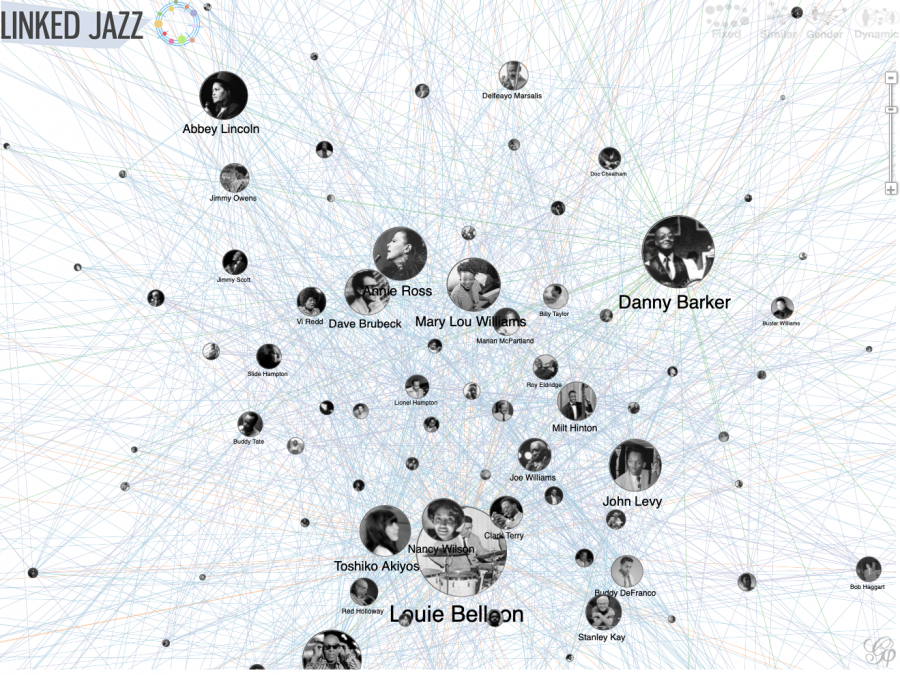
Linked Jazz --> Linked Jerry (a.k.a., the Side Trips Social Network)

Something like this social network graph will form the centerpiece image (I will pay for color) of Fate Music. I presented a brutally rudimentary glimpse of such a thing like ten years ago at the GD Studies caucus meeting in ABQ, calling it "The Side Trips Social Network". Social network analysis (SNA) is groovy stuff.

Sunday, May 29, 2022

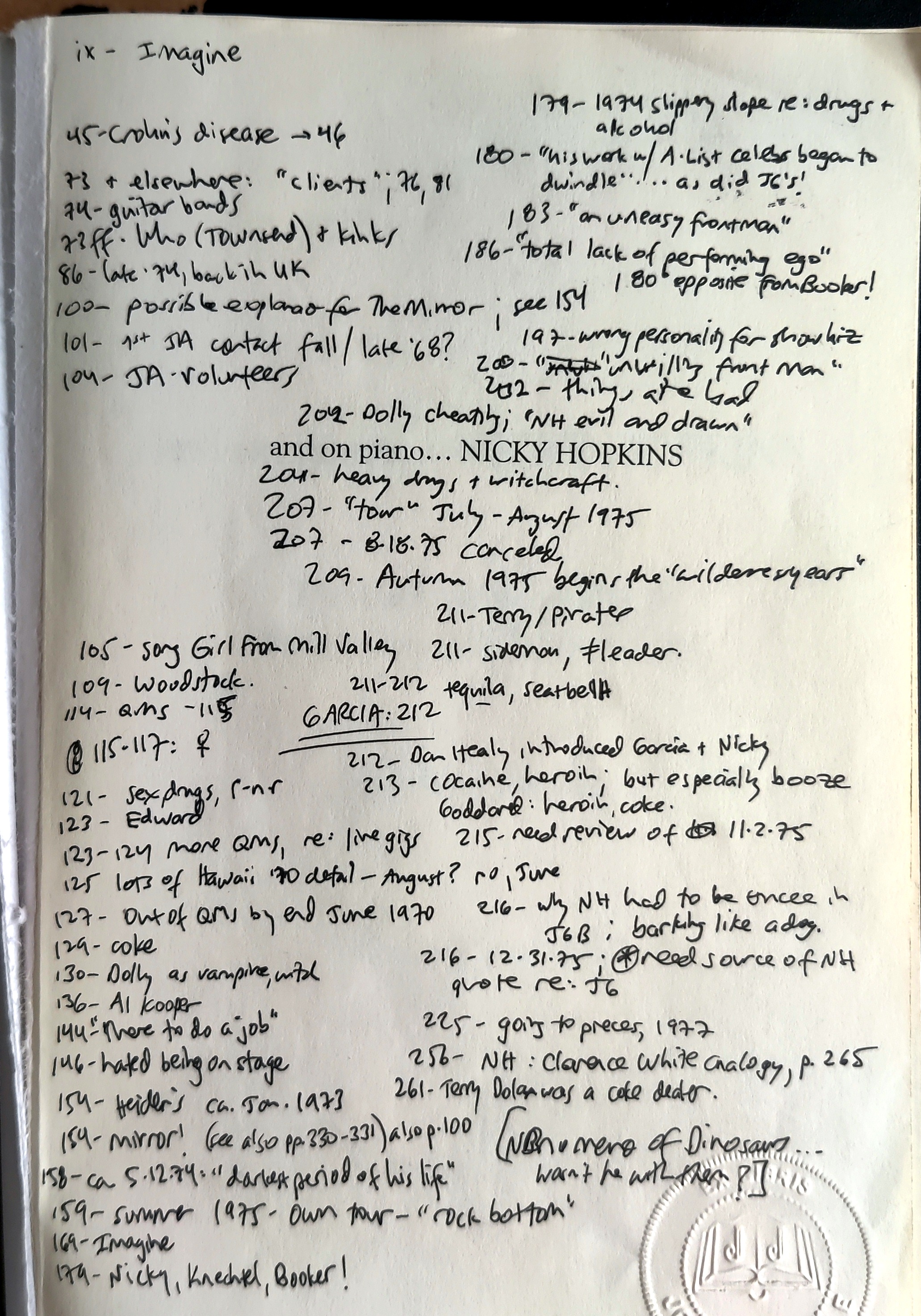
Reading Notes: basic method

I have my research methods. They are time-consuming, but I think they work well. For long written works, they involve several layers of activity.

1) reading, marginal notes, etc.

2) going back through and a) typing direct quotes, with Author, Year, Page reference [for hard copies], or b) copying and pasting direct quotes, with Author, Year, Page reference.

3) this may involve tagging with topics like #drugs or #women or #togotigi or whatever

4) sort these quotes into their thematic buckets, such as a document called "drugs.docx" or "women.docx". Highlight them yellow in the basic document to show they have been "processed".

5a) Eventually, paste these thematic quotes into the relevant part of the overal manuscript outline. So, for example, in the current outline of Fate Music, chapter 2 has a major heading B. "1969 not all that peachy, either: Center on 8/1/69", with a level 2 heading "3. Light Artists' Guild, Wild West Fest", and a level 3 heading "a. LAG strike".  So anything I have on the LAG strike will just get pasted, quote and reference, into that part of the document. Then, when I am actually writing in that part of the document, I will organize them at even deeper levels. All of this corresponds to an "architecture of complexity" a la Simon, or Arthur Koester's rendering of hierarchical systems.

5b) In the alternative, I may just write up prose within the thematic document. So, for the LAG strike, I probably have a document that narrates it all.

6) for redundant references to the same fact or claim or whatever, I string the references together à la brochette, as my grandparents' compatriots would have had it. I don't want to just claim one cite and leave the others aside. I want to document every claim as exhaustively as I possibly can, especially when it comes to the canonical sources. So, in Fate Music, you may see some basic claim noted with multiple references, e.g., to Jackson 1999, McNally 2002, Browne 2015, Gans & Jackson 2015, etc. etc. That way, Fate Music also serves as a reference, which can be checked against as many other sources as possible, to maximize reliability, etc.

7) Then I need to write the words, in plain and preferably attractive English. That's the hardest part for me. The rain man is good at stringing together 27 sources after 20 years of research. He may also be an excellent driver. But writing for other brains, in an idiom other than political science? That's like dancing about architecture, my friends.

Sunday, March 13, 2022

On Tours and Marketing Records

Over at Jerrybase, we have begun grouping events not only by "runs" (consecutive nights at the same venue), but also "tours". It turns out that the notion of a tour isn't quite as crystal clear as one might want it. I wanted it to be at least three out of town gigs in at least two rooms on a single outbound from San Francisco, but, especially in the Garciaverse, this ends up creating some "tours" that lack face validity as such.

Consider Jerry's March-April 1976. The decision rule above would produce the following "tours" that month:

1) Pacific Northwest (Eugene, Portland, Seattle), March 3-6 (3 cities, 3 shows in 4 nights)

2) Midwest College Towns (Evanston, Oberlin, Columbus), March 12-14 (3 cities, 5 shows in 3 nights)

3) Texas (Houston and Austin), March 18-21 (2 cities, 6 shows in 4 nights)

4) the "real" Spring Tour, March 26 - April 5th (9 cities, 13 shows in 11 nights)

My Jerrybase partners have suggested that's a little too granular, and I don't disagree. While they fit the operational definition I offered above, they lack verisimilitude. We'd welcome you to peruse Jerrybase's Tours Page to see what you think.

UPDATE 20220625: correspondent Matt Grady informs that musicians call this little not-quite-a-tour jaunts "runouts" - the perfect word! I am a big fan of words, and when they effectively classify a group of things that would otherwise leave me wordless, well, I like them even more. And, thank you Matt!

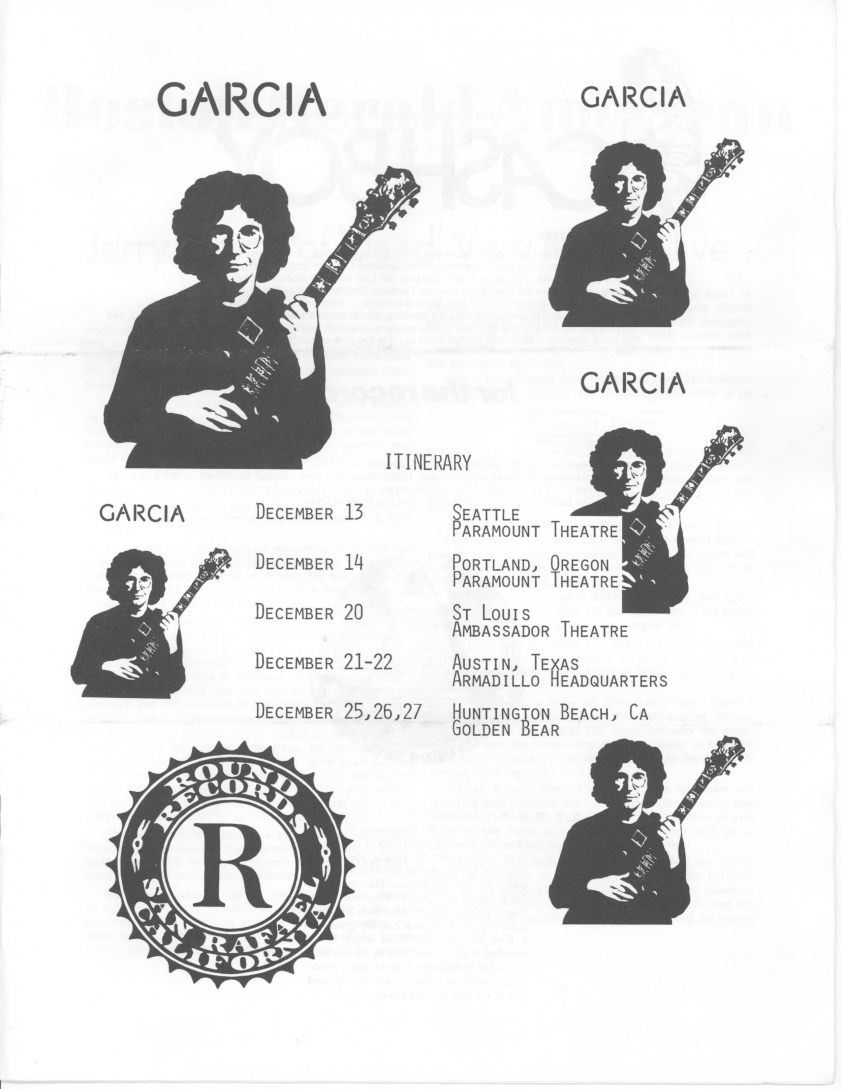
As it happens, this work also allows me to fill in a placeholder post I had been ignoring for awhile, centered on the following image:

Here we have an 8.5" x 11" promotional handbill listing some upcoming Jerry and Merl gigs in various cities in December 1974. I know there is a copy of this in Santa Cruz ("Business: RX-102 - Compliments of Garcia," Grateful Dead Archive, Special Collections, UC Santa Cruz, MS.332.ser. 2, box 17, folder 10), and I know this image is not from there. First, this one seems to have a crease, that one doesn't. Second, they don't allow posting of scans from the collection - a requirement which I respect and I think others do as well. I was about 99% sure I got this from GDAO, but I cannot find it there. So I can't recall how I came into this it. Anyway, I saw it in the GD Archive, and loved it, then found a copy out in the wild which I could reproduce.

Why do I love this?

First, because I love the music this band made. Go get thee to Garcia Live: Volume Three: December 14-15, 1974, Northwest Tour, Legion of Mary (ATO Records, 2013) if you want to hear why.

Second, who doesn't love beardless Jerry?

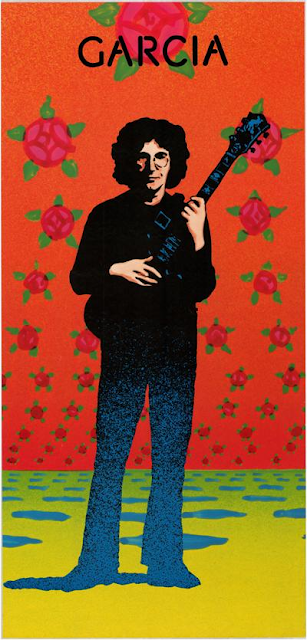
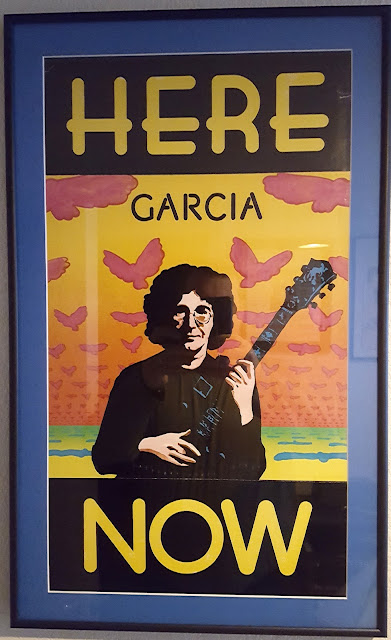
Third, this particular image of beardless Jerry was drawn by Victor Moscoso for the cover of Jerry's second record, Garcia (by which I mean it was his second record, and his second record with that very title), which we all know as Compliments (Round Records, RX-102, June 1974) and I have the very tall, full color poster of the album art at the framer's, and I can't wait to get that sucker up on the wall. It's a beaut.

Fourth, the handbill promotes JGMS gigs --note, still no public use of the moniker Legion of Mary known to me before January 1975-- at the Paramount Northwest in Seattle on December 13, 1974, at the Paramount in Portland on December 14, 1974, at the Ambassador in St. Louis on December 20, 1974, two nights at the Armadillo World Headquarters in Austin on December 21-22, 1974, and then three nights, December 25-27, 1974, at the Golden Bear in Huntington Beach.

Four-A, I love the Pacific Northwest. Four-B, these PNW theaters hosted some killer GD and Jerry over the years. Four-C, the Ambassador, a "landmark of rococo 1920s theater design"? Yes, please. Four-D, I have an original poster from the Armadillo gigs, and it is allegedly the very copy that was hung in the 'dillo lobby at the time of the show. So, there's that. Four-E, the Golden Bear - again, yes, please and thank you. We don't list capacity for it at JB - anyone know? Four-F, the Golden Bear hosted one of my favorite shows from the last eight months of the Garcia-Saunders band, 12/29/74b, partly because of the amazing tape pulled by "Flashback" Charlie Disalvo and partly because I want that version of "Expressway (To Your Heart)" to be my walk-off music as I leave behind my earthly existence. It KILLS.

Fifth, another one of my longtime favorite Garcia-Saunders shows, 12/15/74 in the EMU Ballroom at the University of Oregon, is *not* listed on this handbill, which gives me a sense that it was booked rather later than the others. Who cares? I kind of do, to tell you the truth.

But the BIG takeaway is, Six-A, that I don't know of any other Round promotions for live gigs. Jerry went to NYC on July 1-3, 1974, to play the Bottom Line just a few days after the record came out. The shows sold out in a minute without advertising, but, of course, the record company could also, y'know, have promoted the record. Same goes with the November '74 tour, Jerry and Merl and crew with Martin blowing and the great Paul Humphrey on the drums - no advertising needed for the gigs, but what about cross-promotion with the vinyl? (Yes, I know the record wasn't JGMS. But if we held strict to that, it'd rule out the hints we do have here of a tie between the record and these gigs.)

So, here we have the imagery from Moscoso's cover art, the same lettering on 'GARCIA', and the Round Records logo. But, - Six-B - there is no evidence of the record besides this. No title. No note that there even is a record. It doesn't say "buy the new record, and come see the show", or, "come see the show and, if you dig it, buy the record. Oh yeah - tell your friends!" Instead, we see allusions to Compliments, but no direct mention of it. The Jerry heads would already have recognized some of this, of course, but mostly because they probably already had the record or, as Jerryheads, didn't need to be marketed to buy tickets to see Jerry. Maybe your average head would go to the show, and Round man Steve Brown would ply them with the advertising cards, maybe a "Here Now" poster --already framed and on my wall--

or  some other schwag, so maybe that was the idea. Maybe Anton Round was signing autographs.

I guess it just seems like a little bit of a missed opportunity. Oh yeah, one last thing, in full-circle mode: those March '76 jaunts were almost certainly "behind" Jerry's third record, Reflections (Round Records, RX-107, February 1976) - maybe by then the tie-ins were being made more explicit. But, then again, that'd redound to the benefit of United Artists, since Round, as such, had gone belly-up. I wonder why?

Saturday, January 15, 2022

If ACT = JGMS and Taper = Louis Falanga, and YYMM = 7402, does XX = 17?

I recently wrote that

in engaging any Garcia event, I first want to pin down the who, the where, and the what. So I want the sociometric, geometric, and the chronometric particulars ... If I can pin down those three pieces about any given event with reasonable certainty, I feel like it "exists" in a way I can work with.

That has presented some challenges, as some events we know happen, but that don't have crisp metadata (especially the date, truthfully) sort of elude my understanding. I have tried to do the best I can with "placeholders" and such, but this kind of chronometric fuzziness really makes me itchy. Whatever - that's just how some stuff is.

Recently, two folks asked me about the fileset preserved as shnid-8654, a Louis Falanga (supposedly also Bob Menke) tape of Garcia-Saunders that was only labeled "February 1974". Two people asking me within a day or so tells me it was being discussed online somewhere. Anyway, these queries led me to revisit the fileset, which I haven't listened to in probably 15 and maybe as many as 20 years. I don't have huge love for early '74 Garcia-Saunders relative to later in the year, but I really, truly enjoyed revisiting this stuff. Let me draw especial attention to the 27-minute "He Ain't Give You None". I noted it

is absolutely stunning. God, what an overlooked masterpiece! It starts off slow and deep, Billy makes it hop a little in like the 7 minute mark while Jerry plays it clean. It finds some quiet passages, some spacy bits, hot passages (late 19-22 really driving). In 25 it almost sounds like 'Sitting In Limbo'. An amazing piece of musicianship all around, an incredible version --earliest one known-- of this tune.

I really mean it. Go check this fucker out.

But, enough about the music. What about the metadata? :)

I am going to suggest that we should assign this material the date of 2/17/74, not because that date is true, but because it might as well be. I don't have much to go on, but here is my logic.

1) Louis taped 1/17-18/74, and the datings of those tapes got confused over the years, such that 1/18/74 circulated as if it were a three-set show. So, consecutive shows that end up in confusing labeling.

2) I listened to both the 2/16/74 Falanga tape and the 2/xx/74 Falanga tape (both noted below) in close succession, including a side-by-side comparison of "Money Honey", which appears on both, and the room-and-crowd sound of each. The tapes are quite different, with 2/16 much sharper and cleaner. But it does sound like the same room to me, for whatever that's worth. (2/16/74 still has the second guitarist and conguero we can hear on the board tape, natch.)

3) Louis and Bob were known to hit the Great American Music Hall, and Jerry and Merl did play it on 2/5/74 and 2/12/74. We have complete board tape of the former from Ed Perlstein's master reel (thank you, Ed!). Go check it out and tell us [nick | JGMF] how to make sense of the two saxes one can periodically hear. The latter does not circulate, and we lack setlist for the first set. The 2/xx material could well be from this gig. But, see #2 above. We don't have enough tape for me to be confident that this is NOT the Music Hall, instead of Keystone, but there's nothing to suggest that it is.

4) There is also 2/7/74 at the Keystone, but we seem to have enough of a setlist that, if this stuff really is from one night, it's not from that one.

5) [contra] The GD Archives had a bunch of 2/74 material, including money reckonings, including notes on how the take from 2/16/74 was divvied up among band and crew, and also the 2/9/74 Rheem Theater contract. There was no evidence from 2/17 whatsoever. (I don't recall any from any of the other shows, though, either.) So the dog didn't not bark where it might have.

When I put all of this together, I conclude that we might as well call this stuff 2/17/74, unless and until new shit comes to light. Thoughts?

Listening notes for 2/16/74 and "2/17/74" below the fold.

LN jg1974-02-16.jgms.all-2.aud-falanga.8063.shn2flac
LN jg1974-02-xx.jgms.partial.aud-falanga.8654.shn2flac

Monday, March 15, 2021

Upon Further Review: Various and Sundry Listening Notes on the Last Night of the Fall '83 Tour: JGB at Wilkins Theatre, Kean College, December 13, 1983

LN jg1983-12-13.jgb.early.aud-newberger-seaweed.133469.flac1644
LN jg1983-12-13.jgb.early-late.aud-minches.31253.flac1644
LN jg1983-12-13.jgb.early-late.aud-newberger.77710.flac1644
LN jg1983-12-13.jgb.late.aud-nak300.151810.flac2496


I first heard 12/13/83 in 2003, when Andrew Faintych sent me tapes from both shows recorded with Senn 421s from the 10th row by "Tom from Avon, NJ". In 2005, Bu lent me his DAT of an unattributed aud, and minches and I did our transferring and lossless thing as shnid-31253. shnid-77710 came around in 2006, and I think I listened to it in 2009. shnid-133469 came by in 2015, and I must have listened to it because I have timings, although I have no performance notes. Most recently came 151810 of the late show. It's a sign of my generalized appreciation for this show and tour that I have spun all of these, while countless hundreds of filesets, and probably a dozen or more from this very tour, sit unheard.

Given that weird batch of data, I thought I'd post all my listening notes, and present some extractions, maybe with rough datings, going in performance order. The listening notes comes last, the extractions of comments through the performance are in the middle, and the executive summary comes first.

1. What do we learn from this?

Probably not that much.

I am consistent in timing the blast-off of the early set Deal around 3:45 in, and I also note how it finds an open space at the end which I think is quite uncommon. Now of course I want to listen to the rest of the tour to see. But it's cool and worth checking out.

The late show setlist draws my eye throughout time, but I may well find that the performance doesn't quite live up to it (though my 2009 self raved).

One version of me called the late show "Catfish John" an all-timer, though others didn't bother to make a single note. Similarly, on the most recent listen I found the TUIB pretty compelling, but not so much on earlier listens (to other filesets). 2021 me also raved about the Rhapsody In Red from the Nak 300s, while others did not. The Don't Let Go gets similar notations re the vocal-instrumental doubling around 4 minutes in, and two mes also noted the sweet transition into Mid Moon. 2021 me made the particular note that DLG never returned to the song. On current thinking, that seems exceptionally rare. When did Garcia leave a song unfinished like that outside the Dead? Update: 12/4/83b DLG > Deal segue may be another case, need to double-check if DLG reprises.

2. Note Extractions

A. 1983-12-13 [Tue] Early Wilkins Theatre, Kean College, Union, NJ

2005:  Great setlists (especially the late show), and really terrific performances.  The vocals are a little rough, but there is some sparkling late '83 guitar work here, lots of energy.

Mission In The Rain

2006: the start of MITR is very off sounding. What a weird sounding tape. Where is John Kahn? It's a little cringeworthy for me, as MITR could sometimes be - once he lost the fall 1975 voice with which he originally sang it, it took him years to find an arrangement that really worked - probably not until 1987. I am really enjoying the raindrop notes Garcia's painting on the ceiling of the room, and, 8:20 and a nice note 8:40. Some excellent liquid playing. It's much better to play than sing, sometimes. Melvin stepping up a little bit early 9. I need to check how long this has been instrumental, and how much lyric this covers. Great instrumental break! @ 9:51 "all the things I planned to do I only did halfway ... tomorrow will be Sunday born of rainy Saturday"

2006: wanna hear what Kemper can do for you? Check out 3:04-3:08 of this TLEO. He just does a great driving run to enthuse Melvin for his feature, which sounds fine. Sounds like his fast hard start to TWLWMYD, but in a totally different context. Great drumming, looking way ahead and navigating the whole band to the '1', everyone gets comfortable.

2006: my God you understand exactly why Garcia loves this song. He is giving this great Dylan a great treatment. Carefully phrasing himself. John takes a lead ca. 6:50. Still leading early 9, Garcia has been playing an ethereal bowing sound behind John, who's still fluttering around until Jerry takes over 9:56. That was maybe a little abrupt on poor ol' John, but Jerry has something to say. John is still doing his lead style through 10:30, so a very nice dual thing from them. Good for John not to take getting cut off lying down, but I, for one, vote that it's Jerry's turn. John had stayed very forward into early 11, by 11:30 he drops back into his normal STOF swing. I think that, overall, this is an excellent STOF.

2006: @ 3:55 this one had been dragging for me a little, then to trigger the frenzy, David Kemper just hammers down the drums and forces Jerry into action. Jerry snaps to a higher level, immediately dialing in some fuzz and juice. That piece right from late 3 over 4 is pretty smokin'. @ 5:13 Jerry writes a nice sentence, everyone is playing well. The drummer is a freaking MONSTER. Band is active but indistinct, perhaps recording or PA issue. Organ big and full in all of the spaces, painting in every contour. Jerry very high to frets 6:20. This Deal goes to a totally unique space 10 min mark, almost letting it breathe ... very rare for JGB to enter this space. They find the '1' and come back 10:50. John Kahn sounds lost, or is just not available. Not sure this is entirely successful, a little strange sounding. Unusual.

2009: found Deal hot, especially solo @3:45

Encore:


2009 found this hot

B. 1983-12-13 [Tue] Late Wilkins Theatre, Kean College, Union, NJ

2005:  Great setlists (especially the late show), and really terrific performances.  The vocals are a little rough, but there is some sparkling late '83 guitar work here, lots of energy.

Set 1:


2005: The late show Catfish John is an all-time version of that song, tight all the way through and then really cooking from about the 10-minute mark.

2021: s1t03 Someday Baby a big ol yikes on the vocal clam on the first "worry my mind". He slows down and girds himself for the second one and it's a little better.

2006: TUIB and this whole set, Jerry sounds a little tired to me. Kemper picks up the tempo 1:30ff. Pretty good TUIB.

2021: TUIB is on fiyah, notes flying all over the place, spraying around indiscriminately at moments, but with laser focus at others. Around 9:30 Jerry takes TUIB a little out! Whoa, this is pretty bonkers.

Set 2:

2005: The second set of the late show is maybe just a touch disappointing, but probably only because the setlist raises expectations so much.

2021: HUGE chordal approach 5ff. The ladies tried to sing the chorus and Garcia just bulldozed, now 5:47 doing that syncopated galloping. Loud. Screaming again 9:34. John sounding strong here, too.

2003: Jerry does some really cool sing-along with his guitar in the 4-minute mark, and the jam over to Midnight Moonlight is pretty nice

2021: DLG nice vocal-guitar doubling 4. Steps out into a mode at 4:53. Man I dug this DLG. Garcia just put his head down and played with total determination for like 8 straight minutes. Melvin did some nice chunky stuff relatively early on, everyone else did their thing, but this version just found Jerry having a lot to say, and saying it. And then, fascinating true segue to Mid Moon - he never did reprise DLG, which is very rare indeed.

Midnight Moonlight

2021: Mid Moon has an extra special galloping quality to signify not just the end of the show, but the end of the tour. I don't know if it's the fastest version ever, but it's done really fast.

Listening notes below the fold.

Saturday, August 03, 2019

Chronicle Pickings

Over the years, when I go to the Bay Area I try to make time to spin the Chronicle microfilm to check out the listings. Corry has done some of this as well, and I don't think he'll mind me aggregating a sense of what we have accomplished together.

It is relatively painstaking, of course, though after awhile you learn that the weekday entertainment stuff comes along after the classifieds (which you can train your eyes to detect moving by at fast speed), after the day's TV highlights. Enough hours of this, and you can spin it fast and land right where you want. I never did quite get the hang of the San Francisco Sunday Examiner and Chronicle in the same way, but now that it's been digitized that's no longer of any moment, and the overall progress is faster. That said, the SFE being digitized also decreases the marginal benefits of hitting the Chron.

Yesterday I did 10/16/68-12/31/68, and 3/16/69-5/31/69 (less 5/1-15/69, which I seem to have overlooked). This took almost exactly two hours. I didn't discover anything totally new in the Garciaverse. It's not that frustrating, it's what I expected given that the SFE and the SFC should have covered much of the same ground, especially with a name as big as Jerry's.

So, below I report what we have covered at some level (Corry mostly captured the Ad Libs in Gleason's columns, I have done those and the Datebook openings) and what we mare missing.

Caveat Lector:

  • The data are fragmentary in two senses. First, early years especially just snapshot Gleason's Ad Libs - no Datebooks etc. Second, for a time I was trying to get every day, with an eye toward the needs of future researchers (and realizing that it could all be surpassed if the paper is ever digitized, which I hope it is). But the last few visits I just can't justify it to myself. So I look at every listing, but I only capture it if something catches my eye. Unevenly, this can be the Fillmore Tuesday auditions, Matrix gigs, anyone who touches the Garciaverse, other weirdness that seems noteworthy. So even what we have might be quite incomplete when it comes to what other researchers might be looking for.
  • Also, I am basically comfortable stopping in the mid-to-late 70s. As the Garcia Band drifts into predictability and comfort, and our existing knowledge presumably becomes more complete, I have less inclination to search for needles in haystacks.


So, here is where we are with the Chronicle:

12/1/65-12/10/65DONE
12/11/65-7/31/66NEED
8/1/66-8/15/66DONE
8/16/66-9/30/66NEED
10/1/66-8/31/67DONE
9/1/67-12/31/67NEED
1/1/68-1/7/68DONE
1/8/68-2/28/68NEED
3/1/68-4/30/69DONE
5/1/69-5/15/69NEED
5/16/69-10/20/71DONE
10/21/71-12/31/71NEED
1/1/72-2/28/72DONE
3/1/72-5/31/72NEED
6/1/72-10/30/72DONE
10/31/72-12/20/72NEED
12/21/72-8/10/73HAVE
8/11/73-9/30/73NEED
10/1/73-10/10/73HAVE
10/11/73-4/26/74NEED
4/27/74-4/30/74HAVE
5/1/74-6/9/74NEED
6/10/74-6/14/74HAVE
6/15/74-7/31/74NEED
8/1/74-2/28/75HAVE
3/1/75-6/30/75NEED
7/1/75-8/31/75HAVE

Sunday, August 26, 2018

Examining the Examiner

The great sleuth David Davis of Grateful Seconds fame has alerted me to the fact that the SF Examiner has been digitized and is available through newspapers.com (pay to play, natch).

Mamma mia, what a treasure trove for someone like me. There will be a goodly number of shows new to The List reported on eventually, among many other things.

I am able to do in hours what would have taken me weeks of spinning microfilm to do, which could only have unfolded over years if it ever happened at all, presumably with a much lower error rate to boot. Ain't progress grand?

Now, if the Chron can show up, too, that'd help me even more. And if coverage from the Oakland Tribune and the Marin I-J could extend forward just a bit, that'd please me all the more. But, in general, I am feeling like I have pretty well covered the terrain, and there can't be that much more, in terms of advertised gigs, that we can be missing.

Anyway, thanks David!

p.s. Life becomes very busy again. Not that I have done much here this summer, but things are likely to be even slower until I finish a "real" (i.e., day job) book, and some other real work. But Fate Music will happen and be on shelves within two years, I hope!

Wednesday, January 03, 2018

The Hypothesis is Wrong - Long Live the Hypothesis!

update: I now have it on good authority that, indeed, the arrangements in the tour book are for the crew, while the band enjoyed a somewhat more upscale experience. So, the hypothesis is correct, I just don't have any parchment evidence for it.

update2: here is link to the whole tourbook as a pdf.

I spoke with Melvin some years ago for a half hour or so. He's a very sweet guy.

I came away with the impression that the late-era east coast Garcia Band tours were first-class affairs, staying in a nice Manhattan hotel and flying to and from shows one at a time from Teterboro. (NYT just had a good article on Teterboro, BTW.) It felt like quite a contrast from the bus-centered tour of late '83.

Well, a copy of the JGB's November 1993 tourbook came up on ebay, and while it was exorbitant, I justified the purchase by using a gift card for a chunk of it. (Our psychologies play all kinds of tricks to enable the consumption that makes markets tick.) I was especially interested in this because, rather ironically, I have had more access to 1970s era business materials than to materials from the 80s and 90s. Because one of my abiding interests in institutionalization, which, as any process, only takes over time, this is really problematic: I have the "before", but not so much on the "after". Beyond institutionalization, there's also the overall difference in Garcia's circumstances, lots more money sloshing around post-coma (post-In The Dark) than before, and I sort of assumed an aging and more affluent Garcia would have done exactly as Melvin gave me to believe - a little higher end hotel, a little higher end travel, etc.

So, when the tour book came, I opened it with alacrity, expecting to see mostly one Manhattan hotel, charters out of Teterboro, maybe even first class seats on the transcontinental pieces to start and end the tour.

Well, not so much. Though I haven't seen the '91 tour info, the '93 materials more or less falsify the hypothesis. My mind immediately went to the narrative I was planning - from straitened circumstances on the bus in '83 to the lap of luxury ten years later. I was crestfallen. For all of about a thirty seconds. And then my mind immediately spun a new narrative - that things hadn't changed that much, and wasn't that cool? That the Garcia Band remained a pretty simple, stripped down affair, even as the money got bigger and bigger. He wasn't playing boutique theaters and sweaty college gyms anywhere, but Madison Square Garden and various other five-figure-capacity sheds, but things were still pretty straightforward.

I can make that work, of course. It's interesting, too. But I was just struck by what anybody who knows a lick about human cognition knows, which is that we are storytellers, and we can pretty much always find a narrative to fit any set of facts.

Anyway, that was all I had to say about that.

Oh, no, actually, one more thing: maybe the tourbook is only, or mostly, crew info. update: yes, that is indeed the case. So the Marriots and Embassy Suites, and the sometimes several-hundred mile drives right after shows ended, were maybe only for the grunts. Maybe Jerry and the band did fly around. I'll have to ask around.

Thursday, December 28, 2017

Placeholder Dates

Some time back, you all convinced me that I should track placeholder dates, and I agreed that it would be helpful in all kinds of ways. But I confess that, not having systematically tracked all of this, it would be a truly massive pile of work to try to reconstruct it all.

Does anyone have a starter list? Barring that, I guess I'll try to use comments here to drop breadcrumbs, and I'll invite you all to do the same, if you care to.

Thursday, May 25, 2017

Garciaverse Event Typology

So, the unit of analysis in my basic framework is an "event", defined as GD (musical), JG (musical), or nonmusical. My method can only pick up events assignable to one or several 24-hour-or-less slices of time. So, something that happened May 25 can be picked up as an event, but something that happened "in late May" cannot.

Based on the rich discussion around my Provisional List of Jerry Garcia's Sit-Ins with Other Musicians (JG-GUEST), here's how I currently think of things.
The top layer is the whole Garciaverse.

The second layer is the type of event: GD (musical), JG (musical), or nonmusical. JG is any non-GD musical event.

The third layer is sociological, and it cuts along conceptions of my own regarding what a band is (a standard personnel configuration), and those asymmetric situations in which one is either hosting others or being their guest. By "unnamed" I mean merely that this is a musical event with Garcia in which no-one can "claim" the gig.

On my readers' suggestions, in lieu of "Sit-Ins" (or JG-GUEST), I am being asked to report the entire JG category. If I could color code and that sort of thing, might be helpful.

Saturday, May 13, 2017

Black Roots about Native Americans?

I am thinking about Native American musical influences on Garcia.

As far as I can tell, they are mediated by whites: Hank Williams's "Kaw-Liga," Bill Monroe's "Cheyenne,"Peter Rowan's "Land Of The Navajo" (which the latter inspired).

Is there any black traditional music with Native American narrative or musical themes? Like, any old banjo tunes about the Seminoles?

Some notes on classifying Garciaverse Musics

In narrating Jerry Garcia's Musical Life Outside The Grateful Dead, I think in terms of the various musics he played.

One cut is geographic: 1) world vs. 2) American.

In terms of musics he directly quasi-publicly performed, The World is mostly only reggae and Indian music (e.g., Diga). He got some stuff from Canada, but it was either Americana (e.g., The Band) or pan-white pop (e.g., Bruce Cockburn's "Waiting For A Miracle") - not what I'd call "Canadian music".

Everything else from The World comes to Garcia pre-mediated through America.

Within the second bucket, I want to distinguish a) indigenous music (Hawaiian, Native American) from b) music made by non-indigenous peoples.

As noted above, Native American music came to Garcia pre-mediated by whites. When he played "Native American", he was playing white renderings of that music. I am guessing he jammed around at Hart's with Rolling Thunder and others -- I wonder if there are calendars, diaries, tapes?? --, but it falls sort of short of my fuzzy event threshold ("musics he directly quasi-publicly performed").

It seems like the same is likely true of the other indigenous American music that Garcia engaged, Hawaiian.  Let me put it another way: he directly heard Hawaiian music (grandmother Tillie loved it - McNally 2015, 36), but in playing pedal steel guitar he was playing what white people were doing, inspired by the islanders' music. So it doesn't get the full-on music font.

b) is the set of musics that get the special font and the central real estate in my table on Garciaverse musics.

Tuesday, December 22, 2015

Geocoding

I have been busy geocoding my Garciavents. Since I do this stuff by hand, it's rather laborious. But I am excited about the possbilities the work will create! With Clio and Geo (so to speak), animated maps should be a snap.

Friday, June 05, 2015

Independent Voices

http://voices.revealdigital.com/voices

Independent Voices: An Open Access Collection of An Alternative Press

I signed up, click browse, did a search on "Grateful Dead" and ... wow ... check it out. Lots of results. I do not see a way to access the scans, and a subcription link gets me nowhere.

If you are interested in that stuff and have the means, I am sure throwing a few bucks their way, or more than a few --there are plenty of affluent former hippies, if Berkeley and Boulder are any indication, just to mention a few of the B's-- maybe you can see what they need and write a check. I look forward to having all of this amazing cultural material scanned and available, decades of reading to do!

Thursday, June 04, 2015

Institutions and Paper Trails

Formal institutions, "with their explicit mandates, methods of operation, and extensive paper trails, provide the more ready means for tracking and marking change, as evidence drawn from noninstitutional settings must often rely more heavily on interpretation and conjecture" (Orren and Skowronek 2004, 25; see also p. 79).