I don't know where this would have taken place, but the date of June 2, 1983 seems right, in between shows at the venerable Roseland Ballroom on 52nd Street and promoter John Scher's main room, the Capitol Theatre in Passaic outside of Philly.
I have gotten direct quotes on the Garcia-on-the-side (GOTS) material, and sketchily paraphrased the GD history and other stuff. The man was just so brimming with energy. Check him out around 7 minutes in to part one, talking about the amazing creativity and peculiar genius of so many Deadheads. Good stuff.
update: if you want verbatim, you can copy it from ... the published transcript. D'oh!
! ref: Blackwood, Nina. 1983. Jerry Garcia: Interviewed for MTV. Relix 10, 4 (August): 16-20.
Showing posts with label why. Show all posts
Showing posts with label why. Show all posts
Tuesday, November 26, 2019


Monday, January 18, 2016
Bill Cooper Interviews Jerry Garcia, May 1982
Here's a nice companion piece that really resonates with "Bob Coburn Interviews Jerry Garcia, November 8, 1982".
My notes/transcriptions are little sketchy, but here's what jumps out to me.
On Run for the Roses, with some anti-marketing:
More on anti-marketing: "I’ll be coming east, and I’ll be promoting the album more or less incidentally, but not … I don’t really do the straight show biz formula, where you put out a record and then do a promotional tour"
Because of the priority of the GD over JG: "my solo career is not my primary thing. The GD is really the thing that I’m primarily involved in. My solo career is kind of like, it has to get what it can get. So, when time and space allow the opportunity, then I go out with whatever’s comfortable."
On the acoustic shows of the period:
Interesting contrast with how he'd feel about the GD nine years later: The Dead “hasn’t really affected my life in any negative way, to tell you the truth. It’s been really … It doesn’t impinge. I don’t feel in any way fettered or anything." 0955
Why? “Playing is my life. That’s what I want to do. If anything, I would play more. … It’s what I love to do. Personally, I can’t get enough of it.”
Listening notes, with other interesting tidbits, below the fold.
My notes/transcriptions are little sketchy, but here's what jumps out to me.
On Run for the Roses, with some anti-marketing:
I’ve been working on it for quite a long time. I’ve had to squeeze it in amongst and between lots of other projects. It’s been the project with the least [sic] priority of the things I’ve been working on, so I strung out the actual work on it over three years, which creates certain problems.” Does some work, comes back six months later, and thinks critically “I would just as soon do all of this over.” This project is one of those things that’s so far from what I originally started …On John Kahn: "All of the things that you hear of that are called the Jerry Garcia Band are, in reality, the John Kahn and Jerry Garcia Band” … simpatico, “with just enough difference to make it interesting”. That first line echoes something that Corry has said repeatedly - well done!
...
Select tunes, discarded them, I haven’t been working on it steadily. I’ve been working on it in an extremely fragmentary fashion. But it’s interesting for that, too. It hasn’t worked to the disadvantage of the music. On some levels it’s nice to be able to have the luxury to deal with something over a long period of time because your sense of perspective sometimes improves … So the record is pretty nice. … Because the tracks all come from different times and places … well, actually, they’re all from the same place, pretty much, but … that adds a certain textural variety to it which is, I think, OK. It has quite a range, from things that have an acoustic flavor, to … I have one thing that’s got a big massive horn piece, a big section of highly arranged sort of things. It has a lot of range as far as emotional content as well. To me that’s a nice quality for an album to have.
More on anti-marketing: "I’ll be coming east, and I’ll be promoting the album more or less incidentally, but not … I don’t really do the straight show biz formula, where you put out a record and then do a promotional tour"
Because of the priority of the GD over JG: "my solo career is not my primary thing. The GD is really the thing that I’m primarily involved in. My solo career is kind of like, it has to get what it can get. So, when time and space allow the opportunity, then I go out with whatever’s comfortable."
On the acoustic shows of the period:
I’ll also be doin’ some things that are solo concerts, just me and my friend John Kahn. 0550 I did a couple of them recently on the east coast, one at the Capitol Theatre and one at … [can’t remember the Beacon] the format was that the one at the Capital played all by myself, just me and my acoustic guitar. That’s a little too stark for me. I like the thing of having one other musician, at least. The bass gives me a little bit more room. But I had such a good time, and it’s something I’ve done very little. I’ve never really been a solo performer before. 0640 It’s something that’s exciting for me, and it’s challenging, and it’s also a chance to play around with acoustic guitar, which I’ve been doing at home a lot, but it hasn’t been my primary ... 0655 It’s really quite different from electric guitar, and so this is a chance to push off in that direction
Interesting contrast with how he'd feel about the GD nine years later: The Dead “hasn’t really affected my life in any negative way, to tell you the truth. It’s been really … It doesn’t impinge. I don’t feel in any way fettered or anything." 0955
Why? “Playing is my life. That’s what I want to do. If anything, I would play more. … It’s what I love to do. Personally, I can’t get enough of it.”
Listening notes, with other interesting tidbits, below the fold.
Friday, January 08, 2016
Reading Notes: Henke 1991
I wasn't paying attention at the time, but my sense is that these September 1991 interviews (I think there might have been some separate remarks in the Boston Globe) caused a good deal of consternation in Deadlandia - and why not? The golden-egg-laying-goose sounds like he'd love to leave the reservation at this point.
Lots of good stuff here.
Lots of good stuff here.
Henke, James. 1991. The Rolling Stone Interview: Jerry
Garcia. Rolling Stone, October 31,
34-40, 103, 106, 108.
Two September 1991 afternoons, hotel room overlooking
Central Park.
July 1991 was release of JG DG, August 1991 was release of
double live JGB. Meantime, JGB was a stone-cold junkie, waiting in line for
methadone like everyone else.
“solo jaunts are often more entertaining than his work with
the Dead, and one gets the feeling that if he felt he could
easily extricate himself from the Dead and his attendant responsibilities, he
might just do it. Still, when pressed, Garcia claimed the Dead take
precedence. … We’ve all put so much of our lives into it by
now that it’s too late to do anything drastic” (Henke 1991, 37).
Two separate interview sessions September 1991 NYC. In a
family way with Manasha and Keelin.
“recent” meeting in which Garcia told the other band members
that he wasn’t having fun anymore, that he wasn’t
enjoying playing with the Dead. Garcia confirms this. “The band is the board of
directors, and we have regular meetings with our lawyers and our accountants.
And we’ve got it done to where it only takes about three or four hours, about
every three weeks. But anyway, the last couple of times, I’ve been there
screaming ‘Hey, you guys!’ Because there are times when you go onstage and it’s
just plain hard to do, and you start to wonder, ‘Well, why the fuck
are we doing this if it’s so hard?’”
“We’ve been running on
inertia for quite a long time. I mean, insofar as we have a huge
overhead, and we have a lot of people that we’re responsible for, who work for
us and so forth, we’re reluctant to do anything [38] to disturb that. We don’t
want to take people’s livelihoods away. But it’s us out there, you know. And in
order to keep doing it, it has to be fun” (Henke 1991, 37-38).
“we’re … going to have to construct
new enthusiasm for ourselves, because we’re getting a little burned out. We’re
a little crisp around the edges” (Henke 1991, 38).
They are trying to work up to taking a long break, a la
1974, “aiming for six months off the road” (Henke 1991, 38).
p. 38 Gar talks about how he dislikes trying to write songs.
“It’s like pulling teeth.”
They saw Brent’s death coming. “About six or eight months
earlier, he OD’d and had to go to the hospital, and they just saved his ass. …
I think there was a situation coming up where he was going to have to go to
jail. He was going to have to spend like three weeks in jail, for driving under
the influence or one of those things, and it’s like he was willing to die just
to avoid that. Brent was not a real happy person. And he wasn’t like a total
drug person. He was the kind of guy that went out [39] occasionally and binged.
And that’s probably what killed him” (Henke 1991, 38-39).
Getting older, people dying. Rick Griffin just died. “[F]or
me at this point, I’m just happy if someone dies with a minimum of pain and
horror” (Henke 1991, 39).
“I’m not a religious person” (Henke 1991, 39).
“The Grateful Dead is not
where you’re going to find comfort. In fact, if anything, you’ll
catch a lot of shit. And if you don’t get it from the band, you’ll get it from
the roadies. They’re merciless. They’ll just gnaw you like a dog. They’ll tear
your flesh off. They can be extremely painful” (Henke 1991, 39). Note that one
word from Garcia could have put a stop to that, but he didn’t roll that way.
“Brent had a deeply self-destructive [40] streak.” (Henke
1991, 39-40). Talks about Brent lacking in culture.
“My life would be miserable
if I didn’t have those little chunks of Dylan Thomas and T.S. Eliot”
(Henke 1991, 40).
#drugs “I’ve been round and round with the drug thing.
People are always wanting me to take a stand on drugs, and I can’t. To me, it’s
so relativistic, and it’s also very personal. A person’s relationship to drugs
is like their relationship to sex. … For me, in my life, all kinds of drugs
have been useful to me, and they have also definitely been a hindrance to me.
So, as far as I’m concerned, the results are not in. Psychedelics
showed me a whole other universe, hundreds and millions of universes. So that
was an incredibly positive experience” (Henke 1991, 40).
Still dabble with mushrooms: “It’s one of those things where
every once in a while you want to blow out the pipes. For me, I just like to
know they’re available, just because I don’t think there’s anything else in
life apart from a near-death experience that shows you how extensive the mind
is” (Henke 1991, 40).
“as far as the drugs that are dead-enders, like cocaine and
heroin and so forth, if you could figure out how to do them without being
strung out on them, or without having them completely dominate your personality
… I mean, if drugs are making your decisions for you, they’re
no fucking good. I can say that unequivocally. If you’re far enough into
whatever your drug of choice is, then you are a slave to the drug, and the drug
isn’t doing you any good” (Henke 1991, 40).
“I’m an addictive-personality kind of person. … with drugs, the danger is that they run you. Your soul isn’t your own.
That’s the drug problem on a personal level” (Henke 1991, 40).
Says he was doing H on and off for 8 years.
Hard to quit H, but real problem now is smokes, that last
thing left. “My friends won’t let me take drugs anymore, and I don’t want to
scare people anymore. Plus, I definitely have no interest in being an addict”
(Henke 1991, 40).
“I still have that desire to change my consciousness, and in
the last four years I’ve gotten real seriously into scuba diving.” Also gives
him some physical exertion (Henke 1991, 40).
With Keelin “I have a little more time to actually be a
father. My other daughters have all been very good to me, insofar as they've
never blamed me for my absentee parenting. And it was tough for them, really,
because during the sixties and seventies, I was gone all the time. But they've
all grown up to be pretty decent people, and they still like me. We still talk.
But I never did get to spend a lot of time with them." (Henke 1991, 40).
Garcia got together with Heather (daughter of Jerry and Sara
Katz) for 18 or 19 years at one point (Henke 1991, 103).
At this point, JG and MG are in the process of getting
divorced. “She’s real glad to get rid of me. We had a great time, a nice life
together, but we went past it. … We haven’t really lived together since the
70s” (Henke 1991, 103).
Joe died when Gar was 5. Joe played clarinet and other
woodwinds, in a big ol 40 piece jazz orchestra. “My father’s sister says he was
in a movie, some early talkie.” (Henke 1991, 103).
“I remember him playing me to sleep at night. I just barely
remember the sound of it” (Henke 1991, 103).
Jerry watched Joe go under and drown. “It was horrible. I
was just a little kid, and I didn’t really understand what was going on, but
then, of course, my life changed. “ (Henke 1991, 103).
Ruth was an RN, but after Joe died she took over his bar.
“He had this little bar right next door to the Sailor’s Union of the Pacific,
the merchant marine’s union, right at First and Harrison, in San Francisco. It
was a daytime bar, a working guy’s bar, so I grew up with all these guys who
were sailors. They went out and sailed to the Far East and the Persian Gulf,
the Philippines and all that, and they would come and hang out in the bar all
day long and talk to me when I was a kid. It was great fun for me. I mean,
that’s my background. I grew up in a bar. And that was back in the days when
the Orient was still the Orient, and it hadn’t been completely Americanized
yet. They’d bring back all these weird things. Like one guy had the world’s
largest collection of [106] photographs of square riggers” (Henke 1991, 103,
106).
His third grade teacher Miss Simon hipped him to the
possibility of being a creative type. “’You mean you can spend all day painting
pictures? Wow! What a great piece of news’.” (Henke 1991, 106).
Dwight Johnson was another teacher, “he’s the guy that
turned me into a freak” (Henke 1991, 106). He was a motor cycle guy, 7th grade
teacher.
Talks about liking Dylan songs:
“they speak to me emotionally on some level. Sometimes, I don’t even know why.
Like that song, Señor. There’s something creepy about that song, but it’s very
satisfying in a weird sort of way” (Henke 1991, 106). “This is talking about a
kind of desperation that everybody experiences” (Henke 1991, 108). Songs-S
More fun outside the Dead. “that’s always
dangling in front of me, the thing of, well, shit, if I was on my own, God, I
could … “ (Henke 1991, 108).
“Bruce, Branford, Rob
Wasserman and I have talked about putting something together. I had
this notion of putting together a band that had no material, that just got
onstage and blew. And maybe one of these days we’ll make that happen” (Henke
1991, 108). Him saying this is the verbal equivalent of gazing forlornly out
Grisman's picture window.
Garcia listens to Django, Art Tatum, Charlie Parker,
Coltrane. “Michael Hedges is great. And my personal favorite lately is this guy
Frank Gambale, who’s been playing with Chick Corea for the past couple of
years” (Henke 1991, 108).
“Living Colour is a great band … Jane’s Addiction is another
band I like” (Henke 1991, 108).
“I feel like I’m a hundred
million years old” (Henke 1991, 108).
Why kids keep coming to see the Dead: “There must be a
dearth of fun out there in America. Or adventure. Maybe that’s it, maybe we’re
just one of the last adventures in America” (Henke 1991, 108).
Tuesday, November 24, 2015
Reading Notes: Signpost to a New Space and Stoned Sunday Rap
These are "reading notes" - little stuff I cull when I read. I copy and paste the quotes into thematic documents (e.g., drugs.docx), so all of this has been "processed" out of the book, and up one level, into thematic or other kinds of buckets.
You may not find the quotes of greatest interest to you. Obviously I am doing this for my own purposes.
You may not find the quotes of greatest interest to you. Obviously I am doing this for my own purposes.
Saturday, July 25, 2015
"A Shitty Father"
The title of this post comes from Garcia daughter Annabelle's remarks at his funeral on 8/11/95, probably not said in anger, almost certainly considerably true.
I don't recall Jerry speaking so frankly about this issue as here, ca. July 1981:
p.s. in looking up Annabelle's remarks, I have found three versions quoted:
I don't recall Jerry speaking so frankly about this issue as here, ca. July 1981:
I have a family – I am talking about the woman I used to live with, and my kids—and I visit them. They certainly mean something to me, but they are not the focus of my life, and they know it. It’s been hard for me to come to grips with some of this, because these are people that I care about … Music is my life. There's nothing I love more than music.Van Matre, Lynn. 1981. Jerry Garcia Keeps the Spirit of the Grateful Dead Alive. Chicago Tribune, July 5, p. D11.
p.s. in looking up Annabelle's remarks, I have found three versions quoted:
- "he was a shitty father, but a great man" (McNally 2002, 614)
- "a great American but a shitty father" (Gans 2010, 331 )
- "he may have been a genius, but he was a shitty father" (Edmondson 2009, 100)
Sunday, June 28, 2015
Reading Notes: Dupree 1974
 |
| Zoo World, January 31, 1974. "Cover photo captured by Mario Algaze the afternoon of a Leas Campbell presentation of the Grateful Dead at Curtis Hixon Hall in Tampa, Fla.", December 18 or 19, 1973. |
 |
| A clean-shaven Jerry Garcia in Tampa, Florida, December 18 or 19, 1973. Photograph by Mario Algaze, published in Zoo World, January 31, 1974, p. 12. |
Dupree, Tom. 1974. Grateful Dead: Hipper Than the Average
Corporation. Zoo World, January 31,
pp. 12-13.
The pictures are from Tampa. As the Thoughts On The Dead guy might say, Billy looks like he wants to
The article draws from December 12th in Atlanta, meetings and interviews with band members, a few expost reax to the show. As the title implies, the main topic of discussion is Grateful Dead Records, and business matters (this appears to have been an industry paper based in Nashville, I should probably know that).
p. 12
booking firm: Out Of Town Tours
Dead inspired travel agency Fly By Night
"Garcia's country group Old And In The Way"
Sparky And The Ass-Bites From Hell
Weir interview
Meeting in the Regency Hyatt House Hotel, not where band is
staying. Bob is there to sightsee the tony hotel's glass elevator, architectural
emanation of American opulence, on the side of a newspaper interview downtown. Pull-quote paints picture of a wine-snobby Bobby, which is partly true but
pretty unfair for a guy who has worked hard for fifty years despite probably
sitting on a pile of family money (the Atherton house he grew up in alone would
make quite an inheritance). In his seventies as I type this, tonight he's playing the second night of GD50 in Santa Clara.
Weir: the hippie thing was a good time, but we've moved on.
Record company: "the Dead organization picked a network
of conventional distribution firms" to get the Wake of the Flood into the stores.
p. 13
Rock Scully is current road manager – when did Cutler leave
the road?
Weir says they have reduced
their risk by having a less diversified portfolio than most record
companies. They don't have to pay for the 6 or 7 Donnie and the Doughnuts
records that lose money. They have just the 1 GD record, which they have some
idea can sell. "Any fears about the company's success in its initial
stages have been quieted: the album is about to go gold, with RIAA
certification expected to come in January, just about two months after
release" (Dupree 1974, 13).
"The Dead organization … is hoping the LP will provide capital
to bolster and expand other aspects of its operation" (Dupree 1974, 13).
Interesting – note that at this early stage, no mention of Round Records, Round
Reels, etc. I want to triangulate to when we get the first mention of the Round stable of shell corporations.
Ever the anti-businessmen, Rock and others say the album
kind of sucks! (Dupree 1974, 13).
"I like it," Garcia says of Wake of the Flood. "I thought the material was very good. And
there's no question that we were rushed on it. We did that to ourselves,
really, by leaving ourselves too short off time. But, considering, I think it
turned out pretty well" (12/12/73, Dupree 1974, 13).
JG: "Phonograph records are misleading … First of all,
there's an artificial start and stop, the physical dimensions of an album. …
There's only, what, 22 minutes to an album side, and our thoughts are much
longer than that" (12/12/73, Dupree 1974, 13).
Odd moment 12/12/73 Garcia to say they now like big rooms
because of the WOS: "If we couldn't get off in them, we wouldn't play big
halls. But now we understand them about as well as we understood theaters when
we were playing them" (Dupree 1974, 13).
Rock 12/12/73 says the band will take five days off, play
the Florida gigs, then take a month or two off. "That's the whole band I'm
talking about. Garcia has never taken a moment off since he picked up his first
guitar. He is playing somewhere every night" (Dupree 1974, 13).
Keith speaks! 4th column, p. 13 "I'm sure
there are a lot of relatively honest ways of calling attention to yourself, as
long as it's not hype. We are not in a position to be ripped off. We can't
afford yet to give $3,000 to a local distributor and then have him forge
newspaper receipts on us. Where we're at right now is, we have people on the
inside we can trust. Now we're trying to find the people on the outside that we
can feel the same way about. But with this operation, we're gonna be honest if
we have to beat some ass."
"Or take it in the ass," Weir says. "We've
done both. We just are trying to take some of the sleaze out of it, and say
that things should be done in an above-board manner or not at all."
At the end of the interview, Keith "Godchaux drags on
his cigarette, then leans over purposefully: 'I'm not averse to hustling,
either'" (12/12/73, Dupree 1974, 13).
Saturday, February 28, 2015
Clio's Garcia
"More and different" pithily summarizes what Garcia was pursuing in his Side Trips relative to what he got out of the Grateful Dead. Here are a few snapshots of some over-time trends I find illuminating.
 "More": this is a calendar view of Garcia's out of state tours with the Dead (pink) and his side bands (green), which thus also indicates time he was mostly in the Bay Area (there are a few SoCal trips not captured in any of these three categories). He always endeavored to fill these spaces with hometown gigs.
 Pretty self-explanatory. This is my gig count as of two weeks ago, always subject to change.
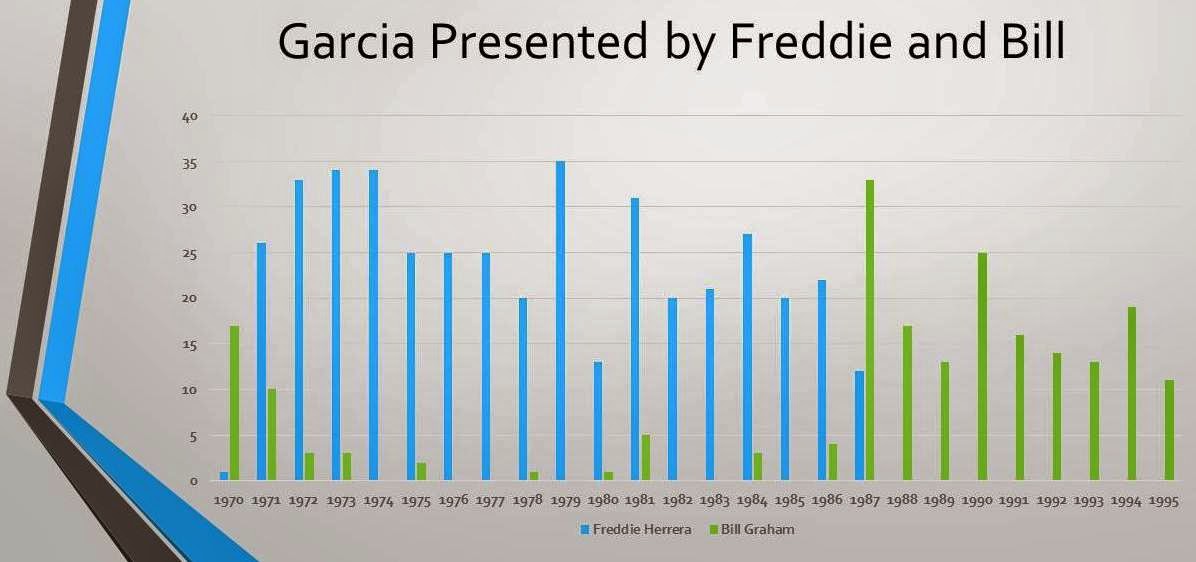
 Here are a couple of time series that I find depressing. The first shows Garcia gigs promoted by Fred Herrera (Keystone Korner, New Monk/Keystone Berkeley, Keystone Palo Alto, The Stone) and by Bill Graham over the years. In mid-1987 Garcia's 16+ year business relationship with Freddie comes to an end, wholly supplanted by Bill Graham. The second shows the decline of college gigs (Dead and Garcia), just a little color.
The next (last) one is another depressing one, showing the ebb and flow of Garcia's engagements with other artists (non-Dead, non-Garcia) over time both live and in the studio. Note the giant hole that forms as the opiates take hold during the 1975-1985 decade.

The next (last) one is another depressing one, showing the ebb and flow of Garcia's engagements with other artists (non-Dead, non-Garcia) over time both live and in the studio. Note the giant hole that forms as the opiates take hold during the 1975-1985 decade.
Monday, September 01, 2014

Tuesday, July 01, 2014
Garcia Talks Locally, Fall 1972
Staska, Kathie, and George Mangrum. 1972. Rock Talk by KG:
Jerry Garcia discusses Grateful Dead, albums. Hayward Daily Review, October 12, 1972, p. 42.
It's a marvel to study Garcia interviews over the years in all kinds of ways. The man could talk as knowledgeably, engagingly, expansively, and articulately as he played the guitar, which is really quite something.
By way of preface, let me note the out-of-town selection bias exhibited by published interviews - locals barely bothered, but journalists in every burg across the country wanted to write Garcia up when he or the Dead came to town. This has all kinds of observable implications. One I'd note in passing is that it reinforces Garcia's remarkable ability to find an oral formulation that worked, and to stick with it,when it came to the inevitable stock questions about the Acid Tests, all that. He spoke to lots of people he didn't know - good to have a rap ready. Out-of-town stuff is probably also more tied up in commercialization than most local chats, a record to promote or, more likely, just trying to sell out the local basketball shed. It's not good or bad, but to me it's worth remembering that for a lot of what we read Garcia saying, he's on the road talking to people who aren't from where he's from. We get something of Garcia's self projection, from the outside looking in.
Local interviews for lots of periods were more rare. Corry often notes that most media just weren't that interested, a lot of the time. For many years (e.g., probably the second half of the 70s and the first half of the 80s) you'd only write up Garcia for a really slow news day.
This interview seems to have the commercial pretext of promoting the Dead's forthcoming Europe '72. This gives way to a small, slightly grainy, but interesting snapshot of the local context of Jerry Garcia, fall 1972. Among other things, he seems accidentally anti-commercial.
First, about the column. Kathie Staska and George Mangrum ran the amazing "Rock Talk by KG" column in the Hayward Daily Review throughout the 1970s in an unlikely passage from school paper to legit townie news. Hayward is an East Bay town between Oakland and Fremont, a crossroads (I580 and I880 join up, and Mission Blvd. starts running south all the way to Mission San Jose). It's surely a real property-rich spot nowadays, but I have it as "generic East Bay" in the 1970s. Anyway, good little town, and from this spot K and G reported on the Bay Area music surrounding Garcia when he wasn't on the road. They did a great job not just with San Francisco but also with the Berkeley roots music places (Mandrake's, New Orleans House, Longbranch Saloon) forgotten joints like the Bodega down in Campbell, the Marin clubs, all of it. Nice mix of touring acts, one-offs, and local favorites. In short: this is a great local music news column for a guy like me.
Anyway, here are a few shutterclicks.
Garcia Had A Lot of Album Credits in This Period
KG: It sounds like every album we pick up has your name on it. It would seem that you spend quite a bit of time on other people's albums.Fogerty Record
Garcia: It's just an illusion. I don't actually spend that much of my life doing it. Each one of those albums represents about two days in the studio, maybe less, sometimes more. It doesn't represent that much ... accumulated time.
KG: One of the latest examples of this is on the new Tom Fogerty album.Goodness, I wish he had taken the bait. He sounds rushed. I don't think he's on record anywhere about Tom Fogerty. But here's a chance for him to sell some vinyl - that's why they're together, I presume - and he sort of whiffs. Silly, anti-commercial man. On the other hand, this is a great GOTS quote: "a chance for me to play different styles than I normally play".
JG: It has [sic] a chance for me to play different styles than I normally play.
August 1972 BCT Dead Shows
The Dead played a four-of-five night run August 21-22 and 24-25 at the Berkeley Community Theatre, selling it out (I think?) for Bill Graham and finding some utterly transcendent moments, as during a hellfiring "The Other One" on the second night. I don't think I have ever met a Deadhead who doesn't love these shows.
Garcia, not so much.
KG: How did your last concert in the area (Berkeley) go for you?Two thoughts.
JG: The four days at the Berkeley Community Theatre weren't our best performances. They could have been a lot better in my opinion. We haven't done a good show around here for quite awhile. Generally speaking, when we play here it's during our off season because when we're touring, we're usually touring the rest of the country.
When we've been working is when we're best. When we did the Berkeley show [sic] we hadn't been playing in quite awhile. It was more of a warmup for us for going out on the road.
First, huh. I think he's too hard on himself. If ever there was proof of the proposition that Jerry often articulated, that the Grateful Dead experience was totally subjective, this might be it. Anyway, de gustibus and all that. I hope he at least liked Veneta!
Second, I guess this is the piece that frames in the local vs. the road thing for me. Nothing earth-shattering, but an interesting perspective, and one that resonates . It has often been said that, for many years, the Dead played their best shows on the east coast. There's something to this, the people are different, sure, but also the energy of the road, that diesel taste of airline fuel in your nose, the zing. Home is home, if you're lucky.
Sunday, March 16, 2014
March 23, 1975 - Jerry Garcia Interview
I don't know who the interviewer is, nor the radio station from which this particular recorded. It is the first track of shnid-126296. This is the interview Jerry gave before the SNACK Benefit at Kezar Stadium. Sounds like reading the newspapers around the time of the show will prove interesting, mismanagement of budgets by bureaucrats probably a recurring theme. I can't talk about that now.
Instead, just a few quick thoughts, with link to audio and my reasonably full transcription below the fold.
1. Why Side Trips?
One of the theses I'll address in the book is that Garcia's side projects were about more and different live gigging, relative to what he could get with the GD. It ain't earth-shattering to posit the primitives of quantity and quality of course. But the evolution over time is very interesting, how he interpreted and put into practice, these desiderata, is really rich. Indeed, it's what Fate Music will be about, how Garcia navigated his life beyond the Grateful Dead. It's a nontrivial problem, and his solutions tell us a lot about him and, certainly for me, sheds light on the human condition, on how each and all of us must navigate our own lives "beyond the Grateful Dead".
On the quantity side, history's arc bends pretty straightforwardly: until mid-1975, "more" meant "all the time". As time went on, it would this would diminish and become highly routinized, mostly through the Jerry Garcia Band. He'd play a weekend or two at a regular local haunt (the Keystone Family of venues until 1987, the Warfield after that, a weekend or two every few months, with the occasional off-weekend show thrown in. West coast trips to SoCal and up to the Pacific Northwest. Maybe an East Coast tour, eventually only in the fall.
A simple chart of the number of GOTS gigs over the years will nicely illustrate the point, but I don't want to go generate one right now. Soon enough.
The quality calculus, i.e., the evolving meaning and practice of "different" on The Side, moves, over the years, from challenge to comfort. The cut-point is 12/31/75-1/1/76. Prior to that point, the side projects involved more challenge than comfort. After that point, the curves cross and comfort starts trumping challenge.
I say all of this because there's a nice Q&A here on where Garcia's head was it, with respect to all of this, on March 23, 1975.
There's a great little Fate Music line here, too, where he talks about OAITW (@01:46)
I like this for the Fate Music theme of these things coming together by happenstance. But this little synopsis also speaks to the process of institutionalization. It starts off a lark and ends up a job. That's one feature of the arc of Garcia on The Side that's essential to keep in mind.
3. GD and Side Trips
One of the key issues that I spend a lot of time thinking about (since my subtitle is Jerry Garcia's Musical Life Outside the Grateful Dead) is how the side stuff and the GD interact. Here, Garcia is asked whether being so busy with side stuff undermines the Dead. His answer (@02:22): "No, I don’t think so. I think it adds to it, just in terms of that each thing stays fresh if you’re not doin’ it all the time. You come back to it with new ideas and new influences and stuff like that.
4. Record Companies
The interviewer asks Garcia to evaluate whether the record companies were a good idea, in retrospect. This is really informative: in his mind, they were dead by 3/23/75. Here's Jerry's reply (@0427):
5. Film Company
Round Reels, the film company, remains almost totally opaque to me. Garcia mentions it here as if it's a relatively recent innovation. He mentions The Movie and also the company's involvement with what would become, in 1983 (!) Hells Angels Forever [imdb].
6. The First Pirates' Ball, JGMS, 9/5/73, S.S. Bay Belle, NYC Harbor
In that connection, he paints a great picture of the first Pirates' Ball show (for the second, see my post on 9/15/76), September 5, 1973 (@0540). There was one
"That's part of the reason we stopped performing, was an effort to pursue completely new ideas and shake loose the past, in terms of musical … stuff" (@0742, discussing the "Blues For Allah" stuff they're going to play in just a few minutes)
Anyway, loved this interview. Not sure if it has been transcribed before, but, anyway, here it is.
Instead, just a few quick thoughts, with link to audio and my reasonably full transcription below the fold.
1. Why Side Trips?
One of the theses I'll address in the book is that Garcia's side projects were about more and different live gigging, relative to what he could get with the GD. It ain't earth-shattering to posit the primitives of quantity and quality of course. But the evolution over time is very interesting, how he interpreted and put into practice, these desiderata, is really rich. Indeed, it's what Fate Music will be about, how Garcia navigated his life beyond the Grateful Dead. It's a nontrivial problem, and his solutions tell us a lot about him and, certainly for me, sheds light on the human condition, on how each and all of us must navigate our own lives "beyond the Grateful Dead".
On the quantity side, history's arc bends pretty straightforwardly: until mid-1975, "more" meant "all the time". As time went on, it would this would diminish and become highly routinized, mostly through the Jerry Garcia Band. He'd play a weekend or two at a regular local haunt (the Keystone Family of venues until 1987, the Warfield after that, a weekend or two every few months, with the occasional off-weekend show thrown in. West coast trips to SoCal and up to the Pacific Northwest. Maybe an East Coast tour, eventually only in the fall.
A simple chart of the number of GOTS gigs over the years will nicely illustrate the point, but I don't want to go generate one right now. Soon enough.
The quality calculus, i.e., the evolving meaning and practice of "different" on The Side, moves, over the years, from challenge to comfort. The cut-point is 12/31/75-1/1/76. Prior to that point, the side projects involved more challenge than comfort. After that point, the curves cross and comfort starts trumping challenge.
I say all of this because there's a nice Q&A here on where Garcia's head was it, with respect to all of this, on March 23, 1975.
2. Fate Music0018 interviewer You're an incredible guy, because with all the history of the GD and the all the musical avenues that the Dead has explored, you also work with Merl Saunders and the bluegrass thing OAITW… do you find that that is what you need to keep stretching musically?0044 Well it’s just that I have a lot of different interests, and any one thing might not take up … If I have space … for example, when the Grateful Dead were touring, there would be times when we would be on the road for two weeks, three weeks, and then off the road for two or three weeks. During that two or three week interim period, I’d usually want to play some, y’know, play music somehow. And, obviously the Grateful Dead can’t go out and play in clubs, without causing some sort of amazing commotion … and so I started taking up my time about four or five years ago jamming, just jamming, on Monday nights at the Matrix, and started playing with Howard Wales and them, and later Merl, and John Kahn played bass and stuff like that. But it started to be a more or less regular thing, and I just got into feeling that, ‘yeah, when I’m not workin’, if I’m not on the road or touring or something like that, there’s still a lot of room for me to play and cha … and reach, y’know, out to a, … in a learning sort of situation and all that.
There's a great little Fate Music line here, too, where he talks about OAITW (@01:46)
Bluegrass music is something that’s a little different. It’s something I’ve always loved. And mainly with bluegrass music, you sort of have to wait for an opportunity to present itself, where there are musicians around that understand the music and play it really well .. and Old And In The Way was a result of that sort of coincidence, where suddenly there was [sic] three or four of us around who knew the music and who enjoyed playin’ it. So we started loosely, just getting together and playing for fun, and then got to be more serious about it as time went on. But really those things sort of happen accidentally in a way.
I like this for the Fate Music theme of these things coming together by happenstance. But this little synopsis also speaks to the process of institutionalization. It starts off a lark and ends up a job. That's one feature of the arc of Garcia on The Side that's essential to keep in mind.
3. GD and Side Trips
One of the key issues that I spend a lot of time thinking about (since my subtitle is Jerry Garcia's Musical Life Outside the Grateful Dead) is how the side stuff and the GD interact. Here, Garcia is asked whether being so busy with side stuff undermines the Dead. His answer (@02:22): "No, I don’t think so. I think it adds to it, just in terms of that each thing stays fresh if you’re not doin’ it all the time. You come back to it with new ideas and new influences and stuff like that.
4. Record Companies
The interviewer asks Garcia to evaluate whether the record companies were a good idea, in retrospect. This is really informative: in his mind, they were dead by 3/23/75. Here's Jerry's reply (@0427):
Well, yeah. I think so. Certainly in our heads I think it was a good idea. It hasn't been the world's most outrageously successful endeavor, but that's not the focus, either. Again, that hasn't been the focus. Now that we're in the midst of a bone-crushing economic slump, and all the rest of that stuff, our, we're scuffling just like everybody else is, basically.
5. Film Company
Round Reels, the film company, remains almost totally opaque to me. Garcia mentions it here as if it's a relatively recent innovation. He mentions The Movie and also the company's involvement with what would become, in 1983 (!) Hells Angels Forever [imdb].
6. The First Pirates' Ball, JGMS, 9/5/73, S.S. Bay Belle, NYC Harbor
In that connection, he paints a great picture of the first Pirates' Ball show (for the second, see my post on 9/15/76), September 5, 1973 (@0540). There was one
time that Merl and I and Bill Kreutzmann and John Kahn played for the Hells Angels, for one of their parties, where they rented sort of a ferry boat … the kind that go around Manhattan, y'know? They rented a ferry boat and they had this blowout for all these Hells Angels. They came from all over the United States, plus all kinds of New York weirdos and stuff like that. We played on this boat, on the top deck of the boat, underneath the Brooklyn Bridge, and went around the island a few times. The Jolly Roger was flying, y'know? And we played out by the Statue of Liberty with all these crazy Hells Angels and all this stuff. And they were filming it from all over, from perspective points like the tops of buildings, in New York, looking down those long canyons, and you could see this ferry boat go by with the Jolly Roger and that kind of stuff. There's a lot of really … there's a lot of arresting … striking visual stuff in the movie.7. Hiatus
"That's part of the reason we stopped performing, was an effort to pursue completely new ideas and shake loose the past, in terms of musical … stuff" (@0742, discussing the "Blues For Allah" stuff they're going to play in just a few minutes)
Anyway, loved this interview. Not sure if it has been transcribed before, but, anyway, here it is.
Subscribe to:
Posts (Atom)