Showing posts with label Ron Rakow. Show all posts

Sunday, March 13, 2022

On Tours and Marketing Records

Over at Jerrybase, we have begun grouping events not only by "runs" (consecutive nights at the same venue), but also "tours". It turns out that the notion of a tour isn't quite as crystal clear as one might want it. I wanted it to be at least three out of town gigs in at least two rooms on a single outbound from San Francisco, but, especially in the Garciaverse, this ends up creating some "tours" that lack face validity as such.

Consider Jerry's March-April 1976. The decision rule above would produce the following "tours" that month:

1) Pacific Northwest (Eugene, Portland, Seattle), March 3-6 (3 cities, 3 shows in 4 nights)

2) Midwest College Towns (Evanston, Oberlin, Columbus), March 12-14 (3 cities, 5 shows in 3 nights)

3) Texas (Houston and Austin), March 18-21 (2 cities, 6 shows in 4 nights)

4) the "real" Spring Tour, March 26 - April 5th (9 cities, 13 shows in 11 nights)

My Jerrybase partners have suggested that's a little too granular, and I don't disagree. While they fit the operational definition I offered above, they lack verisimilitude. We'd welcome you to peruse Jerrybase's Tours Page to see what you think.

UPDATE 20220625: correspondent Matt Grady informs that musicians call this little not-quite-a-tour jaunts "runouts" - the perfect word! I am a big fan of words, and when they effectively classify a group of things that would otherwise leave me wordless, well, I like them even more. And, thank you Matt!

As it happens, this work also allows me to fill in a placeholder post I had been ignoring for awhile, centered on the following image:
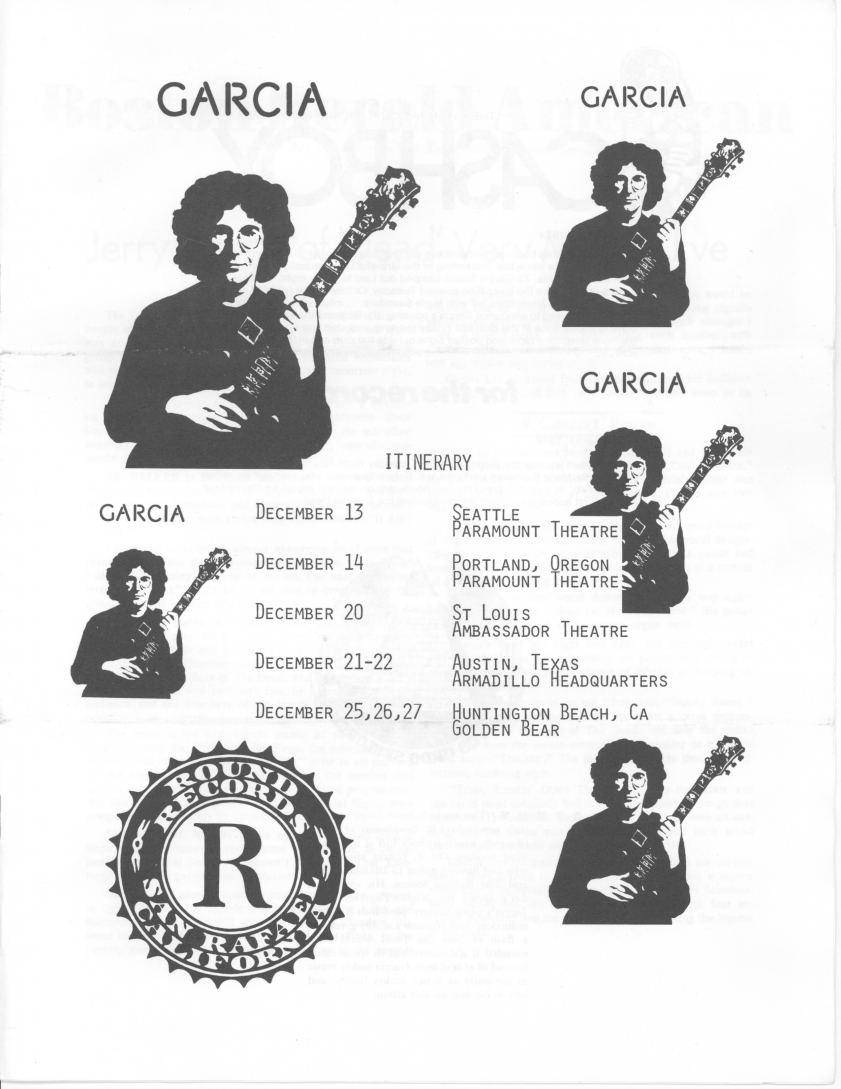
Here we have an 8.5" x 11" promotional handbill listing some upcoming Jerry and Merl gigs in various cities in December 1974. I know there is a copy of this in Santa Cruz ("Business: RX-102 - Compliments of Garcia," Grateful Dead Archive, Special Collections, UC Santa Cruz, MS.332.ser. 2, box 17, folder 10), and I know this image is not from there. First, this one seems to have a crease, that one doesn't. Second, they don't allow posting of scans from the collection - a requirement which I respect and I think others do as well. I was about 99% sure I got this from GDAO, but I cannot find it there. So I can't recall how I came into this it. Anyway, I saw it in the GD Archive, and loved it, then found a copy out in the wild which I could reproduce.

Why do I love this?

First, because I love the music this band made. Go get thee to Garcia Live: Volume Three: December 14-15, 1974, Northwest Tour, Legion of Mary (ATO Records, 2013) if you want to hear why.

Second, who doesn't love beardless Jerry?

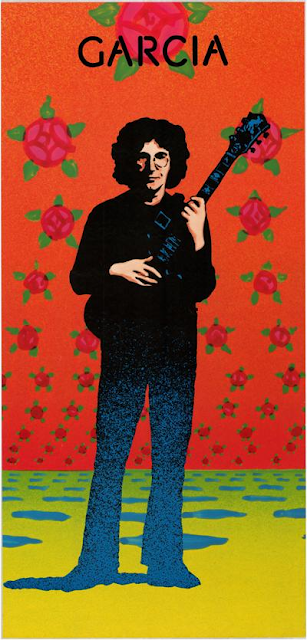
Third, this particular image of beardless Jerry was drawn by Victor Moscoso for the cover of Jerry's second record, Garcia (by which I mean it was his second record, and his second record with that very title), which we all know as Compliments (Round Records, RX-102, June 1974) and I have the very tall, full color poster of the album art at the framer's, and I can't wait to get that sucker up on the wall. It's a beaut.
Fourth, the handbill promotes JGMS gigs --note, still no public use of the moniker Legion of Mary known to me before January 1975-- at the Paramount Northwest in Seattle on December 13, 1974, at the Paramount in Portland on December 14, 1974, at the Ambassador in St. Louis on December 20, 1974, two nights at the Armadillo World Headquarters in Austin on December 21-22, 1974, and then three nights, December 25-27, 1974, at the Golden Bear in Huntington Beach.

Four-A, I love the Pacific Northwest. Four-B, these PNW theaters hosted some killer GD and Jerry over the years. Four-C, the Ambassador, a "landmark of rococo 1920s theater design"? Yes, please. Four-D, I have an original poster from the Armadillo gigs, and it is allegedly the very copy that was hung in the 'dillo lobby at the time of the show. So, there's that. Four-E, the Golden Bear - again, yes, please and thank you. We don't list capacity for it at JB - anyone know? Four-F, the Golden Bear hosted one of my favorite shows from the last eight months of the Garcia-Saunders band, 12/29/74b, partly because of the amazing tape pulled by "Flashback" Charlie Disalvo and partly because I want that version of "Expressway (To Your Heart)" to be my walk-off music as I leave behind my earthly existence. It KILLS.

Fifth, another one of my longtime favorite Garcia-Saunders shows, 12/15/74 in the EMU Ballroom at the University of Oregon, is *not* listed on this handbill, which gives me a sense that it was booked rather later than the others. Who cares? I kind of do, to tell you the truth.

But the BIG takeaway is, Six-A, that I don't know of any other Round promotions for live gigs. Jerry went to NYC on July 1-3, 1974, to play the Bottom Line just a few days after the record came out. The shows sold out in a minute without advertising, but, of course, the record company could also, y'know, have promoted the record. Same goes with the November '74 tour, Jerry and Merl and crew with Martin blowing and the great Paul Humphrey on the drums - no advertising needed for the gigs, but what about cross-promotion with the vinyl? (Yes, I know the record wasn't JGMS. But if we held strict to that, it'd rule out the hints we do have here of a tie between the record and these gigs.)

So, here we have the imagery from Moscoso's cover art, the same lettering on 'GARCIA', and the Round Records logo. But, - Six-B - there is no evidence of the record besides this. No title. No note that there even is a record. It doesn't say "buy the new record, and come see the show", or, "come see the show and, if you dig it, buy the record. Oh yeah - tell your friends!" Instead, we see allusions to Compliments, but no direct mention of it. The Jerry heads would already have recognized some of this, of course, but mostly because they probably already had the record or, as Jerryheads, didn't need to be marketed to buy tickets to see Jerry. Maybe your average head would go to the show, and Round man Steve Brown would ply them with the advertising cards, maybe a "Here Now" poster --already framed and on my wall--
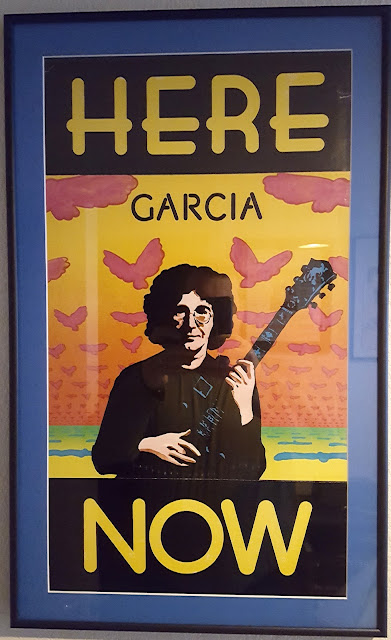
or  some other schwag, so maybe that was the idea. Maybe Anton Round was signing autographs.

I guess it just seems like a little bit of a missed opportunity. Oh yeah, one last thing, in full-circle mode: those March '76 jaunts were almost certainly "behind" Jerry's third record, Reflections (Round Records, RX-107, February 1976) - maybe by then the tie-ins were being made more explicit. But, then again, that'd redound to the benefit of United Artists, since Round, as such, had gone belly-up. I wonder why?

Sunday, December 02, 2018

Round Reels, Incorporated August 1, 1974


Round Reels is the company Ron Rakow created for film projects, not least the Grateful Dead Movie. As with many of Rakow's business activities, it's really hard to find any solid information about the company. So when the corporate stamp came up for auction over the summer, I was very excited to see it! This image was associated with the auction, but I guess the seal was pulled under threat of legal action, or at least in light of legal questions.

August 1, 1974. Happy Birthday, Jerry! I have always held that Garcia made the decision to Hiatus right in this time frame, August 1974. I imagine that The Movie, and thus Round Reels, was bound up with the Hiatus. If that's right, then the decision would have been at least a little bit before August. It could have been even earlier, but I don't think so. Thoughts?

Monday, August 10, 2015

On lead guitar and vocals, Mr. Jerry Garcia


Bill Graham:

Good evening. We welcome you, on behalf of the group. We should introduce ... We should thank United Artists and Mr. Ron Rakow. I should make it official. Mr. Rakow is the President of Round Records. He asked if I could be here this evening, and I said 'I'd like twelve dollars and fifty cents', which he paid me at the door, and we flipped double or nothing, and I won, and he wanted to flip again, so I'm being paid fifty dollars for being here. I want to thank him very much.

On the piano we have Mr. Keith Godchaux [electric piano] ... on the drums, on stage left, Mr. Mickey Hart [drums begin] ... on bass and vocals, Mr. Philip Lesh [bah-doomp-bah-doomp bah-doohhhom] ... on rhythm guitar and vocals, Mr. Bob Weir [Bob filligrees a little top knot] ... on the drums on stage right, Mr. Bill Kreutzmann [tss-ts-tss, tss-ts-tss] ... on the vocals Mrs. Donna Jean Godchaux ... on lead guitar and vocals, Mr. Jerry Garcia ... will you welcome, please, the Grateful Dead!

Update: Jesse Jarnow and I are on the same wavelength!

Sunday, June 28, 2015

Reading Notes: Dupree 1974


Zoo World, January 31, 1974. "Cover photo captured by Mario Algaze the afternoon of a Leas Campbell presentation of the Grateful Dead at Curtis Hixon Hall in Tampa, Fla.", December 18 or 19, 1973.

A clean-shaven Jerry Garcia in Tampa, Florida, December 18 or 19, 1973. Photograph by Mario Algaze, published in Zoo World, January 31, 1974, p. 12.

Dupree, Tom. 1974. Grateful Dead: Hipper Than the Average Corporation. Zoo World, January 31, pp. 12-13.

The pictures are from Tampa. As the Thoughts On The Dead guy might say, Billy looks like he wants to kick punch some dicks. Anyway, Donna Jean was back home giving birth, and the band played two kickass shows December 18-19, 1973, really great.

The article draws from December 12th in Atlanta, meetings and interviews with band members, a few expost reax to the show. As the title implies, the main topic of discussion is Grateful Dead Records, and business matters (this appears to have been an industry paper based in Nashville, I should probably know that).


p. 12

booking firm: Out Of Town Tours

Dead inspired travel agency Fly By Night

"Garcia's country group Old And In The Way"

Sparky And The Ass-Bites From Hell

Weir interview

Meeting in the Regency Hyatt House Hotel, not where band is staying. Bob is there to sightsee the tony hotel's glass elevator, architectural emanation of American opulence, on the side of a newspaper interview downtown. Pull-quote paints picture of a wine-snobby Bobby, which is partly true but pretty unfair for a guy who has worked hard for fifty years despite probably sitting on a pile of family money (the Atherton house he grew up in alone would make quite an inheritance). In his seventies as I type this, tonight he's playing the second night of GD50 in Santa Clara.

Weir: the hippie thing was a good time, but we've moved on.

Record company: "the Dead organization picked a network of conventional distribution firms" to get the Wake of the Flood into the stores.

p. 13

Rock Scully is current road manager – when did Cutler leave the road?

Weir says they have reduced their risk by having a less diversified portfolio than most record companies. They don't have to pay for the 6 or 7 Donnie and the Doughnuts records that lose money. They have just the 1 GD record, which they have some idea can sell. "Any fears about the company's success in its initial stages have been quieted: the album is about to go gold, with RIAA certification expected to come in January, just about two months after release" (Dupree 1974, 13).

"The Dead organization … is hoping the LP will provide capital to bolster and expand other aspects of its operation" (Dupree 1974, 13). Interesting – note that at this early stage, no mention of Round Records, Round Reels, etc. I want to triangulate to when we get the first mention of the Round stable of shell corporations.

Ever the anti-businessmen, Rock and others say the album kind of sucks! (Dupree 1974, 13).

"I like it," Garcia says of Wake of the Flood. "I thought the material was very good. And there's no question that we were rushed on it. We did that to ourselves, really, by leaving ourselves too short off time. But, considering, I think it turned out pretty well" (12/12/73, Dupree 1974, 13).

JG: "Phonograph records are misleading … First of all, there's an artificial start and stop, the physical dimensions of an album. … There's only, what, 22 minutes to an album side, and our thoughts are much longer than that" (12/12/73, Dupree 1974, 13).

Odd moment 12/12/73 Garcia to say they now like big rooms because of the WOS: "If we couldn't get off in them, we wouldn't play big halls. But now we understand them about as well as we understood theaters when we were playing them" (Dupree 1974, 13).

Rock 12/12/73 says the band will take five days off, play the Florida gigs, then take a month or two off. "That's the whole band I'm talking about. Garcia has never taken a moment off since he picked up his first guitar. He is playing somewhere every night" (Dupree 1974, 13).

Keith speaks! 4th column, p. 13 "I'm sure there are a lot of relatively honest ways of calling attention to yourself, as long as it's not hype. We are not in a position to be ripped off. We can't afford yet to give $3,000 to a local distributor and then have him forge newspaper receipts on us. Where we're at right now is, we have people on the inside we can trust. Now we're trying to find the people on the outside that we can feel the same way about. But with this operation, we're gonna be honest if we have to beat some ass."

"Or take it in the ass," Weir says. "We've done both. We just are trying to take some of the sleaze out of it, and say that things should be done in an above-board manner or not at all."

At the end of the interview, Keith "Godchaux drags on his cigarette, then leans over purposefully: 'I'm not averse to hustling, either'" (12/12/73, Dupree 1974, 13). 

Saturday, June 27, 2015

Ron Polte on the Demise of the Carousel

Bottom line:
A bunch of hippies, a bunch of good people, got together and refused to run a business. And, I'm sorry, you've got to live in that world if you're gonna run a business.
On Rakow, in particular:
What Ron Rakow did to those people, he chained them to a machine that couldn't make money. It wasn't free. And the energy of all those good people in that building wasn't going anywhere, It was being trapped. Because he chained them to a financial problem, which was $9,000 a month rent, plus 20%. They couldn't have made it in 25 million years, man.
And then when he was going down, and he was $66,000 in the hole and they were in danger of losing it, they ran to the community and said, "Let's get the community together, together we can save it." It was a bummer to lay on the community.
In front, had Ron Rakow been honest with himself about business, he would have said, "$9,000 a month is too fucking high. And if we can't get this dance hall for $5,000, let's not take it. But instead, he took it. So it just went down the tubes.
On Graham taking over:
The only reason that Bill Graham got that dance hall was because they gave it to him. He would not have taken that dance hall. Ask Ralph Gleason, Ron Rakow, Bill Thompson, Rock Scully ... They said, "If we can't score it by Wednesday, if we can't make any deal with the owner to come up with the eight grand or a new ballroom manager, and a new organization, then you're free to go do whatever you want on Thursday. And that's what he did.
Ideas for the future:
Let's get together, do a benefit or a festival, and rent two places like the Matrix for a year, one at the south end and one at the north end of the city. And hire a couple of people to manage those 2 or 3 hundred capacity rooms, and put the young bands in there. … We should do that. Right now, there's a lot of wounds to heal and everybody is tired after the Carousel, so it's gonna take a little while. But it should come to pass.
The festival idea would manifest as the ill-fated Wild West Festival. At the same time, the Matrix really did take up some of the slack left by the Carousel (the  Tuesday Night Jam morphed into the Monday Night Jam), and the Family Dog had the south end of town covered, albeit in a bigger room with the problems of rent and overhead and all that Polte identified as problematic for the prospective hip community musical operations. Indeed, Chet Helms never could make the Dog work, and he was out in less than a year.

REFERENCE:
Darlington, Sandy. 1968. Ron Polte: A Good Word for Bill Graham. San Francisco Express Times, July 31, 1968, p. 13.

Friday, May 15, 2015

Sole Star at Paul's Mall

For the JGMS gigs November 12-13-14, 1974, Paul's Mall in Boston, two shows a night booked by one Fred Taylor.
MERL SAUNDERS AND JERRY GARCIA CONTRACT RIDER

3. MERL SAUNDERS & JERRY GARCIA shall receive 100% sole star billing in any and all advertising and publicity, including marquee ...
Does this mean that things should be advertised "Merl Saunders & Jerry Garcia"? Because earlier I dragged this out:

Not sure what to make of it.
4. The name GRATEFUL DEAD or the association of JERRY GARCIA as a member of the GRATEFUL DEAD shall not be exploited or used in any manner in any and all advertising and publicity, including marquee and radio advertising.
This kind of provision would be standard fare for Garcia contracts for as long as there were such things, as far as I can tell. I wonder if Hal Kant drafted some stuff up that required this, or otherwise if there was any explicit understanding between Jerry and the members of the Dead that demanded this, or if Jerry alone insisted on it? I doubt Merl Saunders would have insisted, and the money was going straight to him (this was before Kahn became the business end of Garcia, Inc.) It does seem pretty clear that Phil Lesh and a few of the others insisted that Garcia shoulder the risk of his own endeavors with Pegleg Ron Rakow - and wisely so, though they ended up collectively losing hundreds of thousands anyway. Eliminating this provision would probably have generated more dollars, all told, so someone is paying the opportunity cost of not being able to say "Grateful Dead", but there's a there here that I can't quite pin down.

I also love the 14th paragraph of the band rider, back when Garcia couldn't get enough: " Band Rider, p. 2, para. 14: "Employer agrees that MERL SAUNDERS & JERRY GARCIA will be able to perform up to 120 minutes if they so desire". You go, guys.

see also: LN jg1974-11-13.jgms.late.aud-seaweed.121034.flac1644

Monday, March 03, 2014

Grateful Dead Three Ways: December 20, 1975

Selvin (1975c) reviewed the December 19, 1975 Winterland show billing Keith and Donna Godchaux, Kingfish, and the Jerry Garcia Band as "Grateful Dead Divided Three Ways". Hence, my title, even though I am working the crossings through the next night.

Since I have fallen down the rabbit hole of a long post on 10/17/75, and at the risk of dispersing comments and my own thoughts, I thought I could cut and run on a post on 12/20/75. Here are a few takeaways.

First, I don't recall many people talking much about these threeway shows as part of the GD's 1975 revenue model. The first one, 6/17/75, was a benefit, but 10/17/75 and these Winterland shows were intended to be fully paying gigs. I think the results on that score were mixed. For example, here's how it coulda looked for this big weekend:

Grateful Dead Three Ways: JGMF scenario for 12/19-20/75

Friday night would have been significantly undersold, and even Saturday not a sellout, on this scenario. And that notwithstanding the event being a cool happening for teens.


Second, contrary to my expectations, Nicky sounds pretty good, not too slurry. He plays Randy Newman's "Birmingham" for the only known time [JB], does a little "Jingle Bells" for the season, and generally plays well, IMO.

Third, this version of Let's Spend The Night Together -> Edward is top-shelf, grade A JGB #1. Check it out.

More notes, including stuff I didn't bring up top here, below the fold.

Thursday, November 25, 2010

Reading Notes: “Dead Awaken: New Albums, Label, Tour,” Rolling Stone 163 (June 20, 1974), p. 28.

“Dead Awaken: New Albums, Label, Tour,” Rolling Stone 163 (June 20, 1974), p. 28.

This unsigned, one-column thing datelined from San Rafael is chock full of tidbits. I'll just throw them out and comment on them ad seriatim.

Gives 5/24/74 release date for Rum Runners and Garcia [Compliments], 6/21 for GD’s Mars Hotel.

I have Compliments out on Friday 6/21/74 and Mars Hotel on 6/27,  but those dates are not reliably sourced. Anyone have good solid dates?

“’Round Records,’ said Ron Rakow, head of both labels, ‘is a separate entity. Grateful Dead Records was designed to distribute just Dead product. We did this for maximum safety for the Dead.’ In other words, minimum risk.”


So the GD forced Garcia to create Round for his solo projects? (See my post on Garcia and Round here.)  That is a *very* interesting angle. (And the possibility that a bunch of them might go on to sink the label with their non-selling "product" would not be without irony.) Makes me think ...
Rakow: “Even a Garcia album is more high-risk than a Grateful Dead record. Some of the Dead don’t want a risk. Garcia likes risks, likes worries, so he can always be on the edge.”

Same theme as above, but this is very interesting to me. One thing it shows is how committed Garcia was to the GD. Even though the GD couldn't exist without him, they felt strong (and perhaps ungenerous?) enough to get him to shoulder his own risk *in addition to* radically lessening their own (on the GD side). I originally wrote "with friends like these ...", but having slept on it I guess I understand. If everyone but Jerry thought Rakow was a snake, and that seems clearly to have been the case, then it seems they were ensuring risk against Rakow, not against Jerry. Probably wise.
“[Rakow:] ’When Garcia wanted to do his LP, he and I got together with Jon McIntyre [sic] (the Dead’s manager) and Anton Round, an old rich guy I don’t know much about.’ … And another label was born.”
Does anyone know anything about Anton Round? I just looked through McNally's LST and didn't see him, which is surprising given how comprehensive McNally is (through the hiatus, anyway). Might this have been either a nom de guerre of Rakow, like his criminal alter ego? Or maybe some sort of associate of Rakow?

Anyway, lots of random bits and pieces floating around ...

Saturday, July 24, 2010

Jerry Garcia and Round Records

(Parenthetically, the Grateful Dead Archives at UC Santa Cruz will eventually, hopefully, allow us to get a great close look at some of these hitherto opaque business/economic issues. Go, Nick, Go! But I pregress.)

I have just been eyeballing some articles that appeared in the amazing, incredible, Golden Road, edited by Blair Jackson and Regan McMahon. I think I just peeled the onion back to a really important issue to which I have, until now, paid too little attention, and that's the issue of Round Records (RR). I just want to make a brief comment here. Steve Brown had a great piece from the perspective of the GD Record company in the Summer 1986 issue (1) with the following tidbit.

Despite their reputation as a group of guys who liked to take risks, Rakow and the Dead decided that rather than jeopardize Grateful Dead Records, which was co-owned by all the voting members of the organization, they would create a second label to handle the more financially dubious solo projects members of the Dead were interested in pursuing. Thus was born Round Records, owned 50/50 by Garcia and Rakow.

IMO, Garcia owning RR 50/50 is very interesting, for at least three reasons.

First, I think it’s great evidence of the extent to which Garcia was the firmest (only?) supporter of Rakow in the group. As we know with hindsight, this was a devastatingly bad piece of character judgment on Jerry’s part. Neither his first nor his last, but certainly one of the most consequential.

Second, having his own finances tied directly to the fate of the record company might have given Jerry the incentive to put his own name on his band, eventually to professionalize it. As someone who has puzzled a lot over the question of why Garcia would put his name on his band, if he was after a bit of anonymous gigging –a premise almost certainly true of most of the early and some of the later GOTS stuff—this helps clarify the probable reason. No-one else’s records were going to make money, so he needed to make sure that at least his stuff did as well as possible, since that’s basically what would finance Round. Business drove the decision. How mundane, I know. But worth noting about a guy who tried and failed, as so many did, to live outside of all of that.

Third, it really speaks to how committed Jerry was to the other GD members, the Family, etc. He was not only subsidizing their solo projects (did anyone really think that Diga or Seastones or Keith and Donna would sell?), but also taking on disproportionate risk. While he had a tendency to leave women and side band members (except John Kahn) high and dry, Garcia jumped two feet in in committing to his GD bandmates (and, beyond the scope, John Kahn). True, they backed him with the Albatross of the Movie, but Jerry was pretty much carrying everyone and everything. We know this. Yet he is often condemned for irresponsibility (and often, to be sure, demonstrated it) in his personal relationships. Here's a thought: maybe carrying that many others is about as much as we might expect of anybody …

I know everyone knows all of this, but I thought I'd put it out there. And remind myself that I have a lot to learn about Round Records.

REFERENCE :
(1) Brown, Steve. 1986. If I Told You All That Went Down … A fond look back at Grateful Dead Records. Golden Road 11 (Summer): 21-27.