Showing posts with label compensation hypothesis. Show all posts

Sunday, February 27, 2022

Old old old notes: JGB at the Leroy Theatre, Pawtucket, RI, March 11, 1978

LN jg1978-03-11.jgb.all.aud-friend.97682.flac1644

I listened to this years ago, was just doing some housecleaning and thought I'd post.


Bullets:

Really nice tape. Piano sounds especially great .Thank you, Tim Friend! I note that it runs faster than the set II soundboard tape. I also noted that AF's ITAM patch from shnid-14931 (Tom Dalti aud) sounds pitched differently. Not sure which, if any, of these might be on A=440.

Third gig in three nights (whole tour was 11 11 eastern time zone shows in 11 days, March 9-19), poor ol' Jer's voice is already shot. It's not that surprising - the Dead's "laryngitis shows," with all Weir lead vocals, were only two months past, and he wasn't smoking fewer cigarettes nor, by all accounts, doing less blow or inhaling less burnt aluminum foil. He sometimes uses his rough edges to good effect, as when he growls in "Harder They Come" (HTC) about getting his share of what's his. But, this massively percussive band --Keith very loud, Kahn still a monster-- really calls for lots of vocal power, and Jerry just can't deliver the goods.

We do find the big, bad, cokey-Wolfy guitar chords throughout, plenty of power and burning tone. We find plenty of evidence in support of the "compensation hypothesis" --partly induced from the aforementioned laryngitis GD shows-- whereby vocals (and other) challenges drive good and aggressive guitar playing. In "I'll Take A Melody" here, for example, the whole band finds itself tripping over vocal timing, and I hear Garcia rip off an angry, aggressive-embarassed flurry, like he had to peel off that nervous extra skin he grew while the band was out of sync. Similarly, Jerry scrambles back from the brink of a near-unraveling in "Mystery Train" (MT) by picking some special  notes.

I love the ladies' harmonizing --I don't always-- on "Catfish John" here, and Jerry sings along with them, and it really reminds you of the beauty, that Donna has especially noted, that could happen when these people who love each other blend their voices. I need to find the quote of Donna talking about that -- feel free to point me to it! Buzzy sounds great on "That's What Love Will Make You Do", and I hear Kahn "dropping big artillery" in HTC and "rumbling like a motherfucker" in MT. I regularly criticize The Mule's playing after 1980, but in the 1970s the man played world-class electric bass.

"Rhapsody In Red" is one of my favorite Garciaverse tunes, and when it's great it absolutely slays me with some of the loudest and shreddiest rock'n'roll guitar Garcia would ever play. This version does deliver some screaming crazed fanning and other shreddy goodness, and Jerry puts feeling into the question of where playing the blues has led him, but overall I find this version a little ponderous, more in well than in top-shelf territory. So it goes. Crazy that I don't even mention "Lonesome And A Long Way From Home". So it goes.

Oh yeah, for real good fun, check out Dave Davis's writeup of this show and the prior night's Bob Weir Band gig in Provy at Grateful Seconds, Italian exchange student Gianni Rosati's endearing review in Relix, and the best-in-class Garcia Band interview by Andy Gefen from earlier on March 11th, which brings some interesting conversation but, especially, some great laughs. And who can't use more of those?

Jerry Garcia Band
Leroy Theatre
66 Broad Street
Pawtucket, RI 02860
March 11, 1978 (Saturday) - 7 PM
Tim Friend 145 minute audience recording

--set I (8 tracks, 79:02)--
s1t01. crowd and tuning [0:35]
s1t02. How Sweet It Is (To Be Loved By You) [7:17] [1:05]
s1t03. Catfish John [9:55] [1:22]
s1t04. That's What Love Will Make You Do [10:11] [1:38]
s1t05. I'll Take A Melody [15:15] [1:00]
s1t06. Harder They Come [12:45] [1:11]
s1t07. Gomorrah [6:10] [0:34]
s1t08. % Mystery Train [9:45] (1) [0:21]

--set II (7 tracks, 66:26)--
s2t01. crowd and tuning [1:02]
s2t02. Love In The Afternoon [11:30] [0:28] % [0:11]
s2t03. Rhapsody In Red [8:16] [1:58]
s2t04. Knockin' On Heaven's Door [12:39] [0:22]
s2t05. Tore Up Over You [8:11] [1:05]
s2t06. I'll Be With Thee [4:46] ->
s2t07. Lonesome And A Long Way From Home [14:42] (2) [1:17]

! ACT1: Jerry Garcia Band #4a
! Lineup: Jerry Garcia - el-g, vocals;
! Lineup: John Kahn - el-bass;
! Lineup: Buzz Buchanan - drums;
! Lineup: Keith Godchaux - piano;
! Lineup: Donna Jean Godchaux - vocals;
! Lineup: Maria Muldaur - vocals.

JGMF:

! Recording: symbols: % = recording discontinuity; / = clipped song; // = cut song; ... = fade in/out; # = truncated timing; [m:ss] = recorded event time. The recorded event time immediately after the song or item name is an attempt at getting the "real" time of the event. So, a timing of [m:ss] right after a song title is an attempt to say how long the song really was, as represented on this recording.

! Jerrybase: https://jerrybase.com/events/19780311-05

! db: http://etreedb.org/shn/14931 (Tom Dalti aud); http://etreedb.org/shn/97682 (goodbear various auds); http://etreedb.org/shn/97682 (Tim Friend aud, this source); http://etreedb.org/shn/135199 (s2 sbd AJL). NB the board tap runs a fair bit slower than this aud. I don't know which might be correct.

! map: https://goo.gl/maps/BspT8D8hQXT2

! JGBP: http://jerrygarciasbrokendownpalaces.blogspot.com/2012/05/leroy-theater-66-broad-street-pawtucket.html

! venue: http://cinematreasures.org/theaters/5639. "Pawtucket’s “Million Dollar Theater” opened May 1, 1923 to a packed house, with numerous celebrities in attendence. Designed by local architect John F. O'Malley, the theater featured a mirrored lobby, an electric chandelier with 4,700 bulbs, and the largest Wurlitzer organ in New England. ... After 55 continuous years as a movie and concert showplace, the Leroy was forced to close in 1978 due to fire code violations". So, the place closed within the year of Jerry playing there.

! band: JGB #4a (JGB #4 + Maria) (http://lostlivedead.blogspot.com/2012/01/jerry-garcia-band-personnel-1975-1995.html)

! historical / Sue: Promoter: John Scher. Co-promoter: Gemini Concerts (Provy). Sound check 4:30 p.m. $4,000 flat guarantee on gross potential of $17,424. Sell out. Garcia and crew were interviewed by Andy Gefen earlier in the day at WBRU-FM in Provy. It is a classic - check it out!

! review: [positive] Rosati 1978. Rosati was an Italian exchange student at Providence College in Spring 1978. He notes "no opening act for the Mystery Cats, who played twice as much music as the Weir Band [the night before, in Provy] over a span of more than four hours, which included a one-hour break in the middle of the set."

! see also: GratefulSeconds, "A Weekend in Rhode Island with Bobby's Band and Jerry's Band, March 10-11, 1978"

! R: field recordist: Tim Friend

! R: field recording location: Fifth row orchestra, left center section

! R: field recording equipment: 1x AKG D200E (mono) > Sony TC-153SD (Maxell UD-XLII 90's, no Dolby).

! R: Transfer: MAC > Nakamichi DR-8 (with no Dolby) > Edirol FA-66 > Wavelab > R8Brain > CD-Wave > TLH > FLAC 1644 by Andrew F. 02/2009.

! R: JGMF rename to sets (replace 'd' with 's' in filename), plus tagging in foobar2000.

! R: This tape is nice. The piano is especially well-mic'd, but the bass, drums and vocals are all very nice. I bet the acoustics in this place were very good. Thank you, Tim Friend! The taper did a tremendous job of capturing the between-song tunings. I have tried to note the flips where I heard them, but this is a great job of taping. Listening in ITAM, and I'll reiterate: thje piano is beautifully recorded. Wow! That said, from Mystery Train forward I find Garcia's vocals to be a little buried, and for reasons unclear to me things muddy up a little in my ears.

! P: At the start, I was loving this performance. I find a lot to like, but I guess I don't stand up and say WOW! anywhere. The vocals detract.

! P: s1t02 HSII Jerry's voice sounds really, really rough. Ouch.

! P: s1t03 CJ if you want to hear the Donna/Maria vocals working, listen to the opening chorus of Catfish John. Jerry's vocals are nice and careful here. JG is even trying to harmonize more with the ladies in the 2:15ish chorus. Nice! Like a freaking church hymn, I tell ya. JG just running around the fretboard beautifully in the late 6-minute mark, Keith steps up for some really pretty piano playing, light and airy, while Jerry traipses about the melody.

! P: s1t03 TWLWMYD you can really here what a hot drummer Buzz Buchanan is. He's really good. Keith hits a little rough patch in the late 6-minute mark, but he stays with it and drops some nice bob and weave. Late 7-minute mark and forward for awhile, Jerry Garcia is playing his rock and roll guitar, bending notes around 8:20, pretty big and powerful chords for him to be pulling at this stage of the proceedings, until 8:45, when they hit the '1' very convincingly, and Jerry is doing his coke yelling.

! R: s1t05 seeder note: The end of Melody was cut by a tape-flip. ShnID-14931 provided a patch from 14:51 > 15:01. The patch material was EQ'ed and mixed down to mono to more closely resemble Tim's recording. JGMF note: The patch has a noticeable pitch difference, but I appreciate Andrew F.'s work in putting it together.

! P: s1t05 ITAM Garcia's voice is so scratchy, mournful, weary. The song is a little bit of a mess. For example, around the 13 minute mark they spend a minute or two just trying to get back on the same page, and it had been a struggle getting there in the first place. Jerry and Donna's vocals are just not sync'd up. Then @ 14:30 Keith does a sharp key slide at the same time that Jerry was going to --and indeed does-- rip off an angry, aggressive-embarassed flurry. Like he had to peel off that nervous extra skin he grew around the syncing issues.

! P: s1t06 HTC ouchy ouchy ouchy that voice sounds like it hurts. But Jerry is giving it some blowback, growling about getting his share of what's his. Keith does some nice little piano soloing in the 6-minute mark, Garcia enters 6:43 with some round-and-round chords, Kahn drops some big artillery right around 7-min mark and forward. Mmm-mm-m. Again at 8:16 forward, John Kahn thumping the woofers, higher up around 9-minute mark, but pulling very nicely. They finish with enthusiasm, some extra vocalization from the ladies.

! P: s1t08 MT Kahn is rumbling like a motherfucker as they start. Something pops, they almost false start, but they pick up the pieces. As so often happens, we get some special notes on the scramble back from the brink. Unfortunately, Jerry's vocal mic seems to be having some problems, and worse still his voice is just not up to the challenge. It just sounds a little weak relative to all that percussion, including very upfront piano.

! s1t08 (1) JG: "Thank you. We're gonna take a break for a little while. We'll be back in a little bit."

! s2t03 RIR is played too ponderously. Garcia is peeling off some wicked pissah guitar licks late in the 2-minute mark, lots of edge, but the tempo just holds things back a little bit. Now, toward the 4-minute mark, the ladies assert themselves, and Jerry makes it clear that he sings the blues, and he wants to know where it has led. Some serious rock star fanning licks in the 5-minute mark, but then it kind of thuds into Keith, who seems to want to shut it down. Garcia does some screaming crazed fanning mid-6 mark forward. Listen @ 6:58. Overall, though, I don't find this version of RIR to be the equal of, say, the mid-1983 barn-burners.

! s2t04 KOHD has a nice bouncy tempo that would really serve it well in the Garcia Band.

! s2t07 (2) JG: "Thanks a lot. Bye bye."

Sunday, May 10, 2015

Positively Garcia and the East Coast Deadhead

I. Howard Weiner's Positively Garcia

Howard Weiner's very enjoyable Positively Garcia (Weiner 2014) is like a better-written, more musical, less arcane version of my listening notes, great flashing insights on the same issues that occupy Corry, without the depth. That's not a criticism, by the way: it is light in the sense of being quick and fun to read (if you are seeing these words, I think you'll feel the same), not lightweight. Positively Garcia is the first book on the Jerry Garcia Band, as he would have it (see e.g., p. 3), or, as a stickler would have it, since a couple of the shows are from 1972 and hence predate the JGB, Garcia On The Side. Tip o' the cap to Mr. Weiner for kicking off a print discussion that I really look forward to advancing.

The book is chock full of good stuff, and I decided to engage a piece that caught my eye and drew my ear, its treatment of JGB 11/4/81 at the Palace in Albany, which I guess checks in at #6 of Weiner's list of must-hear Garcia shows. I'll take two slices across his piece, roughly speaking a more meta take focused on the economy of this gig at its particular points in space and time, and then a more micro listening engagement, comparing notes and thoughts on the performance.

II. "Rise of the East Coast Deadhead"

Weiner frames JGB 11/4/81 Albany around this theme, and it works wonders.

Quibbling, I'd say that Arnold (ongoing at Lost Live Dead and Hooterollin Around), Jackson (1999), LIA (ongoing at Grateful Dead Essays and Grateful Dead Sources), McNally (2002), Lesh (2005), Richardson (2014), and all the rest have amply elaborated the phenomenal rise of the East Coast Deadhead, and it's of much older vintage than the 1977 root Weiner taps. (What East Coast Deadhead of this vintage doesn't mention Englishtown?) If, In The Beginning there were Sue Swanson and whatshername, by about the third day He made the East Coast Deadhead, probably via a solid black phone with a rotary dial. The birth year of the East Coast Deadhead sports a '6' in the tens column. In the Garciaverse, the curve first kinks at An Evening With The Grateful Dead and the May 1970 East Coast tour, then again in January 1972 on the Wales-Garcia Hooteroll? tour, the first time Garcia had his name on an East Coast marquee since the birth of the Grateful Dead. A more accurate chapter heading would have been "a slope-change in East Coast Deadheaddom proximally preceding late 1981", but he writes too well for that.

Quibbles aside, Weiner does a great job of colorfully narrating and analyzing a particular, for lack of a better word, economy. The JGB and its East Coast fans sustained, extended, substantially constituted not only the Garciaverse, but also, or rather thereby, the world of the Grateful Dead. Let me start with the GOTS perspective. "More music" catalyzed the Garciaverse, but the money certainly didn't hurt, and naturally the East Coast was a huge part of that, the modal part of that I'd say. That's where the relevant people were in the 1970s and into the 80s. Monetizing his name helped him make his life of music and women and children and men and meetings and highs and hoots and lonely nights in strange rooms and all the rest. It made his life, as he lived it, possible. If Garcia's name-claiming journey began in the comfort of the Bay Area, it really started paying the bills once it followed the silk road, to the east.

"No Jerry = no Grateful Dead" should be emblazoned into the Dead Canon, the band quite impossible without him as long as he breathed (except for 8/1/69 at the Family Dog and, for an hour or so, 6/8/69 at the Fillmore West, of course), and for a long time after he stopped. From the advent of Jerry Garcia as a commodity/man alongside the Dead, and hence, by a kind of natural market gravity, Jerry Garcia as an East Coast phenomenon, the pieces almost always acted as complements, working together and strengthening each other. I can think of one exception, summer 1992, when a hard/hot/rough JGB jaunt to Southern California wrecked Garcia to the tune of several cancelled Dead shows and probably a few hundred thousand dollars. But mostly, they worked together.

After a time, GOTS made "Jerry Garcia" possible. To that extent, it set the conditions of possibility for the Grateful Dead as Garcia aged.

In the making of this Jerry Garcia, the institution of the East Coast tour was a cornerstone social technology, the essence of creative destruction from 1975 until his death. JGB and its acoustic brethren took reasonably long jaunts that year (e.g., October 22 - November 2), and then in the following biggish pieces:

spring 1976: 
fall 1977,
spring 1978,
early 1980,
early and late 1981,
mid-1982,
mid-1983,
late 1983,
mid-1984

[work in progress]

The Dead had assiduously monetized itself amongst this set of fan-consumers from the beginning. Having built that, in 1975 Garcia claimed his name, in that wonderful modern Western sense of property rights, of packaging it up, dba Jerry Garcia Band, and selling it to willing customers, exercising an entitlement to the residual claim (which is the definition of property rights) on a very valuable asset: his name. Weiner does a great service by Polaroiding the East Coast Deadhead as a key ingredient in the alchemy by which Jerry Garcia of the Grateful Dead also became Jerry Garcia, full stop.

East Coast Deadheads loved Garcia, and he played them some great shows. As Weiner describes it, they are "rabid" fans who
attend college at SUNY Albany, or one of the plethora of upstanding schools in the area. One day they’ll be the doctors, lawyers, scientists, and politicians of America. But on this night they are boisterous, stoned, Garcialoving sycophants, escaping the cultural doldrums of the times—new wave, punk, Jordache Jeans, and The Dukes of Hazzard-- ... East Coast Deadheads inspired Garcia by raising a ruckus—hooting and hollering at exactly the right moments. These rowdy cats appreciated the intricacies of improvisation, and Garcia would respond by dialing up the jam—impassioned fret work. Garcia was the embodiment of California culture, yet his creativity thrived in the chaotic environments hovering around New York City, New Haven, Boston, and Philadelphia (Weiner 2014, 68).
This is a standard analysis, supported by statements made by Garcia and other GD members over the years - the East Coast was more intense and often produced diamonds, while the West Coast typically got a more laid-back, home town vibe. Either way, commerce abetted some outstanding art, and it was win-win all around. That's certainly Weiner's claim about 11/4/81, since he places the show in his top twelve. I'll go through the show alongside Weiner, see how our subjective assessments compare. Bottom line of this is that Weiner puts it in his top 6, and I might put it as average for the tour (which was, admittedly, a very good one).

III. Listening Comparison

--set I--

How Sweet It Is
Weiner calls it lackluster, I find nothing of note. Our assessments converge.

Catfish John
Weiner lumps it with HSII (lackluster), but then narrates as follows:" As Garcia strums the climactic finale of the “Catfish John” jam, the Palace Theatre erupts. These overly eager fans are cuckoo for Jerry from the first note" (Weiner 2014, 68).
I note: "@ 2 John's bass sounds great, not sure how much is PA/tape and how much is just that he sounds strong, some combination of both. 7:06 JG symphonic." So I am with the crowd here. Again, I'd say Weiner's sense and my own sense are pretty close.

I Second That Emotion
Weiner likes it.
I systematically dislike this as a Garcia-Kahn tune, which is unfortunate since they played it hundreds of times in just about every band. Songs that stood the test of time in that particular way --start early, stay consistent, never very far from being at hand -- songs Garcia really liked and really liked playing, weren't that common, and if it was good enough for him who am I to say? And here at 3:25 ish I hear why he feels enthusiastic about playing this song, he's is right on it, Mr. Tutt is right on it. Another run 'round the bases for Jerry late 3 over 4, cruising into second on the double, safely ahead of the throw. Garcia sounds great, the whole band sounds great."
So, against my priors (I thought Weiner would be more positive than me), we both converge on liking it.

Simple Twist Of Fate
Weiner does not mention this song. I don't have that much to say, pace a little draggy for me, but nice inflection on "waterfront docks | where the sailors all come in," a classic Dylan palabragraph of Garcia's sailor- and salt air-San Francisco early childhood. It doesn't feel like Weiner and I diverge much on this one.

Mystery Train
Weiner calls it "the transformative performance, the one that really hurtles [it] towards immortality".
I don't make one note. So here I'd say we diverge substantially.

Deal
Weiner: "Once upon a time, this was a onejam pony with a tight instrumental tucked in the middle; but now there's an outrageous ending jam, one that Garcia has been cultivating for the past year" (Weiner 2014, 69). Here's an example of Weiner's really wonderful musical insight: he's absolutely right, I bet, that if we trace back to the handful of summer 1980 East Coast shows (with –ex Family Stone Greg Errico on drums), but especially in the February '81 tour, we'd find the big, hugely layered runs he stacks on the back of little Deal, really making it a rip-snorter all the way through his last good playing late in life.

I have to quote Weiner at length here:
I recommend the final solo from the Albany "Deal." Garcia opens swiftly with screeching twangs that'll burn your brain right out. The crowd is overwhelmed, and the crazed shouting begins …  The music thunders. Kahn and Tutt are the sound and the fury-the Palace walls are shaking. A crazed outburst from Garcia draws a tumultuous roar … Garcia restates the riff, louder, and with more authority. A wave of approval reverberates through the faithful, and the crowd barks for more … An obliging Garcia drops the hammer--same melody line in a higher register, and incrementally quicker, 85 mph ... 90 mph ... 95 mph. Feeding off the loudest roar of the night, Garcia invents exclamation notes born out of the heat of the moment. It's an inspired collaboration, an emotional give and take between a performer and an audience in peak states. … Garcia would play many longer versions of "Deal" featuring mind-bending jams executed with brilliant technique; but few are as stunning as 11-4-81. There's virtuosity within this solo, but the real thrill is hearing how Garcia works the crowd, and how he lets the crowd work him. It's a time out of mind moment, aural transcendence captured on an audience recording (Weiner 2014, 70).
These were the kinds of experiences, a night of world class American music for your $7.50, smokin' hot guitar playing in front of a great band churning out some great rock n roll, by dint of which Garcia earned his audience-for-life.

My notes give it a very good review, but then I conclude a little contradictorily:
You can start to hear Garcia's voice really thinning out in this period. Nevertheless, as I hear him doing some chorus 3:30, I hear him nodding his head to the ladies and signaling that he wants to dig in a little. They step up, and he does step up nicely second half of 3, now stacking and building 4:15 to a nice full peak 4:24, crowd into it 4:32, great notes everywhere, mixing and blending times, scales and excursions trading off at random, then decaying intervals, a nice extension 5:20 when he could have done something else, building it up 5:31, not in the key I want, but he's building it up 5:45, ethereal peaks 5:45, trotting down a scale right over 6. Puts a pedal on it 6:20, Melvin right where he needs to be, Jerry and the ladies rejoin the vocals on cue 6:30ish. He didn't blow the roof off with that Deal, but it was very good, as it often was during this period.

--intermission--

--set II--

Roadrunner
Weiner nicely narrates the hard traveling of 1981, with this particular Jerry Garcia Band tour (October 31 – November 19, 1981, 18 shows in 14 cities) coming less than two weeks after coming back from a European Dead tour for the second time that year, followed by ten days off and then seven more Midwest Dead shows. "Roadrunner", indeed.

I am a little grumpier about things: "Again I notice Garcia's thinning, increasingly nasal vocal delivery".

Mission In The Rain
Weiner loves it, loves it, loves it, drapes it in lots of hyperbole. I think he is mistaken when he says "'Mission in the Rain' is Hunter's portrait of Garcia when they both resided in the Mission District of San Francisco" (Weiner 2014, 73), though it is clearly bound up in the songsters' biographies. It also works well, for older Jerry, who "had lost a lot during the last decade. His bushy black mane and beard had grayed prematurely, and his addiction to smoking Persian had him by the balls" (Weiner 2014, 74).
With expressive and cascading guitar runs, Garcia evokes the pains and pleasures of the human experience as the band backs him in a dreamlike trance. … In the Albany "Mission," his Tiger guitar has the gift of gab as he scurries from scene to scene-everything's poignant and picturesque-brilliant brushstrokes galore. Garcia's phrasing is immaculate. Each riff is a clever idea, complete with its own zestful flavor and texture. There's a brief interlude from Seals, but Garcia's guitar won't be hushed. Just when you think the Bearded One has ended a phrase, he sneaks in a spine-tingling flurry, a little something for us elitists who think we've heard it all. And the way Garcia manipulates the silence is an art form within itself (Weiner 2014, 74).
Weiner notes a miscue that Garcia turns to gold, an extra measure on a Mission chorus compensated by some monstrous guitar work. At 14 and a half minutes, Weiner notes, this is the longest MITR on record (Weiner 2014, 75).

What did I think of the Mission? Heh heh, here's old Grumpy Gus now.
This Mission did absolutely nothing for me. Sounds draggy, and I notice vocal weakness. For a good part of 11 he is not really playing his guitar. 11:45 nice little run over 12. Some envelope late 12 and louder, now doing well over 13, talking himself into putting some oomph into some solos. Not bad, but he hasn't blow the roof off this night. Good picking here 13:36, but for some reason I am wanting more pure decibels and he's not delivering.
Subjectivity is funny, isn't it?

That's What Love Will Make You Do

Weiner: "After such an overwhelming display, on a another night, Garcia might have slowed things down with "Simple Twist of Fate" or "Russian Lullaby," but instead, he almost incites a riot by busting into "That's What Love Will Make You Do," an atypical pick for the third spot of the second set" (Weiner 2014, 75). But he doesn't spend much time on it.

Me: "TWLWMYD I am anxious because I think the one on 11/10/81 (early or late?) is supposed to be the best. This starts off nicely, yeah, in a good groove."

Night They Drove Old Dixie Down ->

Weiner talks about the song, but doesn't have much to say about the performance. I found nothing noteworthy.

Tangled Up In Blue

"Out of the final 'Dixie' chorus, JGB blasts into 'Tangled Up in Blue'. A classic Band anthem precedes a classic Dylan anthem. American history and culture rolls into one" (Weiner 2014, 76). Weiner doesn't like this TUIB as much as he likes the version from Cape Cod on 5/28/83, not as much as I do, apparently: "@ 4:29 Garcia lets loose some very fast and deft picking, very fluid, pulls back again 5:01 like he's got the horse to a good canter and you just keep on going, confident strumming mid-5 to the Montague Street verse. Over 10 this is some exceptionally inventive guitar work, all the way across the 10-minute mark, long cascading scales, digging in a little very end 10 to start bringing things home."

So, sounds like I liked this particular Dylan more than HW.

--encore—

Sugaree
Noting the relative rarity of a JGB encore, Weiner likes this version, which he calls intense and short. So funny. Here's what I said: "It's rather amazing this is the encore, because Garcia is not rushing this too much at all. Around 5:27 I found myself really liking what he was doing; it struck me as patient and inventive. Greatness 7:15 over 7:30 high searing peak." Sounds like we pretty much converge in liking it, though.

In summarizing this listening comparison, I certainly don't put this show anywhere near my top 10, as Weiner does. It's good, it has a lot of good moments, but it strikes me as representative of the tour, which was generally quite strong. I'd need to do more listening to really feel confident about that.

IV. Conclusion

I have been talking a lot about some of the recent and forthcoming books we get to enjoy here in the 50th anniversary of the birth of the Dead and the 20th anniversary year of Garcia's death. Weiner's will never be part of The Canon, but it's a good read and, naturally enough, I am thrilled to see Garcia On The Side getting some love. I recommend it.

Listening notes after the jump.

Wednesday, January 07, 2015

The Compensation Hypothesis: GD, January 7, 1978, San Diego Community Concourse

I have explored, mentally more than online, the hypothesis that when Jerry's vocals were especially, noteworthily bad, he compensated with his guitar playing, really concentrating on it and giving it extra "oomph".

If we could gather all the data (like continuous measures of the quality of singing and guitar playing), the compensation hypothesis might be testable in a satisfactorily scientific sense.

That's not going to happen.

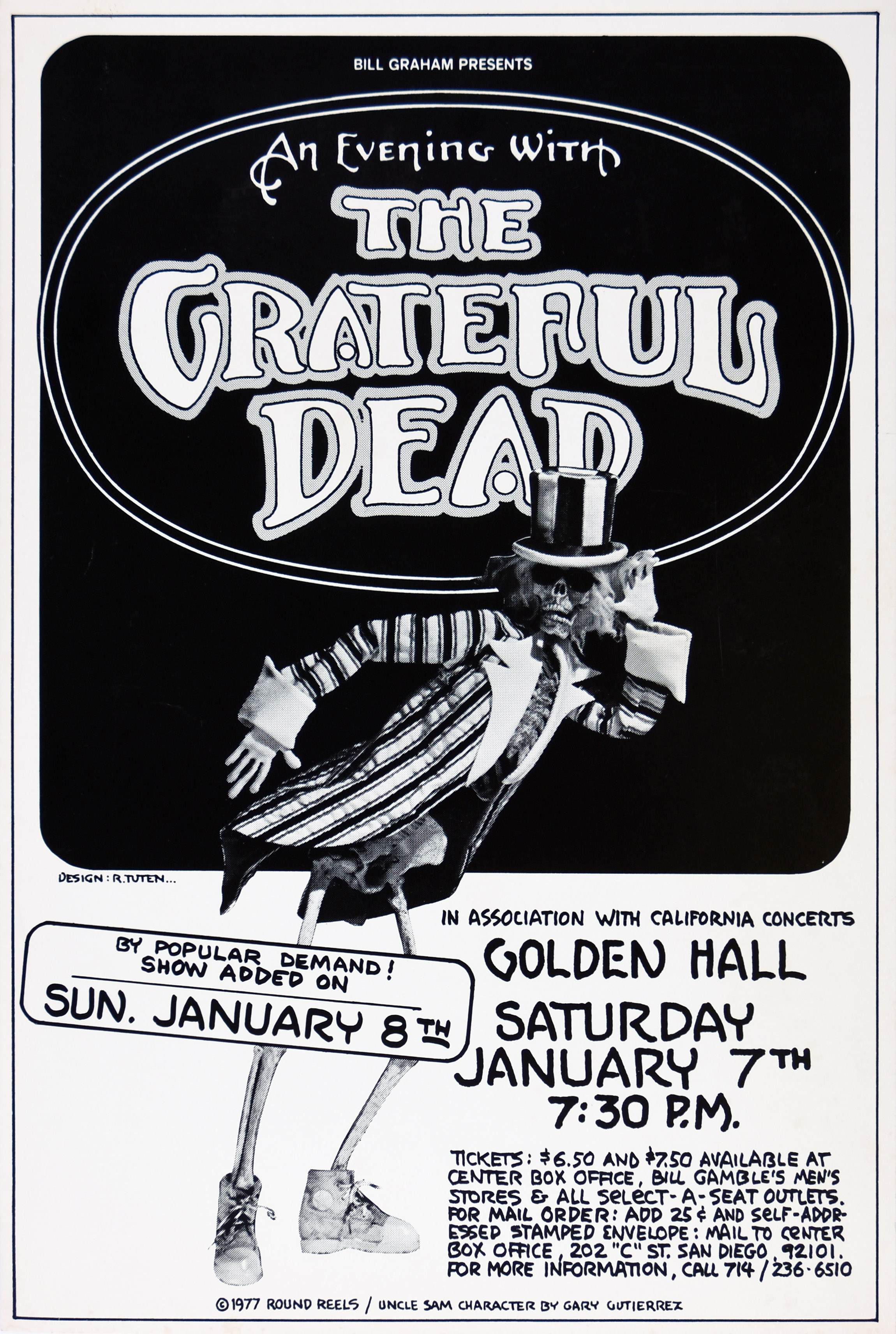
Instead, I'll say that I believe it sometimes to have been true, which is a simply a statement of possibility. And I might offer in support the Grateful Dead show at Golden Hall, San Diego, CA, January 7, 1978.


I think there are several tapes, but this is the one I am listening to. It's a great tape that puts you right in the sweet spot.

https://archive.org/details/gd1978-01-07.aud.unknown.89474.sbeok.flac16

The worst case of laryngitis in his 30-plus career struck Garcia in early 1978. Outright pneumonia caused cancellations --even the Dead had humanitarian standards, and even its Garcia was subject to the relevant labor laws. But, mere laryngitis from blow and cigs and more blow and more cigs, and chasing the dragon off of hot tinfoil, and snoring stentoriously (sleep apnea) in your Gar-o-Lounger? No. The Show Would Go On. They played two nights in San Diego (Sunday 1/7 and Monday 1/8) without "Jerry songs", i.e., no Garcia lead vocals. On the tape linked above, Weir informs the crowd of this (track 9, "Jerry's problem").

The results are pretty striking, and I think are indicative of various compensation effects.

From a Grateful Dead perspective (not usually the one I take here), the whole band seems to respond. The bassist and the drummers all have great nights. Partly this is the tape, I assume, but Phil, Bill and presumably Mickey just sound great. Lesh plays some very forward, fluid stuff all night long. The drummers sound alive, really as one on this night (which was too infrequently the case - I am not a fan of the two-drummer sound). I don't hear Bob tearing it up on guitar quite as might as one might expect, but I am not firm on that.

The key pieces of evidence from the tape are "Let It Grow" and the big jam on "Dancing In The Street".

"Let It Grow" might be exhibit #1 in support of the compensation possibility from a Garciacentric perspective. (Though the whole band is great, I think that's partly endogenous to Jerry.) Pantagruel's tape picks this up beautifully, but any recording would find Garcia playing "Let It Grow" like a man with his hair on fire, scrubbing, hammering, scrubbing some more, occasionally soaring; parkour guitar. Maybe he's a little angry, and he takes it out on the Tiger (right? I should know these things). Somewhere around 3:45 and again right around the 5-minute mark, he fans with tremendous power. If you have good speakers and a good room --this tape needs space to breathe, but given the space I think it will sound very nice indeed -- go ahead and turn it up, LOUD.

Dancin' finds the whole band highly exploratory, a great piece of  group improvisation. For at least five or eight minutes they explore lots of creative byways. "Compensation" has a quite specific manifestation here, because I don't think that, initially, they are trying harder so much as the tried and true is not ready-to-hand. When you reach for the standard formula and it's not there, right where it usually is and where you implicitly expected it to be, what do you do? You improvise.

(Note here that Corry has discussed a related phenomenon, whereby the band "compensates", responds to, a small and alien crowd by hunkering down and, together, tearing the roof off the place. Not only that, he discussed in the context of this very tour, and specifically the 1/15 show at Selland Arena in Fresno. JGMF: Corry's ideas, my turgid prose.)

I lament the institution of the vocal rotation in the Dead. It began very early and didn't really start to stifle things, too much, until other features, such as the setlist structure, and the subsong types such as "Bob rockers" and "Jerry ballads", populating a rather limited ecology, ossified around it. By 1980 a Dead setlist was highly predictable on all kinds of dimensions, and various members of any given crew of fans typically specialized in "calling songs". Alas, it wasn't rocket science.

I don't consider 1978 to be a great year for the Dead, but I like it relative to what followed because I so strongly dislike the ossuary that the setlist structure became, a deadweight around the band's neck. One could still be surprised by a GD setlist in 1978 in ways that one could never be in any of the band's remaining years that contained an '8'. And 1/7/78 has this in spades, since even what was already tried-and-trued by this time, the Bob-Jerry rotation, and certain song combinations, were ruled out by Jerry's laryngitis.

With routinization, space for true exploration becomes more and more constrained. This is probably tautological. What this show allows us to see is that the vocal rotation was part of this limitation, and breaking it down posed interesting questions, calling forth interesting answers. On more than a few occasions I hear Jerry suggesting "Franklin's Tower", for example. Now maybe he had a mic set up and was considering exercising a vocal option. Or maybe he just wanted to attack the song from a new angle, free of singing responsibilities and with a chance to focus on just playing it. Or maybe he just stumbled into it. Whatever the case, the whole band is fun and engaged and ripping it up in a very interesting Dancin' - looking down the setlist, I have high hopes for what looks like a tight Playin, a long and hopefully not too dull Drums -> NFA, and what I am hoping is a hot Around & Around (with the double-time ending? I hope so). I hope not to listen to OMNS, but I might slip up.

(some hours later)

I have picked this up again after being taken away by other things. I love this "Playing In The Band" - not as long as it had been, which is fine - more like a nice compact 1972 version. At 9:19 Garcia quotes "Close Encounters" a few times, which I am contractually obligated to remind you he broke out with the Garcia Band, not the Dead, in November.

Still listening, but anyway, I hear this show as strong evidence in support of the compensation hypothesis. Of course I am listening *for* this, to some extent. But either way, it's there.

Let me be clear: I don't think there's a linear and negative relationship between vocals and guitar, symmetrical across all the values those two things can take. Instead, I would model this as a conditional relationship: it's only when the vocals fall below some threshhold that the compensation kicks in. When the vocals are really terrible (or, in the limit, as with 1/7/78, Garcia cannot sing), then he compensates. It's a categorical ("if ..., then ...") rather than a continuous ("as ..., then ...") kind of statement.

One last set of points, the kind of thing we ask in my day job, what's the mechanism? Here, I speculate.

1) Marginal reallocation of attention/effort: Here, the idea is that Garcia has some amount of relatively fungible energy and attention to expend. When he doesn't have to worry about singing, he can reallocate that stuff into his playing. This doesn't have to be conscious.

2) Guilt: I have discussed at some length how important the idea of being a competent professional musician was to Garcia. If this sounds obvious, it shouldn't. Some great players don't give a shit about this. But Garcia cared about being a pro, embracing if not always respective a set of professional standards. He rejected "Cabaret Economics" as a concept, even if he sometimes inflicted it on his loyal fans. But I surmise that when he couldn't sing, or when he knew that his vocals were objectively embarrassing, he would feel that he needed to make it up to his fans with better guitar work. This one sort of implies a lit more consciousness.

3) anything else?

Anyway, do check this show out. NFA playing and Garcia still sounds great. Two snaps up.


Tuesday, December 30, 2014

Lost Your Voice? Play a Monster "Don't Let Go" (8/27/84)

LN jg1984-08-27.jgb.all.aud-corley.15029.shn2flac

I have sometimes joked, half-seriously, that 8/26/84 may be Garcia's most wasted performance, but I just do that to embody a feeling about the period as a whole. At some point I'll bring myself to revisit it.

I like listening around such things, as much as listening directly to them. Hence the JGB #21b gig from Monday, August 27, 1984 down at the Keystone Palo Alto entered the listening queue. Why hear the show itself when you can hear the next night? This could also provide a check against a listen last year to 8/24/84, which I probably unfairly shorthand with "It's not that bad, given how much Persian he was doing"; take my own temperature on this period. Seeing taper John Corley's name, I know it will be a great upfront tape, with the deconstructed Nak 700s nestled inside the obscuring, silly hat.

This show has all of the hallmarks of this down-and-dirty period in Garcia's life, some stellar, grungy loud guitar playing, occasionally brilliant, contrasts with some slightly slippery arrangements and, it must be said, objectively horrifying vocal limitations dictated by a set of badly shredded chords.

I don't say much about the guitar work (about anything, really) - it struck me as sometimes very good. Deal might be hot enough to merit a note, but for whatever reason I wasn't moved quite enough to take up the cause. There are a few but not an inordinate number of vocal flubs, the arrangement slips out of sync a time or two, some of the tempos (e.g., RFTR) strike me as sluggish. Mostly, nothing to write home about, maybe a lit below average (maybe slightly below 8/12/84 at Club Casino, maybe around the same level as 8/11/84 at the Nunnery, better than 8/24/84).

But the real jewel here is "Don't Let Go", as it almost always was. DLG was a weathervane tune, one that Garcia had to play as if he meant it, and so would only play on a relatively "good" night. Don't Let Go made a Garcia Band show special.

I was not in much of a note-taking mood in this listening session, but I recall a number of very interesting passages during which Garcia picks up and elaborates distinctive themes with all due care, taking the time to work through each one. Many of them just echo around a hundred sounds that you've heard Garcia make, that sound like something you've heard before but that you can't quite put your finger in, as elusive as a dialect. I note a point about 13 minutes in where they had setup a little landing pad, had Jerry wanted to wind it down, he sets it up and then gamely runs away from it to explore some of these ideas. It's nice.

This version of "Don't Let Go" puts me in mind of what I call the compensation hypothesis - when one particular performative aspect was hamstrung, he compensated this weakness with extra effort in other areas. It doesn't always hold, of course, but it might account for a few observations. In spring 1978, when his voice was shot with laryngitis, Garcia employed much crisper articulations, often early-Dylanesque. As the voice gets regularly bad starting in 1980 --to such an extent that, at some point, it's not really the same voice at all-- Garcia starts playing louder guitar, using lots more feedback than he had previously. This is especially characteristic of his 1983-1984 style, before, based on the sound of very little tape because there were relatively few shows, just running out of gas for a few years leading up to his descent into a diabetic coma on July 10, 1986.

It feels for all the world here like Jerry steps from a long "Harder They Come" to an ambitious, expressive, and even longer "Don't Let Go" to make up for not being able to sing, which had become painfully apparent as the evening progressed. He could have mailed in a few relatively easy vocal numbers - mumbling is not that hard on the chords. He didn't have to go 65 minutes in the second set, as he'd demonstrate more and more consistently over the next few years - 50 wouldn't have been a total embarrassment. But on this night, he took the road less traveled and reached a little further for the gold ring, and I respect that.

Listening Notes below the fold. (update: see also listening notes for the previous night, 8/26/84)

Monday, April 11, 2011

'And It Stoned Me' Debut: JGB, The Stone, October 18, 1986

LN jg1986-10-18.jgb.81mins.sbd-jgmf.112794.flac1648


Jerry Garcia Band
The Stone
492 Broadway
San Francisco, CA
October 18, 1986 (Saturday)
mono sbd shnid-112794

--set I (6 tracks, 33:58)--
s1t01. //Think [#3:52] [0:12]
s1t02. And It Stoned Me [5:25] [0:30]
s1t03. Run For The Roses [5:21] [0:02] ->
s1t04. Let It Rock [4:49] [0:59]
s1t05. Forever Young [6:24] ->
s1t06. Deal [6:19] [0:04] %

--set II (6 tracks, 47:16)--
s2t01. Harder They Come [10:28] [0:06]
s2t02. Knockin' On Heaven's Door [9:35] [0:12]
s2t03. Dear Prudence [9:46] [0:17]
s2t04. That Lucky Old Sun (Just Rolls Around Heaven All Day) [6:25] ->
s2t05. Gomorrah [6:02] ->
s2t06. Tangled Up In Blue// [4:22#]

! ACT1: Jerry Garcia Band #21b
! lineup: Jerry Garcia - el-g, vocals;
! lineup: John Kahn - el-bass;
! lineup: Melvin Seals - keyboards;
! lineup: David Kemper - drums;
! lineup: Gloria Jones - backing vocals;
! lineup: Jacklyn LaBranch - backing vocals.

JGMF Notes:

! Recording: symbols: % = recording discontinuity; / = clipped song; // = cut song; ... = fade in/out; # = truncated timing; [x:xx] = recorded event time. The recorded event time immediately after the song or item name is an attempt at getting the "real" time of the event. So, a timing of [x:xx] right after a song title is an attempt to say how long the song really was, as represented on this recording.

! Jerrybase: https://jerrybase.com/events/19861018-01

! db: https://etreedb.org/shn/21300 (John Corley audience recording). No soundboard source in circulation as of 4/10/2011, but then this one emerged (https://etreedb.org/shn/112794 [mono sbd]). AF subsequently did some patching for the optimal version, https://etreedb.org/shn/116850.

! R: Specs: MSC > 1C > 1DAT (16bit/48kHz) > Panasonic SV-3700 playback > Pyle Pro cables > WaveTerminal 2496 > Wavelab v5.0.1a record (16/48 wav) > CDWave v1.9.8 (tracking) > Traders Little Helper v2.4.1 (FLAC encoding, level 8) > foobar2000 v0.9.6.8 (tagging).

! R: Nice mono soundboard recording from a period in which there are very few. At some point this should be patched with the Corley aud tape, which could supply the missing ~90 seconds at the start of Think and the missing ~5 minutes at the end of Tangled Up In Blue. Update: AF has done it, shnid-116850.

! P: Overall, this is a pretty workaday first set and a pretty nice second set. A first set comprised of six 5-6 minute songs, clocking in around 36 minutes total, feels pretty cursory. It provides a kind of hit-and-run tightness which is merely interesting. To be fair, the man was at death's door 14 weeks prior to this, and we know that he had to develop his chops and his stamina progressively. Third show out, he's not quite there yet. The second set strikes me as still very short (under an hour), but better than set I. I will forever lament the emergence of "That Lucky Old Sun" into the Garcia Band's repertoire, but it's their band and they get to play what they like, so I'll leave it at that.

! R: s1t01 Think enters in progress.

! R: s1t01 Think static @ 2:42

! setlist: Public JGB debut of "And It Stoned Me" (s1t02). Second public JGB performance of "Forever Young", after the Triumphant Return show (debuted on October 4, 1986). Third public JGB performance of "Lucky Old Sun" (October 4 and 5, 1986).

! R: Guitar is very low in the mix. s1t02 And It Stoned Me level adjustments @ ca. 2:42.

! P: s1t04 Let It Rock takes a while to settle in, with Kemper and Jerry not quite on the same page. It ends up being played at a very fast tempo, Garcia really on the seat of his pants with the lyrics; kind of makes it interesting. This may be the peppiest JGB LIR ever.

! P: s1t05 Forever Young Jerry has a hard time staying in key. He hits the high notes in the chorus OK, he's just changing key during the verses, trying to find the right spot.

! P: s2t01 Harder They Come Jerry sounds refreshed, invigorated. It could just be that they hit the pocket of HTC and it's in a good range for his voice. You can hear him re-learning how to sing onstage here in October 1986, two weeks to the day and only the third show back. Gone was harsh croakiness of '85 GD ... after the coma, he changed his singing style to better accommodate his vocal limitations. This was also probably a needle's eye through which song material had to pass, with Jerry figuring out what he could and couldn't do, if if he could, how. A lot to learn, and it took a little while. I have always thought that's partly why his guitar playing was relatively unadventurous from late '86 through most of '87 (obverse of the compensation hypothesis). I think he was focusing on re-learning how to sing, and letting the process of relearning how to play happen more organically. The vocal constraint was the one that required more attention ... the guitar playing was just fine. Anyway, to the point, this HTC is very tight and very sweet sounding, which really comes through on the nice board tape, on which only the bass is still too faint. Kemper is really hitting, really swinging on HTC, a super tight pocket. Melvin is just filling some sweet licks back behind, the ladies' harmonies are spot-on, everything sounds well-rehearsed. Jerry gives a little extra "What I say, now what I say" toward the end, and it finishes strong. Excellent @@ version of HTC.

! P: s2t02 Knockin' On Heaven's Door is also just fantastic. This song was always better with the JGB than with the Dead, with Melvin's organ just being so spot-on, the beautiful raised tempo parts like the one about 6 minutes in here ... wonderful

! P: Kemper does a little march thing about 3 minutes into Dear Prudence that's pretty sweet.

! P: s2t04 Lucky Old Sun has never been a favorite of mine. But this one is interesting for at least two reasons. First, the sbd tape allows you to really hear what's happening. Second, it's an interesting early version ... more uptempo than later ones.

! R: s2t04 Lucky Old Sun there's some weird, low-tone vibration happening from time to time. Sounds a little like a very low helicopter rotor.

! R: s2t06 TUIB cuts out, maybe a few minutes missing.