Showing posts with label David Nelson. Show all posts

Sunday, November 13, 2022

Good Old Boys at Keystone: June 14, 1974

I  just want to pin down some details of the Good Old Boys sets from June 13 and June 14, 1974, opening for Great American String Band. These come from tape that I have been able to audition but that is not supposed to circulate. Sometimes, a "hush-hush" approach is necessary to protect the innocent. That's not the case here - just gratuitous hoarding. I don't make the rules.
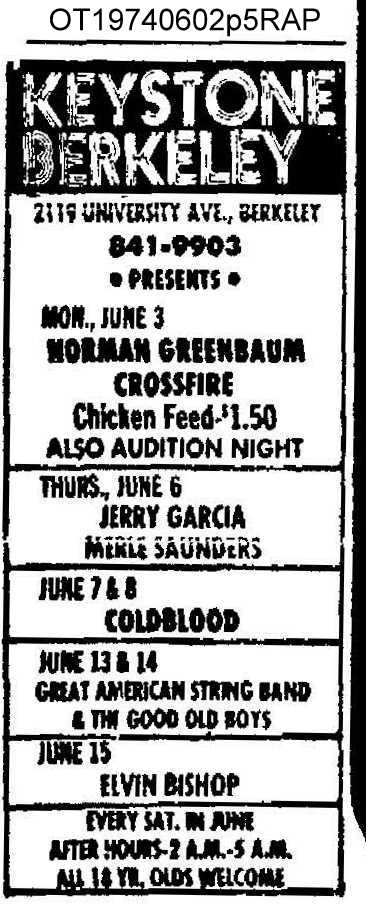

Good Old Boys
Keystone
2119 University Avenue
Berkeley, CA 94704
June 14, 1974 (Friday)

--early set main--
Blue Grass Breakdown (1)
Sittin' On Top Of The World (2)
Dim Lights, Thick Smoke (And Loud, Loud Music)
Deep Elem Blues
(3) I'll Never Make You Blue (4)
Jesus Loves His Mandolin Player #2 (5)
Pistol Packin' Mama (6)
Wild Side Of Life (7)
Uncle Pen
Raw Hide (8)
--early set encore--
Colored Aristocracy (9)
Back Up And Push

--late set--
Goin' Down The Road Feelin' Bad (10, 11)
Nine Pound Hammer (12)
Little Girl And The Dreadful Snake
Used To Be
Ragtime Annie
Roll In My Sweet Baby's Arms (13)
Jesus Love His Mandolin Player #34 (14, 15)
Crooked Judge

! Band: Good Old Boys
! Lineup: Frank Wakefield - mandolin, vocals;
! Lineup: David Nelson - -ac-g, vocals;
! Lineup: Robert Earl Davis - banjo;
! Lineup: Pat Campbell - bass;
! Lineup: Fred Weisz - fiddle;
! Guest: Richard Greene - fiddle (early show encore);
! Guest: David Grisman - mandolin (early show encore).

JGMF:

! map: https://goo.gl/maps/LDc43

! JGBP: http://jerrygarciasbrokendownpalaces.blogspot.com/2012/02/keystone-2119-university-avenue.html

! reference: http://deaddisc.com/disc/Pistol_Packin_Mama.htm Pistol Packin' Mama (Round RX-109 / RX-LA597-G, March 1976).

! metadata: None of the advertisements indicate separately charged early and late shows, but I think that's what happened on this Friday night at Keystone.

! (1) David Nelson: "Thank you. We're the Good Old Boys. We're the Good New Boys, actually now, we've got a new banjo player ... uhhh what is his name anyway? Bob Davis. We've been stealing musicians from other bands", etc. FW: "Here's one now that David wrote about fifteen years ago. It's called 'If I Miss You On The Matress, I'll See You On The Springs'. [crowd laughs] I had to say something funny."

! (2) Frank Wakefield: "I'd like to close ... really we're almost up here. We've got some very special guests here. And I'm not gonna introduce them right on the stage [inaudible]. Fred Weisz worked with him in 1960. Dave Nelson. Nelson:  "Pat Campbell. ... This guy over here ... from New York, hails from Manhattan New York. Frank Wakefield." NB they forget to introduce the banjo player, though I guess they just had (see note 1).

! song: "Deep Elem Blues": The GOB version is like the old Jerry & Sara versions and like the JGAB ones, which are based on the Red Allen/Frank Wakefield arrangement.

! (3) FW: "Here's one now that David wrote a long time ago."

! (4) DN, paraphrased/truncated: Right now Frank's gonna do one of his mandolin tunes Jesus loves up to bout 36. What we want to do is record them all at once. #2. FW, paraphrased: "Hey maybe I'll change. How many folks was in here last night? Can I see your hands. Don't want to repeat myself. Song we did last night. ... some slow parts and some real fast parts." More chatter. NB that they did, indeed play Jesus #2 on 6/13/74. More cross-validation, not that these dates needed it.

! (5) Nelson: [inaudible] "you can lock me up in jail, but you can't keep my face from breakin' out."

! (6): FW: "One that David wrote about fifteen years ago in San Quentin."

! (7) Fred Herrera: "David, we're running late." Then something like "let's do a nice ending" or "let's do a last number"

! (8) Nelson: "Thank you, thank you very much" and crowd cheers indicate this is the end of the set.

! guest: early show encore with Richard Greene (fiddle), David Grisman (mandolin).

! personnel: With Dawg playing, and if Nelson's still onstage, this might be the only known instance of them playing together (check Fillmore East GD 1970).

! (9) Someone says "We got one here called 'Back Up And Push'. Hope you all like it. I don't recognize the speaker's voice. Not Richard Greene, Grisman, Wakefield or Nelson. Richard Greene: "Hope you all like, uh, country music. 'Cause if you do, we get to disappoint you by playing other stuff. But not for awhile." Note that this whole "encore" piece is one continuous piece of tape. So the guy who announces "Back Up And Push" is onstage playing, I assume one of the GOB guys not named Nelson or Wakefield.

! song: "Back Up And Push" sounds a little like the melody to "This Land Is Your Land" and, I hate to say it, in places, like "Copacabana". Regardless, it's credited to Bill Monroe. http://www.youtube.com/watch?v=s6jFF0asxWM is an amazing version by Bill Monroe, The Father of Bluegrass (tm).

! (10) unknown speaker: "Thank you thank you, the Good Old Boys." Sounds like the end of an evening.

! (11) Nelson: "We're gonna have some strange guests, but I can't tell ya who they is. Right now we got over on the fiddle on the right hand side, Fiddlin' Fred Weisz. On the banjo, stolen directly from Western Union, (Frank: "The hills of Manhattan, New York") Bobby Davis. All right. He's never played with us before. He played with us about five minutes in the back room there, so we have to work out our arrangements onstage. I think he's doin' pretty good. Then uhhh I'm not gonna introduce. On the bass, another musician stolen from Western Union, Pat Campbell. He's doin' real good too. He's doesn't know any of our songs either. (Frank: "He probly wrote 'em.") But he probably wrote 'em, yeah. And on this little red instrument --whaddya call that please?-- (Frank: "Ukelele.") Ukelele, yeah. That thing's falling apart. I keep worrying about it. He puts his finger underneath the binding on the frets and it snaps off every set, little pieces ... bridge is on backwards ... From the hills of Manhattan, New York, Frank Wakefield." Frank Wakefield: "This feller on the git-tar here, he's from the hills of Tennesse. I believe you're from [inaudible] Actually, the fact of the matter is, he's from a big rock group, like Jerry is ... y'know, when he plays, he plays super banjo too, he plays super acoustic, David Nelson, from Easy Riders of the Purple Sage. Give him a hand, he'd appreciate it. ... I'm mad at y'all now, I'm mad at y'all 'cause he got a better hand than I did. I feel bad now." [woman in audience says "Nobody loves you, nobody [inaudible"] Frank, responding: "So, since she said that, here's one called 'If I Miss You On The Mattress, I'll See You On The Springs'. [laughter] Here's one that David wrote when he was with the Purple Sage, and still is."

! (12) FW: "Here's another one that David wrote a long time ago. If you folks know anything about folk music. David wrote [inaudible] he wrote one here a long time ago. What sparked that?" Nelson: "When I saw my first snake."

! (13) long banter. David Nelson: "Thank you. Thank you. A little ragged, but that's all right. Half of us don't even know the words to these songs here. But this one doesn't have any words, so that's OK too. Frank's gonna do a solo mandolin tune. He writes these mandolin tunes. I am not supposed to talk while he's tuning. He doesn't remember words ... he doesn't know what necessary means, for instance. And he says to people ..." etc. etc. while FW is tuning. "But he remembers all these tunes, these long classical tunes that he wrote." FW tuning and rap. "Last set I did two harmonies. Gonna do [something else] this set." The structure here makes me thing these were separately billed early and late shows.

! (14) Frank: "We're gonna do a thing now where a guy by the name of Robert Hunter wrote a song and David, me and David arranged that and we'll do some very special stuff on the mandolin and the git-tar. And it'll prolly be on this new record, I guess, too, right?" (Nelson: "Yeah.") And it's called the 'Crooked Judge'."

! (15) This is some great context. Fred Herrera must have an intercom from his little room, and you hear it click on and a guy says, in a hushed, golf-announcer voice, "Dave. Dave. (Nelson: "Yeah?") Hey. We're startin' to run kinda late. Two tunes or so. Then someone, it sounds like Marmaduke, says "Hey, uh, Freddie says [inaudible] late." Then "[inaudible, maybe "The man returns"], there's a hoot and cheer from the audience. Frank: "So we'll get David to do that judge song first. ... If you all saw the concert we did last Saturday, we did this'un pretty much the same way." NB that implies a gig on 6/8/74.

Good Old Boys at Keystone: June 13, 1974

I  just want to pin down some details of the Good Old Boys sets from June 13-14, 1974, opening for Great American String Band. These come from tape that I have been able to audition but that is not supposed to circulate. Sometimes, a "hush-hush" approach is necessary to protect the innocent. That's not the case here - just gratuitous hoarding. I don't make the rules.


Good Old Boys
Keystone
2119 University Avenue
Berkeley, CA 94704
June 13, 1974 (Thursday)
opening for Great American String Band

--set I--
ambience (1)
Deep Elem Blues
(2)  Earl's Breakdown
(3) I'll Never Make You Blue
(4) Jesus Loves This Mandolin Player #2
On Top Of Old Smokey
Pistol Packin' Mama (5)
Raw Hide

--set II--
ambience (6)
unidentified-GOB19740613-01
(7) Jesus Loves His Mandolin Player #1
Little Girl And The Dreadful Snake (8)
Bill Cheatham (9)
T For Texas (Blue Yodel No. 1) (10)
(11) Teardrops In My Eyes (12)
New Camptown Races
(13) Uncle Pen
(14) Sally Goodin (15)
A Voice From On High (16)
Back Up And Push [1:59] [0:03]

! ACT1: Good Old Boys
! Lineup: Frank Wakefield - mandolin, ?vocals?;
! Lineup: David Nelson - guitar, vocals;
! Lineup: Fred Weisz - fiddle;
! Lineup: Sandy Rothman - banjo;
! Lineup: Pat Campbell - ac-bass.

JGMF:


! setlist: I am confused about the structure of the festivities at Keystone this Thursday, June 13, 1974. Need to write it out at greater length than this info file will allow.

! expost: Philip Elwood, "From country to jazz – a snap," San Francisco Examiner, June 14, 1974, p. 27. He spells fiddle player's name Wiesz, but it must be former Greenbriar Boy Fred Weisz, who had bipolar disorder and might have been a street person around Everett, WA.

! song: traditionals: s1t02 "Deep Elem Blues"; s1t06 "On Top Of Old Smokey" (Trad., arr Wakefield); s2t10 "Sally Goodin"; count: 3.

! song: country: s1t04 "I'll Never Make You Blue" (Ray Cline, Charlie Cline); s1t07 "Pistol Packin' Mama" (Al Dexter); s2t06 "T For Texas (Blue Yodel No. 1)" (Jimmie Rodgers); count: 3.

! song: bluegrass: s1t03 "Earl's Breakdown" (Earl Scruggs); s1t08 "Raw Hide"; s2t02 "unknown-GOB19740613-01"; s2t04 "Little Girl And The Dreadful Snake" (Bill Monroe); s2t05 "Bill Cheatham"; s2t07 "Teardrops In My Eyes" (Red Allen, Tommy Sutton); s2t09 "Uncle Pen" (Bill Monroe); s2t11 "A Voice From On High" (Bill Monroe, Bessie Lee Mauldin); s2t12 "Back Up and Push"; count: 9.

! song: Wakefield originals: s1t05 "Jesus Loves This Mandolin Player #2"; s2t03 "Jesus Loves His Mandolin Player #1"; s2t08 "New Camptown Races"; count: 3.

! (1) Frank: "Actually, Fred Weisz and Jerry Garcia wrote this one."
 
! (2) Someone says "Bluegrass Stomp", and Nelson says "Yeah, how 'bout 'Bluegrass Stomp'?" Not sure what Wakefield says, but David says "Let's pick one." I think Sandy suggests "Earl's Breakdown", Nelson affirms, and Wakefield introduces it. "Here's one where Sandy does some ... if y'all ever seen a [inaudible] player uh accordion player twist some keys, he's gonna do this for ya." ?Sandy?: "Frank does a little fancy key-twistin' on this one, too." DN, laughing, "Watch his hands!"

! (3) Frank: "Here's another song that Sandy wrote, about his sweetheart. She broke his heart, and he's gonna break her darn jaw now, right?"

! (4) Nelson: "Thank you. Right now, Frank's gonna do a solo mandolin tune. I don't know if of you have him heard do it before. He writes these mandolin tunes that are like classical music. They sound like classical music, but not really, I mean, it's hillbilly classical. And he's got about 34 or 6 tunes written out, and they all used to be called "Symphony #94", since that was the only classical piece he'd ever heard, by Beethoven. ... 'Jesus Loves His Mandolin Player #2'." FW gives an explanation. Talks about NYC Ballet Orchestra.

! (5) Frank: "Thank ya. Now we're gonna play one called the 'Berkeley Waltz', then we're gonna take a little intersection [sic] and we're gonna come back and play some more for ya." Nelson, to FW: "Do you know that that word means? What's that word mean?" Frank: "Oh yeah, I forgot what that word means."

! (6) Frank: "I'm sorry, about six months. Can you hear it way back in the back alright? You need more volume? Is that loud enough now? [crowd guy: "'s'all right!"] Bless you, thank you."

! setlist: s2t02 is solo mandolin. It may be one of the Jesus songs, but I just don't know. Even Neil Rosenberg was stumped!

! (7) Frank: "That's an 8-string harmony, now we're gonna play some grass for you." David Grisman, I need to borrow your mandolin real fast. I just broke a string. David? Where you is?" Ballet Opera NYC. Gimme that mandolin!

! (8) FW: "Thanks a lot. Now we're gonna turn Fred loose, who's a super good fiddle player."

! (9) Frank: "Thanks a lot. Now we gonna do somethin' where this super good bass player, Pat, he's really good on the bass", etc.

!  (10) FW: "I'd like to thank David Grisman for loaning me this mandolin. Thank you."

! (11) FW: "Now here's one that David has on record. Him and the Purple Sage Dust."

! (12) FW: "Here's one that David here wrote a long time ago. One called 'New Camptown'. What inspired you to write it, David?" Nelson, off-mic: "Who you talkin' to?"

!  (13) FW: "Here's one that Fred Weisz wrote a long time ago, that he does on the fiddle, called 'Uncle Fred'."

! (14) unknown speaker (not FW or DN): "Here's a little Sally Goodin, we'll get Fred to play a little piece of pie."

! (15) Freddie Herrera: "David ... David ... David ... David, We're starting to run late." FW: "We feel so unnecessary." Nelson: "Hey, what's unnecessary mean?" Freddie: "David, can you hear me?" And they answer with "I Hear A Voice A Callin'!" Perfect!

! (16) Freddie: "Dave. Dave. Can you hear me? Dave? Dave. I'm down here. We are starting to run late, we have time for maybe one more tune at the most." DN, to band: "Oh, we have one more tune."

Thursday, August 20, 2015

GD: August 19, 1970 at the Fillmore West


! R: field recordist: Gene Taback

! R: field recording gear: Sony TC-124 with Sony stereo mic
! R: transfer: Master/1st generation cassettes played back on Nakamichi Dragon > Digital Audio Labs Card Deluxe soundcard (96Mhz/24 bit)> HD.

My goodness, I love love love love love this acoustic set. The recording really captures a feeling.

"How Long Blues" spinning now, very nice.

Here are Jim Powell's typically awesome acoustic set notes, from Deadlists:
David Nelson plays mandolin on Friend Of The Devil, Dark Hollow, Tell It To Me, Rosalie McFall, Cold Jordan and Swing Low. Pigpen plays piano on How Long Blues, Candyman, Ripple, Truckin', and New Speedway. There's a hint of harmonica at the beginning of Ripple; it seems too discreet to be Pigpen's. Jerry plays electric guitar on Cumberland and New Speedway while Bobby continues acoustic. Marmaduke provides bass vocal accompaniment on Cold Jordan and Swing Low. It seems probable that this set as listed is missing a tune from Pigpen (compare Operator the previous night). This set was preceded starting at 8:00 by an unbilled opening set from a bluegrass vocals quartet, possibly the Rowan Bros.
see also: "GD: August 17, 1970, Fillmore West, San Francisco, CA", with some setlist Reconstruction. Did my conjectures there make it into Deadbase 50, BTW?

Tuesday, December 16, 2014

NRPS 12/15/73 Winterland w/ guests


Uhhh, wow.

The amazing NRPS archivist Rob Bleetstein not only responded to my query about the source for the NRPS official concert history listing that shows Garcia (guitar) and Sandy Rothman (banjo) sitting in with the New Riders on "Glendale Train", 12/15/73 at Winterland (see also Corry). I say, he not only responded to my query, he went ahead and posted video of the thing at YouTube.

Check it out.

Thank you, Rob.

Since this is JGMF, I'll allow myself a few Garciacentric observations.

Our Hero steps up for a little twirl from about 4:45ff, on Marmaduke's invitation. Not that there's any doubt about provenance, but he's beardless, as he should be during this particular period, wearing what I can only think of as an "Atlanta" dye, similar in pattern to what he wore on 5/10/70.

This is a great little piece of evidence around Garcia's traveling habits. One might have thought he'd stay in the southeast between the Dead's gigs in Atlanta on 12/12 and Tampa on 12/18, but no - back home he goes. Since it seems a safe assumption that the Dead's gear didn't need to breathe the salt air of The City, and thus stayed in the east, Jerry doesn't have his regular guitar, and is playing one I don't recognize here with the New Riders - I assume it's one of Nelson's. Gear heads (not me!) take note.

Sociometrically, I believe this is the only known Garcia-Rothman shared stage until Thanksgiving 1986 (which wasn't really a stage, but was a performance together in front of other people). Garcia would sit in again with the Riders a few months later, at Keystone Berkeley on 2/2/74, and as far as I know would not play live with Nelson again until the same Thanksgiving '86 reunion.
Wow. What a world we live in. Thanks again, Rob!

Sunday, April 24, 2011

NRPS-Matrix-1970 06 of 7: LN19700902: Wednesday, September 2, 1970

NRPS-Matrix-1970: a seven part series discussing New Riders of the Purple Sage (NRPS) gigs at the Matrix, 1970, including listening notes on the circulating tapes, speculation on dates, observations on playing, general pontificating.
  1. Introduction
  2. LN19700430: Thursday, April 30, 1970
  3. LN19700707: Tuesday, July 7, 1970
  4. LN19700729: Wednesday, July 29, 1970
  5. LN19700730: Thursday, July 30, 1970
  6. LN19700902: Wednesday, September 2, 1970
  7. Analysis and Conclusions
Overall Impressions

The 86 minute sbd-sourced recording identified as NRPS at the Matrix on Wednesday, September 2, 1970 captures some really loose moments. David Nelson is absent this night, out sick, and so Garcia is more forward both in terms of instrumental leadership but, especially, in terms of harmony vocalizing. He just didn't do too many harmonies behind the pedal steel, ever. I think he really had to focus on his hands, knees and feet (which sounds like enough to occupy anyone!). But here he jumps in with enthusiastic harmonies, at little cost (that I hear) to his steel playing. Nice. Marmaduke is slurring very, very heavily in set I, though it affects his banter with/to the crowd more than his singing, which is obviously more important. He seems to set himself straight a bit for set II.

I have no idea how many people are in the room. Sounds like a small but enthusiastic bunch. To my clumsy ears the tape is sonically superior to the 7/29 and 7/30 tapes. My instinct is that it sounds more like 7/7 in terms of sound quality, but I need to try out a specialized listening enterprise to make any tape comparison with any kind of confidence. This is one of the more complete tapes of the NRPS-Matrix-1970 set, with lots of off-mic chatter and tuning available for transcription. I have done what I can in that regard.

Dating and Venue

Like every other NRPS-Matrix-1970 tape, this one has some dating ambiguity. Chicken on a Unicycle's state of the art Matrix list shows Seatrain and Kracker Jacks down in the Marina this night. There is no known basis for a NRPS entry except the tape, and we know that those can be unreliable, at best. The only thing that I can hear on the tape that helps with dating is the "Big Yellow Taxi," which the 7/29/70 tape suggests they picked up in Hawaii in June 1970 (see those notes for details). So all we can really conclude is that this show takes place after that, i.e., the second half of 1970 or later. I don't hear anything else that might help me identify the date with any precision. Based on some of the uncertainties around Matrix newspaper ads and listings, I am coming around to the view with most of these tapes (except 4/30) that they are approximately correctly dated. Indeed, I feel pretty comfortable just continuing to list this as 9/2/70, despite the lack of any corroborating evidence.

Regarding venue, I asked this question in re 7/29/70, but does anyone know if Matrix showed "weird movies" at setbreaks during this time frame? Dawson references it again at the end of set I here, as he had done on the earlier-dated recording.

Historical Interest

The whole premise of this series is that there's historical interest in the NRPS-Matrix-1970 interface.

The obvious things here are a couple of setlist rarities. Foremost among them are another version of Joni Mitchell's "Big Yellow Taxi" (which also appears on 7/29/70) and, especially, the only known NRPS version of the Beach Boys' "Fun, Fun, Fun." [check that - 4/25 and 4/28/71, around the famous Dead/Beach Boys set of 4/27. I am not sure how that escaped me - h/t Grateful Seconds] To hear Garcia playing pedal steel over this number around Labor Day 1970 is just too amazing. Had he ever played that song publicly before? What about surf music in general? I don't have anything in my notes (but confess to not having checked The Sources) about him playing surf music, but I'd bet it's absolutely possible. He grew up and was playing in coastal California in the first half of the 60s, for goodness sake. Why the hell not tear it up a little bit, lay down some fuzztone and try to get some chicks? Specifically, though, to find a Beach Boys connection in the setlist fascinates. Is there any other Beach Boys-Garcia connection besides the unbelievable 4/27/71 Fillmore East encounter?

I don't know what "Little Boy" is, the song said to follow "Glendale Train" on the Jerry Site's list. Anyone? It might be "Two Little Boys", apparently a traditional played in an earlier Garcia life by the Black Mountain Boys, but without being able to hear it I can't say.

Everything else is standard NRPS: mostly Dawson originals with a few country covers thrown in. Lots of good Bakersfield sound here, even without Nelson's picking.

Far and away, though, the feeling is what's so interesting. This entire enterprise I am involved in began with the observation that Garcia On The Side was supposed to be about "music without bullshit", i.e., playing in front of an audience, but without all of the baggage of being Jerry Garcia Of The Grateful Dead. And being able to hear Garcia so relaxed, so loose, so open to playing whatever, just playing, is fantastic. Quite often on these tapes one can hear the band talking off-mic about what to play, and Garcia just basically being pretty agreeable to play whatever. So nice! Then you get a little sardonic Jerry humor, as they are looking to replace some strings after "I'm In Love With You". Garcia, affecting a sneer:
They use the good steel for the war. [crowd laughs] They do man, really, it's awful.
Big deal, I know. But, as I have said over and over again, before too long Garcia would rarely find himself in a performing situation in which he felt comfortable saying anything at all to the crowd, let alone anything humorous or even obliquely (anti-) political. I am sure that in future years he would lament his perceived inability to just go down to the bar and fuck around. Thank goodness we have tapes that display him doing it for as long as he felt he could.

Listening Notes after the jump.

Friday, April 22, 2011

LN jg1970-07-30.gd.33mins.sbd-cotsman.17077.shn2flac

Vegas is skeptical that I can do the NRPS-Matrix-1970 thing in seven posts, but I never claimed I'd do them consecutively. And, well, if I happen to cover related terrain, well, that's just how it goes. And it just so happens that LIA's post "The Hartbeats - July 1970" mentions some GD material that I'd like to post on right about now. ;) Specifically, I'd like to do Listening Notes on the GD sets dated Thursday, July 30, 1970 (Matrix, SF, CA) and Wednesday, August 5, 1970 (Golden Hall, San Diego, CA). Since LIA has posted such thorough analyses, I'll just post the listening notes I have written up (with LIA's analyses in mind), without further comment.


Grateful Dead
The Matrix
San Francisco, CA
July 30, 1970 (Thursday)
acoustic set; unknown if there was an electric set

SBD > ?? > CD > EAC > SHN (shnid 17077) > FLAC level 8 (TLHv2.6.0, build 168, 'convert encoding format' command).

(7 tracks, 32:46)
t01. To Lay Me Down [6:09] [0:38] {6:47}
t02. Dire Wolf [4:00] [0:06] {4:06}
t03. Candyman [6:29]
t04. stage banter (1, 2 3) [2:42]
t05. Rosalie McFall [3:32] (4, 5) [1:52] % [0:12] {5:36}
t06. A Voice From On High [2:49] [0:02] % (6) [1:04] {3:55}
t07. Swing Low, Sweet Chariot [2:54] (7) [0:14] {3:08}

Lineup:
Jerry Garcia - acoustic guitar, vocals;
Bob Weir - acoustic guitar, vocals;
Phil Lesh - (?electric?) bass;
Mickey Hart - drums (tracks 1-3 only);
David Nelson - mandolin, vocals (tracks 5-7);
John "Marmaduke" Dawson - ?guitar?, vocals (tracks 6-7).

Seeder Comments:
- This short acoustic set seems to be all that the Dead played in capping off a couple New Riders sets at the Matrix.
- Sound Forge was used for a slight pitch correction and minor edits.
- Part of The Music Never Stopped Project 2003
- Thanks to Chuck Gannon; edits/encoding by JCotsman.

JGMF Notes:
! Recording: symbols: % = recording discontinuity; / = clipped song; // = cut song; ... = fade in/out; # = truncated timing; [ ] = recorded event time. The recorded event time immediately after the song or item name is an attempt at getting the "real" time of the event. So, a timing of [x:xx] right after a song title is an attempt to say how long the song really was, as represented on this recording.
! db: http://db.etree.org/shn/17077 (this recording, degraded sbd).
! t04 @ 0:16 (1) some drunk-sounding guy mutters something inaudible, and Garcia says "Go away, man. Get your own band." Guy: "What?" JG: "Get your own band." Guy: "My own band?" JG: "Sure." Guy: "What does that mean, 'get my own band'?" JG: "It means fuck off, man. Fuck off." Guy keeps muttering some stuff. Says something to Weir. Weir: "I don't care, man." A weird exchange, for sure.
! t04 @ 0:59 (2) JG: "Is Nelson here?" @ 1:04 Nelson, laughing: "Ha ha, take care of my boy there, Hart."
! t04 @ 1:18 (3) Nelson: "Are you guys gonna do some gospel numbers? Aw, you don't need drums on gospel numbers."
! t05 @ 3:50 (4) JG: "Where's Marmaduke?"
! t05 @ 5:15 (5) Weir: "'I Hear A Voice A' Callin''." I only note this to underline that this traditional goes under many names, as many traditionals do.
! t06 @ 3:27 (6) JG: [clears throat] "Is this gonna work? Just stand back a little [inaudible]. Turn the microphones up. Let's do it that way." Nelson: "Barbershop." [cross-talk] JG: "This is an old principle. It's called singing in a group."
! t07 (7) Nelson: "Thank you. Thanks a lot."

Thursday, March 31, 2011

Reading Notes: Kahlbacher, Gene. 1974. Aquarian Interview: New Riders of the Purple Sage. Aquarian, January 29 – February 12, 1974, pp. 14, 27, 31.

NB: I didn’t have the year of this publication, somehow. But from the context of Torbert leaving and Battin just arriving, I believe it is 1974.

Kahlbacher 1974, 14: How much of an inspiration has JG been to NRPS, and was he its Founding Father? Spencer Dryden: “Rather than father, I look to Jerry for inspiration. But he doesn’t want to hear any more about it.” JG doesn’t want to be seen as a mystic.

Kahlbacher 1974, 14: Dawson on origins of NRPS: “I was wandering around for a long time at several colleges and not really knowing what the goal was. … I’d learned to play the guitar a long time back, but I never practiced a whole bunch. … I was wandering around and this whole bunch of changes came down on me. For one thing, I ceased trying to get a group together right then, as I had been for a long time. I finally came down to the point of saying ‘This obviously isn’t what’s happening right now, and instead of wasting my time trying to do that – putting my energies into something that isn’t panning – I should put my energies into something that is working. So I got a gig in a little coffee house, playing and singing songs … eventually it came down where Jerry Garcia was learning pedal steel guitar at the same time that I was trying to learn how to be a singer and pick a few songs. We got together on a kind of thing where I’d come to his living room and I’d plunk out simple tuns for him to try to put steel licks behind.”

Kahlbacher 1974, 14: Nelson: “I played in a bunch of bands, mostly bluegrass bands. There were lots of clubs we played … Later I played with Torbert in an electric band called the New Delhi River Band, and then I was with Pete Albin and Dave Getz.”

Kahlbacher 1974, 14: Dryden’s entry into NRPS: “The tune ‘Dirty Business,’ actually, made me join the Riders. I was leaving the Airplane, and McIntyre [sic] and Owsley came down to the big house [the Airplane House] … and said ‘You really should see the New Riders. I think you might be able to help them out’. But I was thinking of producing, not playing. I was tired. I’d been through that before. But I went down to see them [NRPS] at the Family Dog on the beach, on the Great Highway … At the time the drummer for the Riders was Mickey Hart, and they also have Phil Lesh and Jerry Garcia. So the thing was, I wasn’t doing anything, and Mickey was looking for his own trip which culminated in his producing a solo album, Rolling Thunder.”

Kahlbacher 1974, 14: how have NRPS evolved since they were just opening for GD? Dryden: “It’s evolved … graduated. Jerry was working two gigs at once and doing extra recordings, and it became hard. Two sound checks [raising his eyebrows]. He was working the equivalent of 12-14 hours a day. It’s rough, man. He’s got other things he wants to do, other people he wants to play with, other music he wants to make. So we went out [in 1971] and got Buddy.”

Kahlbacher 1974, 14: how did Buddy Cage become a member of the group? Dryden: “Buddy, immediately prior to us, was with Ann Murray, from Canada. And before that he was with Ian and Sylvia [Tyson] and the Great Speckled Bird. When the guys made that train trip across Canada … we met up with Buddy and it was a real flash. And for Jerry especially, because he considers himself a novice at the pedal steel. I don’t consider him so, I consider him an innovator. Because he plays differently from almost anybody I’ve heard. But he admits that he didn’t have the chops that Buddy has. I mean, Buddy’s got years and years and it’s his main instrument. It’s Jerry’s second or third: he’s played banjo and mandolin and shit like that, besides electric guitar … Buddy knows how to play that sucker, real clean and real fast. And Jerry’s amazed, yet Buddy’s amazed at Jerry’s chordal formations and legato [smooth] style. Actually, you want to know what really happened? Well, we were making this tour, see. And we called Buddy down ‘cause Jerry said he was gonna quit … this was three [and one-half] years ago. So we got Buddy down, made some rehearsals, and then we were going on tour. But Jerry was still with us. We flew from San Francisco to Atlanta, and Jerry missed the plane. Buddy made the plane. And we got in at something like four in the morning. Jerry couldn’t get there ‘till seven that night and we went on at seven. So the trip was all of a sudden ‘Hey Cage, Garcia’s not here. You wanna go on stage?’ ‘Sure, man’, he says, ‘set up my pedal steel’. He went on and played with us. Jerry came in –they came down and picked him up at 7:30 or so, and he got there at quarter to eight –and he heard the end of the set. Buddy walked off the stage, and Jerry went up to Buddy, shook his hand, and said ‘Man, you just got yourself a gig!’”

Kahlbacher 1974, 27: how Marmaduke got his name: Dawson: “A guy named Rick who was hanging out in this house where we were all hanging out, in the summer of 1965, smoked this large joint of Acapulco Gold one morning just before I came over to visit them. As I walked in, he decided that my name shouldn’t be John Dawson after all, and that ‘Marmaduke’ was much better.”

Kahlbacher 1974, 27: Marmaduke on ‘Last Lonely Eagle’: “It was one of the major comings out of my personal life … one day I ate a couple of chemicals and went wandering around in a place called Pinnacles National Monument with David Torbert and two guys that’re now in his band – Chris Herold and Matthew Kelly, who’s played harmonica on some of our albums. We were wandering around down there and this whole bunch of changes came down on me.”

Kahlbacher 1974, 27: why did Torbert leave the band? Dryden: “He wanted to make other music. And he only joined this band to make an album. He was on his way from Hawaii to Europe about three or four years ago. He got a call from Marmaduke, who said ‘Why not come and help us make this [the first] album, play a bit.’ He said okay and stayed with us.”

Kahlbacher 1974, 31: “when Buddy Cage came down from Toronto to join the band … Jerry was totally happy.”

Kahlbacher 1974, 31: do you attribute your success to the band’s association with the GD? Nelson: “It helped.”

Saturday, March 12, 2011

Second Guitarist, No Martin: JGMS, Keystone Berkeley, July 12, 1974


19740712: Jerry Garcia and Merl Saunders: Friday, July 12, 1974, Keystone, Berkeley, CA.

There is a second guitarist on this show. I am concluding it's David Nelson, but I am really uncertain. Can anyone else with this recording take a listen? Can anyone shed any more light?

Jerry Garcia and Merl Saunders
Keystone
Berkeley, CA
July 12, 1974 (Friday)

Disc One (6 tracks, 73:35)
--Set I--
1. //Hi-Heel Sneakers [#8:52] [0:49]
2. //Expressway [16:09#] [1:30]
3. He Ain't Give You None [12:08] [0:25]
4. Wondering Why [11:14] [0:16]
5. I Second That// Emotion [12:04#] [1:08]
--Set II--
6. It Ain't No Use [8:37] [0:19]

Disc Two (5 tracks, 46:09)
--Set II (con't)--
1. tuning [0:59]
2. (I'm A) Road Runner [9:19] [0:19]
3. [0:14] That's Alright, Mama [9:54] [0:13]
4. [0:12] It's Too Late [9:4x] [0:10]
5. [0:15] Harder They Come [14:26] [0:20]

! ACT1: Jerry Garcia and Merl Saunders
! lineup: Jerry Garcia - guitar, vocals;
! lineup: Merl Saunders - keyboards;
! lineup: ?Bill Kreutzmann? - drums;
! lineup: John Kahn - bass;
! guest: ?? - guitar.

JGMF Notes:

! Recording: symbols: % = recording discontinuity; / = clipped song; // = cut song; ... = fade in/out; # = truncated timing; [ ] = recorded event time. The recorded event time immediately after the song or item name is an attempt at getting the "real" time of the event. So, a timing of [x:xx] right after a song title is an attempt to say how long the song really was, as represented on this recording.

! TJS: http://www.thejerrysite.com/shows/show/1070. They mention a 90-minute sbd tape ("complete except missing the last two songs of Set 2") about which I am very skeptical. I got a copy of this from what I think is related to the copy TJS is noting, and I determined it to be a mislabel/hodgepodge of stuff. I am prepared to be disproven on this, and hope indeed that there is a legit alternative recording of this!

! db: (this recording). "MAC (Louis Falanga's onstage Sony ECM-250 > Sony TC-110) > DATx1 > CD > EAC > CD > EAC > SHN. Extraction, re-tracking, and compression using EAC, CD Wave & WavMerge, and mkwACT by jupillej@mediaone.net." These are non-seekable shns, and the fileset in this format should be retired. shnid 8072.

! Recording: Unbelievable what Louis Falanga was able to do with these onstage recordings. Kudos and thank you, sir. I am not sure about the gear (didn't a TC-110 have a built in mic, for example)? I believe that Bob Menke did these transfers in the early 2000s. He made CD copies for Jim Powell, who made them for Jack Warner, who made them for Joe Jupille, who created shnid 8027 out of them. There are a few blemishes here and there but overall this is just great to listen to. Special thanks to Mr. Menke for all he has done over the years.

! Personnel: Martin Fierro is not present on this recording. All we really know is Garcia & Saunders. Kahn is a pretty safe assumption. Kreutzmann on drums is nothing more than a conventional understanding, as far as I know. Do we really have any idea who was drumming this night? I don't doubt it's him, but just not sure how we "know" it is.

! Personnel: There is a second guitar player throughout the show. This is an electric player, a little country, who likes to play high up the neck. I have horrible ears for this stuff, but if forced to guess I'd say it's David Nelson.

! Personnel: The guest performer on It's Too Late is playing mandolin for awhile, I think. This has previously been noted as David Grisman, but I wonder if it isn't David Nelson? To check out this person's soloing, check the following spots: d1t03 HAGYN @ 4:50; d1t05 ISTE @ 6:58; d2t05 HTC @ 5:30.

! R: d1t01 Hi-Heel Sneakers cuts in

! R: d1t02 Expressway cuts in; pop/click @ 0:49

! R: d1t05 Second That Emotion cut/splice @ 10:35

! R: there are small pops at several of the track markers.

Sunday, January 02, 2011

LN19690219 High Country "2/19/69" Matrix, San Francisco, CA

LIA's argument that the GD set circulating under the date of 6/19/68 is actually the 2/19/69 GD show is totally persuasive to me. Of course that probably implies that the 2/19/69 dating of the High Country set from the Matrix, with Garcia and Nelson joining Butch Waller and Rich Wilbur, is probably mis-dated. (A Wednesday afternoon show at the Matrix strikes me as unlikely.) Unless someone knows something I don't, I'd guess I'd say, based on understanding gleaned from Corry and Yellow Shark, that the "2/19" dating is indicative of a general timeframe.

(Parenthetically, does anyone know anything about the GD show at the Lyric Theatre in Baltimore, MD, on February 9, 1969, listed at Deadlists based on Deadbase IX?)

Anyway, LIA's post led me to revisit this little bluegrass set, which I thoroughly enjoyed. This is important, of course, as the first known Garcia bluegrass (and banjo) playing since the Warlocks went electric in 1965. Makes you wonder what else we don't know! It's also always nice to hear Garcia just relaxing and picking a little bit.

UPDATE: Of course LLD has posted on this gig, which I had forgotten about.

Anyway, I post my listening notes below. The song titles are all over the place in terms of how Deadheads keep track of this stuff; I have confirmed all but the unidentified ones below. Thanks in advance for corrections/additions!

High Country (w/ Jerry Garcia & David Nelson)
The Matrix
3138 Fillmore Street
San Francisco, CA
"February 19, 1969 (Wednesday)" [probably incorrect date]

MSR > ? > R > CD, via fstop.

(16 tacks, 56:13)
t01. /Mississippi Sawyer [1:58] [0:48]
t02. On And On [2:36] [1:30]
t03. Walls Of Time [3:18] (1) [1:12]
t04. Pike County Breakdown [2:09] [0:08] % [0:19]
t05. Teardrops In My Eyes [2:29] [0:36]
t06. Big River [1:57] [1:05]
t07. Working On A Building [3:42] [1:12]
t08. Brand New Shoes [1:42] (2) [1:04]
t09. Soldier's Joy [3:07] [0:56]
t10. Swing Low Sweet Chariot [2:08] [0:55]
t11. I'm Blue, I'm Lonesome [2:39] (3) [1:03]
t12. [0:15] Bluegrass Stomp [3:40] [0:14] %
t13. //I Wonder Where You Are Tonight [#2:22] (4) [1:03]
t14. unidentifed country bluegrass 19690219-2 [3:01] [0:22] % [0:18]
t15. Live And Let Live [2:27] (5) [0:12]
t16. Bluegrass Breakdown [3:15] [0:14]

! ACT1: High Country
! lineup: Butch Waller - mandolin, vocals;
! lineup: Rich Wilbur - bass, vocals;
! lineup: David Nelson - guitar, vocals;
! lineup: Jerry Garcia - banjo.

JGMF:

! /=clip; //=cut; %=tape discontinuity; #=truncated timing

! Show: Frank Wakefield is sometimes identified as the mandolin player, but I think the evidence (including reference in Rothman 1998) suggests that it is Butch Waller and that the lineup listed above is correct. The show has conventionally been dated 2/19/69, but as of 1/1/11 that seems unlikely, since the GD played the "Celestial Synapse" show at the Fillmore West. Deadheads have attached many different song titles to lots of these numbers. I have pretty well confirmed the titles given above, with the obvious exception of the two unidentified tunes (t01 and t14).

! Recording: This version comes from fstop, who was one of those who copied Peter Abrams's reels in the 1970s. It is mono throughout, but a nice recording overall. We can't really know the lineage with any certainty. I didn't necessarily note all of the between-song tape discontinuities.

! t01 clips in

! t01 unidentified bluegrass standard 19690219-1 is identifiable. We need some bluegrass ears on this!

! Love how they are calling out the song keys to Garcia, and deciding on the spot when he'll take his break (e.g., t02 before Walls of Time)

! Sounds like there are about 20 people in attendance.

! t03 (1) @ 3:46: Guy asks Jerry if he wants to play "Pike County?" Jerry sort of groans and indicates he's not sure he can play it: "Oh, God, OK, I'll try it." The following song is indeed "Pike County Breakdown"

! t06 tick near start of Big River

! t08 (2) @ 1:47: guy to Jerry: "You let us know when we should call it a day." JG: "[inaudible] should keep playing." Guy: "All right!"

! t11 title confirmed from http://www.bluegrasslyrics.com/song/im-blue-im-lonsome/

! t11 (3) @ 2:4: guy: "What do you think we ought to do? You think we ought to stay here, or you think we ought to go away?" Garcia: "I don't know. Let's play some more." Guy: "OK. Let's play Bluegrass Stomp."

! t13 I Wonder Where You Are Tonight fades in, almost nothing missing.

! t13 (4) @ 2:26: Guy: "Bluegrass Breakdown" ... JG, about 2:34: "Oh, man. I'm gonna have a hard time  with this one." DNA/genetic code talk. JG: "Go ahead. You guys do it. ... I just can't play it." Guy: "You can do it in  'D'." JG: "I can do it in 'C'." Guy: "Me too, I guess." @ 3:03, sounds like guy changes the song: "Do this one. This one's easier." Then they do a more guitar-driven song the title of which I don't know.

! t14 TJS lists this song as "Don't Say Goodbye If You Love Me", but I don't think that's what this is. It's a really nice number, whatever it is. We need some folk/country/bluegrass ears on this!

! t15 Live And Let Live title confirmed at http://www.bluegrasslyrics.com/node/667

! t15 (5) @ 2:26: JG: "Let's do one more." Guy: "Bluegrass Breakdown."

References:
Rothman, Sandy. 1998. Jerry Garcia’s Musical Roots: The Banjo Years. Relix 25, 4 (August): 26-30.