Showing posts with label Sandy Rothman. Show all posts

Sunday, November 13, 2022

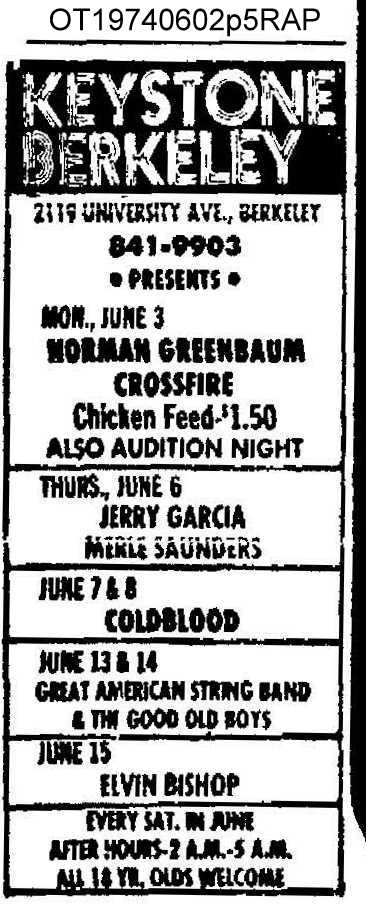
Good Old Boys at Keystone: June 14, 1974

I  just want to pin down some details of the Good Old Boys sets from June 13 and June 14, 1974, opening for Great American String Band. These come from tape that I have been able to audition but that is not supposed to circulate. Sometimes, a "hush-hush" approach is necessary to protect the innocent. That's not the case here - just gratuitous hoarding. I don't make the rules.

Good Old Boys
Keystone
2119 University Avenue
Berkeley, CA 94704
June 14, 1974 (Friday)

--early set main--
Blue Grass Breakdown (1)
Sittin' On Top Of The World (2)
Dim Lights, Thick Smoke (And Loud, Loud Music)
Deep Elem Blues
(3) I'll Never Make You Blue (4)
Jesus Loves His Mandolin Player #2 (5)
Pistol Packin' Mama (6)
Wild Side Of Life (7)
Uncle Pen
Raw Hide (8)
--early set encore--
Colored Aristocracy (9)
Back Up And Push

--late set--
Goin' Down The Road Feelin' Bad (10, 11)
Nine Pound Hammer (12)
Little Girl And The Dreadful Snake
Used To Be
Ragtime Annie
Roll In My Sweet Baby's Arms (13)
Jesus Love His Mandolin Player #34 (14, 15)
Crooked Judge

! Band: Good Old Boys
! Lineup: Frank Wakefield - mandolin, vocals;
! Lineup: David Nelson - -ac-g, vocals;
! Lineup: Robert Earl Davis - banjo;
! Lineup: Pat Campbell - bass;
! Lineup: Fred Weisz - fiddle;
! Guest: Richard Greene - fiddle (early show encore);
! Guest: David Grisman - mandolin (early show encore).

JGMF:

! map: https://goo.gl/maps/LDc43

! JGBP: http://jerrygarciasbrokendownpalaces.blogspot.com/2012/02/keystone-2119-university-avenue.html

! reference: http://deaddisc.com/disc/Pistol_Packin_Mama.htm Pistol Packin' Mama (Round RX-109 / RX-LA597-G, March 1976).

! metadata: None of the advertisements indicate separately charged early and late shows, but I think that's what happened on this Friday night at Keystone.

! (1) David Nelson: "Thank you. We're the Good Old Boys. We're the Good New Boys, actually now, we've got a new banjo player ... uhhh what is his name anyway? Bob Davis. We've been stealing musicians from other bands", etc. FW: "Here's one now that David wrote about fifteen years ago. It's called 'If I Miss You On The Matress, I'll See You On The Springs'. [crowd laughs] I had to say something funny."

! (2) Frank Wakefield: "I'd like to close ... really we're almost up here. We've got some very special guests here. And I'm not gonna introduce them right on the stage [inaudible]. Fred Weisz worked with him in 1960. Dave Nelson. Nelson:  "Pat Campbell. ... This guy over here ... from New York, hails from Manhattan New York. Frank Wakefield." NB they forget to introduce the banjo player, though I guess they just had (see note 1).

! song: "Deep Elem Blues": The GOB version is like the old Jerry & Sara versions and like the JGAB ones, which are based on the Red Allen/Frank Wakefield arrangement.

! (3) FW: "Here's one now that David wrote a long time ago."

! (4) DN, paraphrased/truncated: Right now Frank's gonna do one of his mandolin tunes Jesus loves up to bout 36. What we want to do is record them all at once. #2. FW, paraphrased: "Hey maybe I'll change. How many folks was in here last night? Can I see your hands. Don't want to repeat myself. Song we did last night. ... some slow parts and some real fast parts." More chatter. NB that they did, indeed play Jesus #2 on 6/13/74. More cross-validation, not that these dates needed it.

! (5) Nelson: [inaudible] "you can lock me up in jail, but you can't keep my face from breakin' out."

! (6): FW: "One that David wrote about fifteen years ago in San Quentin."

! (7) Fred Herrera: "David, we're running late." Then something like "let's do a nice ending" or "let's do a last number"

! (8) Nelson: "Thank you, thank you very much" and crowd cheers indicate this is the end of the set.

! guest: early show encore with Richard Greene (fiddle), David Grisman (mandolin).

! personnel: With Dawg playing, and if Nelson's still onstage, this might be the only known instance of them playing together (check Fillmore East GD 1970).

! (9) Someone says "We got one here called 'Back Up And Push'. Hope you all like it. I don't recognize the speaker's voice. Not Richard Greene, Grisman, Wakefield or Nelson. Richard Greene: "Hope you all like, uh, country music. 'Cause if you do, we get to disappoint you by playing other stuff. But not for awhile." Note that this whole "encore" piece is one continuous piece of tape. So the guy who announces "Back Up And Push" is onstage playing, I assume one of the GOB guys not named Nelson or Wakefield.

! song: "Back Up And Push" sounds a little like the melody to "This Land Is Your Land" and, I hate to say it, in places, like "Copacabana". Regardless, it's credited to Bill Monroe. http://www.youtube.com/watch?v=s6jFF0asxWM is an amazing version by Bill Monroe, The Father of Bluegrass (tm).

! (10) unknown speaker: "Thank you thank you, the Good Old Boys." Sounds like the end of an evening.

! (11) Nelson: "We're gonna have some strange guests, but I can't tell ya who they is. Right now we got over on the fiddle on the right hand side, Fiddlin' Fred Weisz. On the banjo, stolen directly from Western Union, (Frank: "The hills of Manhattan, New York") Bobby Davis. All right. He's never played with us before. He played with us about five minutes in the back room there, so we have to work out our arrangements onstage. I think he's doin' pretty good. Then uhhh I'm not gonna introduce. On the bass, another musician stolen from Western Union, Pat Campbell. He's doin' real good too. He's doesn't know any of our songs either. (Frank: "He probly wrote 'em.") But he probably wrote 'em, yeah. And on this little red instrument --whaddya call that please?-- (Frank: "Ukelele.") Ukelele, yeah. That thing's falling apart. I keep worrying about it. He puts his finger underneath the binding on the frets and it snaps off every set, little pieces ... bridge is on backwards ... From the hills of Manhattan, New York, Frank Wakefield." Frank Wakefield: "This feller on the git-tar here, he's from the hills of Tennesse. I believe you're from [inaudible] Actually, the fact of the matter is, he's from a big rock group, like Jerry is ... y'know, when he plays, he plays super banjo too, he plays super acoustic, David Nelson, from Easy Riders of the Purple Sage. Give him a hand, he'd appreciate it. ... I'm mad at y'all now, I'm mad at y'all 'cause he got a better hand than I did. I feel bad now." [woman in audience says "Nobody loves you, nobody [inaudible"] Frank, responding: "So, since she said that, here's one called 'If I Miss You On The Mattress, I'll See You On The Springs'. [laughter] Here's one that David wrote when he was with the Purple Sage, and still is."

! (12) FW: "Here's another one that David wrote a long time ago. If you folks know anything about folk music. David wrote [inaudible] he wrote one here a long time ago. What sparked that?" Nelson: "When I saw my first snake."

! (13) long banter. David Nelson: "Thank you. Thank you. A little ragged, but that's all right. Half of us don't even know the words to these songs here. But this one doesn't have any words, so that's OK too. Frank's gonna do a solo mandolin tune. He writes these mandolin tunes. I am not supposed to talk while he's tuning. He doesn't remember words ... he doesn't know what necessary means, for instance. And he says to people ..." etc. etc. while FW is tuning. "But he remembers all these tunes, these long classical tunes that he wrote." FW tuning and rap. "Last set I did two harmonies. Gonna do [something else] this set." The structure here makes me thing these were separately billed early and late shows.

! (14) Frank: "We're gonna do a thing now where a guy by the name of Robert Hunter wrote a song and David, me and David arranged that and we'll do some very special stuff on the mandolin and the git-tar. And it'll prolly be on this new record, I guess, too, right?" (Nelson: "Yeah.") And it's called the 'Crooked Judge'."

! (15) This is some great context. Fred Herrera must have an intercom from his little room, and you hear it click on and a guy says, in a hushed, golf-announcer voice, "Dave. Dave. (Nelson: "Yeah?") Hey. We're startin' to run kinda late. Two tunes or so. Then someone, it sounds like Marmaduke, says "Hey, uh, Freddie says [inaudible] late." Then "[inaudible, maybe "The man returns"], there's a hoot and cheer from the audience. Frank: "So we'll get David to do that judge song first. ... If you all saw the concert we did last Saturday, we did this'un pretty much the same way." NB that implies a gig on 6/8/74.

Good Old Boys at Keystone: June 13, 1974

I  just want to pin down some details of the Good Old Boys sets from June 13-14, 1974, opening for Great American String Band. These come from tape that I have been able to audition but that is not supposed to circulate. Sometimes, a "hush-hush" approach is necessary to protect the innocent. That's not the case here - just gratuitous hoarding. I don't make the rules.


Good Old Boys
Keystone
2119 University Avenue
Berkeley, CA 94704
June 13, 1974 (Thursday)
opening for Great American String Band

--set I--
ambience (1)
Deep Elem Blues
(2)  Earl's Breakdown
(3) I'll Never Make You Blue
(4) Jesus Loves This Mandolin Player #2
On Top Of Old Smokey
Pistol Packin' Mama (5)
Raw Hide

--set II--
ambience (6)
unidentified-GOB19740613-01
(7) Jesus Loves His Mandolin Player #1
Little Girl And The Dreadful Snake (8)
Bill Cheatham (9)
T For Texas (Blue Yodel No. 1) (10)
(11) Teardrops In My Eyes (12)
New Camptown Races
(13) Uncle Pen
(14) Sally Goodin (15)
A Voice From On High (16)
Back Up And Push [1:59] [0:03]

! ACT1: Good Old Boys
! Lineup: Frank Wakefield - mandolin, ?vocals?;
! Lineup: David Nelson - guitar, vocals;
! Lineup: Fred Weisz - fiddle;
! Lineup: Sandy Rothman - banjo;
! Lineup: Pat Campbell - ac-bass.

JGMF:


! setlist: I am confused about the structure of the festivities at Keystone this Thursday, June 13, 1974. Need to write it out at greater length than this info file will allow.

! expost: Philip Elwood, "From country to jazz – a snap," San Francisco Examiner, June 14, 1974, p. 27. He spells fiddle player's name Wiesz, but it must be former Greenbriar Boy Fred Weisz, who had bipolar disorder and might have been a street person around Everett, WA.

! song: traditionals: s1t02 "Deep Elem Blues"; s1t06 "On Top Of Old Smokey" (Trad., arr Wakefield); s2t10 "Sally Goodin"; count: 3.

! song: country: s1t04 "I'll Never Make You Blue" (Ray Cline, Charlie Cline); s1t07 "Pistol Packin' Mama" (Al Dexter); s2t06 "T For Texas (Blue Yodel No. 1)" (Jimmie Rodgers); count: 3.

! song: bluegrass: s1t03 "Earl's Breakdown" (Earl Scruggs); s1t08 "Raw Hide"; s2t02 "unknown-GOB19740613-01"; s2t04 "Little Girl And The Dreadful Snake" (Bill Monroe); s2t05 "Bill Cheatham"; s2t07 "Teardrops In My Eyes" (Red Allen, Tommy Sutton); s2t09 "Uncle Pen" (Bill Monroe); s2t11 "A Voice From On High" (Bill Monroe, Bessie Lee Mauldin); s2t12 "Back Up and Push"; count: 9.

! song: Wakefield originals: s1t05 "Jesus Loves This Mandolin Player #2"; s2t03 "Jesus Loves His Mandolin Player #1"; s2t08 "New Camptown Races"; count: 3.

! (1) Frank: "Actually, Fred Weisz and Jerry Garcia wrote this one."
 
! (2) Someone says "Bluegrass Stomp", and Nelson says "Yeah, how 'bout 'Bluegrass Stomp'?" Not sure what Wakefield says, but David says "Let's pick one." I think Sandy suggests "Earl's Breakdown", Nelson affirms, and Wakefield introduces it. "Here's one where Sandy does some ... if y'all ever seen a [inaudible] player uh accordion player twist some keys, he's gonna do this for ya." ?Sandy?: "Frank does a little fancy key-twistin' on this one, too." DN, laughing, "Watch his hands!"

! (3) Frank: "Here's another song that Sandy wrote, about his sweetheart. She broke his heart, and he's gonna break her darn jaw now, right?"

! (4) Nelson: "Thank you. Right now, Frank's gonna do a solo mandolin tune. I don't know if of you have him heard do it before. He writes these mandolin tunes that are like classical music. They sound like classical music, but not really, I mean, it's hillbilly classical. And he's got about 34 or 6 tunes written out, and they all used to be called "Symphony #94", since that was the only classical piece he'd ever heard, by Beethoven. ... 'Jesus Loves His Mandolin Player #2'." FW gives an explanation. Talks about NYC Ballet Orchestra.

! (5) Frank: "Thank ya. Now we're gonna play one called the 'Berkeley Waltz', then we're gonna take a little intersection [sic] and we're gonna come back and play some more for ya." Nelson, to FW: "Do you know that that word means? What's that word mean?" Frank: "Oh yeah, I forgot what that word means."

! (6) Frank: "I'm sorry, about six months. Can you hear it way back in the back alright? You need more volume? Is that loud enough now? [crowd guy: "'s'all right!"] Bless you, thank you."

! setlist: s2t02 is solo mandolin. It may be one of the Jesus songs, but I just don't know. Even Neil Rosenberg was stumped!

! (7) Frank: "That's an 8-string harmony, now we're gonna play some grass for you." David Grisman, I need to borrow your mandolin real fast. I just broke a string. David? Where you is?" Ballet Opera NYC. Gimme that mandolin!

! (8) FW: "Thanks a lot. Now we're gonna turn Fred loose, who's a super good fiddle player."

! (9) Frank: "Thanks a lot. Now we gonna do somethin' where this super good bass player, Pat, he's really good on the bass", etc.

!  (10) FW: "I'd like to thank David Grisman for loaning me this mandolin. Thank you."

! (11) FW: "Now here's one that David has on record. Him and the Purple Sage Dust."

! (12) FW: "Here's one that David here wrote a long time ago. One called 'New Camptown'. What inspired you to write it, David?" Nelson, off-mic: "Who you talkin' to?"

!  (13) FW: "Here's one that Fred Weisz wrote a long time ago, that he does on the fiddle, called 'Uncle Fred'."

! (14) unknown speaker (not FW or DN): "Here's a little Sally Goodin, we'll get Fred to play a little piece of pie."

! (15) Freddie Herrera: "David ... David ... David ... David, We're starting to run late." FW: "We feel so unnecessary." Nelson: "Hey, what's unnecessary mean?" Freddie: "David, can you hear me?" And they answer with "I Hear A Voice A Callin'!" Perfect!

! (16) Freddie: "Dave. Dave. Can you hear me? Dave? Dave. I'm down here. We are starting to run late, we have time for maybe one more tune at the most." DN, to band: "Oh, we have one more tune."

Friday, October 30, 2015

Jerry and Sandy's Adventure, May 1964

http://jerrygarciasbrokendownpalaces.blogspot.com/2015/10/jerry-and-sandys-adventure-may-1964.html

I don't do pre-Dead stuff, but this of course interests me because, as a member of the JGAB, Sandy Rothman interests me.

Great archaeological work by JGBP, and thanks to Sandy for sharing his recollections for public consumption!

Monday, May 25, 2015

Jerry Garcia Transcribing Lenny Bruce

I had completely forgotten that in 1964, upon returning from his bluegrass road trip with Sandy Rothman, Garcia got a job transcribing Lenny Bruce's comedy routines for Lenny's various legal defenses. So cool.

! ref: McNally 2002, 73.


Tuesday, December 16, 2014

NRPS 12/15/73 Winterland w/ guests


Uhhh, wow.

The amazing NRPS archivist Rob Bleetstein not only responded to my query about the source for the NRPS official concert history listing that shows Garcia (guitar) and Sandy Rothman (banjo) sitting in with the New Riders on "Glendale Train", 12/15/73 at Winterland (see also Corry). I say, he not only responded to my query, he went ahead and posted video of the thing at YouTube.

Check it out.

Thank you, Rob.

Since this is JGMF, I'll allow myself a few Garciacentric observations.

Our Hero steps up for a little twirl from about 4:45ff, on Marmaduke's invitation. Not that there's any doubt about provenance, but he's beardless, as he should be during this particular period, wearing what I can only think of as an "Atlanta" dye, similar in pattern to what he wore on 5/10/70.

This is a great little piece of evidence around Garcia's traveling habits. One might have thought he'd stay in the southeast between the Dead's gigs in Atlanta on 12/12 and Tampa on 12/18, but no - back home he goes. Since it seems a safe assumption that the Dead's gear didn't need to breathe the salt air of The City, and thus stayed in the east, Jerry doesn't have his regular guitar, and is playing one I don't recognize here with the New Riders - I assume it's one of Nelson's. Gear heads (not me!) take note.

Sociometrically, I believe this is the only known Garcia-Rothman shared stage until Thanksgiving 1986 (which wasn't really a stage, but was a performance together in front of other people). Garcia would sit in again with the Riders a few months later, at Keystone Berkeley on 2/2/74, and as far as I know would not play live with Nelson again until the same Thanksgiving '86 reunion.
Wow. What a world we live in. Thanks again, Rob!

Wednesday, November 17, 2010

The Birth of the Great American Music Band

Editor's Note: I should point out that the timing of this post was inspired by Corry, who has recently posted on the misty origins of OAITW and who earlier had posted on what might have been the "public debut of a very important band," the GAMB. While I think this post casts a different light on the "public debut" question, I am of course indebted to Lost Live Dead!

I am going to offer and try to defend the hypothesis, just articulated, that the Great American Fiddle / String / Music Band was "born", as recognized by David Grisman at least, on Saturday, March 9, 1974 at the Great American Music Hall in San Francisco, CA. I will try to post separately on the convoluted tale of the band's name.

Let me start by reproducing a calendar listing for the show from the Hayward Daily Review:

We see the following two listings:
  1. Saturday, March 9, 1974: Richard Greene, David Grisman, Vassar Clements and Skunk Cabbage; Great American Music Hall, SF, CA; two shows.
  2. Sunday, March 10, 1974: Richard Greene, David Grisman, Vassar Clements and Skunk Cabbage, Great American Music Hall, SF, CA (NB 6 p.m. to midnight)
I believe the first listing is effectively the first GAMB show, and the second is the first with Garcia. Let me lay it out for you.

First, let's recapitulate David Grisman's various tellings of the birth of GAMB.
A gig came up at the Great American Music Hall which was supposed to be Richard Greene and Vassar Clements, each with his own band. Richard asked me to play with him, so we got Eric Thompson on guitar, Sandy Rothman on banjo, and Bing Nathan on bass. Some promoter got a local group called Skunk Cabbage to back Vassar, and on the afternoon of the opening night both bands played a radio show. After Skunk Cabbage heard us play they said “We can’t play with Vassar; he belongs with you guys.” … So they opened the show for us, and we had Richard and Vassar and called it the Great American Fiddle Band. The second night Jerry Garcia played banjo, and Sandy Rothman switched to guitar. Bing Nathan couldn’t make the second night, so Taj Mahal played upright bass. Another musical friend of mine, David Nichtern … had been interested in my stuff … So he showed up the second night (ref 1, p. 34).
Richard Greene and I had a gig at the Great American Music Hall with Vassar Clements and his band, so we called it The Great American Fiddle Band (ref 2, p. 26).
The first quote establishes that Greene, Vassar and Grisman were at the GAMH together for two nights, with Vassar slated to play with Skunk Cabbage. That looks an awful lot like the March 9-10 listings. He also says that Garcia didn't show up until the second night, which is consistent with Jerry and Merl being in Berkeley on the Saturday night (March 9th).

Second, note the 6 pm - midnight billing on Sunday night. This was clearly something special.

Third, I have independent evidence that Grisman and Vassar were interacting with Jerry at precisely this time. There was a Round Records recording session at Columbia Studios, San Francisco, on Friday, March 8, 1974, from 11:00 a.m. until 2:00 p.m. involving Vassar and Grisman working on "Lonesome Town", "Indiana," and "Russian Lullaby". The first and last of these appeared on Garcia's Compliments, while the middle one is probably "Back Home in Indiana," which appeared as a Compliments outtake on the incredible All Good Things boxset.

Fourth, there is the tantalizing little 7-minute snippet of Stinson Beach rehearsals featuring David Grisman, Richard Greene, Jerry Garcia, Eric Thompson, Bill Wolfe, and maybe others, that is dated March 8, 1974. They work through "Sweet Georgia Brown" and "Limehouse Blues," both of which were staples in the (too brief!) GAM/SB repertoire. Related, there is independent reason to believe that there are four reels' worth of materials labeled "Grisman's House", with this date, in the Garcia vault.

Fifth--and this to me is just the sweetest batch of evidence-- there is a fascinating set of fly on the wall recordings, a few hours' worth, labeled only "Bluegrass at Grisman's," that I think is relevant here. It's a mix of material, including some work-throughs of OAITW material (presumably from ca. early 1973) and some other stuff that sounds more like OAITW. But there's at least 20 minutes, and maybe more, of stuff that is clearly proto-GAM/SB, including very early run-throughs of Grisman's (eventually, but not yet!) amazing "Dawg's Rag." Sandy Rothman seems to be present for some of this, and Grisman, Greene and Garcia are omnipresent.

Now, here is the real kicker. At one point during this GAM/SB-ish material, we have the following exchange between what sounds like an older southerner and Garcia.
Older southerner: "Jerry, everybody, I'll see you bright and early tomorrow. You're playin' a gig tomorrow night, then?"
JG: "Yes I am, yeah."
Older southerner: "Sunday you'll be there."
JG: "Yeah, Sunday I'll be there."
Ladies and gentlemen, I am prepared to call it QED on this basis. This material is from March 8, 1974. Grisman and Vassar do a morning studio session for Garcia for a little payday. Then everyone heads over to Grisman's in Stinson Beach. We already know, from point three above, that a bunch of guys are playing proto-GAMB in Stinson Beach, and uncirculated tapes suggest it's at Grisman's house. It sounds for all the world like someone's living room, including side conversations, phone calls, etc. The southerner gives us days of the week: "tomorrow", a Saturday, when Jerry cannot be there because he has a gig, and then a Sunday when he will be there. Those are clear references to March 9 and March 10. When we circle back to Grisman's account (first quote above), it all fits together perfectly. Note that he mentions both Sandy Rothman and Eric Thompson as being involved with the GAMH gigs. Well, here we have Sandy with these guys on the "Bluegrass at Grisman's" recording, and Thompson listed on the 7-minute snippet that David Gans shared with the world on the amazing (if perhaps presently a bit troubled) KPFA. Way too much coincidence not to be correct, IMO.

In conclusion, the evidence overwhelmingly points in favor of the proposition that GAMB was born on March 9, 1974, and Garcia first joined in on March 10th.

One last thing: it sounds like it was a helluva a great show. One account based on interviews with Grisman refers to the legendary 1974 GAMH gig with a "monumental jam" featuring Grisman, Greene, Vassar, Garcia, Fierro, Nichtern, and “from these jams, the Great American String Band was born" (ref 3). Having Fierro in with those guys would have been interesting, to say the least. I hope he just brought the flute and left the sax at home! I have also heard tell of an incredible rendition of "Wild Horses" played by the GAM/SB with Sandy Rothman around this time frame, taped by Betty but with no tape in circulation, which I believe must be from this night. Sounds like fun! Set time capsule ..

REFERENCES:
  1. Forte, Dan. 1979a. David Grisman: Taking the Mandolin Beyond Tradition. Frets 1, 1 (March): 30-36.
  2. Juanis, J.C. 1992. Dawgwood Revisited. Relix 19, 6 (December): 25-27. 
  3. Sharpe, Ted. 1977. David Grisman: Mad, Marvelous Mandolinist. Blue Sky Review no. 7: unpaginated.

Sunday, August 29, 2010

How JGAB Ended

Can't believe I have never posted about the Jerry Garcia Acoustic Band (JGAB), a.k.a. the "Black Mountain Boys" (1987 model), a.k.a., in a weird little Bill Graham marketing campaign, "Jerry Garcia: The Band Acoustic". This is the wonderful band consisting of Jerry (ac-g, vocals), John Kahn (ac-bass), David Nelson (ac-g, vocals), Sandy Rothman (dobro, mandolin, vocals), David Kemper (drums), and sometimes Kenny Kosek (fiddle). I won't get into the details of the configuration's origins and playing history here, though it's a neat story from a neat time in Jerry's musical life.

Instead, I just want to say one thing about how the JGAB ended, based on a just-completed read of a great Sandy Rothman interview from ca. 1989 (1).

Sandy says that the JGAB was supposed to do a studio album, but ended up with the live album (Almost Acoustic) instead because the planned studio time never materialized. This was "partly because Jerry was in high gear on a couple of other projects and partly because a certain enthusiasm about playing with these old buddies had cooled off ...” (1, p. 18).

This last phrase really intrigues me. It's never been clear how the JGAB ended, though like so many other Jerry configurations it may just have withered for inattention. There were a few super-fun shows in the summer of 1988 (early and late shows at the tiny Cabaret Cotati on July 7th, and a sweet show at the Frost Ampitheatre on July 9th), and then nothing more. Ever, AFAIK.

The way Sandy phrases this interests me, too. The phrase "a certain enthusiasm" and the use of the passive voice are both constructions that seem intended to obscure whatever agency lay behind the sentiments. We are not told whose enthusiasm this was that had cooled off, less still why..

So my simple question, almost certainly strictly rhetorical, is this: Jerry's, or the GD's?

REFERENCE:
(1) Juanis, Jimbo. 1989. Old and Even More in the Way: An Exclusive Interview with Sandy Rothman. Relix 16, 2 (April): 15-18.