(formatting will almost certainly be a mess - I blame Blogger)
I.
Preface
My band is in a state of flux right now. John Kahn and Ron
Tutt and I are the main … are the nucleus of it, such as it is. We’re hoping to
have a four-piece band that we all like, sometime. So far, the combinations
that we’ve tried have been interesting, but not exactly where we’re trying to
go musically. And so that’s, we’re waiting – we’re more or less auditioning
keyboard players, playing with different people.
– Jerry Garcia to velvet-voiced KSAN-FM DJ Bonnie
Simmons, live in studio the afternoon of January 23, 1976, via GDAO
The demise of 1975 marks the end of the challenge-seeking
phase of Garcia's Side Trips, and 1976 marks the start of a comfort-seeking
phase. The transition was abrupt, but it was not instantaneous; it most
directly took place over the month of January 1976. Armed with some fresh data
from the GD Archives, I annotate a chronology of this liminal month.
II.
The Pivot of 1975-1976
Time powerfully constructs the human experience. Just
think of the importance of the concept of a week, in our everyday lives, for a
demonstration. Years, with their added relationship to the physical universe, do so even more so.. Ever the dilettante, I get my general sense of
this from Boorstin (1985), but here's what some recent science (Tu and Soman
2014) tells us (Korkki 2015).
In one study, conducted in 2010, the researchers asked two
groups of farmers in India to set up a bank account and accumulate a certain
amount of money by a deadline, offering extra money as an incentive. One group
was approached in June, with a deadline of December that year. The second group
was approached in July with a deadline of January the next year. The farmers in the first group were more likely to set up an
account immediately, even though both groups had the same amount of time.
That’s because the deadline was in the same year as the assignment and
therefore seemed more like the present.
The turn of the year is the big one. At the level of the
day, shit happens on New Year's Eve; legion is the New Year's Day on which we
wake to find that "new shit has come to light". Variance is probably
higher across that pair of consecutive days than any other in the calendar.
1975-1976 is to years as 12/31-1/1 is to days. No two
consecutive years in Garcia's life outside the Grateful Dead differ more resolutely
than this mismatched pair. His personal life sees a sharp break, as he leaves Sans Souci (and Mountain Girl and their girls) right around Christmas 1975 and
moves in with Deborah Koons right
around the start of the year. (It's no coincidence that relationships end and
begin with particular frequency in liminal times – again, that's probably the
time structuring us, and not the reverse.) Pharmacologically, and though the
precise dates are not known, by many timelines, including my own, late 1975
marks the entrance of Persian as a regular part of Garcia's life. If 1975 is
the year he gets hooked, 1976 is his first year as an addict to the ultimate
comfort drug, the poppy. Socio- and musico-metrically, Merl Saunders and the jazz-funk parts of the JGMS/Legion repertoire
exit stage right, and David Grisman
leaves the Garciaverse for the next fifteen or so years. Nicky Hopkins (three-plus months) and James Booker (three-plus days) fugue through, and we land on Keith and Donna Jean Godchaux and their
slower, swampier, gospel sensibilities.
It's the musical break that really interests me.
The demise of 1975 marks the end of the
challenge-seeking phase of Garcia's Side Trips, and 1976 marks the start of a
comfort-seeking phase. Thereafter, challenge and comfort ebb and flow
together, and this is how I mark the course of the Side Trips (
"Musical
Challenge in the 1970s"). Local peak in 1979 (
"Risky
Reconstruction"), way too much comfort until the next great breakpoint
("1986, Coma and Recovery", xxx-WIP), a little rise thereafter
("Great Late Jerry", xxx-WIP) and then the roll downstream, the final
Grisman re-engagement a rare distillation, longer on both dimensions, deeper in
amplitude. In the end, of course, there's quiet.
All is not sharp lines. The human quest for novelty (i.e.,
Challenge!) drives up from way deep down, from primal places, and at least, because
of the Booker experiment, it went out with a creative bang, ten days into the
new year. Time undertakes fine needlework across our phony seams. Knowing that
this is not a 12/31-is-black-and-1/1-is-white state-change invites me to get up
a little closer to inspect the stitching. Hearing Garcia confirm "my band
is in a state of flux right now", plus a productive research trip to the
Grateful Dead Archives, supplies some concrete motivation and raw material.
Accordingly, let's drill down to the literal meso-level, the month, for a
granular look at a critical juncture.
III.
January 1976 and Its Legacy
In the challenge-comfort transition of 1975-1976, January
1976 is liminal, embodying massive challenge-seeking (hello, James Booker) and
massive comfort-accepting (hello, Keith and Donna Jean). Within the span of a
month, Side Trips Jerry of the 1968-1975 flavor (tastes like acid) gave way to
a very different model, tasting more like cough syrup and one which, all cards
on the table, I find rather less compelling than its predecessor. Don't get me
wrong, Garcia was still doing amazing things, and working maniacally, on a
day-in and day-out basis. But, as far as his musical life outside the Grateful
Dead, his Side Trips, go, I will argue strongly that he "settled"
when the Godchaux Era JGB was allowed to form. (Note the passive voice.) I
don't know that the alternatives really were – laying at least some of them out
will be a chunk of what I will do below. But the (non-) decision was not, to my
taste, musically salubrious, the band trying to lumber through and around its
members' various and sundry heavy loads. Though it has its moments, it took 18
months, the advent of great new material for Jerry's first Arista record (eventually,
Cats Under The Stars)
and the departure of stalwart Ronnie
Tutt for the band to shake loose of its general torpor and find its groove,
which it would then have about a year to really enjoy.
A. Background:
End of the Hopkins Era
Most importantly, at least in terms of our innate desire not
just to see variation (see above), but to account
for it, we don't really know why it happened. The standard account has it that
Nicky was just too out-of-control and had to go. Because I am not a big fan of
the show, I have harbored the idea that 12/31/75 was just the straw that broke
the camel's back. But I now believe that Nicky's tenure with the JGB, despite
the existence of a formal business partnership (Jerry Garcia, John Kahn, Ron
Tutt, Nicky Hopkins dba Jerry Garcia
Band), was always probationary, at best, and perhaps even foreseen as
temporary. I am elaborating the evidence in work in progress.
This preliminary view sheds new light, in my eyes, on the
dawn of January 1976. If I am right, the unpleasantness of ending things is
already at least several weeks back in the past; a reasonably fresh start is
possible. Let's see how it went down. (I will be trying on some weird
interweaving of headings and such here, not sure how success it will be.)
B. Chronology
1. Welcome to 1976, the Bicentennial.
January 1, 1976 (Thursday)
Good morning, Belvedere! (Garcia has moved out of the
Stinson place he shared with Mountain Girl and moved in with Debrorah Koons,
apparently in Belvedere. And, no, I don't actually know where he woke up on
1/1/76, but if you do I certainly invite you to email me! ;-))
January 2-5, 1976 (Thursday-Monday)
No sign of our hero this weekend. Good – young man, not that
young now at 34, is working very hard; he really has earned a break. I hope he
took one.
2. Junco Partners
January 6, 1976 (Tuesday)
James Booker flies in on Delta 928, according to Steve
Brown's notes.
I
am not sure who paid for the ticket.
Kahn:
He came to my house in Mill Valley a couple of days before
the gigs. First he didn't show up until 5 in the morning. Me and Jerry were
there and we're getting calls from his grandmother and his priest — Booker had
gotten lost en route somehow; they'd lost track of him. Finally I got a call
and it was Booker himself. He was calling from Dan's Greenhouse, a liquor
store. He was in front of there at 5 in the morning with an overcoat and no
socks and a hat bag; that was it — no clothes. He had about 30 eye patches and
eight or nine wigs.
I am not 100% sure how to piece the airline info together
with a) what we are told about Booker's arrival and b) the fact that during the
1/7/76 rehearsal Booker refers to stuff they worked up last night", i.e.,
January 6.
This could indicate that the 1/7/76 material is mis-dated, and is really, say,
1/8/76 (see below), or that Kahn is mis-remembering something.
January 7-8, 1976 (Wednesday-Thursday)
Rehearsals with James Booker.
shnid-28366 delivers 90 minutes of
tape from a rehearsal, said to be at 20 Front Street ("Club Front") on
January 7, 1976, of Garcia, Kahn, a drummer (presumably Tutt) and the great
James Booker working up some material.
Corry
is skeptical and thinks they might have taken place in John Kahn's living room,
but I note that Steve Brown's papers locate 1/24-25 rehearsals at "Front
Street" (see entry below), making it more likely that these were there,
too. These rehearsals are well worth a listen (see my
listening notes). Booker's mad brilliance, which I
have parsed a little in
"James
Booker, Classified", fully displays itself; this is a great piece of
tape in the too-sparse Booker record, to say nothing of the Garciaverse.
The following tunes appear:
Tico Tico
Don't Try To
Be Your Brother's Keeper
Something
You've Got
Just a
Closer Walk With Thee
Goodnight
Irene
United Our
Thing Will Stand
Classified
->
Right Place,
Wrong Time
Slowly But
Surely
The Booker originals are pretty stunning (I especially love
"United Our Thing Will Stand", "Classified", and "Slowly
But Surely"), but the whole set is all Booker: his material, his
direction, his hilarious banter. If I can sometimes hear the sounds of Garcia
smiling behind his beard, maybe scratching his head, through his guitar
playing, I definitely get that here. Fascinating. And not to be gainsaid,
either – part of the "Burden of Being Jerry" (Gans and Greenfield
1996) -- is that, after about this time, he could no longer just be a guy in
the band even as,
in
Reconstruction a few years later, he might have tried. Here he gets to back
one of the true greats ever to grace a bench – the Bayou Maharajah, James
fucking Booker.
January 8, 1976 is the contract date for the weekend's gigs,
though the copy I saw was not signed.
January 9-10, 1976 (Friday-Saturday)
Newly rehearsed, the band plays weekend gigs at
Sophie's, 260 S. California Avenue
in Palo Alto (
94306). The contract with
impresario
Ken Rominger (who also
ran the Bodega at 30 South Central in Campbell) is $500 guaranteed against 90%
of the gross total receipts. (Is that ticket sales only, or would it include
bar?) I don't have ticket prices for the night, but they might have been $4.50
or 5 bucks. I have the room capacity at 420 as Keystone Palo Alto from 1977,
though there's a sense it might have held fewer in this earlier incarnation. If
we call it 400 and we assume they shows sold out (?), that would have been
$4,000 gross for the weekend, so $3,600 for JGB.
Note that the paperwork shows Nicky Hopkins in the Garcia
Band, which puzzles me a little bit, given that the paperwork is dated January
8th. I presume there were no real plans that he should be there,
that his name was there as a placeholder and/or boilerplate, but I don't quite
know.
Kahn
described
the weekend's gigs to Blair Jackson:
The shows were really cool. But he wouldn't learn any of our
songs. We tried to teach him songs and he refused. He was a little crazed, so
we ended up doing mostly his songs. He did half a set of solo piano and it was
great; you could hear a pin drop. And he played things like the "Minute
Waltz"; it was incredible. He could still play great. He could switch
between piano and organ really easily and it would sound amazing. But he was
out of his mind. He was watching cars go by and was checking out license plates
and talking about the CIA. He saw a Louisiana license plate and then John
Kennedy's name somewhere and that freaked him out. He saw bad omens everywhere
and he was getting really weird. I didn't know he was that crazy, so I might
have had delusions that we'd stay together longer.
Cryptdev attended on Friday the 9
th and
offers
a convergent narrative:
It was one of the wildest and weirdest Garcia shows I ever
saw. Basically Booker took over and the rest of the band was doing their best
to keep up with whatever poured out of his keyboard. Booker was clearly very
lubricated with something(s) and spent the break at the bar imbibing
prodigiously. Jerry did get in a few tunes from his usual repertoire at the
time, but clearly with some difficulty.
The first night circulates from soundboard tape derived from
copies long in private hands in the East Bay (
shnid-8386), as I understand things. Highlights
for
me include Garcia navigating some relatively unfamiliar classical and
operatic terrain, as snippets of "Für Elise" and "Flight Of The
Bumblebee" tumble from Booker's fingers and, especially, a nice wide
version of his original "Classified", which finds some nice space and
signposts what might have been, musically.
The second night circulates from an audience tape (
shnid-8077 |
listening
notes), which includes more evocative nuggets of musical Americana
(trifectal "Junco Partner" is in the road-, drug-, and prison-song halls of
fame) than transcendent musical moments.
If you want to hear Garcia play New Orleans style, if you
want to hear every note you can of the great James Booker on the keyboards,
check them both out. They're a mess, but then again, aren't lots of the
interesting things?
Corry
sums:
"The two-date James Booker experiment remains as a curiously forgotten
fork in the Jerry Garcia Band, a final ride down the Genius Highway before a
U-Turn back towards more conventional territory". The End Of A Very Brief
Era.
3. Interregnum
January 11, 1976 (Sunday)
Grateful Dead band meeting.
Yes, they had those. Regularly.
January 13-14, 1976 (Tuesday-Wednesday)
January 14, 1976
Noting they'd already spent $100,000 and needed $400,000
more, Ron Rakow sends a letter to United Artists asking the firm to back the
film project.
The program aired at 1 PM on January 31st.
January 20-22, 1976 (Tuesday-Thursday)
Film house.
4. My band is in a state of flux right now
January 23, 1976 (Friday)
About midday, Garcia heads to the KSAN studios in the city
and does a live interview with the delightful Bonnie Simmons (Simmons 1976, via
GDAO), ostensibly to
promote his forthcoming record
Reflections
(
Round RX107, February 1976).
Her "tell me about your band" elicited the epigraphed response. I
hate to treat him like an oracle, but for purposes of this blog, which focuses
on Garcia's musical life outside the Grateful Dead, this is very important
material – he was rarely asked and less often spoke about his side bands, let
alone at such a fluid time. So I'll unpack it a little, representing in a way
that's more narratively convenient for me.
5. "John Kahn and Ron Tutt and I are the main … are the nucleus of it,
such as it is"
They seem to have formed this nucleus upon Tutt's arrival
(with the formalization of a band name, Legion of Mary), and at this time the
nucleus probably included Merl, who had been doing "Jerry and Merl"
paperwork for sometime. When Nicky arrived he joined the core group, but when
he spun out his name pretty quickly came off the fictitious business name
statements. Garcia, Kahn and Tutt remained, dba
Jerry Garcia Band.
Is Bonnie implicitly asking "Why did Nicky leave/Why
was Nicky let go?" Given how big a name Nicky was and the utter absence of
information about his abrupt departure, I have to think she is. Regardless,
I'll proceed as if she is. The JGB's problem, Blair Jackson writes, "was
Hopkins, who besides being a major cokehead -- not an issue where Garcia and
Kahn were concerned-also had a severe drinking problem. This is why he
occasionally rambled on incessantly between songs onstage, muttering
incomprehensibly in his thick British accent, and why by year's end he was out
of the group" (Jackson 1999, 270). Blair lays out John Kahn's elaboration
for why "it didn't work out".
Tutt really didn't like Hopkins, and after a while he blew
Jerry out, too, because he was just too over the edge; he was too fucked up to play music. That's the line where you've gone too
far. At this Winterland show [in December 1975] he was on another
planet, playing in the wrong key, and you just couldn't get to him. He sort of
wrecked that whole gig. Tutt was really mad (Kahn in Jackson 1999, 271).
Thankfully, Jerry would never have narrowcast that sort of
slight over the short wave of a conversation, less still broadcast it over
KSAN's 35,000 watts. He keeps it simple:
6. "So far, the combinations that we’ve tried have been interesting, but
not exactly where we’re trying to go musically"
On its face this could sound like the "irreconcilable
differences" of the musical vocation, a catchall, a nostrum. But I find it
an informative little kernel, consistent with what John told Blair. Musical
problems, in the end, are the one thing that can't be overlooked. He could have
said that Nicky was pursuing other opportunities – everyone would have been
ready to hear that the Session Man had some big jobs lined up, whether that was
true or not. Instead, hearing Garcia say it leads me to think that it
"really" was so simple as that, by whatever means, stuff was getting
in the way of the music.
I don't think of this question and answer in terms of James
Booker, because no more than a few hundred people at most were aware of his
connection to Garcia. But everything I said above Nicky above applies to Booker
by analogy, each the driver of his particular rig down the "Genius
Highway" (Corry). And the Booker experiment was certainly interesting, no
doubt about that.
To what extent, if any, is Merl implied in this answer? I
don't know. I don't get the sense that Jerry intends this explanation to go
back that far. But then again, it's only been five months, so maybe it does
cover Legion of Mary. Hell, maybe after playing almost five years together,
"what happened with you and Merl?" might be the real $64,000
question. Toward the end of the interview, in a question put by a fan (via Ms.
Simmons), Garcia is asked about playing again with Merl. He says "Yeah, if
it's the right situation", without further elaboration. It must have been painful
for him to be broadcasting his need for a keyboard player, while clearly not
preferring this particular one that's ready-to-hand. Reconstruction would
reconstruct their musical partnership, for a time, but that is almost three
years in the future.
7. "we’re more or less auditioning keyboard players, playing with
different people"
My initial reaction to this was something like "Well,
you didn't try very hard", since only the Booker tryout has been known.
Who else, I asked myself, did they bother trying out? How active a search was
this? Did they "audition" anyone else?
Corry
once wrote about a mysterious episode, October 11, 1975 in which a second
pianist sits in and is introduced by Nicky Hopkins as "Tim Hensley",
in his "first gig with the band"; he sticks around and plays again
the next night. He offers various kinds of speculations about why the band
would try out a second keyboardist while Nicky was apparently on board, and
what might have gone down. Hell, until reading this you don't even know who
"Tim Hensley" is, and that's because drunk Nicky mis-slurred
Tim Henson's name. Corry has kindly
shared some thoughts via email, including this
link
with more information about this very talented man, a member of the famed
Muscle Shoals rhythm section, shot to death on Christmas Eve, 1977. I am not
sure whether the fact that he didn't stick makes it more or less likely that he
might have gotten a call in January. Either way, if we're drawing up a roster
he might need to figure.
We presume that
Larry
Knechtel could have been another candidate. Of course he appeared on
Reflections, and a February ad for the
record introduced him as a
member of the Jerry Garcia Band (
Village Voice, February 16, 1976, p. 117).
My hunch is that this just reflects old, ambiguous, indifferent copy, possibly
desperation (leveraging Bread!), and not any real information from inside
Garcia HQ. But there must have been some chatter about Knechtel
joining the band, maybe coming out on tour. Since he doesn't remember anything, and no-one else has ever
said, this has to remain pure speculation.
There's one other name I can add to the mix, and as with the
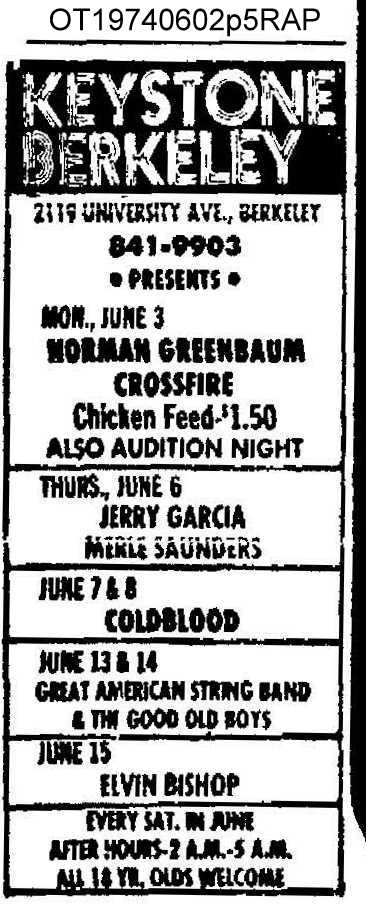
others I can only mostly speculate. Steve Brown noted Garcia Band gigs January
26-28 (see below) as "Keystone with
Randy
Wallace", with the latter name crossed out and Keith and Donna
substituted.
Who is Randy Wallace? I have no idea. Did he ever play with Jerry (e.g., at the
1/24 rehearsal)? I don't know that, either. What happened to him? Your guess is
as good as mine. But apparently things were far enough along with him that Garcia's
business manager wrote down his name.
One final set of points for now from the Bonnie Simmons
interview. The pretext for the visit is to promote the forthcoming
Reflections (
Round Records RX 107, February
1976). They play pretty much the whole record and talk about it. Again,
that's why they are there. Bonnie's question "Do you have any upcoming
gigs?" is supposed to elicit a response like "Well, yes, Bonnie,
we'll be at the Keystone Berkeley next Monday through Wednesday, come check us
out." But when Bonnie asks him about upcoming gigs, he either willfully or uncomprehendingly relates it to the Dead and the group's still nebulous plans
to start playing live again.
Given that the historical record shows (see below) that the
Jerry Garcia Band, whose leader Jerry Garcia was about to drop a new record,
indeed did play locally three days after the interview, and given that they are
together in a promotional context, why didn't Garcia mention the gigs?
One possibility is that he just forgot. Another is that they
hadn't been booked yet, though I doubt that (see the next few days' entries).
Still another is that, because this was basically an audition, he didn't want
to bring out too many people, put that pressure on the new (presumed) guy. A
fourth, not contradictory with the previous one, is that he didn't know who the
new guy would be, and was hedging in case he had a dozen wigs, and maybe needed patches over both eyes, but, unlike Booker, couldn't play. Whatever the case may
be, I entertain the idea that Bonnie's question, or rather his inability really
to answer Bonnie's question about upcoming gigs, may have spurred what we see
over the next few days.
8. State Change
January 24, 1976 (Saturday)
If forced to choose, I'd say the tide turned, and the switch
from challenge to comfort was proximally effected (like very nearly in the
"pulling the trigger" sense) on this date. See next entry.
January 24-25, 1976 (Saturday-Sunday)
Steve Brown's papers identify Front Street rehearsals on
these dates.
Nothing else is known about the 24
th. Soundboard tape of 1/25/76
circulates,
and
it finds Keith at the keys and Donna Jean singing harmonies, including quite
nicely over multiple takes of the
Porter
Wagoner –
Dolly Parton smash
"Tomorrow Is Forever". (Dolly, by the way, was Jerry's "favorite
girl singer", per McLanahan 1972).
But, uhh,– Keith and Donna? WTF? How did that happen?
More below, but first let me step back.
Also on Sunday 1/25, the
Oakland
Tribune runs listings for Garcia Band at Keystone starting the next day and
running through Wednesday (i.e., January 26-28).
This must have been called in the day before at the latest, i.e., on Saturday
1/24. Again, this puts Garcia's non-response to the question about upcoming
gigs in sharp relief. Speaking on Friday, he could have forgotten there were
gigs coming up to start the next week. But I don't think so. It's also possible
that the gig was not planned when Bonnie asked the question, but was spurred by
it – signaling to Jerry that he needed to start shitting or getting off the pot
when it comes to the band-in-flux. Somehow, though, I think it's that he wanted
to keep a real quiet couple of nights in Berkeley, less pressure on whoever's
auditioning. Monday-Tuesday-Wednesday shows? That's typically how they
structured the first shows out for new (or temporary) players, especially if
they didn't manage to book off the beaten path, in Cotati or somewhere.
Summarizing the arc of the weekend: On 1/23 Garcia either
forgets the gigs or, perhaps because they haven't pinned down who will be on
keys, he just doesn't mention them. By 1/25, they have advertised gigs starting
the next day and they are rehearsing with Keith and Donna. 1/24 Looks like the
inflection point to me.
January 26-28, 1976 (Monday-Wednesday)
The Garcia Band System, such as it was, involved breaking in
new or temporary players on off-nights, off-the-beaten-path, or both. A
Monday-Wednesday run at the Keystone fits the bill perfectly. Though the first
night has been in some question,
I don't see any reason to doubt it, first because it's advertised in the
Trib and second because (though this is
not necessarily independent of the listing), it's in Steve Brown's notes.
Originally noted by Steve Brown as "Keystone with Randy Wallace", he
later crossed that out and substituted Keith and Donna.
But what happened to …
"… we’re hoping to have a four-piece band that we all like,
sometime"
That's what Jerry had said on 1/23. Somewhere in advance of
that, Brown wrote that Randy Wallace was to be tried out. Yet, on 1/25 Garcia's
doing his best Porter to Donna Jean's Dolly, in a five-piece band, 3/5 of the
members of which are in the Grateful Dead. WTF? You're Jerry Garcia, you have
most every keyboardist in the Bay Area at your disposal, and many beyond, you
are looking to put together a quartet, in your project generally aimed to
delivering things you can't get out of your playing with the Dead, and you end
up with the Dead keyboardist, neighbor down the street, and, oh, by the way,
you're a quintet because you got his old lady (again, Dead), in the deal. The
Garcia Band is made more of a redundancy, the Italian Senate of the
Garciaverse.
C. JGB
#2 Membership
But this gives me an opportunity to play with concepts and
words that matter to me. Like all human scoeities, the Jerry Garcia Band was stratified.
At the apex, of course, stood its namesake, a very consequential Head of State,
with his Prime Minister John Kahn, his right-hand man, running the show
day-to-day. Ron Tutt joined them in the ownership group. Nicky Hopkins had
been, but eventually he buys or is bought out, and his name disappears from the
papers. (I have never seen any contracts, fictitious business name statements,
or anything else that might clarify the details of how, precisely, these gents
were
dba Jerry Garcia Band, despite
years of searching. I know the formalities only through
tax liens
against the band and its members.)
Unlike the man he was replacing, Keith never joined the ownership group, and generally seems to be held
at arm's-length, a hired player. Donna
Jean, far from not being on the ownership group, is not even listed among gig personnel on the union contracts,
which I gather would be something of a no-no for her and for the Garcia Band.
She only led on one or two numbers a night, it's true, but she was onstage with
the band, singing harmonies or just swaying around (to no small effect on
anyone who could watch her, not least Jerry, as video from the period shows),
more often than not. There's probably a technicality at the union about what
percentage someone needs to play before they need to be listed. But it's also
possible that everyone was just skirting whatever requirements there were. I am
not even sure Donna Jean was in the
union.
From Nicky to Keith, then, the JGB undergoes an
organizational change – the keyboardist is no longer an owner, but a hired
player.
The formal triumvirate endured beyond Tutt's participation in live gigging with
the Jerry Garcia Band – it would take the late-1981
"Return
of Ron Tutt" Tour to generate the cash needed to square everything
away, I believe. After that, Jerry Garcia Band is, formally, what had long been
germinating in practice: a Jerry Garcia-John Kahn joint.
January 29, 1976 (Thursday)
Maybe he rests a little, gets his haircut.
IV.
Garcia's Comfort: The Godchaux-Era JGB
The Godchaux Era JGB appears to have been born by default,
for wont of a better option (or the time/energy/inclination to generate it).
That's probably too harsh – Jerry and John did try to "drive the Genius
Highway" with Booker even after co-genius Nicky Hopkins flamed out;
playing with Booker, and working with him, would have been ... a challenge. But the only other known
candidate is Randy Wallace, it's not clear to me who he is --though I suspect,
based inter alia on the arcs of two
careers and my own preconceived ideas, that he'd have had a hard time
challenging Garcia in the latter's band—and it's not even clear that he ever
played with these guys. No other players are known to have been engaged, and
then, of a sudden, it's Keith and Donna.
LIA
gets one great angle on this:
It's interesting to me how passive Garcia seems to have been
about getting bandmembers - like whoever wound up there, 'OK, let's try it out.
Kahn, this would sound nice with some pedal-steel ... or maybe another piano.'
This might explain why some of these mid-'70s guests/members didn't last very
long. And of course, when he was done with somebody, he wouldn't say a word
himself but left it to a henchman. What a strange band-leader.
Indeed! He put his name on it, but, as Corry has said, it
could also have been called the John Kahn Band, since Mule ran the thing.
And whether it was John's inertia, or Jerry's, or their co-dependent (or, hell,
independent!) "both", it doesn't really matter. That inertia, or a
lack of time or energy, should drop its leaden hand on the proceedings is
fitting, since, like the new drug of choice, the band is all about the comfort.
Musically, and not unrelated, it favored a super slow, super opiated groove.
Check out the January 27 and 28 shows
for this in spades, or even worse, the Valentine's Day show, which … makes … me
… sleepy even to contemplate. The January recordings sound incredible (made
respectively by Betty Cantor-Jackson at the soundboard and
Bob Menke and
Louis Falanga
from the crowd) – but this band utterly slogs. It's a matter of taste, of
course, but I find the slow tempos of the 1976-1977 Garcia Band – Jerry's Comfort,
though it was Robert Hunter who would, the next year, adopt a band of that name—I
find the plodding dirges utterly exhausting and generally uninteresting. Keith
Godchaux could play (especially when he could stay awake and upright at the
keyboards), but whatever his native gifts he could never challenge Garcia the
way Nicky or Booker could.
Inertia seems to have driven this outcome. When asked about
Keith and Donna joining the JGB, Rock Scully (RIP) replied that they were just
around - he mentioned Club Front as the center of gravity, that whoever was
there was a live candidate, whoever wasn't, wasn't -- some auditioning
process!. Keith and Donna were there, and they just sort of accreted into JGB
membership by virtue of their sheer presence. Inertia is a powerful force, and
the comfort of the tried-and-true is especially appealing when all else is
askew. Garcia's personal life was in a shambles - he and MG had just broken up
for good (sort of) around Christmastime, he had moved out of Sans Souci and was
just moving in with Deborah right at this time. He was working like a maniac,
starting to spend lots of time at the "film house" in Mill Valley,
working on the movie that would consume two years of his life and leave him
rather a smoking ruin, all Persian, Peruvian and Camel cigarettes (vaguely
Ottoman, judging by the iconography).
We can't always do it all, sometimes we just have to cut the
knot, and sometimes cut knots take on lives of their own. I think that's what
happened here, and that's what happened on the Side Trips road from challenge
to comfort.
V.
Postscript
January 30-31, 1976 (Friday-Saturday)
The knot cut, Garcia kept on working, as the
creatively-inspired and/or workaholic will do, whatever their drugs of choice
and the other opportunity costs they pay. The last weekend of the month found
our Leonardo mixing the Good Old Boys' forthcoming
Pistol Packin' Mama at Ace's, at Bob Weir's house in Mill Valley.
I love this as a postscript. After what seems like a very
busy month full of other things, he has still other things to do, a hat he has
been paid to wear --$2,100 and 10¢ a disc
–
as a record producer, winding up the business of Round Records with its final
release.
Because even if, as I suggest, the Garcia Band keyboard flux
materialized with a thud in Keith Godchaux's heavily percussive hands, with
consequences for the musical experience of the next 18 months, even if Jerry's
personal life was in a shambles and his pharmacological choices becoming
riskier, even if he is still scrambling around his record companies going bust,
his pirate business partner is about to snatch back two hundred twenty-five
thousand 1976 dollars, even if the GOB stuff had been recorded precisely a year
before (January 27-29, 1975) and was probably way behind schedule -- well,
there's no time like the present.
In other words, these last two dates remind me to give the
guy a break, to set my own preference for other musical approaches aside, and
understand that sometimes a piece has to be held back to move others forward. Let
JGB coast for awhile, a very simple enterprise requiring effectively no
adjustment to the status quo ante, almost
certainly a net improvement in terms of hassles encountered and time to do
other things. And he is doing other things: not least continuing to make
records and, now becoming utterly consumed in a theatrical film project, for
the first time. But maybe, too, if only momentarily, he's drawing back, if only
a little, from some of the ambitions of a younger-man. Sometimes you have to
just hunker down, and that's as good as a way as any of characterizing where
his Side Trips find themselves as the January 1976 page turns.
REFERENCES:
! ref: Arnold, Corry. 1987. The Jerry Garcia Band: 11 years
and still rockin'. Golden Road no. 13
(Winter): 22-26.
! McClanahan, Ed. 1972. Grateful Dead I Have Known. Playboy 19, 3 (March): 84-86, 108,
218-228.
! ref: Simmons, Bonnie. 1976. Bonnie Simmons with Jerry
Garcia. Broadcast on KSAN in San Francisco on January 23, 1976 [radio
broadcast].
Grateful Dead Archive Online,
accessed November 10, 2013,
http://www.gdao.org/items/show/379971.
ACKNOWLEDGEMENTS
Beyond the usual suspects, particular thanks to the
Special Collections pros at
McHenry Library,
UC Santa Cruz, most obviously and especially
Nicholas Meriwether, who expertly curates the amazing
Grateful Dead Archive. It's a real pleasure to be able to dive into the Dead's papers, which hold a million answers to crucial questions we didn't know we had.