Sunday, January 18, 2015

Flight Of The Bumblebee

LN jg1976-01-09.jgb.all.sbd-tjs.8386.shn2flac

More Booker raw materials.

Jerry Garcia Band
Sophie's
260 S. California Avenue
Palo Alto, CA 94306

January 9, 1976 (Friday)
112 minute sbd Kahn Shriver shnid-8386 shn2flac

--set I (7 tracks, 54:05)--
s1t01. //All By Myself [#7:47] (1) [0:54]
s1t02. Goodnight Irene [10:35] ->
s1t03. Für Elise [0:51] ->
s1t04. Slowly But Surely [11:41] ->
s1t05. Please Send Me Someone To Love [10:31] (2) [1:01]
s1t06. It Takes A Lot To Laugh, It Takes A Train To Cry// [4:31#]
s1t07. //Tore Up Over You [#5:24] (3) [0:40] % dead air [0:09]

--set II (7 tracks, 67:22)--
s2t01. //Neighbor Neighbor [#2:05] [1:20]
s2t02. United Our Thing Will Stand [11:40] ->
s2t03. Classified [8:35] ->
s2t04. Baby Won't You Please Come Home [10:16] [0:39]
s2t05. Tico // Tico [6:22#] [0:14] % [0:07]
s2t06. Let It Rock [12:18] [1:59]
s2t07. (I’m A) Road Runner [11:29] (4) [0:16]

! ACT1: Jerry Garcia Band #2
! lineup: Jerry Garcia - el-g, vocals;
! lineup: James Booker - piano, vocals;
! lineup: John Kahn - el-b;
! lineup: Ron Tutt - drums.

JGMF:

! Recording: symbols: % = recording discontinuity; / = clipped song; // = cut song; ... = fade in/out; # = truncated timing; [ ] = recorded event time. The recorded event time immediately after the song or item name is an attempt at getting the "real" time of the event. So, a timing of [x:xx] right after a song title is an attempt to say how long the song really was, as represented on this recording.

! Jerrybase: https://jerrybase.com/events/19760109-01

! db: http://etreedb.org/shn/8386 (this fileset)

! map: https://goo.gl/maps/A20r6

! venue: http://jerrygarciasbrokendownpalaces.blogspot.com/2012/11/keystone-sophies-260-s-california-ave.html

! band: http://lostlivedead.blogspot.com/2012/01/jerry-garcia-band-personnel-1975-1995.html

! ref: Arnold, Corry. 2012. January 9-10, 1976: Sophie's, Palo Alto, CA: The Jerry Garcia Band with James Booker. Lost Live Dead, May 24, 2012, URL http://lostlivedead.blogspot.com/2012/05/january-9-10-1976-sophies-palo-alto-ca.html, consulted 12/31/2013. 

! seealso: JGMF, "'Gimme Some Chords, Jerry Garcia, Gimme Some Chords!'" (1/7/76 rehearsal)

! seealso: JGMF, "Junco Partners" (1/10/76)

! seealso: JGMF, "Jerry's January 1976" (discussing 1/76 as *the* GOTS pivot)

! R: MSR > ? > 1C > 1D > 1CD > EAC > SHN. This version, via Ryan Shriver, is more complete than the previously circulating version. Extraction using EAC, tracking using CD Wave, .shn encoding using mkwACT, and proper sector boundary verification using shntool.

! R: shn2flac JGMF 1/10/2015

! R: seeder note: "A very light, intermittent clicking reoccurs throughout the recording, though it is primarily audible during tuning breaks." The mix is all over the place.

! R: s1t01 All By Myself fades in, not much missing; light pops @ 0:02, 0:05, 0:07; mix/level fluctuations first 0:20.

! P: s1t01 ABM @ 5 James starts singing, but his mic is out. 5:35 Garcia was going to solo, but Booker does the equivalent of another verse. More singing, but no mic, over 6. I wish I could hear these vocals. Garcia just playing the basics, while Booker is grooving, switching keys, etc. 6:35 Jerry provides some good guitar, James vocalizes with him for half a measure, and then it's Garcia leading. The mix is super wonky, only guitar, drums and Garcia vocals, very little piano, no bass or Booker vocals. So Jerry pulls the rip cord at 7:31.

! s1t01 (1) JG: "This is James Booker playing the piano. [inaudible]" Some joker calls out "White Rabbit" at 8:22.

! R: s1t02 Goodnight Irene painful static and mix fluctuations, ca. 1:30, but this is the mix starting to settle in with Mr. James Booker, the mix settling in.

! P: s1t02 "This song was written by a dude called Leadbelly - whoop-whoop!" Continued monologuing by James, steps up to the song 1:18. By 2:45 Booker is swangin' and sangin', he sounds great.

! P: s1t04 SBS what a great song. James is playing something that sounds more like a Wurlitzer at 4. 4:53-5:07 "Flight Of The Bumblebee" (see https://www.youtube.com/watch?v=8alxBofd_eQ). 9 Garcia is playing some great, soaring guitar. The recording buries it (bass is badly overloading now). John is playing some interesting stuff right around 11, he tries to tie on a knot in it, Tutt hears him, but it takes awhile, and 25 seconds later Booker calls a close to it.

! s1t05 (2) JB: "Thank you very much. This is my first appearance here, and I must say I feel flattered in being so well rec-- --accepted. I love you all from A to Z - I love you that much, and further beyond. As a matter of fact, I'd like to do a song I wrote, that contains those lyrics, named 'So Swell When You're Well' This song was recorded by Aretha Franklin and Fats Domino." Stage talk. Booker: "Oh, we'll come back to that [laughs sheepishly]." Sounds to me like they've got a setlist written out, maybe? They roll into Train To Cry.

! R: s1t06 Train to Cry cuts out

! R: s1t07 Tore Up cuts in; static

! s1t07 (3) JG: "Thank you. It's great to have everybody dancing - it's nice - real nice. I think we're gonna take a break and try to figure out what else to play. We'll be back in a little while. Thank you."

! R: s2t01 Neighbor Neighbor fades in

! P: s2t01 NN enters on James Booker playing this one real, real blue - doesn't sound like they are totally together on the arrangement, but Booker has this way down deep in the "House Of The Rising Sun" groove, as it should be. Man prolly knew him some nosy neighbors. Jerry trying to end it, James just playing real loud for a bit, he notices and then shut it down. Can't wait to hear more Booker coming up!

! R: s2t02 UOTWS vocals low in the mix.

! P: s2t02 UOTWS no real comments.

! P: s2t03 My God, at late 7 things melts into dissonance, led by James Booker and Jerry Garcia, melts into Booker doing lounge blues.

! s2t04 BWYPCH: "I'd like to dedicate this whole set to one of my stronger influences, Mr. Ray Charles." After the song, can hear Jerry call "Hey Booker!" and say something.

! setlist: s2t05 was labeled "Fandango", but "Tico Tico" is how it is labeled in the rehearsals, and it certainly sounds a good deal like TT (though I am not 100% about this).

! R: s2t05 Tico Tico cut/splice @ 0:35, unknown missing. I note a tape discontinuity later in the track, after the song, but I don't think there's anything really missing there, very nearly a real-time little splice.

! P: s2t06 LIR no comment.

! s2t07 (4) JG: "Thank you. See y'all later on."

"Gimme some chords, Jerry Garcia, gimme some chords"

LN jg1976-01-07.jgb-rehearsal.93mins.sbd-tjs.8385.shn2flac

I will just post raw listening notes, because I will be sweeping bit and pieces of it up into a larger narrative that I have been working on. (update - see "James Booker, Classified")

Jerry Garcia Band
Club Front
20 Front Street
San Rafael, CA 94901
January 7, 1976 (Wednesday) - rehearsal
93min TJS sbd shnid-8385 shn2flac

--(14 tracks, 93:02)--
t01. Tico Tico (1) [11:11] ->
t02. Tico Tico [4:42] 
t03. talk (2) [0:40]
t04. Don't Try To Be Your's Brother's Keeper [15:51]
t05. Something You've Got [5:21] ->
t06. Just A Closer Walk With Thee [4:00] ->
t07. Goodnight Irene (3) [4:50] ->
t08. Just a Closer Walk With Thee (4) [0:50]
t09. //Goodnight Irene// [#1:43#]
t10. //Goodnight Irene (5) [11:29#] [0:32]
t11. (6) United Our Thing Will Stand [8:21] [1:23]
t12. Classified [6:08] ->
t13. Right Place, Wrong Time (7) [3:31] [0:23]
t14. Slowly But Surely [11:37] [0:10] % dead air [0:14]

! ACT1: Jerry Garcia Band #2
! lineup: Jerry Garcia - el-g, vocals;
! lineup: James Booker - piano, vocals;
! lineup: John Kahn - el-b;
! lineup: Ron Tutt - drums.

JGMF:

! Recording: symbols: % = recording discontinuity; / = clipped song; // = cut song; ... = fade in/out; # = truncated timing; [ ] = recorded event time. The recorded event time immediately after the song or item name is an attempt at getting the "real" time of the event. So, a timing of [x:xx] right after a song title is an attempt to say how long the song really was, as represented on this recording.

! Jerrybase: https://jerrybase.com/events/19760107-01

! db: http://etreedb.org/shn/4466 (shorter shnf); http://etreedb.org/shn/8385 (this fileset); http://etreedb.org/shn/28366 (EAC-FLAC of shnid-4466, probably deprecated).

! venue: http://jerrygarciasbrokendownpalaces.blogspot.com/2011/09/club-front-20-front-st-san-rafael-ca.html

! map: https://goo.gl/maps/Ree7m

! band: http://lostlivedead.blogspot.com/2012/01/jerry-garcia-band-personnel-1975-1995.html

! ref: Arnold, Corry. 2012. January 9-10, 1976: Sophie's, Palo Alto, CA: The Jerry Garcia Band with James Booker. Lost Live Dead, May 24, 2012, URL http://lostlivedead.blogspot.com/2012/05/january-9-10-1976-sophies-palo-alto-ca.html, consulted 12/31/2013.

! R: source: MSR > ? > 1C > 1D > 1CD > EAC > SHN. Extraction using EAC, re-tracking using CD Wave, and .shn encoding using mkwACT. Proper sector boundaries verified using shntool.

! R: shn2flac jgmf 1/8/2015.

! R: seeder notes: "This version should be compared to the previously circulating version to be understood.  This one is slightly more complete (the two takes of Goodnight Irene, here laid out at the start of disc two, are absent from the other version).  It also has slightly clearer lineage, at least in terms of the analog-to- digital transfer (John Kahn's cassette to Ryan Shriver's DAT). In terms of sound quality, it seems a bit of a toss-up.  The other version had some noise reduction and other work done in Sound Forge, and actually seems to have considerably more high end than this version, which is considerably flatter and bassier. d2t01 & t02 both cut in"

! t01 TT this first version with Booker on piano, then on organ for t02. (1) @ 3:47 they bring it to a little close, JB "Play that part again". Until about 6:15. JB explains: "I do one medley of that. I do one chorus of that, "Bei Mir Bist Du Schoen, please let me explain, Bei Mir Bist Du Schoen means that you're grand." "Hey John, you wanna try this 'Bei Mir Bist Du Schoen'?" until 6:45 ish. Jerry doing more of his Tico Tico stuff 6:45ff with Tutt. Not sure I have heard John yet.

! t02 Tico Tico JB on organ

! t03 (2) JB: "Hey what about this tune 'Your Brother's Killer'" -- band laughs, eggs him on, whoa, whoa! Being goofy. JB, coquettishly: "Oops - I slipped." Garcia laughing. @ 0:33 JB: "Hey, look here - listen at this - hey John, listen at the changes in this" -- starts playing.

! P: t04 DTTBYBK is just Booker for the first two minutes. Jerry comes in around 2:18 a little, Tutt is real light behind. Booker is a rather amazing one-man band. Jerry comes in more seriously 3:17, lands safely, catches the ground running like a parachutist, real soft, turns himself up 4:10. If Booker was looking for a backing band, this guy's not particularly backing. JB calls it to a halt, 5:45, sounds a little frustrated - "you stay on that 'C', stay on that 'C'", and he hits it, calling out some chords over the progressions, with lyrics. 6:15: "Look, John, do this. Listen at me." He's showing it to John. By 6:48 John is with him.

! P: t05 SYG JB stops, "Wait a minute - I done messed up the changes."

! t07 (3) JB: "Goodnight, ladies and gentlemen!" as they start the song, and he's playing it as outro music as the bar winds down. @ 0:38, Booker starts playing, calls out "pick your feet up and shuffle!", and Garcia digs into a good strong shuffle. "That's how we're gonna go out" - Booker is structuring the show. And, fuck yeah, this is the way to take the band out. This is Jerry Garcia playing Goodnight Irene with James freaking Booker. Thank you, tape Gods. "See ya later ladies and gentlemen! How about a hand for Jerry Garcia, and brothers, and others! Yeah! "Jerry Garcia, of the Grateful Dead: thankful as evah. Yeah! How 'bout a hand for gratitude ... in the grave -aw!-- how about a hand for resurrection ... and reincarnation ... and all that karma, and all that jazz."
! song "Goodnight Irene" (t07, t09, t10): The earliest known recording 1/7/76 is the first extant recording of Garcia playing the New Orleans classic, and he's doing it with the Bayou Maharajah, Professor Longhair student and Mac Rebbenack (Dr. John) mentor, entertainer to anyone who ever kept his presence, the great piano wizard James Booker [x-ref earlier Booker materials - probably prefer to keep this discussion for later JGJK].

! t08 (4) JB "Gimme some chords, Jerry Garcia, gimme some chords" (sung to this shuffle of "Just A Closer Walk With Thee"), then breaks it down for instruction: "Jerry, gimme some chords ... a few places, you know? Don't just wire it all up, you dig? Try to settle down a little something so we can keep some contrast in it."

! R: t09 there's a cut here, but this sounds like it follows from what they were just doing.

! P: t10 (5) @ 4:20, James is telling John to "ride the tonic" - "John Kahn, ride the tonic, like I'm doin' rightchere wit my lef' han'" - Tutt thinks he's found the end @ 4:35, hits it clean, but no-one else appears to have taken note.  At the end of the song, Booker asks "Now, what was the name of that?" Garcia: "Goodnight Irene". JB: "Yeah". What an odd little exchange. JB @ 11:45 "Now, this other tune is the one we did before. Oh no no no no ... yeah? Didn't we do that, 'So Swell When You're Well'? What key did I do that in?" Garcia: "That's what we were tryin' to figure  out." JB: "Oh no, I wanna do this first." JG: "Just tell us the name of 'em." I figure they must have had charts, but Garcia didn't read music, did he?

! t11 (6) JB: "'United, Our Thing Will Stand' - it's in F." The guys say "yeah", and they jump right in, so they are working from something. 5 JB brings in some nice loud B3. After the song, 8:24, James says "This thing in D-flat? I think I'm gonna do it in C instead." I think I hear Jerry say "all right". No, E-flat. I better try it in C." Last song title discussion. @ 9:23. "I wrote that in the New Orleans Parish prison in 1970." More: "I wanna do this, here's another one (t12) - do it in C. we did it last night, but it was in D flat."

! P: t12 Classified JB is calling out the notes. At 2 Jerry could have made it sounds like his great jam in Hard To Handle, but he resists. JB wants him to play some chords 2:18. 4 he tells Jerry to vamp on that C.

! t13 (7) at the end JG asks what was the name of that again? JB: "'Classified', but I just made a medley of it." Then: "This other thing ... 'One Helluva Nerve' - oh no no, not that, yet."

! P: t14 SBS John and Ronnie are on it. Garcia slow to join, than @ 0:30 JB: "No - it's not a straight thing, it's choppy - real choppy fonk, regular choppy New Orleans fonk." 10 he dedicates the song to his Aunt Bessie down in Bay St. Louis. She used to say that all the time - "slowly but surely". And she'd say this: "Dead and gone, I may be dead and gone, just under the ground rottin' [??]. Oh but the truth will live on, you know, it never be forgotten, oh no." etc Jerry does some nice scrubbing 10:44.

Friday, January 09, 2015

Oscuro - February 2, 1975

(Editorial note: I debated whether to post this, for two reasons. First, these are people's lives. I will try to stick to the facts. Second, as an aesthetic proposition, obscurity needs to be done in moderation -- it isn't always fun to try to take in, in looking at a painting or in trying to do a little light reading around Jerry Garcia's Musical Life Outside the Grateful Dead. In the end, obviously, I decided to go with it, on chiaroscuro grounds.)

Monday morning coffee, February 3rd, 1975 Marin IJ, beneath the "Storm Rips Into Bay Area" headline and next to that seventies classic "Ford Sees Some Bad Times Ahead", we learn that "Wife Of Guitarist Bob Weir Reported Shot In Stomach". Sunday, February 2, Bob and Frankie Weir arrived back in Mill Valley at 5 a.m. after a Kingfish gig (at the Gold Rush in Walnut Creek), quarreling, and around 6:15 she shot herself in the stomach, Weir picked the gun up and threw it out the window; she's off to the hospital.

What a nightmare for all involved, to say the least. Thankfully, we learn the next day that Frankie is recovering, a graft of chiar into the oscuro, as there must be (conditional on not being at the center of a black hole).

That same Tuesday morning coffee finds Lenny Hart's obituary on the same page. Leonard, 55, former manager of the Grateful Dead, disappeared Sunday, February 2, after a long bout with cancer. Funeral is Wednesday, 2 o'clock at the Chapel of the Hills in San Anselmo, and his body will be put to rest in Mount Tamalpais Cemetery.

The curriculum vitae is worth posting for the record:
Hart, married and divorced five times, became the manager of the Grateful Dead in the 1960s after one of his seven children joined the group. He left the Marin-based rock group in 1970. In 1970, he went to San Diego, where he studied religion and became an ordained minister in the Assembly of God Church. After he returned to Marin, he worked as a part-time instructor in the Mill Valley School District’s music program. Last semester he taught a class in the education department at Dominican College in San Rafael. His home was at 10 Bayview Drive, Kentfield.
Hart was born and reared in New York City. He served with the Marine Corps during World War II and, after the war, worked in various capacities in the music business.
Astute readers will be aware that one of the capacities in which Lenny worked the music business was as convicted felonious thief from, among others, that one of his seven children. That was right before the God part, which was right before the (unmentioned) prison time. This is not speaking ill of the Dead. This is stating facts.

Mickey reminds us of some of the human cost of Lenny's Perfidy:
He robbed us blind.
One night in 1970 some guys came on stage after a show to reclaim Pigpen's organ. We were stunned. From our perspective we were doing really  well, playing nearly every night to one or two thousand people. The next day Phil and I went to see Lenny. Phil asked to see the books. Lenny refused in a suave, bankerly sort of way and at that instant I knew: he had stolen our money. While we had been struggling on this incredible adventure in sound sharing, my charrning dad had been skimming off everything. How much he took, we could never discover.
Lenny went to jail for it. I couldn't go anywhere near him or the trial. I didn't want to play, didn't want to go out on the road. Confused, unbalanced, I wanted to flee and hide, bury my head and cry. I stopped touring with the Grateful Dead in 1971 and went to ground at the Barn (Hart 1990, 144-145).
All of which is to say, for JGMF purposes, that Sunday, February 2, 1975 can only have been a pretty shitty day. True, these clouds cover the Garciaverse less intensely, less ominously than they do, say, Bob Weir's and Mickey Hart's worlds. But perhaps nothing moves faster through strong-tie social networks such as these than the deathly things. And there were no ties, in the Garciaverse, stronger than the Dead ties. It's remarkable to reflect on how close these men were, forged together musically by the shared experience of playing together before a crowd while high on LSD, but also across all the other sinews that bind business partners, collaborators, friends, and loved ones together.

Bob and Jerry were like junior and elder brothers, and they spent lots of time together even during the Dead's touring hiatus. Over the course of February 1-2, Jerry did some jamming and recording with Bill Cutler and the band Heroes, which would appear in 2008 on a record called Crossing The Line (Magnatude, 2008).

At point, I thought those sessions might have happened at Mickey's place. They didn't, but here's my picture from the entry gate to what was once Hart's Barn from sometime in the 21st century:


Jerry and Mickey spent lots of time together at Hart's Barn in Novato during this period (see the Arnold references below), the former working and Mickey, the "ostensible host … allowed to live unhindered with [his] pain" (Hart 1990, 145). Just a few days before Lenny's death, Jerry spent January 27-29, there producing the Good Old Boys' Pistol Packin' Mama (Round Records RX-109, March 1976), probably picking a few tunes uncredited. These men were in the flow of each other's daily lives.
 
I try to keep a sharp focus on Garcia's Musical Life Outside the Grateful Dead, as the subtitle has it. But the surroundings define the shadings, like the customs house in Caravaggio's The Calling of Saint Matthew; the pieces of our lives "bleed together" in artistic and more literally sanguinous senses. Did these events affect Jerry Garcia? Surely, they did, though I can't say how. There's no passing unscathed through these kinds of storms, though, even toward the outer edges. Having brothers in pain, confronting the shit that a turbulent storm can lay bare as it strips away the silty protections of temporal distance (and the psychological armoring and good, old-fashioned capacities-to-forget that unfold across it), whether these be memories of Lenny's Perfidy or anything else, these things getting kicked up always matter, bedding back down onto a new floor, a course altered, if imperceptibly.

(Some things, of course, never change. The February 6 IJ runs a rather ignominious piece in the day's obituaries, again under the deceased's name: "Leonard B. Hart, onetime Grateful Dead rock group manager, was not an ordained minister of the Assembly of God church, according to Rev. Reuben J. Sequeira, pastor of the Assembly of God in San Rafael. … Sequeira said he checked with the national headquarters of the Assemblies of God and learned the office has no record of Hart ever being ordained with the church.")

REFERENCES:

! ref: "Obituaries: Leonard Hart," Independent Journal (San Rafael, CA), February 4, 1975, p. 4.

! ref: "Obituaries: Leonard Hart," Independent Journal (San Rafael, CA), February 6, 1975, p. 4.

! ref: "Frankie Weir Is Recovering," Independent Journal (San Rafael, CA), February 4, 1975, p. 4.

! ref: “Wife of Guitarist Bob Weir Reported Shot In Stomach,” Independent Journal (San Rafael, CA), February 3, 1975, p. 1.

! ref: Arnold 20110115. Grateful Dead Solo Album Contracts, 1970-73. Lost Live Dead, January 15, 2011, URL http://lostlivedead.blogspot.com/2011/01/grateful-dead-solo-album-contracts-1970.html, consulted 1/24/2014.

! ref: Arnold 20120824. Album Projects Recorded at Mickey Hart's Barn, Novato, CA 1971-76. Hooterollin' Around, August 24, 2012, URL http://hooterollin.blogspot.com/2012/08/album-projects-recorded-at-mickey-harts.html, consulted 1/24/2014.

! ref: Hart, Mickey, with Jay Stevens. 1990. Drumming at the Edge of Magic: A Journey Into the Spirit of Percussion. New York: HarperCollins.

Wednesday, January 07, 2015

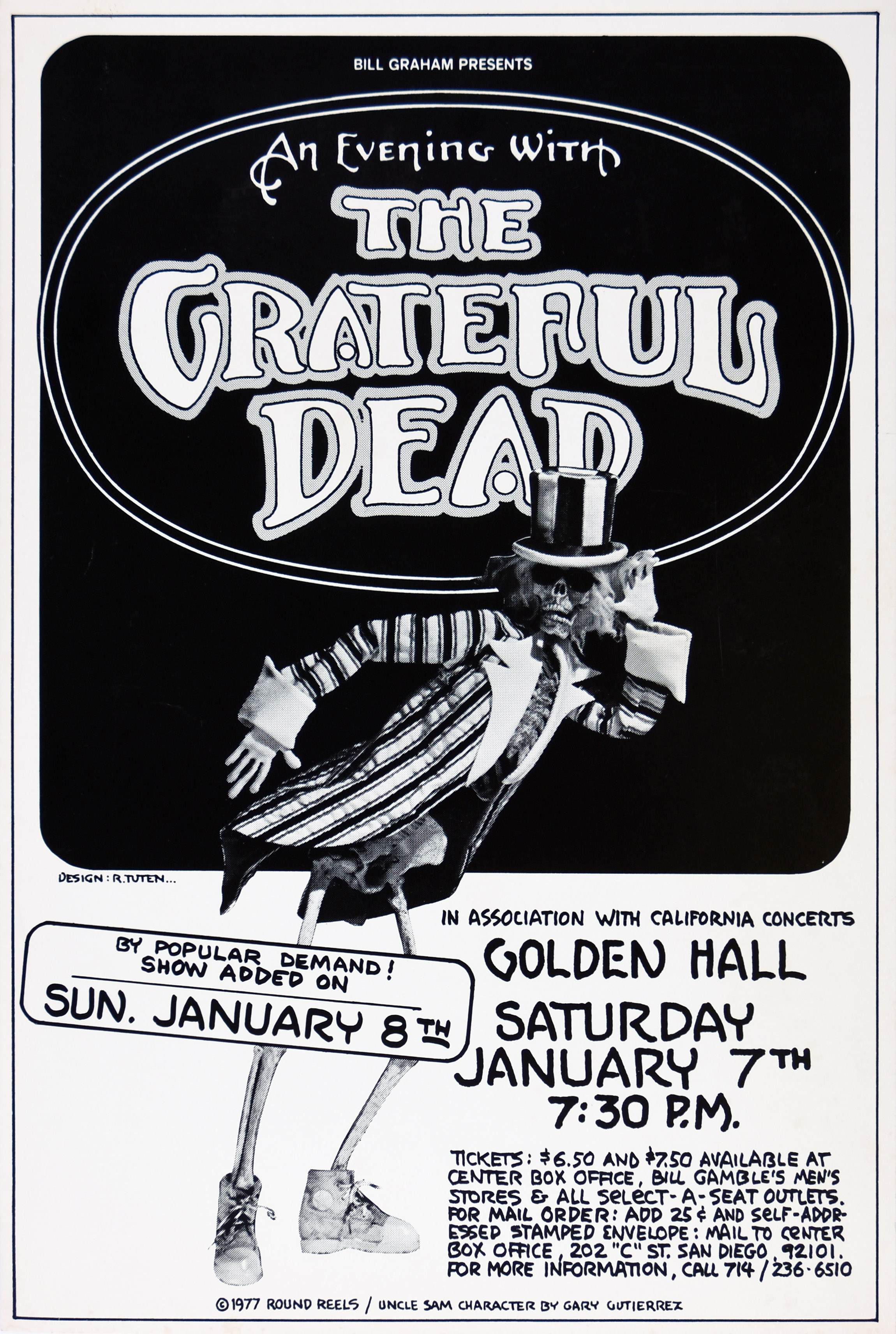
The Compensation Hypothesis: GD, January 7, 1978, San Diego Community Concourse

I have explored, mentally more than online, the hypothesis that when Jerry's vocals were especially, noteworthily bad, he compensated with his guitar playing, really concentrating on it and giving it extra "oomph".

If we could gather all the data (like continuous measures of the quality of singing and guitar playing), the compensation hypothesis might be testable in a satisfactorily scientific sense.

That's not going to happen.

Instead, I'll say that I believe it sometimes to have been true, which is a simply a statement of possibility. And I might offer in support the Grateful Dead show at Golden Hall, San Diego, CA, January 7, 1978.


I think there are several tapes, but this is the one I am listening to. It's a great tape that puts you right in the sweet spot.

https://archive.org/details/gd1978-01-07.aud.unknown.89474.sbeok.flac16

The worst case of laryngitis in his 30-plus career struck Garcia in early 1978. Outright pneumonia caused cancellations --even the Dead had humanitarian standards, and even its Garcia was subject to the relevant labor laws. But, mere laryngitis from blow and cigs and more blow and more cigs, and chasing the dragon off of hot tinfoil, and snoring stentoriously (sleep apnea) in your Gar-o-Lounger? No. The Show Would Go On. They played two nights in San Diego (Sunday 1/7 and Monday 1/8) without "Jerry songs", i.e., no Garcia lead vocals. On the tape linked above, Weir informs the crowd of this (track 9, "Jerry's problem").

The results are pretty striking, and I think are indicative of various compensation effects.

From a Grateful Dead perspective (not usually the one I take here), the whole band seems to respond. The bassist and the drummers all have great nights. Partly this is the tape, I assume, but Phil, Bill and presumably Mickey just sound great. Lesh plays some very forward, fluid stuff all night long. The drummers sound alive, really as one on this night (which was too infrequently the case - I am not a fan of the two-drummer sound). I don't hear Bob tearing it up on guitar quite as might as one might expect, but I am not firm on that.

The key pieces of evidence from the tape are "Let It Grow" and the big jam on "Dancing In The Street".

"Let It Grow" might be exhibit #1 in support of the compensation possibility from a Garciacentric perspective. (Though the whole band is great, I think that's partly endogenous to Jerry.) Pantagruel's tape picks this up beautifully, but any recording would find Garcia playing "Let It Grow" like a man with his hair on fire, scrubbing, hammering, scrubbing some more, occasionally soaring; parkour guitar. Maybe he's a little angry, and he takes it out on the Tiger (right? I should know these things). Somewhere around 3:45 and again right around the 5-minute mark, he fans with tremendous power. If you have good speakers and a good room --this tape needs space to breathe, but given the space I think it will sound very nice indeed -- go ahead and turn it up, LOUD.

Dancin' finds the whole band highly exploratory, a great piece of  group improvisation. For at least five or eight minutes they explore lots of creative byways. "Compensation" has a quite specific manifestation here, because I don't think that, initially, they are trying harder so much as the tried and true is not ready-to-hand. When you reach for the standard formula and it's not there, right where it usually is and where you implicitly expected it to be, what do you do? You improvise.

(Note here that Corry has discussed a related phenomenon, whereby the band "compensates", responds to, a small and alien crowd by hunkering down and, together, tearing the roof off the place. Not only that, he discussed in the context of this very tour, and specifically the 1/15 show at Selland Arena in Fresno. JGMF: Corry's ideas, my turgid prose.)

I lament the institution of the vocal rotation in the Dead. It began very early and didn't really start to stifle things, too much, until other features, such as the setlist structure, and the subsong types such as "Bob rockers" and "Jerry ballads", populating a rather limited ecology, ossified around it. By 1980 a Dead setlist was highly predictable on all kinds of dimensions, and various members of any given crew of fans typically specialized in "calling songs". Alas, it wasn't rocket science.

I don't consider 1978 to be a great year for the Dead, but I like it relative to what followed because I so strongly dislike the ossuary that the setlist structure became, a deadweight around the band's neck. One could still be surprised by a GD setlist in 1978 in ways that one could never be in any of the band's remaining years that contained an '8'. And 1/7/78 has this in spades, since even what was already tried-and-trued by this time, the Bob-Jerry rotation, and certain song combinations, were ruled out by Jerry's laryngitis.

With routinization, space for true exploration becomes more and more constrained. This is probably tautological. What this show allows us to see is that the vocal rotation was part of this limitation, and breaking it down posed interesting questions, calling forth interesting answers. On more than a few occasions I hear Jerry suggesting "Franklin's Tower", for example. Now maybe he had a mic set up and was considering exercising a vocal option. Or maybe he just wanted to attack the song from a new angle, free of singing responsibilities and with a chance to focus on just playing it. Or maybe he just stumbled into it. Whatever the case, the whole band is fun and engaged and ripping it up in a very interesting Dancin' - looking down the setlist, I have high hopes for what looks like a tight Playin, a long and hopefully not too dull Drums -> NFA, and what I am hoping is a hot Around & Around (with the double-time ending? I hope so). I hope not to listen to OMNS, but I might slip up.

(some hours later)

I have picked this up again after being taken away by other things. I love this "Playing In The Band" - not as long as it had been, which is fine - more like a nice compact 1972 version. At 9:19 Garcia quotes "Close Encounters" a few times, which I am contractually obligated to remind you he broke out with the Garcia Band, not the Dead, in November.

Still listening, but anyway, I hear this show as strong evidence in support of the compensation hypothesis. Of course I am listening *for* this, to some extent. But either way, it's there.

Let me be clear: I don't think there's a linear and negative relationship between vocals and guitar, symmetrical across all the values those two things can take. Instead, I would model this as a conditional relationship: it's only when the vocals fall below some threshhold that the compensation kicks in. When the vocals are really terrible (or, in the limit, as with 1/7/78, Garcia cannot sing), then he compensates. It's a categorical ("if ..., then ...") rather than a continuous ("as ..., then ...") kind of statement.

One last set of points, the kind of thing we ask in my day job, what's the mechanism? Here, I speculate.

1) Marginal reallocation of attention/effort: Here, the idea is that Garcia has some amount of relatively fungible energy and attention to expend. When he doesn't have to worry about singing, he can reallocate that stuff into his playing. This doesn't have to be conscious.

2) Guilt: I have discussed at some length how important the idea of being a competent professional musician was to Garcia. If this sounds obvious, it shouldn't. Some great players don't give a shit about this. But Garcia cared about being a pro, embracing if not always respective a set of professional standards. He rejected "Cabaret Economics" as a concept, even if he sometimes inflicted it on his loyal fans. But I surmise that when he couldn't sing, or when he knew that his vocals were objectively embarrassing, he would feel that he needed to make it up to his fans with better guitar work. This one sort of implies a lit more consciousness.

3) anything else?

Anyway, do check this show out. NFA playing and Garcia still sounds great. Two snaps up.


Sunday, January 04, 2015

Jerry Band at the Pismo Theatre


On Friday-Saturday, November 19-20, 1976, the Jerry Garcia Band played four improbable gigs at the stunning Pismo Theatre in foggy, salty, sandy, lovely little Pismo Beach, California. If you only know it from Bugs Bunny, I urge you to pass through it some time (though I have not done so in more than twenty years). It is the quintessence of that part of the California coastline.

Commenter nick had listened to 11/20/76 not too long ago and mentioned it, also noting a guest rhythm player in "Don't Let Go".  I confess that I listened without recalling the putative guest shot, and I didn't even hear it! It was only in polishing my notes that I was reminded about it, and went back to check it out. It's very subtle, until about 5:18 when it comes forward a bit more. It's pretty basic chording on an electric guitar, nothing particularly distinctive, which is fine. (Though, once I alerted my ears to it, it became quite repetitive.) But it makes me wonder whether this guy (probabilistically speaking) isn't present in other parts of the set. Could be, and I just missed it.

Who is it? Well, this is the earliest known entry in the late-1976 to early-1977 second guitarist experiments. John Rich plays pedal steel at the December 21-23 Keystone Family shows. But there is a second guitarist also on 1/29/77, 1/30/77 and 4/9/77, and while I initially thought it was Mr. Rich, I have determined that it is someone else, and further that that someone else should also be associated with 2/5/77, 2/6/77 and 4/10/77. This might just constitute a hitherto-undocumented "Era" of the Jerry Garcia Band, the only one to feature two guitars (earlier two-guitarist situations, whether with Tom Fogerty, George Tickner, or mystery players (2/16/74, 7/12/74) all predated JGB, and in the latter case would be construed as guest shots rather than (ongoing) band membership.

If forced to wager, I'd say the guy here is the same guy playing in the first half of 1977, whose name I'll reveal once I get a chance to engage him directly. I don't like that this stretches his known timeline back a month --I'd feel better if this fell within the January-April window, for which there is good contemporary evidence-- but he's my best guess. Of course, it could have been any one of a dozen guys within driving distance of Pismo, and I just don't know.

Musically, meh. The shows are long and stretched out, clocking in well over an hour and a half each, and this show doesn't suffer from the turgid tempos of so many of any its 1976 brethren. It just doesn't move me.

I like the "After Midnight" in the early show. But "Don't Let Go", as it almost always is in any show in which it made an appearance, is the highlight, though this is far from the best version out there. Keith does some very interesting multiplets in the 12 minute mark, John Kahn takes a very uncommon-for-the-song lead piece on his electric bass, Jerry steps up a few minutes later with some really cosmic stuff, but too-briefly, Tutt drives with some amazing foundational and flourish work underneath him, and for awhile it's really great. But they end up just repeating "don't let go" an awful lot to the crowd, and ten minutes of real highlight isn't much in three hours of time. I have a well-known bias against 1976, but I think it's reasonably well-deserved. There's nothing wrong with this, it just doesn't light me up.

One last point: Jerry Speaks. More than that, he advocates (after TLEO in the late show): "I'd like to remind you all to come down here and see old Hoyt Axton, December 10th and 11th. He'll be down here doin' a benefit for Redwind, which is just a good scene, about forty miles from here, a lot of good people workin' real hard. Hope you can make that one." This is the only time since the 60s (it hadn't happened since, that I can recall, and would never happen again, that I can think of) that Garcia directly pitches a charity to the crowd. Jerry was mostly mute from stage by this time except for his setbreak announcement and parting word. But he was especially averse to advocating anything. What's going on here?

The RedWind Medicine Camp was a Native American community, chiefed by the last full-blooded Chumash, Semu Huaute, located in rugged San Luis Obispo County. In correspondence, Bob Sewana Saenz explains: "Jerry visited me in SLO after a show at the Pismo Beach Theater in late 1976. I drove him and a few band members to Semu Huaute's (Chumash) Red Wind Medicine Camp. I showed him a school project that we were in need of funds to develop for the many children there." I presume they went up on Saturday, and came back down in time for Jerry to play his shows. He must have been moved, because he speaks. Even more importantly, he puts his money where his mouth is, headlining a benefit for the RedWind Foundation at UCSB on February 5, 1977 - but I'll get to that later. [edit: done!]
 
Detailed listening notes, references, etc. below the fold. There's a funny beach bum who keeps yelling "fried chicken!" for no apparent reason, and a little other color.

Musicological Methods question

Is there a convention about the order in which to list performers in, e.g., jazz performance? It looks like Corry's Garcia Band Personnel page goes 1) leader and then 2) others in alpha order by last name.

I have been all over the map with this, and the above method seems sound, but I thought I'd get a sense of whether and how this has been conventionalized.

Friday, January 02, 2015

Jerry Garcia Band at Keystone Korner, December 19-21, 1976 (UNCERTAIN)

I am a stickler for accuracy with things like band names, and yet, given what we know, you would think that the words in my title, "Jerry Garcia Band at Keystone Korner", could not be strictly accurate. Garcia stopped playing Keystone Korner in 1972, three years before the Jerry Garcia Band existed, the stickler would say.

That's true, but, imagine my surprise when, in spinning through some more BAM listings that I gathered this summer, I find the following.
BAM no. 9 (December 1976), p. 34. (Sorry about the obnoxious watermark over it.)

Listing for Jerry Garcia Band at Keystone Korner, December 19-21, 1976. Fascinating.

Did These Shows Happen?

12/21/76 almost definitely seems not to have happened, since JGB played Keystone Berkeley (1st of three nights just before Christmas). The show was reviewed (Kelp 1976), there's tape (shnid-20474), and there was a listing in the Oakland Tribune based on considerably fresher information than BAM, still a monthly at this time, could have had.

What about Sunday-Monday, December 19-20? My hunch is that they did not happen, confident to maybe 75%. I couldn't tell you how I come to that assessment so, again, a hunch. Maybe the note to call to confirm the dates plants an extra seed of doubt about it in my mind.

The Listings Themselves Are The Point

Even if the shows did not happen, the listing is fascinating. Someone with calendaring knowledge at Keystone Korner conveyed to someone at BAM that JGB would play Todd Barkan's Keystone Korner in December 1976. Beyond merely stretching the period of known Garcia-Barkan engagement by four years, it ties back into a legendary jazz room. Garcia wasn't playing very jazzily at this time, so bringing him in would have been an exception to the regularity that, after the first six months or so of Barkan's proprietorship (let's say, starting January 1, 1973) it was strictly jazz.

I have a sneaking suspicion the shows never materialized, but either way I am fascinated to contemplate the possibility.

REFERENCES

! review: Kelp, Larry. 1976. A Showcase for Garcia’s Styles. Oakland Tribune, December 23, 1976, p. 22

! listing: "Bay Area Calendar," Oakland Tribune, December 19, 1976, p. E-14

! listing: [contra: Keystone Korner] BAM no. 9 (December 1976), p. 34.

Tuesday, December 30, 2014

The vocals are as bad as Garcia ever inflicted on a paying audience: August 26, 1984

LN jg1984-08-26.jgb.all.aud-dearth.84568.flac1644

OK, turns out I was most of the way through a listen to this, so I finished it.

On the one hand, that wasn't so bad. I don't feel too unclean. On the other hand, as Jimmy Fallon's teenaged character Sara might say -- "Ew".

First, tip o' the cap to Mr. Don Dearth for heading down to Palo Alto, fresh tape and batteries, the mics and the deck, and walking out into the early summer morning with a fine aural commemorative. And thanks to John Moses for getting this tape into the world.

Second, my prior opinion of this show, that it may be the single worst Garcia performance in the canon, is based in a 2007 listen, only tersely noted. I now think that's an overstatement, but my main position now is just that it's hard to verbalize summary judgments of multidimensional phenomena. In brief, my assessment is that one aspect of the show is just so bad that it cannot help but color assessment of the whole show. I'll elaborate.

"Ew"

The vocals are as bad as Garcia ever inflicted on a paying audience. To my taste, late 1984 (this period through December) is Jerry's vocal nadir - he is just absolutely, fundamentally shredded up. Under the overall heading "Jerry sounds absolutely awful", I note the following specifics.
  • ! P: s2t01 MITR starts off as one of Garcia's worst recorded performances. In 2007, more terse than I seem to be now, I wrote simply "MITR is a mess". Even though it's not quite as badly off-key as some other versions --he really had trouble arranging this song to suit his ever changing vocal abilities-- he botches the words and just sounds rather lost at the start. I think he was *this close* to asking for a mulligan. He finds his footing a little bit, "tonight I would be thankful for any dream at all". Indeed.
  • ! P: s2t02 LITA Jerry again clams up the beginning, this time with some ill-plucked strings.
  • ! P: s2t04 DLG Garcia has completely lost his voice.
On the Other Hand ...

There is some excellent guitarwork, including in sometimes-throwaway "They Love Each Other" and the new-to-the-repertoire hottie, Allen Toussaint's "Get Out Of My Life, Woman" (GOOMLW) -- "there is absolutely nothing wrong with this." Even 2007 me, even after the pooch-screwing that starts "Love In The Afternoon", conceded that "LITA has some pretty nice playing." Oh, and "Don't Let Go", as ever, is a treat that could bear repeat engagements. (That said, I think the next night's version outdoes this one.) If you had paid your however-much-it-is to get it, you would have seen some world class music being performed.

... and the servings are so small

What about quantity? Later, especially after getting busted in Golden Gate Park in January 1985, Jerry regularly crossed the entertainment industry's version of baseball's Mendoza line (a .200 batting average, honoring a light-hitting Pittsburgh Pirates shortstop) - the Minelli Line: 45 minutes of big show per paid admission, and that's it. Cabaret economics is like Manchester Capitalism, without the morals. You want more? Pony up for the next show, and pass me my drink and cigarettes. The most egregious example of Garcia doing this is probably an acoustic duet gig with John Kahn in Kahn's Beverly Hills hometown, May 31, 1985, when Garcia's often-fawning (and, at this point, regularly-suffering) fans brought a chant of "bullshit! bullshit!" down around him and forced him to cough out a few extra numbers before turning them out.

This first set dangerously skirts the Minelli Line, while set II is about an hour, a decent quantity that's more like batting .250. The show is not as long as the next night. But more importantly, this Saturday show just isn't as good as the next night. The weekend's pair of "Don't Let Go"s provides an easy contrast: 16 minutes versus 22, especially at the relatively brisk pace they were playing it with at this time (nearly optimal to my ears, BTW), is the difference between Jerry striking the fly or mostly just swaggering around it, seeing it, knowing he could reach for it if he tried, but the moment never quite culminates, for whatever reason. Interesting that I noted this on the Sunday version: "go-for-it' continuation early in 13 by Jerry. Very long and interesting DLG" - that's the difference between the two versions - on 8/26 he passes up the opportunity to stretch the song out, while on 8/27, at just the same point, he seizes it.

One way to think of this is the linear-and-additive-effects model - take the average. The guitar playing can be good, but there aren't enough of them. The vocals are horrible. DLG interesting. Below average show for the period (compare next night) but, as I said from the show two days earlier (8/24),
if this is rock bottom, it's not that bad.
But I just can't escape those bloody vocals. I want to suggest that there's something so qualitatively bad about these vocals that we must condemn this show as an affront to the professionalism that Garcia, for all of his travails, almost never failed to strive to achieve. (This is not weasel language. He failed to achieve a standard of professionalism many times, as anyone who's trying hard to do something hard to do must. The key is in being conscious of the standard, and in the trying to uphold it.) Those short sets in 1985 can define the show, to my satisfaction, as a ripoff, and thus a professional violation, a violation of the should-be-inviolable pact with your paying customers. And I might have to rule similarly about these late August '84 vocals, and say that keeping yourself in such a state that you can't, y'know, sing, and charging people to hear you try to do so anyway, to general icky embarrassment, doing all of that violates some standard of professionalism that Garcia professed to uphold, which he almost always did - except for during this period, 1984-1985.

And you know that on some level, for as extensively as he bandaged all those frayed endings in a poppy gauze, dulled the annoying sensibilities, he knew - he knew, and he was mortified. This is pure speculation on my part, of course. But Garcia's a smart guy. He knows the vocals are rough to such an extent, on some nights, that no amount of compensatory guitar wizardry can really make it OK. He's thought very consciously over a two-decade professional career about his relationship with fans, with customers, their respective rights and responsibilities to each other. He's violating that, in this window. He's violating that with 30-something minute sets (generally the next year), and he's violating that with cringeworthy vocals here. And I am sure that somewhere and somehow he regrets it. But, of course, sometimes it's as if one's hands were tied.

So, no, while I am not interested in blame, I am interested in evaluating Garcia as a professional musician, and, here, I don't want to give this guy a pass. I want to hold him to his own standards, to which he almost always held himself. But not in this period. For Garcia, a professional musician to the core of his being, that's Rock Bottom.

Listening notes below the fold for this Sunday night show during the busy and interesting month of August 1984 (see also 8/11/84, 8/12/84, 8/24/84, 8/27/74).

Lost Your Voice? Play a Monster "Don't Let Go" (8/27/84)

LN jg1984-08-27.jgb.all.aud-corley.15029.shn2flac

I have sometimes joked, half-seriously, that 8/26/84 may be Garcia's most wasted performance, but I just do that to embody a feeling about the period as a whole. At some point I'll bring myself to revisit it.

I like listening around such things, as much as listening directly to them. Hence the JGB #21b gig from Monday, August 27, 1984 down at the Keystone Palo Alto entered the listening queue. Why hear the show itself when you can hear the next night? This could also provide a check against a listen last year to 8/24/84, which I probably unfairly shorthand with "It's not that bad, given how much Persian he was doing"; take my own temperature on this period. Seeing taper John Corley's name, I know it will be a great upfront tape, with the deconstructed Nak 700s nestled inside the obscuring, silly hat.

This show has all of the hallmarks of this down-and-dirty period in Garcia's life, some stellar, grungy loud guitar playing, occasionally brilliant, contrasts with some slightly slippery arrangements and, it must be said, objectively horrifying vocal limitations dictated by a set of badly shredded chords.

I don't say much about the guitar work (about anything, really) - it struck me as sometimes very good. Deal might be hot enough to merit a note, but for whatever reason I wasn't moved quite enough to take up the cause. There are a few but not an inordinate number of vocal flubs, the arrangement slips out of sync a time or two, some of the tempos (e.g., RFTR) strike me as sluggish. Mostly, nothing to write home about, maybe a lit below average (maybe slightly below 8/12/84 at Club Casino, maybe around the same level as 8/11/84 at the Nunnery, better than 8/24/84).

But the real jewel here is "Don't Let Go", as it almost always was. DLG was a weathervane tune, one that Garcia had to play as if he meant it, and so would only play on a relatively "good" night. Don't Let Go made a Garcia Band show special.

I was not in much of a note-taking mood in this listening session, but I recall a number of very interesting passages during which Garcia picks up and elaborates distinctive themes with all due care, taking the time to work through each one. Many of them just echo around a hundred sounds that you've heard Garcia make, that sound like something you've heard before but that you can't quite put your finger in, as elusive as a dialect. I note a point about 13 minutes in where they had setup a little landing pad, had Jerry wanted to wind it down, he sets it up and then gamely runs away from it to explore some of these ideas. It's nice.

This version of "Don't Let Go" puts me in mind of what I call the compensation hypothesis - when one particular performative aspect was hamstrung, he compensated this weakness with extra effort in other areas. It doesn't always hold, of course, but it might account for a few observations. In spring 1978, when his voice was shot with laryngitis, Garcia employed much crisper articulations, often early-Dylanesque. As the voice gets regularly bad starting in 1980 --to such an extent that, at some point, it's not really the same voice at all-- Garcia starts playing louder guitar, using lots more feedback than he had previously. This is especially characteristic of his 1983-1984 style, before, based on the sound of very little tape because there were relatively few shows, just running out of gas for a few years leading up to his descent into a diabetic coma on July 10, 1986.

It feels for all the world here like Jerry steps from a long "Harder They Come" to an ambitious, expressive, and even longer "Don't Let Go" to make up for not being able to sing, which had become painfully apparent as the evening progressed. He could have mailed in a few relatively easy vocal numbers - mumbling is not that hard on the chords. He didn't have to go 65 minutes in the second set, as he'd demonstrate more and more consistently over the next few years - 50 wouldn't have been a total embarrassment. But on this night, he took the road less traveled and reached a little further for the gold ring, and I respect that.

Listening Notes below the fold. (update: see also listening notes for the previous night, 8/26/84)

Sunday, December 28, 2014

updated - OAITW at Homer's 7/24/73

I have updated my post on OAITW at Homer's Warehouse, 7/24/73.

OAITW at Homer's Warehouse - March 4, 1973

This started off, and can still function, as a post with the setlists for the 3/4/73 OAITW gigs at Homer's Warehouse. But now there are a few other fragmentary thoughts.


Jerry Garcia lived an idyll at Sans Souci (18 Avenida Farallone, Stinson Beach, CA, 94970, map). It was his most domestic period, living with MG and their daughters Sunshine Kesey and Garcias Annabelle (b. 2/2/70) and Trixie (b. 9/21/74). I have lots to say about Sans Souci, but not here/now. Idylls pool time up, and idyllic Sans Souci hearkened pretty deeply to the past, in some ways the counterbalance to the amazing professional growth Jerry was living with his side projects (the first big one of which, Garcia, had bought them the house) and, especially, the Dead.

Breaking out the old banjo, which he hadn't played in a sustained way since about 1963, is of course a throwback move, both in terms of Jerry's biography and, of course, in the tapestry of American music. With old and new musical friends David Grisman, Peter Rowan and often involving Chis Rowan and Lorin Rowan [a.k.a. "The Brothers"], OAITW formed a pretty pure roots project, a deep dig into rural white American musical canon, Garcia on 5-string banjo, an ancient African instrument which was one of so many to cross putative racial divides. The pull of the past is strong in OAITW.

But it also has a real fresh taste of ambition and hard work, even leaving aside stuff like starting a record company (which would happen on July 15, 1973). Just musically, picking up the banjo in ca. late 1972 and getting serious about it in 1973 is really grasping the nettle. Once before Garcia had walked away from banjo because it just demanded too much self-discipline, too much time to do right, an instrument which could only be attacked with a single-minded fury, rough on the dilettante. It posed a real challenge, he knew this, and he tackled it, again, practicing not only religiously at home, as Mountain Girl recounts, but bringing his banjo on tour with the Dead ("You know that banjos act funny at weird altitudes? Why, my banjo sounded just great in Salt Lake City" – Jerry ca. 3/13/73 [Tolces 1973]).

In Garcia's world, you know it's getting good when it goes public, from sitting on the edge of the bed to standing onstage, with an audience which may well be paying for the privilege. After a particularly tasty take of Grisman's "Old And In The Way" in a Stinson Beach living room, Garcia made these boys an offer they couldn't refuse. "Beautiful. We've got a full band. We can go down and take over Sweetwater. ... We'll just work up a few tunes and take it on down there. Kreutzmann owns the place."[1] The fly on the wall reports that this is the birth of the idea of taking the band out in public, gigging around. Playing Sweetwater is not getting paid, in all likelihood, maybe some beer and coffee. Playing the bar in Stinson Beach, maybe not any different. But when the curtain draws and things go public in the Garciaverse, Mr. Price Mechanism shows up soon enough, and these young go-getters tear out of the gates like bats out of hell, with six live gigs and a live radio broadcast in four days! They certainly didn't lack for energy.[2].
Table xxx. Old And In The Way but Fast Out Of The Gate.
The band's third night out found it the newly up-and-running and frequently rocking Homer's Warehouse in Palo Alto, at 79 Homer Avenue (map). This is a nicely burnished picture: Garcia hadn't played the banjo regularly in ten years, and he hadn't played Palo Alto regularly in a decade, either. Between times, there were a few visits to Stanford, with Jerry and Merl opening for Big Black at the Frost Amphitheatre on 10/3/71 (Grushkin 1971, JGMF), and the Dead playing Maples Pavilion on 2/9/73, but Garcia's last gig in a Palo Alto club had been a flurry of woodshedding arrangements at the Poppycock in late 1969. Before that was probably with the Mother McCree's Uptown Jug Champions and, as pre-Dead, falls beyond my scope. "This would be a homecoming of sorts for Jerry", Bernstein notes. "He'd not been around Palo Alto for a while, and we wanted him to feel comfortable. Perhaps he would return for more appearances if it felt right to him. We knew this was a great opportunity to make a splash. All fingers and toes were crossed" (Bernstein 2013, 114).

It sounds like Mr. Price and Ms. Vibe danced well together this night. Some color:

["Peruvian Marching Powder"] was making its way around the Purple Room-not copious amounts, just enough to keep things lively. The band all wanted coffee, no beer or anything stronger. Of course, there was always a joint going around. At the bar, we had sold more beer than anticipated and thought we'd run out of kegs because Lou, the driver, had not completely filled our order. I called the president of the Coors franchise, a nice Italian guy, and told him the driver cut me short on kegs. He apologized. He couldn't take a truck out of the yard, but he would leave his home, pick up six kegs with his Lincoln, and bring them over to us. Midway through the dynamite second show, he arrived with his son and brought all six kegs through the back door. He said the keg driver was cutting everyone short, just to make trouble in anticipation of a teamsters' strike in the Bay Area (Bernstein 2013, 116). 

Color is great, but we can also engage the subtleties of chiaroscuro,[3] maybe a sepiatone of a simple day-in-the-life of an ambitious, engaged, super-talented, successful thirtyish professional, Jerome John Garcia. He rolls up at 1 in the afternoon for two Sunday shows, smokes and picks some, plays protean video games for two hours while drinking black coffee, plays two sellout shows (three encore calls at the early show, "the audience went wild after the second" one), plays another hour of games and drives Pete Rowan and himself home (Bernstein 2013, 113-118). Not too bad, all told.[4]

Setlists follow.

Old And In The Way
Homer's Warehouse
79 Homer Avenue
Palo Alto, CA 94301
March 4, 1973 (Sunday) – 3 PM and 9 PM
no known recording

--3 PM early show (main set + encores) (10 songs, max 90 minutes)--
--main set (7 songs, ca. 60-75 minutes)--
The Willow Garden
Going To The Races
Wild Horses
Soldier's Joy
Land Of The Navajo
Lonesome L.A. Cowboy
Blue Mule
--encores (3 songs, ca. 15 minutes)--
Panama Red
Till The End Of The World Rolls 'Round
White Dove
! setlist: The set and encore structure are not made explicit on AB's setlist, but he recalls "After an hour and a half, the band finished [a] third encore to thunderous applause", and lays out this list (see Bernstein 2013, 116-117).

--9 PM late show (12 songs)--
Going to the Races
Katie Hill
Till the End of the World Rolls 'Round
Panama Red
White Dove
Knockin' on Your Door
Fanny Hill
Land of the Navajo
Wild Horses
Blue Mule
Lost
Hard Hearted

! ACT1: Old And In The Way
! lineup: Jerry Garcia - banjo, vocals;
! lineup: David Grisman - mandolin, vocals;
! lineup: John Kahn - bass;
! lineup: Peter Rowan - guitar, vocals.

JGMF:

! JGC: none as of 12/28/2014.

! db: none as of 12/28/2014.

! metadata: solid as a rock, via Bernstein 2013, 113-118, ads in the Stanford Daily.

! ad: Stanford Daily, February 23, 1973, p. 6; bills"Bluegrass music with Old And In The Way featuring Jerry Garcia [name was larger, prominent] plus the Rowan Bros." This ad also had some other gigs, Nick Gravenites and whatnot.

! ad: Stanford Daily, February 27, 1973, p. 6; this one is just OAITW. "The New Homer's Warehouse ... presents Old And In The Way featuring Jerry Garcia formerly with The Warlocks, David Diadem formerly with Earth Opera, Peter Rowan, formerly lead guitar with Sea Train. Special guests The Rowan Brothers."

! ref: Arnold, Corry. 2013. February 1973, unnamed bar, Stinson Beach, CA: Old And In The Way. Lost Live Dead, June 6, URL http://lostlivedead.blogspot.com/2013/06/february-1973-unnamed-bar-stinson-beach.html, consulted 12/28/2014.

! ref: Bernstein, Andrew J. 2013. California Slim: The Music, the Magic, and the Madness. Xlibris LLC.

! ref: Grissim, John. 1973. Garcia Returns to Banjo: Splendor in the Bluegrass. Rolling Stone, April 26, 1973, p. 14.

! ref: Grushkin, Paul D. 1971. Garcia, Saunders Impressive at Frost. Stanford Daily, October 5, 1971, unknown page [JGMF].

! ref: McNally, Dennis. 2002. A Long Strange Trip: The Inside History of the Grateful Dead. New York: Broadway Books.

! ref: Tolces, Todd. 1973. Jerry's Bluegrass Boys. Melody Maker 48 (April 28): 35. [JGMF reading notes].


[1] "Bluegrass at Grisman's" (sound recording).
[2] Note another pattern that we have often had occasion to observe: new band = off-the-beaten path, smaller, and/or off-night gigs. The Share in San Anselmo, Homer's in Palo Alto, and the Inn in Cotati certainly qualify.
[4] Morbidly, contrast with Pigpen, who is on his deathbed and would pass away on Thursday, March 8th (McNally 2002, 447).