Sunday, April 08, 2012

Stirring It Up with E.W. Wainwright [sic]: JGMS, Keystone Berkeley, March 9, 1974

update: apparently this is not E.W. Wainwright at all, but BK drumming.

LN jg1974-03-09.jgms.all-1.sbd-alligator.33750.flac1644

Jerry Garcia and Merl Saunders (JGMS)
Keystone
2119 University Avenue
Berkeley, CA 94704
March 9, 1974 (Saturday)

The recent slow pace of posting is exceeded by the even slower pace of my listening. I have been able to do very little for quite some time.

I did manage to sneak in some notes on this one, with the added surreal property that I was sure I had done it before. Since I can’t seem to find an old trace of such notes, I do some new ones here.

Upshot: great recording, a personnel novelty and some really nice moments, but I have a hard time getting excited about this show. I have long thought that the January-February 1974 shows were, generally, dull. By June things are getting interesting (again), and for me they’d mostly stay that way through the end of Legion of Mary in 1975. Unfortunately, to my ears, on this listen, 3/9/74 is more like February 9th than the again-more-adventurous unit from June and after. The qualifier “this listen” could be key – my perceptions can vary a great deal across different engagements with the same fileset.

update: RoG detected that set I of this recording is from 1/17/74. At least that partly explains my feeling from the above paragraph.

Anyway, let me just briefly say something about the recording provenance, the personnel novelty, and the musical moments.

Recording Provenance

What we have here is some prime cut, chunkalicious Betty Cantor-Jackson soundboard tape, from the Third Batch that re-emerged in the mid-1990s, after presumably having entered private (non-band-affiliated) hands sometime in the 1980s. There are lots of 10” 7.5ips ½-track reels of Garcia stuff in this batch, most of which remains out of circulation. There are mix and other issues, but the recordings are fundamentally beautiful. Betty is just a natural genius as a recording engineer, and given the state the tapes were in we should be grateful that Eaton preserved them so expertly. These are important historical documents.

It’s hard for me to make sense of the pattern of recording discontinuities. Set I runs, to my ears, like a continuous 90-minute piece, though I suspect there’s a reel change somewhere in there. I was not listening with headphones, and Betty’s tapes have so little noise that it’s easy to miss a reel change during a long tuning and talking. 90 minutes would be a quite long set for the era, though I haven’t directly compared timings. update: set I is from 1/17/74, not this night.

Set II is stranger still, represented by two fragments. The first piece cuts in on Roadrunner and segues artfully (more below) into Harder They Come, a 26 minute piece. The second is the 22+-minutes covering It Ain’t No Use and Ain’t No Woman. We are told that there’s a Dixie Down to close the show, presumably based on tape box notations transcribed by Rob Eaton. If TNTDODD clocked in at like 12 minutes, we’d have a set of about an hour. Pretty short. I do find Dixie Down a reasonably unlikely show-closer for this period (maybe How Sweet It Is or Mystery Train would have been more likely). This all gives me the impression that we’re missing some material from this set, and/or that the pieces we have here are from tape fragments that are only uncertainly assigned a 3/9/74 dating. I tend to buy the former (missing material) argument first, but I don’t know.

I noted above that these tapes have mostly stayed out of the public realm. The history of this batch is basically 1) some process by which they left Betty’s possession and entered those of a private holder ca. 1986; 2) re-emergence in late 1995, with preservation by Eaton in 1996; 3) provision of DATs by Eaton to the GD/Garcia Vault at some subsequent point, I believe before Dick Latvala’s death in August 1999. I am about 95% confident around the second stage, much less so about stages 1 and 3.

This 3/9/74 tape came to the rest of the world via a mysterious benefactor named Alligator, who came on the scene via the Bit Torrent site Lossless Legs (shnflac.net). I want to say LL started up around mid-2005, and Alligator seems to have begun sharing choice uncirculated Garcia material from the Third Betty Batch not long thereafter. Here’s the list, as I know it, where the last number is the yyyymmdd on which the seed was entered into the etree database.
These generally listed "DATx3" in the lineage. Whether this is accurate is unknown to me. Update: I do not believe this to be correct.

Alligator also dropped some delightful uncirculated Grateful Dead, including some ’66 stuff and delicious board tapes of 4/4/71 and 4/17/72. All of those are beyond my scope here. I’ll just conclude by saying that I don’t know who Alligator is, nor where he/she obtained copies of these tapes, but I am deeply grateful to Alligator for sharing some wonderful-sounding and historically important stuff.

Personnel

One of the most interesting aspects of the Third Batch Betty tapes is how many of them include unusual personnel configurations. One hypothesis is that this is an accurate representation of all shows during the period. Since most of these tapes are from 1973-1974, a period during which what we refer to as Jerry Garcia – Merl Saunders (JGMS) was a relatively fluid aggregation, there were lots of wrinkles in terms of who was on stage at any given point in time. Bill Vitt or Bill Kreutzmann or, eventually, Paul Humphrey or Ronnie Tutt on drums (and sometimes backing vocals), Tom Fogerty or George Tickner on second guitar, the mysterious Sara Fulcher on vocals, conga players and unknown guitarists, mystery trumpet players, unknown harmonica players, etc. etc. Things were loose and the tapes reflect that.

A second hypothesis is that Betty “collected” the best (i.e., most interesting) tapes. She has said that one of the plans mulled by Ron Rakow at Round Records ca. 1974-1975 was to put together a “Jerry in all his styles” type compilation of great and interesting performances with great and interesting players. So Old and in the Way (OAITW) could have been in there; a variant on the Great American String Band, with Sandy Rothman onboard, playing a stunning version of “Wild Horses”; a sit-in with Garcia and friends by Jerry Jeff Walker; maybe some jazz/R&B/funk with Merl, etc. It’s a great idea, and I think that still today, such a compilation would be especially interesting if it were framed around Jerry and American music. Anyway, maybe the tapes that Betty kept in her basement, and which got inundated in the early ’82 floods, whence they went into storage, whence they were auctioned off, were precisely unrepresentative in various senses, including personnel.

I don’t have any evidence that discriminates among these two claims. The present tape features E.W. Wainwright playing drums. Based on the linked bio, Wainwright has had a fascinating and varied career that includes not only playing with and recording for many jazz greats, including McCoy Tyner, Pharoah Sanders and Rahsaan Roland Kirk, among many others, but also some really innovative music-in-communities kinds of work. It seems pretty clear that he came into the Garcia (and hence JGMF) orbit via Merl Saunders. Wainwright’s bio says he “served as Oscar Brown Jr.'s band leader in 1969”, and I do wonder if he was succeeded in that role by Merl, who served as Musical Director and arranger for the Broadway musical “Buck White” (starring none other than Muhammad Ali) in December of that year.

Wainwright seems to have spent 1970-1975 in the Bay Area. He got two performing credits on the eponymous Merl Saunders (Fantasy, 1973) before any direct Jerry connection that I can find. Tony Saunders has told me that E.W. played with Merl at the Sand Dunes, but it’s not clear if he and Jerry ever shared that stage (though Jerry definitely showed up a time or two). Three identifiable “shared stage” events between Jerry and E.W. can be dated to January-March, 1974. The liner notes from Merl’s Keepers have Garcia and Wainwright playing together at Fantasy Studios on January12, 1974, late into the night on a number of tracks that appear on that album. Then we have the March9, 1974 and March 14,1974 dates at Keystone, on which E.W. “replaces Bill Kreutzmann”, according to TJS’s notes. Maybe Billy K. was in Hawaii, or working at CBS Studios on the GD’s Mars Hotel, or reading a book. I dunno. So three shared stages between Jerry and E.W. in a couple of months, and then nothing more. One of those folks who passes through our lives.

Musical Moments

Interesting things can happen when a relatively unfamiliar drummer enters the mix, and some interesting things do happen here. Wainwright is rock solid, and seems either to know the songs or to have minimal difficulty picking them up. I never really detect any rhythmic anomalies … things work pretty well like clockwork. I hear a little more hi-hat than I think I am used to with, e.g., Kreutzmann, on whom there’s a fair amount of tape. But observation effects or just plain bad ears could be driving that perception.

I organize this around “moments” because, on this listen, the show does not demonstrate any sustained distinction. The setlist looks really interesting, and a number of interesting things happen, but the whole thing doesn’t make me stand up and say “wow”, if you know what I mean.

The show starts off rather lackluster, to my ears. I like “Someday Baby” and “La-La”, but these versions strike me as unmemorable. I don’t object to Smokey Robinson’s “I Second That Emotion”, but it always struck me as worthless in a Garcia-Saunders set. It just doesn’t do anything for me.

Things get a little bit more interesting during “My Funny Valentine”, but, as is often the case, I find the idea of a 25 minute version of this song more appealing than the performance of it. I note an interesting dark turn around seven minutes in, Martin quoting Shorter’s “Footprints” a few times around twenty minutes in, and some nice empty space late in the song, but it just never reaches escape velocity. At the end it sounds like Garcia wants to noodle over to something else, but some verbal communication (I presume with the drummer) imposes itself and there’s no true segue into the next song. "That's All Right" (a.k.a., among Deadheads, “Who’s Loving You Tonight”) is a nice treat, Jerry sounding really mournful and everyone clearly on board with this treatment of a song they all knew. Martin at one point quotes “Lonely Avenue” quite directly to my ears (though it could be a coincidental musical similarity), and Jerry follows him for a little bit. This is interesting since that song hadn’t been played since May 4, 1973 (as far as we know), and would only appear again on August 10, 1974.

We return for “set II” (see above my slight question about what this material might actually be), with a working vocal mic for Jerry (it had been out during WLYT), a fatter tone on the bass, a cut into a spry version of “(I’m A) Road Runner”. Jerry doesn’t overdo the lyrics here the way he had tended to do, to quite distressing effect on me, in January and February. Good.

Next comes the most unique playing of the night, and something that stands up in terms of uniqueness to anything in the GOTS canon: Road Runner morphs from R&B to reggae, and for two solid minutes, from about 12 to 14 minutes into the song, Jerry is gently strumming and then picking the chords to Bob Marley’s "Stir It Up" [Allan | deaddisc]. This is really quite something. Deaddisc indicates that it was probably only widely released around 1973, and the fact that this is a Jerry-led interlude is further proof (along with Harder They Come, of course) of Garcia’s relatively early and focused engagement with reggae. Garcia wouldn’t publicly play the song proper until mid-1976 with the Keith and Donna era Jerry Garcia Band (JGB), in the sets of which it would appear regularly through the end of 1977. I have very mixed feelings about ca. 1976 JGB, but they do not center on the band's version of "Stir It Up", which is like cinnamon oatmeal on a cold morning, Donna Angelica brand. Check out the first known full/live version from July 8, 1976 at Keystone, to see what I mean. Oh yeah, in late '77 the song served as an improbable improvisational vessel, giving rise to no fewer than three (and the only three known) jams on the Beatles' "Here Comes the Sun".

(The GD would also dabble twice with "Stir It Up," as an opening noodle on 3/26/88 (Hampton, VA) and as a nice little instrumental, out of continuous jamming out of "Fire On The Mountain" in Landover, MD on 3/21/91. The latter is a beautiful piece of musicality, inside a GD show that is unquestionably top-shelf stuff.) There aren't that many songs that fit this profile, a true rarity, but not a one-off, with instances appearing across more than fifteen years. This being the first known appearance of it makes it significant.

What follows is a real rarity in the GOTS canon: a nearly true segue into “The Harder They Come”. This may have been the intent all along, by bending Road Runner into a reggae number. Maybe “Stir It Up” was supposed to give some purchase on the road to HTC, or maybe Jerry was playing the melody to the wrong reggae song for awhile. Either way, the segue is “nearly true” in the sense that, while HTC does not emerge thread by thread out of the weave of the previous song, the previous song gets the band to the right key and tempo to drop into HTC. This version strikes me as good but not great, but there certainly is a lot to like in this piece of tape.

Rounding things out in terms of the tape, “It Ain’t No Use” (Jerry Williams, Gary U.S. Bonds, and Don Hollinger) never moves me that much. It’s a blues, it’s done bluesy, it’s fine. “Ain’t No Woman (Like The One I’ve Got)” [Allan] is the biggest novelty of the setlist. It’s a Dennis Lambert/Brian Potter soul piece that always reminds me a little bit, and a little incongruously, of The Guess Who’s “These Eyes”. The Four Tops released it as an A-side single in early 1973 (Dunhill D-4339) which peaked at #2 on the US R&B charts and #4 on the US pop charts (wiki). One of the very earliest released versions of the song appears to have been on none other than 1973’s Merl Saunders (Fantasy), with none other than E.W. Wainwright on the drums. March 9, 1974, with Wainwright on drums, brings the first known live performance of the song by JGMS, and March 14th, same place and personnel, is the second. It certainly makes one wonder whether Wainwright is drumming for the other two known versions, May 30,1974 and/or August 11, 1974 [JGMF | JB]. It’s a really interesting song, not just for its rarity, but also for illustrating Garcia’s willingness and ability to engage with a stunningly wide range of material across every indigenous American musical form.

Summary

Not much to do except reiterate that I think there are a number of interesting moments, worth documenting and thinking about, but that this is not a fileset that I’ll listen to, in its entirety, very often. Most of the action is in Road Runner, Harder They Come, and Ain’t No Woman, the three songs that set this show apart from the pack; those will reward more ear time, I am sure.

Listening Notes follow.

Jerry Garcia and Merl Saunders (JGMS)
Keystone
2119 University Avenue
Berkeley, CA 94704
March 9, 1974 (Saturday)
s2-1 Betty [s1 w this date is 1/17/74]

--Set I (5 tracks, 87:03)--
s1t01. (d1t01) [0:10] Someday Baby [13:38] [2:22]
s1t02. (d1t02) La-La [11:23] [2:37]
s1t03. (d1t03) I Second That Emotion [14:35] [1:17]
s1t04. (d1t04) My Funny Valentine [24:21] [0:40]
s1t05. (d2t01) That's All Right [15:29] (1) [0:30]

--Set II (4 tracks, 48:43)--
s2t01. (d2t02) //(I'm A) Road Runner [#14:14] ->
s2t02. (d2t03) The Harder They Come [11:42] (2) [0:20] % [0:07]
s2t03. (d2t04) It Ain't No Use [10:36] [0:17]
s2t04. (d2t05) Ain't No Woman (Like The One I've Got) [11:22] [0:02] % [0:05]

[MISSING: The Night They Drove Old Dixie Down]

Lineup:
Jerry Garcia - el-g, vocals;
Merl Saunders - keyboards;
John Kahn - el-bass;
Martin Fierro - saxophone, flute (s1t02, s2t04);
E.W. Wainwright - drums.

JGMF:
! Recording: symbols: % = recording discontinuity; / = clipped song; // = cut song; ... = fade in/out; # = truncated timing; [ ] = recorded event time. The recorded event time immediately after the song or item name is an attempt at getting the "real" time of the event. So, a timing of [x:xx] right after a song title is an attempt to say how long the song really was, as represented on this recording.
! db: http://etreedb.org/shn/33750 (this source).
! R: Specs: "SMR > DAT3x > Delta DIO 2496 > Soundforge > WAV > CD Wave Editor > FLAC1644; seeded to Lossless Legs by alligator." db entry date of April 9, 2006. JGMF notation by set rather than by CD breakdown, which is how info originally traveled.
! R: Seeder (Alligator) note: "This show was originally seeded by www.shnflac.net (Lossless Legs). Please thank the moderators for encouraging fresh seeds."
! R: Tape History/Provenance: This comes from the "third" batch of Betty Cantor-Jackson soundboard recordings. While its early history is murky, this batch came into the light in around late 1995. Grammy award-winning sound engineer (and lead guitarist of Dark Star Orchestra) Rob Eaton was called in to rescue music from a batch of tapes in very sorry shape, caked with mud and filth, boxes rotted away and illegible, etc. I have narrated this story a little bit in a few places. Eaton supplied DAT copies of all of the GD- and Garcia-relevant material to the then- GD Vault, whence it has presumably been sorted into the successor GD and Garcia Vaults. The provenance of this particular fileset is something of a mystery to me, insofar as it came into circulation via the legendary "Alligator" (seeded to Lossless Legs). Who Alligator is and where he/she got these recordings is not known to me. But the important thing is that Alligator was responsible for bringing a number of key early Garcia tapes into the light xxx list of Alligator tapes.
! R: This is a gorgeous recording by the justly-revered Betty Cantor-Jackson. It comes in a little hissy at the start, but the mix settles in pretty well. There are some warts throughout the recording, the most notable of which are, well, noted. Recall that these tapes were caked in mud and filth and had to be hand-cleaned, inch-by-inch with Q-tips, by Rob Eaton.
! R: s1t01 @ 1:58 some bad digi-scratches.
! P: s1t03 I am not a fan of ISTE, and this version doesn't make me one. At 8-mins in, no-one seems to want to take the solo, so Martin tentatively (really!) wades in and takes it. Sounded to me like it was Merl's turn and he missed it, but I could very well be wrong. Anyway, I find this version of this song --as most of them-- totally uninteresting.
! Personnel: E.W. Wainwright is said to be drumming here. It's dangerous for me to comment on drumming styles, since I am so deaf to and ignorant of them, but I'd say that EWW uses more hi-hat than most other drummers.
! P: s1t04 MFV @ about 7-minutes in Garcia goes a little hot and bent and starts indicating that he wants to get a little jangly with it. Merl's solo is halfway to spooky, but only halfway, while Garcia does some darker stuff around it. Nice. @ 19:34, Martin clearly quotes Wayne Shorter's "Footprints", again @ 19:44, and still playing it past 19:52. Drops into some deep space in the 22-min mark, where it could have ended. As the song ends, sounds like Jerry wants to noodle right over to something else, but sounds like there needs to be some verbal communication to get there.
! R: s1t05 The vocal mics seem not to be working.
! P: s1t05 @ 11:25-12:15ish Martin is clearly playing "Lonely Avenue" for a little while, and Jerry definitely supports him by playing along, then bending things into the very similar WLYT.
! s1t05 (1) JG: "We're gonna take a break for a little while. We'll be back [inaudible]." He still strums a thing or two. I think he feels driven to the setbreak by the failure of the vocal mics.
! R: s2t01 Roadrunner cuts in.
! Recording/setlist: Unknown amount missing on either side of the material we have represented here as set II. We just don't have enough setlist data from this period to identify what (if any) patterns may have held. I assume the information about a TNTDODD closer comes from Rob Eaton's tape box transcriptions. It's possible the song is on another tape. If anyone ever gets a chance to try to reassemble the Third Batch of Betty tapes, it might be worth keeping an eye open for a show-closing TNTDODD as a tape snippet/fragment on another reel. Otherwise, when we factor in the splice after HTC, set II as given here is a 26-minute piece and a 20-minute piece.
! R: s2t01 the bass is thick and fat and delicious in set II here, more than set I.
! setlist: s2t01 JG noodles "Stir It Up" from about 11:56-13:56 of Roadrunner. This is pretty fascinating, to hear Roadrunner done reggae-style.
! P: s2t01-s2t02 And then, after the little "Stir It Up" thing, there's a great and totally unique segue from Roadrunner to HTC.
! s2t02 (2) band members are calling for water.
! R: s2t03 I can't tell if this fades down to a splice after the song.
! setlist: s2t04 Ain't No Woman is quite rare. This is the earliest-known JGMS version. Note that E.W. Wainwright drums on the version that appears on Merl’s 1973 self-titled album.

Sunday, March 18, 2012

From Family Dog to Friends and Relations, 1970-1971

http://www.chickenonaunicycle.com/FD%20Shows.htm

Does anyone know the story of the end of the Family Dog, and the re-emergence of 660 Great Highway as Friends and Relations Hall? I am sure it's out there, but I don't recall seeing it and I know nothing other than what I see in the listings.

I am presently going through some ca. 1970-1971 listings and find first reference to "Friends and Relations Hall" for March 12, 1971 (Big Brother). I had found listings as Family Dog through scattered through December 1970 (not listed at the Chicken).

Anyway, what's the story? I have been surprised to see nothing reported (as far as I have found) in the various music columns in the Bay Area papers.

Edit: Guess I haven't looked that hard. Heh heh.

Saturday, March 10, 2012

Location Geocoding (wonky, as Krugman would say)

Do any of you venuologists (or anyone else) have any ideas about how best to codify the geospatial data attached to the locations we love?

So let's say, hypothetically, I have a giant spreadsheet full of concerts and such. There are pretty well coded temporal data. For many of the events of interest, I have address, city, state and zip.

What's the best, quickest, and most fungible way to code in geospatial data? I guess I am thinking GPS coordinates.

Related, I just tried the following process, with the following results.

1268 Sutter Street, San Francisco, CA, 94109

Google Maps: http://maps.google.com/maps?q=1268+Sutter+Street,+San+Francisco,+CA&hl=en&ll=37.787624,-122.421319&spn=0.010582,0.026157&sll=37.788929,-122.421319&sspn=0.010581,0.026157&oq=1268+Sutt&hnear=1268+Sutter+St,+San+Francisco,+California+94109&t=h&z=16

GPS Visualizer: http://www.gpsvisualizer.com/geocode, returns latitude-longitude of 37.787619, -122.4213121.

When I plug that back into Google Maps, it takes me to 1244 Sutter Street:

Ultimately, I am interested in street addresses. But since some of them may no longer exist, it seems to me that some kind of geospatial coding is preferable. But I am worried that on my very first look at this, I get the kind of result above, one which could really mess me up.

Help?


Thursday, March 08, 2012

GD: August 30, 1970, "Calebration"

I always loved the "Calebration" thing dated 8/30/70. My favorite Candyman, a really great Easy Wind. There's also video out and about that gives a very rare glimpse of the GD of this period (though, I do wonder if that QMS video has made it into the world?).

But, I think the set we know was not actually recorded on August 30, 1970. John L. Wasserman's August 28, 1970 "On the Town" column in the San Francisco Chronicle --he had replaced Ralph J. Gleason in that space on June 15, 1970, when Gleason left his regular column at the Chron for a desk at Fantasy Records-- says that various bands' sets "have been taped" (1). So this material is from sometime prior to 8/28/70, and was broadcast on August 30th.


For The Record, and all that.

REFERENCE:
Wasserman, John L. 1970. On the Town: Ex-Monkee Nesmith And His New Band. San Francisco Chronicle, August 28, 1970, p. 41.

Friday, March 02, 2012

List of John Scher - promoted concerts

Does anyone know a list of John Scher-promoted concerts?

I thought, one day, while I'm at it, why don't I systematically start coding in PROMOTERs? Yeah, that won't take long!

So, having more or less finished coding Jefferson Airplane through 1969, I have taken to coding promoters for them and all of the Garcia stuff, at least i nthe Bay Area. All of this to check a point about the comparison of GD and JA business crossings with Helms/FD and Bill Graham (think of a 2x2 table ... I want the frequencies in the cells, and basically want to do a t-test.)

Thanks to Ross, I have been able to code Bill Graham in, in a rough way. The Family Dog stuff is easy enough, as will be the Herrera stuff.

So, while I am at it, I thought another day, why don't I code Scher? Be good prosopographical practice, says I.

So, I need a list of all John Scher -promoted concerts, at least those involving GD/Garcia. Preferably in Excel format. :)

Moyssi's site, besides containing a huge number of terrific scans of program covers, has a "Complete list of Capitol Concerts 1971-1984 — Compiled by John Goodfellow. Great work, and thank you, gentlemen! (A complete set of Garcia/GD-relevant programs for my archive/museum would be gratefully received!)

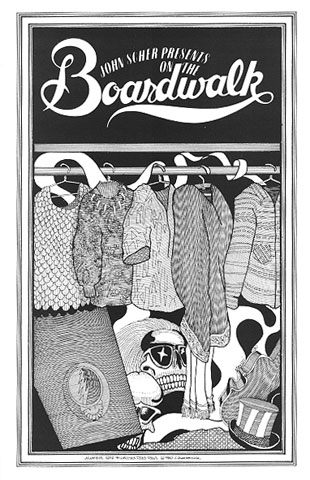
And, for our enjoyment, here's a non-Capitol program cover, from the JGB show 7/26/80 at the Convention Hall in Asbury Park, NJ, a "John Scher Presents on the Boardwalk" promotion:


"John Scher Presents on the Boardwalk"
Jerry Garcia Band, Convention Hall, Asbury Park, NJ, July 26, 1980.
Image courtesy of Moyssi (moyssi.com).


Anyway, I need that, but all of his venues, and all of his dates (at least through 1995).


Anyone?

Tuesday, February 21, 2012

New Riders of the Purple Sage and Acoustic Grateful Dead: Lion’s Share, San Anselmo, July 30-August 1, 1970


(This is an updated version of an earlier post,
GD/NRPS19700731-19700801: Lion's Share, San Anselmo, CA, 4/20/2011.)

Some time back, I reported listings for "New Riders of the Purple Sage & Grateful Dead, Lion's Share, 9 pm" for both July 31, 1970 and August 1, 1970, in the calendar section of the Berkeley Tribe. Here’s the scan (click to enlarge). (FWIW, the Tribe calendar’s name was commonly “George”. This day, it was “David” [at the tag end of the question “how about George David?”.)
Calendar section of the Berkeley Tribe v3 n4 (no 56) (July 31 - August 7, 1970), back page.
I have just uncovered a few more tidbits, so I am updating the whole original post. The tidbits are a calendar listing and a preview ‘blurb’ establishing to my satisfaction that the New Riders of the Purple Sage and Acoustic Grateful Dead played the Lion’s Share, 66 Red Hill Avenue, San Anselmo, CA, 94960 on Thursday, July 30, 1970, in addition to the previously-established shows the next two nights.
“Datebook/Opening Today,” San Francisco Chronicle, July 30, 1970, p. 41;
“’Purple Sage’ At Lion’s Share,” San Francisco Chronicle, July 30, 1970, p. 41.
Let me go through some of the points that come up out of this little bit of material, in no particular order.

1. The New Riders of the Purple Sage and Acoustic Grateful Dead played the Lion’s Share, 66 Red Hill Avenue, San Anselmo, CA, 94960 on Thursday, July 30, 1970, in addition to the previously-established shows the next two nights (July 31-August 1, 1970).

2. Michelle’s Mc’s Midsummer 1970 Memories of Acoustic GD at Lion's Share seem confirmed.
With the addition of the Thursday night to our understanding of this run, we can now confirm four of the five confirmable assertions made by Corry's informant "Michelle Mc", as relayed by him at LLD:
The acoustic Grateful Dead played a number of shows at the Lion's Share. They played two or three nights in a row, on a weeknight in the middle of the summer of 1970. She knows--she went. These shows were utterly unpublicized, and only friends of the band were given the heads up.
  • Acoustic Grateful Dead: confirmed.
  • “two or three nights in a row”: confirmed.
  • “weeknight”: confirmed.
  • Midsummer 1970: confirmed.
  • No publicity: disconfirmed. The idea that these shows were mostly for GD family insiders is supported by the fact that the Saturday show was Jerry Garcia’s 28th birthday. If it appeared in the Chron –and more importantly, given that there was an item in the Chron—it was no secret. However, it’s possible that the Share staff called the papers, but weren’t supposed to.
3. Acoustic Grateful Dead
The item and Michelle’s memory make it clear that the Grateful Dead played acoustically (AGD). This brings the 7/30/70 and 8/5/70 tapes to mind, the only two all-acoustic GD nights –billed as such—that I can think of.
4. What About The Tapes?
By the tapes, I refer to the New Riders tape and an Acoustic Grateful Dead tape (shnid 17077), both dated 7/30/70 and said to be from the Matrix. First, given the relative reliability of an “Opening Tonight” item in the Chron and a Matrix tape label, I propose that our lists (i.e., The List) be updated to list GD at Lion’s Share this night, and not at the Matrix.
Second, I had actually offered some analysis and speculation about all of this in the 7/30/70 installation of my still-unconcluded NRPS-Matrix-1970 series. Let me just quote myself at length.
Note that the first NRPS piece (I'll call it set I) runs only 23 minutes. Normally, we would conclude that it's incomplete (and probably missing the material at the start of the set, since there's a set break announcement over continuous tape after Lodi). I do think it's probably incomplete. But it could also be that this night was different, and ended up including the mini GD acoustic set. That might have substituted for at least some part of the expected additional NRPS material.
The tapes do suggest that there was a three-part show on 7/30/70: (I) NRPS, (II) AGD, (III) NRPS. I think the billings fit hand-in-glove with this structure, because …
5. ... The NRPS Appear to Have Been Headliners Above the GD
I think this newly-discovered evidence supports the view that these tape fragments are of a piece, insofar as NRPS seem to be headlining over the Grateful Dead. As far as I know, this is the only time such an arrangement, a kind of inversion of the “An Evening With the Grateful Dead” set structure (see my discussion in connection with a 5/1/70 analysis), ever materialized.
In my post “NRPS-Matrix-1970 05 of 7: LN19700730: Thursday, July 30, 1970”, I had run the discovery of the Tribe listings for 7/31 and 8/1 through evidence provided by the tapes, and said this:
I am intrigued by the possibility that the order in which the acts are listed for those shows might reflect that NRPS was "first billed" over the GD, which might be consistent with NRPS doing two sets and GD just a little acoustic one.
The discovery of another (partially independent) piece of data from the Chron reinforces this connection between these shows and these tapes, in my mind. Both of the calendar listings put the New Riders first, and the Grateful Dead second. If I understand how such listings came about, this correlation is partly spurious: presumably the same person from the Share or from the GD offices called the item into both the Tribe and the Chron. But there may be at least some independence among these observations, insofar as the staffers at the two separate newspapers did not turn the order around and put the GD first. That would have been the obvious, natural thing to do. As far as I know, this is the only time the New Riders are billed over the Grateful Dead. I think the fact that things are billed this way in both papers is no accident. I believe (pure conjecture, of course) that these were quite explicitly and consciously listed as NRPS-GD.
The headline of the preview item, “’Purple Sage’ At Lion’s Share”, especially, reinforces this. It is, I think, incredible to imagine that, under usual circumstances, this would not have said “Dead At Lion’s Share”. Woe betide the Chronicle lackey who should make the mistake of headlining the second act instead of the Grateful Goddamned Dead! No. This was quite consciously constructed with the New Riders at the top of the bill, and the Grateful Dead at the bottom.
I view this as just one more incremental step in the gradual speciation of the New Riders from the Grateful Dead.
David Torbert had been around as NRPS bassist (I said, NRPS bassist. Or, NRPS personnel more generally!) since probably April. They had done a number of high-profile gigs in the An Evening With the Grateful Dead format. I don’t have precise dates for when they started working on the first New Riders album in the studio, but it is certainly right around this time. Dryden said that Tolbert was brought for the express purpose of making an album (Kahlbacher 1974, 27). By mid-1970 the cognoscenti are starting to ask about the Riders’ studio plans (Hard Road interview, took place on 6/22/70). In October 1970, Garcia says that the NRPS record is “about 50% underway” (Goodwin 1971).
We also know, conventionally, that on the Festival Express train a month or so prior to 7/30/70, Garcia had spotted a hotshit pedal steel wizard named Buddy Cage and appeared immediately to have conceived the idea of bringing the Canadian on as his own full-time and permanent replacement. This seems only to have put flesh on the bones of a general plan that he harbored all along, to help found and launch the Riders, help his friends out financially by getting them a record deal (and the attending patch of land in Marin or Sonoma or wherever) and making them famous, and then stepping out gracefully. He was already public with a desire to step back by late 1970: “I think eventually it would be groovy if they auditioned other steel players so they could go out and tour, without having to depend on the Dead” (12/27/70 KPPC-FM interview, shnid 26583).
So, why would NRPS have been top-billed at a local show in a little Marin club that held like 212 people? It’s not like this was their big break. I don’t think they were planning on this being the launch of a national tour in this configuration, of course. Most plausible seems to be just that they wanted to keep things low key, and probably especially the GD guys. These quiet acoustic sets, with loads of wonderful spirituals and such (Jordan, A Voice From On High), along the lines of show known as 8/5/70 San Diego, are profoundly relaxed. From my listen to the NRPS set dated 7/30/70, I said “sounds like just a good old time foolin' around at the bar. It seems to run quite late." Here are Cousin Ace (Bob Weir) and Marmaduke to a sparse and shrinking late-night crowd:
Cousin Ace: “Well the rats are desertin' the sinkin' ship. And, uhh, in the meanwhile we're gonna do a ...” [interruption by Marmaduke: "Welcome to the campfire folks... "] “... hot lead and bloodshed ballad ...” ["... this is story time ..."] “...sad story time ...” ["... here on the plains"] …
All of the tapes in the NRPS-1970-Matrix nexus (feels redundant, but better than NRPS-1970-Matrix matrix!) have that kind of feel. More of alcohol vibe (a la the Festival Express train) than an acid- or coke-fueled one.
So, putting this all together, I think it was probably just a fun, low key, local trial balloon designed to try on what it would look like to have the New Riders go first.
6. What About The Tapes? Part II

So, do the tapes that circulate come from the Lion’s Share? I don’t know. I am honestly pretty stumped.

Everything I know about Lion’s Share tapes has pretty much been posted. Garcia shows are overrepresented since Betty taped so much. Outside of those the only period in which I know tape was regularly spinning at the Share was June 1971-January 1972, when soundman Lou Judson made an impressive handful of recordings.

I cannot explain why the “7/30/70” material comes out of “Matrix Tapes”. The likeliest possibilities, it seems to me, are
  1. that the material is from the Matrix, and is mis-dated (though not by much), and the similarities of the tapes and these Lion's Share shows is spurious. Maybe the tapes really are from 7/27/70, as "Mickey Hart and the Hart Beats, with Jerry Garcia", a billing I have just confirmed at LIA's place, also from the Chron (7/27/70, p. 37); or
  2. the material is correctly dated, but comes from the Lion’s Share (e.g., taped by the GD folks), and somehow eventually made it into (or became conflated with) the Matrix Tapes; or
  3. the 7/30/70 show was moved from the Share to the Matrix.
I doubt #3, but #1 and #2 seem about equally plausible to me.

7. NRPS : GD :: Hot Tuna : Jefferson Airplane

Just wanted to note that the Chron item draws this analogy. It’s true for a time, and interesting. Around the same time that Jack and Jorma are branching out from well-known “day-bands” to play some American roots music on the side (alongside, early on, some really hot rock jamming) –which seems to begin in earnest ca. January 1969—Garcia and others in the GD are doing the same thing. It’s obvious, but since I have Jerry and the Jeffersons on the brain I thought I’d bring it up.

Of course, after the initial period, the arcs of Hot Tuna and NRPS diverge. NRPS ends up completely speciated from the GD in terms of personnel and, eventually, organization. Garcia builds it up and then walks away from it. Hot Tuna, of course, always has and always will include (no, really, "be") Jack and Jorma.

8. Summary

Summarizing, six take home points.

  1. This began as a way to just put another event into The List: NRPS/GD at Lion’s Share on Thursday, July 30, 1970, based on evidence from the San Francisco Chronicle.
  2. It seems to confirm the recollection by Corry’s informant Michelle Mc of Acoustic GD sets at Lion’s Share in midsummer 1970.
  3. It is suggestive of one of the only all-acoustic GD sets, ever (alongside San Diego, 8/5/70).
  4. It dovetails almost perfectly with the tapes we have that are dated 7/30/70, though said to be from the Matrix: two NRPS sets sandwiched around a homey AGD set that also features David Nelson and Marmaduke.
  5. It seems to be a rare (perhaps the only) instance of the NRPS headlining over the GD, a kind of reversal of the “An Evening With the Grateful Dead” format (AGD, NRPS, EGD) of 1970. I have argued that this is a small milestone in the gradual (over two year!) differentiation of the NRPS from the GD, which culminated in Buddy Cage taking over Garcia’s pedal steel bench in November 1971.
  6. I don’t know how to reconcile the tapes (said to be from the Matrix) with the rest of the evidence.
There we have it. Why say it in 50 words when you can say it in 2,300?!?

SOURCES:

Sunday, February 12, 2012

The List Tradition: Chronicling Infinity

Beyer, Susanne, and Lothar Gorris. 2009. SPIEGEL Interview with Umberto Eco: 'We Like Lists Because We Don't Want to Die'. Spiegel Online International, November 11, http://www.spiegel.de/international/zeitgeist/spiegel-interview-with-umberto-eco-we-like-lists-because-we-don-t-want-to-die-a-659577.html, consulted 1/4/2016.

I don't know Eco very well, and there's a bit of mumbo-jumbo in here, but I think it's also a lovely little piece of cultural history, very important to me.


·         "The list is the origin of culture."
·         "What does culture want? To make infinity comprehensible. It also wants to create order ..."
·         "How, as a human being, does one face infinity? How does one attempt to grasp the incomprehensible? Through lists, through catalogs, through collections in museums and through encyclopedias and dictionaries. There is an allure to enumerating how many women Don Giovanni slept with: It was 2,063, at least according to Mozart's librettist, Lorenzo da Ponte. We also have completely practical lists -- the shopping list, the will, the menu -- that are also cultural achievements in their own right."
·         "Wherever you look in cultural history, you will find lists. In fact, there is a dizzying array: lists of saints, armies and medicinal plants, or of treasures and book titles. Think of the nature collections of the 16th century."
·         "In the 'Iliad' [Homer] tries to convey an impression of the size of the Greek army. At first he uses similes: "As when some great forest fire is raging upon a mountain top and its light is seen afar, even so, as they marched, the gleam of their armour flashed up into the firmament of heaven." But he isn't satisfied. He cannot find the right metaphor, and so he begs the muses to help him. Then he hits upon the idea of naming many, many generals and their ships."
·         "At first, we think that a list is primitive and typical of very early cultures, which had no exact concept of the universe and were therefore limited to listing the characteristics they could name. But, in cultural history, the list has prevailed over and over again. It is by no means merely an expression of primitive cultures. A very clear image of the universe existed in the Middle Ages, and there were lists. A new worldview based on astronomy predominated in the Renaissance and the Baroque era. And there were lists. And the list is certainly prevalent in the postmodern age. It has an irresistible magic."
·         "Homer's work hits again and again on the topos of the inexpressible. People will always do that. We have always been fascinated by infinite space, by the endless stars and by galaxies upon galaxies. How does a person feel when looking at the sky? He thinks that he doesn't have enough tongues to describe what he sees. Nevertheless, people have never stopping describing the sky, simply listing what they see. Lovers are in the same position. They experience a deficiency of language, a lack of words to express their feelings. But do lovers ever stop trying to do so? They create lists: Your eyes are so beautiful, and so is your mouth, and your collarbone … One could go into great detail."
·         SPIEGEL: Why do we waste so much time trying to complete things that can't be realistically completed?
·         Eco: "We have a limit, a very discouraging, humiliating limit: death. That's why we like all the things that we assume have no limits and, therefore, no end. It's a way of escaping thoughts about death. We like lists because we don't want to die."
·         SPIEGEL: In your exhibition at the Louvre, you will also be showing works drawn from the visual arts, such as still lifes. But these paintings have frames, or limits, and they can't depict more than they happen to depict.
·         Eco: "On the contrary, the reason we love them so much is that we believe that we are able to see more in them. A person contemplating a painting feels a need to open the frame and see what things look like to the left and to the right of the painting. This sort of painting is truly like a list, a cutout of infinity."
·         "ever since the days of Aristotle, we have been trying to define things based on their essence. The definition of man? An animal that acts in a deliberate way. Now, it took naturalists 80 years to come up with a definition of a platypus. They found it endlessly difficult to describe the essence of this animal. It lives underwater and on land; it lays eggs, and yet it's a mammal. So what did that definition look like? It was a list, a list of characteristics."
·         "The list is the mark of a highly advanced, cultivated society because a list allows us to question the essential definitions. The essential definition is primitive compared with the list."
·         "Schools ought to teach the high art of how to be discriminating."


The piece refers to a forthcoming book under title The Vertigo of Lists, but my copy turns out to be The Infinity of Lists, "first published with the title La Vertigine della Lista in 2009 by Bompiani, Milan"), 2009 translation by Alastair McEwen.
Eco, Umbert. 2010. The Infinity of Lists. Maclehose Press Quercus.

Frankly, the text of that very well done Spiegel interview contains the essential idea of the book, which is a true delight to consume, full of amazing ideas and images. The text is a little uneven in terms of interest to me. Here are some of the words:

What Beyer and Gorris 2009 has translated as "topos of inexpressibility", translator Alastair McEwen renders as "topos of ineffability",[i] a lovelier phrasing to my ear. I am a little bit confused on the translation, in fact, since there is a "Note on translation of the anthology" by Alta L. Price, explaining her translation.[ii] Can anyone explain this to me?

contrasts "practical or 'pragmatic' and 'poetic' lists (Eco 2009, 113). Here we get a real sense of his style: he doesn't define a practical list, but deals out exemplars: shopping list, guest list, library catalog, inventory, list of assets, invoice, menu, tour guide, dictionary.[iii]

Practical lists are purely real-world-referential and finite. He also says they are unalterable, but that's the wrong term and I think the point is redundant.[iv]

He loses that thread, never tells us what poetic lists are. That distinction mostly disappears after the intro, or maybe I just missed it.

"In as much as a list characterizes even a dissimilar series of objects as belonging to the same context or seen from the same point of view (for example, Jesus, Caesar, Cicero, Louis IX, Raymond Lully, Jeanne d'Arc, Gilles de Rais, Damiens, Lincoln, Hitler, Mussolini, Kennedy and Saddam Hussein constitute a homogenous whole if we consider them as people who did not die in their beds), it confers order, and hence a hint of form, to an otherwise disordered set.[v]

defines a congeries as "a sequence of words or phrases that all mean the same thing, where the same thought is reproduced under different aspects".[vi]
museums are "voracious by definition … because they spring from private collections, and private collections spring from rapine, the spoils of war".[vii]

"infinity of properties that may be attributed to the same object".[viii]

"we use definitions by properties if we do not have a definition by essence or if this last does not satisfy us".[ix]

Providing a "semantic representation by essence" requires a strictly constitutive logical hierarchy – platypus. This can generate "dictionary definition", to which actual dictionaries need to provide a great deal more color. Dictionary definition is true in terms of the logic tree and its relations of super- and sub-ordination, but true only as far as it goes. He uses the example of a dog.[x]

We might need to use, instead, semantic "representation by accumulation or series of properties". An open-ended list.[xi]

"Los Angeles … has no center and is practically the outskirts of itself. Los Angeles is an 'etcetera' city and so, if we wish to accept the metaphor, it is a 'list-city' rather than a 'form-city'".[xii]

ch 17 "chaotic enumeration".[xiii]

"disjunctive enumeration expresses a shattering, a kind of schizophrenia of the person who becomes aware of a sequence of disparate impressions without managing to confer any unity upon them".[xiv] Recall Koestler's (1975 [1964]) Act of Creation, the "bisociation of previously independent matrices of thought" … this might be like thinking you spot a pattern, searching around for it, but never pinning it down.

"On considering both coherent excesses [ch. 16] and chaotic enumerations [ch. 17]" Joyce and Borges "did not make lists because they did not know what to say [like Homer, he asserted earlier], but because they wanted to say things out of a love of excess, hubris and a greed for words, for the joyous (and rarely obsessive) science of the plural and the unlimited. The list became a way of reshuffling the world, almost putting into practice Tesauro's invitation to accumulate properties in order to bring out new relationships between distant things … In this way the chaotic list becomes one of the modes of that breakdown of form set in motion in different ways by Futurism, Cubism, Dadaism, Surrealism or by New Realism".[xv]


[i] Eco 2009, 49.
[ii] Eco 2009, 407.
[iii] Eco 2009, 113.
[iv] Eco 2009, 113.
[v] Eco 2009, 131.
[vi] Eco 2009, 134. This reminds me of my ol' favorite, the fish-scale model of omniscience (Campbell 1969).
[vii] Eco 2009, 170.
[viii] Eco 2009, 217.
[ix] Eco 2009, 218.
[x] Eco 2009, 231.
[xi] Eco 2009, 231.
[xii] Eco 2009, 241.
[xiii] Eco 2009, 321.
[xiv] Eco 2009, 323; re Koestler, need to get documented formulation, full reference xxx.
[xv] Eco 2009, 327.