Showing posts with label jazz. Show all posts

Monday, November 13, 2023

John Coltrane has a spudfactor of 2?

Spudfactor is the number it takes to get from Jerry to another musician, using ties defined as making music together, in person.

Jerry Garcia = spudfactor 0

Anyone who played with him, live or live in studio, even picking in someone's living room, has SF1.

Then everyone they ever played with --same definition-- now has SF 2 (at most). And so forth.

The universe of SF1, when we draw all of the ties between all of the other players, defines the Side Trips Social Network.

Anyway, we were playing around with links out from Jerry to Coltrane, and my amazing commenters have determined that Jerry 0 > Ornette 1 > Coltrane 2.

So much fun. Original question was about John Chambers. We have moved on.

It's my understanding that Hartbeats era Matrix drummer John Chambers played with John Coltrane. I could check, but I wanted to pin this here before I head out to the ol' salt mines.

Tuesday, November 08, 2022

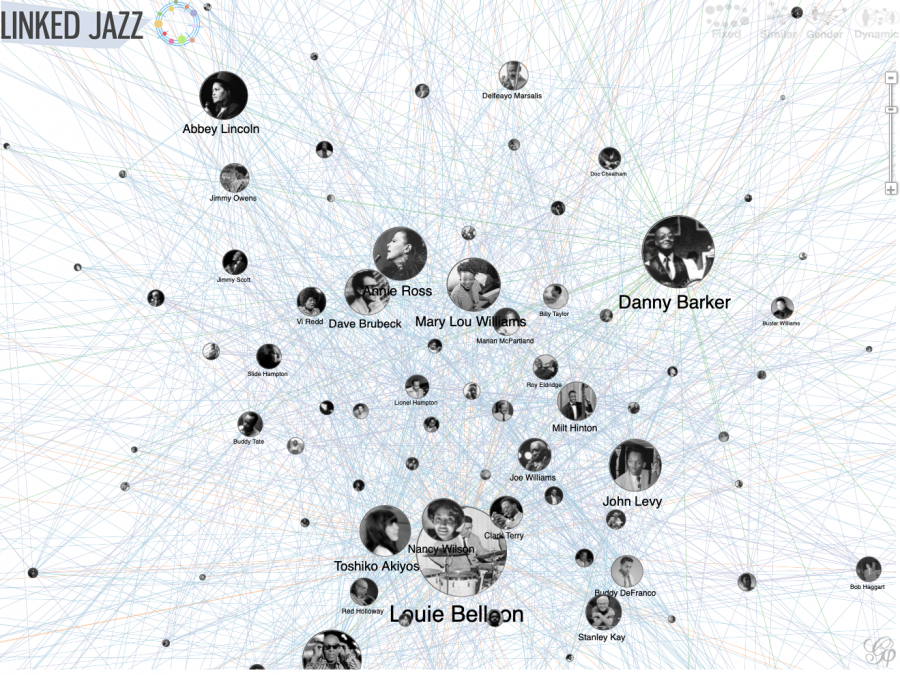
Linked Jazz --> Linked Jerry (a.k.a., the Side Trips Social Network)

Something like this social network graph will form the centerpiece image (I will pay for color) of Fate Music. I presented a brutally rudimentary glimpse of such a thing like ten years ago at the GD Studies caucus meeting in ABQ, calling it "The Side Trips Social Network". Social network analysis (SNA) is groovy stuff.

Thursday, January 14, 2021

Garcia and The Great American Songbook

Per wiki, The Great American Songbook is "the canon of significant early-20th-century American jazz standards and popular songs". It is put out by The Great American Songbook Foundation, fittingly enough.

I have so damn much to learn about this stuff. It's just a gaping hole in my (admittedly limited) musicological understanding. 

I just fell into the rabbit hole, so let me report here the tunes from the GAS that I understand Garcia to have engaged.

YearSong titleComposer(s)Lyricist(s)
1930"Georgia on My Mind"Hoagy CarmichaelStuart Gorrell
A Good Man Is Hard To Find

The Man I Love


Sunday, December 10, 2017

The Great Barcia

Rock Scully's book occasionally referred to Jerry as "the Great Barcia". I had originally thought it was Salvador Dalí, but looking back, I guess not. It still tickles me.

This just came back to mind as I came across two ads, a month apart, for Reconstruction at the Catalyst in Santa Cruz on 3/31/79. Someone at the Sentinel was either a Prankster or confused, and not just about Jerry (see also "Greg Kihm"). I wonder if Rock got this "Barcia" thing from the second ad posted here? Anyway, I am sure that, especially in Reconstruction, the Great onedidn't mind having some of his higher fans possibly thrown off the scent.

update: commenter Nick points out that the Eldon Porray tapes understood as Reconstruction at the Catalyst on 3/30/79 are probably really from this date, 3/31/79. This pertains to shnid-11673 (deprecated) and the MOTB transfer, shnid-106004. He raves about the "Sama Layuca" as well, which you should take very seriously.

ad for "Re Construction" at the Catalyst, featuring mystery guitarist "Jerry Garsia", Santa Cruz Sentinel, February 23, 1979, p. 16.

ad for Reconstruction at the Catalyst, featuring mystery guitarist "Jerry Barcia", Santa Cruz Sentinel, March 23, 1979, p. 13.

Saturday, March 19, 2016

untitled 19750820b

UPDATE: researcher David Kramer-Smyth spoke with Hadi al-Saadoon, who identified David Kessner as the composer. David Kessner confirms he wrote it, but is not sure if it had a name.

Anyone know the funk-fusion instrumental that ends set I of 8/20/75, Keith and Donna Band at the Great American Music Hall, a week after the Dead's picture-perfect performance in the same hall, a personal favorite space of Jerry's from playing it with Merl? On the much-appreciated Reinhart Holwein tape (shnid-107746), it is d1t08.

JGC doesn't seem to know either, but rather than laying out there as an unknown, they just excise it, leaving the poor unsuspecting fan to imagine that "Sweet Baby" ended the set, which it patently did not.

! JGC: http://jerrygarcia.com/show/1975-08-20-great-american-music-hall-san-francisco-ca/

This track is hot as hell in lots of places. What is it?

update
 
Commenter Nick offers this:
I have it labeled "David's tune (Gm)" in my notes.  If you strain your ears, you can hear someone on the sbd recording saying, “David’s tune… David’s tune… G minor” (this is d2t06 @1:26 on shnid=21672).  And, indeed, the funk instrumental (d2t07) is in G minor (the circulating sbd runs a half-step sharp, but it's definitely in Gm on the pitch-corrected MOTB aud).  There was no one named David in the band, though (??), and I've never bothered to dig around as to who David might be.  Any ideas?
Based on this, I think "David's tune (Gm)" is a great working title, or maybe for now I'll just keep both names, i.e., untitled 19750820b - "David's tune (Gm)".

update2: still searching for the ID five years later.

Recall that Corry has written up this night's version of Freddie Hubbard's "Straight Life" through the lenses of, variously, Art Pepper and Jerry Garcia in the summer of 1975.

! ref: Arnold, Corry. 2012. August 20, 1975 Great American Music Hall, San Francisco: Keith And Donna with Jerry Garcia ('Straight Life"). Lost Live Dead, March 29, 2012, URL http://lostlivedead.blogspot.com/2012/03/august-20-1975-great-american-music.html, consulted 12/27/2013.

It looks like that will be "the book" on this gig.

Friday, January 08, 2016

Reading Notes: Henke 1991

I wasn't paying attention at the time, but my sense is that these September 1991 interviews (I think there might have been some separate remarks in the Boston Globe) caused a good deal of consternation in Deadlandia - and why not? The golden-egg-laying-goose sounds like he'd love to leave the reservation at this point.

Lots of good stuff here.


Henke, James. 1991. The Rolling Stone Interview: Jerry Garcia. Rolling Stone, October 31, 34-40, 103, 106, 108.

Two September 1991 afternoons, hotel room overlooking Central Park.

July 1991 was release of JG DG, August 1991 was release of double live JGB. Meantime, JGB was a stone-cold junkie, waiting in line for methadone like everyone else.

“solo jaunts are often more entertaining than his work with the Dead, and one gets the feeling that if he felt he could easily extricate himself from the Dead and his attendant responsibilities, he might just do it. Still, when pressed, Garcia claimed the Dead take precedence. … We’ve all put so much of our lives into it by now that it’s too late to do anything drastic” (Henke 1991, 37).

Two separate interview sessions September 1991 NYC. In a family way with Manasha and Keelin.

“recent” meeting in which Garcia told the other band members that he wasn’t having fun anymore, that he wasn’t enjoying playing with the Dead. Garcia confirms this. “The band is the board of directors, and we have regular meetings with our lawyers and our accountants. And we’ve got it done to where it only takes about three or four hours, about every three weeks. But anyway, the last couple of times, I’ve been there screaming ‘Hey, you guys!’ Because there are times when you go onstage and it’s just plain hard to do, and you start to wonder, ‘Well, why the fuck are we doing this if it’s so hard?’”

“We’ve been running on inertia for quite a long time. I mean, insofar as we have a huge overhead, and we have a lot of people that we’re responsible for, who work for us and so forth, we’re reluctant to do anything [38] to disturb that. We don’t want to take people’s livelihoods away. But it’s us out there, you know. And in order to keep doing it, it has to be fun” (Henke 1991, 37-38).

“we’re … going to have to construct new enthusiasm for ourselves, because we’re getting a little burned out. We’re a little crisp around the edges” (Henke 1991, 38).

They are trying to work up to taking a long break, a la 1974, “aiming for six months off the road” (Henke 1991, 38).

p. 38 Gar talks about how he dislikes trying to write songs. “It’s like pulling teeth.”

They saw Brent’s death coming. “About six or eight months earlier, he OD’d and had to go to the hospital, and they just saved his ass. … I think there was a situation coming up where he was going to have to go to jail. He was going to have to spend like three weeks in jail, for driving under the influence or one of those things, and it’s like he was willing to die just to avoid that. Brent was not a real happy person. And he wasn’t like a total drug person. He was the kind of guy that went out [39] occasionally and binged. And that’s probably what killed him” (Henke 1991, 38-39).

Getting older, people dying. Rick Griffin just died. “[F]or me at this point, I’m just happy if someone dies with a minimum of pain and horror” (Henke 1991, 39).

“I’m not a religious person” (Henke 1991, 39).

“The Grateful Dead is not where you’re going to find comfort. In fact, if anything, you’ll catch a lot of shit. And if you don’t get it from the band, you’ll get it from the roadies. They’re merciless. They’ll just gnaw you like a dog. They’ll tear your flesh off. They can be extremely painful” (Henke 1991, 39). Note that one word from Garcia could have put a stop to that, but he didn’t roll that way.

“Brent had a deeply self-destructive [40] streak.” (Henke 1991, 39-40). Talks about Brent lacking in culture.

“My life would be miserable if I didn’t have those little chunks of Dylan Thomas and T.S. Eliot” (Henke 1991, 40).

#drugs “I’ve been round and round with the drug thing. People are always wanting me to take a stand on drugs, and I can’t. To me, it’s so relativistic, and it’s also very personal. A person’s relationship to drugs is like their relationship to sex. … For me, in my life, all kinds of drugs have been useful to me, and they have also definitely been a hindrance to me. So, as far as I’m concerned, the results are not in. Psychedelics showed me a whole other universe, hundreds and millions of universes. So that was an incredibly positive experience” (Henke 1991, 40).

Still dabble with mushrooms: “It’s one of those things where every once in a while you want to blow out the pipes. For me, I just like to know they’re available, just because I don’t think there’s anything else in life apart from a near-death experience that shows you how extensive the mind is” (Henke 1991, 40).

“as far as the drugs that are dead-enders, like cocaine and heroin and so forth, if you could figure out how to do them without being strung out on them, or without having them completely dominate your personality … I mean, if drugs are making your decisions for you, they’re no fucking good. I can say that unequivocally. If you’re far enough into whatever your drug of choice is, then you are a slave to the drug, and the drug isn’t doing you any good” (Henke 1991, 40).

“I’m an addictive-personality kind of person. … with drugs, the danger is that they run you. Your soul isn’t your own. That’s the drug problem on a personal level” (Henke 1991, 40).

Says he was doing H on and off for 8 years.

Hard to quit H, but real problem now is smokes, that last thing left. “My friends won’t let me take drugs anymore, and I don’t want to scare people anymore. Plus, I definitely have no interest in being an addict” (Henke 1991, 40).

“I still have that desire to change my consciousness, and in the last four years I’ve gotten real seriously into scuba diving.” Also gives him some physical exertion (Henke 1991, 40).

With Keelin “I have a little more time to actually be a father. My other daughters have all been very good to me, insofar as they've never blamed me for my absentee parenting. And it was tough for them, really, because during the sixties and seventies, I was gone all the time. But they've all grown up to be pretty decent people, and they still like me. We still talk. But I never did get to spend a lot of time with them." (Henke 1991, 40).

Garcia got together with Heather (daughter of Jerry and Sara Katz) for 18 or 19 years at one point (Henke 1991, 103).

At this point, JG and MG are in the process of getting divorced. “She’s real glad to get rid of me. We had a great time, a nice life together, but we went past it. … We haven’t really lived together since the 70s” (Henke 1991, 103).

Joe died when Gar was 5. Joe played clarinet and other woodwinds, in a big ol 40 piece jazz orchestra. “My father’s sister says he was in a movie, some early talkie.” (Henke 1991, 103).

“I remember him playing me to sleep at night. I just barely remember the sound of it” (Henke 1991, 103).

Jerry watched Joe go under and drown. “It was horrible. I was just a little kid, and I didn’t really understand what was going on, but then, of course, my life changed. “ (Henke 1991, 103).

Ruth was an RN, but after Joe died she took over his bar. “He had this little bar right next door to the Sailor’s Union of the Pacific, the merchant marine’s union, right at First and Harrison, in San Francisco. It was a daytime bar, a working guy’s bar, so I grew up with all these guys who were sailors. They went out and sailed to the Far East and the Persian Gulf, the Philippines and all that, and they would come and hang out in the bar all day long and talk to me when I was a kid. It was great fun for me. I mean, that’s my background. I grew up in a bar. And that was back in the days when the Orient was still the Orient, and it hadn’t been completely Americanized yet. They’d bring back all these weird things. Like one guy had the world’s largest collection of [106] photographs of square riggers” (Henke 1991, 103, 106).

His third grade teacher Miss Simon hipped him to the possibility of being a creative type. “’You mean you can spend all day painting pictures? Wow! What a great piece of news’.” (Henke 1991, 106).

Dwight Johnson was another teacher, “he’s the guy that turned me into a freak” (Henke 1991, 106). He was a motor cycle guy, 7th grade teacher.

Talks about liking Dylan songs: “they speak to me emotionally on some level. Sometimes, I don’t even know why. Like that song, Señor. There’s something creepy about that song, but it’s very satisfying in a weird sort of way” (Henke 1991, 106). “This is talking about a kind of desperation that everybody experiences” (Henke 1991, 108). Songs-S

More fun outside the Dead. “that’s always dangling in front of me, the thing of, well, shit, if I was on my own, God, I could … “ (Henke 1991, 108).

“Bruce, Branford, Rob Wasserman and I have talked about putting something together. I had this notion of putting together a band that had no material, that just got onstage and blew. And maybe one of these days we’ll make that happen” (Henke 1991, 108). Him saying this is the verbal equivalent of gazing forlornly out Grisman's picture window.

Garcia listens to Django, Art Tatum, Charlie Parker, Coltrane. “Michael Hedges is great. And my personal favorite lately is this guy Frank Gambale, who’s been playing with Chick Corea for the past couple of years” (Henke 1991, 108).

“Living Colour is a great band … Jane’s Addiction is another band I like” (Henke 1991, 108).

“I feel like I’m a hundred million years old” (Henke 1991, 108).

Why kids keep coming to see the Dead: “There must be a dearth of fun out there in America. Or adventure. Maybe that’s it, maybe we’re just one of the last adventures in America” (Henke 1991, 108).

Thursday, July 30, 2015

Reading Notes: Henke 1991

LIA posted a quote from this, I stumbled across it amidst my materials, and I decided now was as good a time as any to annotate it.

Henke, James. 1991. The Rolling Stone Interview: Jerry Garcia. Rolling Stone, October 31, 34-40, 103, 106, 108.

Two September 1991 afternoons, hotel room overlooking Central Park.

July 1991 was release of JG DG, August 1991 was release of double live JGB. Meantime, JG was trying to kick H again.

“solo jaunts are often more entertaining than his work with the Dead, and one gets the feeling that if he felt he could easily extricate himself from the Dead and his attendant responsibilities, he might just do it. Still, when pressed, Garcia claimed the Dead take precedence. … We’ve all put so much of our lives into it by now that it’s too late to do anything drastic” (Henke 1991, 37).

Two separate interview sessions September 1991 NYC. In a family way with Manasha and Keelin.

“recent” meeting in which Garcia told the other band members that he wasn’t having fun anymore, that he wasn’t enjoying playing with the Dead. Garcia confirms this.

“The band is the board of directors, and we have regular meetings with our lawyers and our accountants. And we’ve got it done to where it only takes about three or four hours, about every three weeks. But anyway, the last couple of times, I’ve been there screaming ‘Hey, you guys!’ Because there are times when you go onstage and it’s just plain hard to do, and you start to wonder, ‘Well, why the fuck are we doing this if it’s so hard?’”

“We’ve been running on inertia for quite a long time. I mean, insofar as we have a huge overhead, and we have a lot of people that we’re responsible for, who work for us and so forth, we’re reluctant to do anything [38] to disturb that. We don’t want to take people’s livelihoods away. But it’s us out there, you know. And in order to keep doing it, it has to be fun” (Henke 1991, 37-38).

“we’re … going to have to construct new enthusiasm for ourselves, because we’re getting a little burned out. We’re a little crisp around the edges” (Henke 1991, 38).

They are trying to work up to taking a long break, a la 1974, “aiming for six months off the road” (Henke 1991, 38).

p. 38 Gar talks about how he dislikes trying to write songs. “It’s like pulling teeth.”

They saw Brent’s death coming. “About six or eight months earlier, he OD’d and had to go to the hospital, and they just saved his ass. … I think there was a situation coming up where he was going to have to go to jail. He was going to have to spend like three weeks in jail, for driving under the influence or one of those things, and it’s like he was willing to die just to avoid that. Brent was not a real happy person. And he wasn’t like a total drug person. He was the kind of guy that went out [39] occasionally and binged. And that’s probably what killed him” (Henke 1991, 38-39).

Getting older, people dying. Rick Griffin just died. “[F]or me at this point, I’m just happy if someone dies with a minimum of pain and horror” (Henke 1991, 39).

“I’m not a religious person” (Henke 1991, 39).

“The Grateful Dead is not where you’re going to find comfort. In fact, if anything, you’ll catch a lot of shit. And if you don’t get it from the band, you’ll get it from the roadies. They’re merciless. They’ll just gnaw you like a dog. They’ll tear your flesh off. They can be extremely painful” (Henke 1991, 39). Note that one word from Garcia could have put a stop to that, but he didn’t roll that way.

“Brent had a deeply self-destructive [40] streak.” (Henke 1991, 39-40). Talks about Brent lacking in culture.

“My life would be miserable if I didn’t have those little chunks of Dylan Thomas and T.S. Eliot” (Henke 1991, 40).

#drugs “I’ve been round and round with the drug thing. People are always wanting me to take a stand on drugs, and I can’t. To me, it’s so relativistic, and it’s also very personal. A person’s relationship to drugs is like their relationship to sex. … For me, in my life, all kinds of drugs have been useful to me, and they have also definitely been a hindrance to me. So, as far as I’m concerned, the results are not in. Psychedelics showed me a whole other universe, hundreds and millions of universes. So that was an incredibly positive experience” (Henke 1991, 40).

Still dabble with mushrooms: “It’s one of those things where every once in a while you want to blow out the pipes. For me, I just like to know they’re available, just because I don’t think there’s anything else in life apart from a near-death experience that shows you how extensive the mind is” (Henke 1991, 40).

“as far as the drugs that are dead-enders, like cocaine and heroin and so forth, if you could figure out how to do them without being strung out on them, or without having them completely dominate your personality … I mean, if drugs are making your decisions for you, they’re no fucking good. I can say that unequivocally. If you’re far enough into whatever your drug of choice is, then you are a slave to the drug, and the drug isn’t doing you any good” (Henke 1991, 40).

“I’m an addictive-personality kind of person. … with drugs, the danger is that they run you. Your soul isn’t your own. That’s the drug problem on a personal level” (Henke 1991, 40).

Says he was doing H on and off for 8 years.

Hard to quit H, but real problem now is smokes, that last thing left. “My friends won’t let me take drugs anymore, and I don’t want to scare people anymore. Plus, I definitely have no interest in being an addict” (Henke 1991, 40).

“I still have that desire to change my consciousness, and in the last four years I’ve gotten real seriously into scuba diving.” Also gives him some physical exertion (Henke 1991, 40).

With Keelin “I have a little more time to actually be a father. My other daughters have all been very good to me, insofar as they've never blamed me for my absentee parenting. And it was tough for them, really, because during the sixties and seventies, I was gone all the time. But they've all grown up to be pretty decent people, and they still like me. We still talk. But I never did get to spend a lot of time with them." (Henke 1991, 40).

Garcia got together with Heather (daughter of Jerry and Sara Katz) for first time 18 or 19 years ... (Henke 1991, 103).

At this point, JG and MG are in the process of getting divorced. “She’s real glad to get rid of me. We had a great time, a nice life together, but we went past it. … We haven’t really lived together since the 70s” (Henke 1991, 103).

Joe died when Gar was 5. Joe played clarinet and other woodwinds, in a big ol 40 piece jazz orchestra. “My father’s sister says he was in a movie, some early talkie.” (Henke 1991, 103).

“I remember him playing me to sleep at night. I just barely remember the sound of it” (Henke 1991, 103).

Jerry watched Joe go under and drown. “It was horrible. I was just a little kid, and I didn’t really understand what was going on, but then, of course, my life changed. “ (Henke 1991, 103).

Ruth was an RN, but after Joe died she took over his bar. “He had this little bar right next door to the Sailor’s Union of the Pacific, the merchant marine’s union, right at First and Harrison, in San Francisco. It was a daytime bar, a working guy’s bar, so I grew up with all these guys who were sailors. They went out and sailed to the Far East and the Persian Gulf, the Philippines and all that, and they would come and hang out in the bar all day long and talk to me when I was a kid. It was great fun for me. I mean, that’s my background. I grew up in a bar. And that was back in the days when the Orient was still the Orient, and it hadn’t been completely Americanized yet. They’d bring back all these weird things. Like one guy had the world’s largest collection of [106] photographs of square riggers” (Henke 1991, 103, 106).

His third grade teacher Miss Simon hipped him to the possibility of being a creative type. “’You mean you can spend all day painting pictures? Wow! What a great piece of news’.” (Henke 1991, 106).

Dwight Johnson was another teacher, “he’s the guy that turned me into a freak” (Henke 1991, 106). He was a motor cycle guy, 7th grade teacher.

Talks about liking Dylan songs: “they speak to me emotionally on some level. Sometimes, I don’t even know why. Like that song, Senor. There’s something creepy about that song, but it’s very satisfying in a weird sort of way” (Henke 1991, 106). “This is talking about a kind of desperation that everybody experiences” (Henke 1991, 108). Songs-S

More fun outside the Dead. “that’s always dangling in front of me, the thing of, well, shit, if I was on my own, God, I could … “ (Henke 1991, 108).

“Bruce, Branford, Rob Wasserman and I have talked about putting something together. I had this notion of putting together a band that had no material, that just got onstage and blew. And maybe one of these days we’ll make that happen” (Henke 1991, 108).

Garcia listens to Django, Art Tatum, Charlie Parker, Coltrane. “Michael Hedges is great. And my personal favorite lately is this guy Frank Gambale, who’s been playing with Chick Corea for the past couple of years” (Henke 1991, 108).

“Living Colour is a great band … Jane’s Addiction is another band I like” (Henke 1991, 108).

“I feel like I’m a hundred million years old” (Henke 1991, 108).

Why kids keep coming to see the Dead: “There must be a dearth of fun out there in America. Or adventure. Maybe that’s it, maybe we’re just one of the last adventures in America” (Henke 1991, 108).

Saturday, February 07, 2015

Jim Nelson on the Drums and Several Great Rarities: JGMS at Keystone, October 4, 1974

LN jg1974-10-04.jgms.all.aud-falanga.8649.shn2flac

This is great to hear.

Three points of historical interest.

1) Louis Falanga's onstage audience tapes are great documents.

2) Lots of interesting material including, here, some great jazz ("Valdez In The Country", "People Make The World Go Round", "Freedom Jazz Dance"), and a great rare (in the Garciaverse) Motown, "Ain't No Mountain High Enough".

3) personnel: Bill Kreutzmann had been drumming with JGMS since about November 1973, by my reckoning, and then, after 9/2/74, JGMS goes in another direction. Here we have Jim Nelson on a tryout, it would seem. Paul Humphrey would be present in Santa Cruz on the 11th and Santa Barbara on the 13th, and is presumed to continue through October. I think it's pretty well established that he was drumming for the Fall 1974 East Coast tour, though truth be told I have never seen a shred of hard contemporary evidence for that. It's "understood". I don't doubt it, but wouldn't it be funny if Jim Nelson were really the drummer in some of these slots?

Jerry Garcia and Merl Saunders
Keystone
2119 University Avenue
Berkeley, CA 94704
October 4, 1974 (Friday)
Falanga-Menke shnid-8649 retrack shn2flac

--set I (6 tracks, 58:27)--
s1t01. //That's What Love Will Make You Do [13:43] % [1:43]
s1t02. Valdez In The Country [12:56] ->
s1t03. Space [1:54] ->
s1t04. People Make The World Go// Round [4:#10] [0:33] % [0:32]
s1t05. (I'm A) Road Runner [10:59] (1) [0:40]
s1t06. /It Ain't No Use [11:01#] (2) [0:16]

--set II (6 tracks, 54:07)--
s2t01. tuning [0:57]
s2t02. Tough Mama [7:34] [1:00]
s2t03. Freedom Jazz Dance [14:42] [1:22]
s2t04. Sitting In Limbo [11:41] [0:09] % [0:30]
s2t05. Ain't No Mountain High Enough [6:26] ->
s2t06. How Sweet It Is (To Be Loved By You) [9:37] [0:08]

! ACT1: Jerry Garcia and Merl Saunders
! lineup: Jerry Garcia - el-g, vocals;
! lineup: Merl Saunders - keyboards;
! lineup: John Kahn - el-bass;
! lineup: Jim Nelson - drums.

JGMF:

! Recording: symbols: % = recording discontinuity; / = clipped song; // = cut song; ... = fade in/out; # = truncated timing; [ ] = recorded event time. The recorded event time immediately after the song or item name is an attempt at getting the "real" time of the event. So, a timing of [x:xx] right after a song title is an attempt to say how long the song really was, as represented on this recording

! Jerrybase: https://jerrybase.com/events/19741004-01

! JGC: https://jerrygarcia.com/show/1974-10-04-keystone-berkeley-ca/

! db: shnid-8649 (this fileset).

! map: https://goo.gl/maps/LDc43

! venue: http://jerrygarciasbrokendownpalaces.blogspot.com/2012/02/keystone-2119-university-avenue.html | http://lostlivedead.blogspot.com/2010/12/2119-university-avenue-berkeley-ca.html | http://lostlivedead.blogspot.com/2011/01/jerry-garcia-and-keystone-shows.html.

! ad: SFSECDB19740922p31

! listing: SFSECDB19740929p05

! ad: SFSECDB19740929p31

! listing: San Francisco Examiner, October 3, 1974, p. 35

! listing: Hayward Daily Review, October 4, 1974, p. 28

! seealso:  JGMF, "Finders Keepers: JGMS with Jim Nelson on Drums, Keystone, October 5, 1974."

! historical: Three points of historical interest. 1) Louis Falanga's onstage audience tapes are great documents. 2) Lots of interesting material including, here, some great jazz ("Valdez In The Country", "People Make The World Go Round", "Freedom Jazz Dance", and great rare (in the Garciaverse) Motown, "Ain't No Mountain High Enough". 3) personnel: Bill Kreutzmann had been drumming with JGMS since about November 1973, by my reckoning, and then, after 9/2/74, JGMS goes in another direction. Here we have Jim Nelson on a tryout, it would seem. Paul Humphrey would be present in Santa Cruz on the 11th, BCT on the 12th, and Santa Barbara on the 13th, and is presumed to continue through October. I think it's pretty well established that he was drumming for the Fall 1974 East Coast tour, though truth be told I have never seen a shred of hard contemporary evidence for that. It's "understood".

! personnel: Betty's reel notes that this is Jim Nelson on drums! I note lots of hi-hat, lots of quick stuff, and find that in general this guy is great, even as the group tries to learn how to play together. It's not entirely successful, but it is super-interesting.

! R: field recordist: Louis Falanga (?and Bob Menke?)

! R: field recording gear: 1x Sony ECM-70 + 1 x Sony ECM-250 Sony TC-152

! R: field recording location: onstage from stage left/house right. The sought-for setup would have been seated at Garcia's feet, one mic pointed into his stage monitor and one mic aimed at the rest of the band.

! R: lineage: unknown cassette master transfer by Bob Menke, ca. late 1990s, unknown process to CDx (Jim Powell) > CDx (Jack Warner) > CDx; re-tracked, shortened, and seeded by jupillej@mediaone.net.

! R: Utterly breathtaking. The vocals are nearly inaudible. We are getting them direct from Jerry's mouth from about 8-10 feet away or whatever, with no amplification. But Garcia's guitar is crystal-clear: this is the best example so far of the technique that Falanga and/or Menke used for these tapes, which was to directly mic Jerry's stage monitor and point another mic toward the center of the stage soundfield. His guitar has incredible tone and volume. The bass is also pretty loud and direct-sounding. Is it possible that what we are hearing is a kind of monitor mix for Jerry? Sorry, summing up: guitar and bass crystal clear and loud, drums real nicely present, keys and horns real low in the mix.

! R: s1t01 TWLWMYD cuts in; drums come up a little @ 9:20

! setlist: s1t02 "Valdez In The Country" originally given as "Boss Martin", per old Jerry Site nomenclature, changed 9/13/2009.

! P: s1t02 VITC Martin takes the first solo, and he is blowing beautifully. This song really suits him. Do we know whether it was him who brought it in to the band? The little thing Jerry and the drummer get together in the 11-min mark is really interesting. The drummer is doing some syncopated percussive stuff with one hand and a nice tight snare in the other. And Jerry really seems to respond. He's noodling low, but check right at the start of the 11-minute mark for some really, really gorgeous musical ideas from the Great Barcia.

! setlist: s1t03 Space is well-placed here. This is completely unmoored from the song, Valdez In The Country, out of which it oozed.

! s1t04 PMTWGR This version is absolutely classic, just how you want it to be: Kahn announces and starts it. Garcia swoops in @ 0:48 with the roundabout strumming he does in this tune ... but Merl wants to keep it spaced out for awhile, and I gotta say the drummer is right there with him. And who is Garcia to say no to some noodly weirdness? Thet let it bounce around for a minute or so, Garcia coming back to his strum @ 1:48, then Merl joins in with the melody. It's really, really nice because it's still really echoey and vibey, Merl using lots of reverb patience. Then the splice, though, and we are winding up. And we don't know what we are missing. Could have been legendary!

! R: s1t04 PMTWGR splice @ 2:29

! s1t05 Road Runner again shows the distinctive style of the drummer, Jim Nelson. Not so much high-hat here, but lots of quick, tight rolls. Guy can hit, all right, and these Holland/Dozier/Holland rollers are presumably pretty well encoded in all the players' respective hardwiring.

! s1t05 (1) @ 11:29 Nelson (presumed): "You guys are treating me rough, man." I think that's Jim Nelson speaking, and he's probably referring to them throwing him out there with a bunch of songs and just telling him to keep up! That's how it sounds to me, anyway.

! setlist: s1t06 "It Ain't No Use" previously known as "It's No Use", changed 9/3/2011.

! R: s1t06 IANU cuts in

! s1t06 (2) JG: "Thanks a lot. We're gonna take a great for a little while. We'll be back pretty soon."

! R: s1t08 there may be a brief splice during the tuning @ 4:28. Then the clear splice @ 4:43

! P: s2t02 There is some really grungy stuff happening off the keyboards, or is it saxophone? at the start of Tough Mama. Can't tell if someone's trying to get some of that, or if it's a bad cable somewhere. Goes away by 1:20. Jerry's vocals are also more audible on the tape here than they had been at the start of set I. Tough Mama gets a little loose for awhile toward the end. They are working on it.

! P: s2t03 old note: "I think they keep trying to end FJD, but they keep forgetting to tell the drummer." new note: That said, this FJD is profoundly interesting to me. I think this is outstanding. Yes, they should have ended it at 12:04. Everything from that point is a little wonky. Though the drummer is super-interesting, they just are not together 12:04ff. Try to end again 12:50, he misses it. OK! They all decide to do some stuff, Jerry playing some realyl plucky 13, Merl does a real nice run 13:08ff, very nice job Merl! Goes high 13:25, Jerry glassy sraping chunking behind him, Merl swirling up some goodies 13:45. Martin adding percussion 14:01. Then they hit it 14:42, so it was just those two misses in the 12 minute range, and then they made some lemonade with them in any case. Very good.

! R: s2t05 Ain't No Mountain High Enough static blip @ 2:40

! P: s2t05 ANMHE amazing to hear this. Great energy. Martin misses once early on, things are a little loose in terms of arrangement, but this has a great groove! 4:30 it is driving beautifully and Garcia does some incredible guitar work, splashy long threads on top of some killer rhythm with an amazing piece of American music at his fingertips. Great. Listen to Nelson drum 5:38! They pull a little minor decay to signal end ... I could have stood for it to go a little longer ... they let it melt and decay, lots of reverb, echoey space, closes to the echo that becomes HSII. Nice!

Saturday, January 24, 2015

Darben The Redd Foxx

Commenter Nick's encyclopedic discographical resources (vinyl and knowledge) rescue me/us from an error and afford a little glancing blow through American culture that helps us situate Garcia in his world.

The song currently understood as "Ptah, the El Daoud" (Alice Coltrane), previously understood "Bag's Groove" (Milt Jackson), performed by Garcia-Saunders on June 4 and June 6, 1974, is actually what I will spell as "Darben the Redd Foxx", which Nick first finds on James Moody (Argo LP 648, 1959) [youtube | wiki]. He supplies a very helpful starter discography:
  • "Darben the Redd Foxx" on James Moody s/t (Argo 1959)
  • "Dobbin' with Redd Foxx" on Eddie Lockjaw Davis, Bacalao (Prestige 1960, rec 1959)
  • "Darbin and the Redd Fox" on Milt Jackson, Vibrations (Atlantic 1964, rec 1960)
  • "Darben the Redd Foxx" on Don Patterson, Mellow Soul (Prestige 1967)
  • "Darbin the Redd Fox" on James Moody, Don't Look Away Now (Prestige 1969)
  • "Darben the Red Fox" on Dizzy Gillespie, live recording 1980 (sextet with Moody), see http://jdisc.columbia.edu/session/dizzy ... er-24-1980
  • "Darben the Red Fox" on Rutgers University Livingston College Jazz Ensemble, Music of the Masters - Past and Present (RJE/PJ, 1981)
  • "Darben the Redd Foxx" on James Moody/Hank Jones, Our Delight (IPO, 2008)
I think Nick suggested we go with "Darben The Red Fox", and WTF am I to say otherwise, but when in doubt I like to use the oldest known title. (Not sure I actually adhere to that rule, but regardless it's the one I am applying here.) So, again, I'll call it "Darben the Redd Foxx", credited to James Moody.

Do your own comparisons:
A little more context from Nick.
It's a random one-shot jazz tune for them to play, but it's certainly possible that Fierro was familiar with Moody and brought it to the group, or maybe even that it was a tune that Tony Saunders was familiar with … It doesn't seem like a complicated song to learn right before a gig. I don't think it was a standard, but it clearly had enough cachet for a few major jazz artists to record versions of it, so maybe it was something that jazz musicians played often at jam sessions or something -- I don't know. The real mystery (for me, at least) is how Alice Coltrane of all people came to reappropriate the exact same melody for one of her own songs -- I wonder if it isn't lifted from some classical or folk melody, but I have yet to get to the bottom of that one.
I look forward to learning more! In the meantime, let me paint around the edges a little, as is my wont, four rough-hewn sets of strokes.

First, #jazz, fine jazz. That's all.

Second, Redd Foxx -- John Elroy Sanford (December 9, 1922 – October 11, 1991) – wow. Hello to an America you couldn't, initially, see on your TV: "Foxx was born in St. Louis, Missouri and raised on Chicago's South Side. His father, Fred Sanford, an electrician and auto mechanic from Hickman, Kentucky, left his family when Foxx was four years old. He was raised by his half-Seminole Indian mother, Mary Hughes from Ellisville, Mississippi, his grandmother and his minister." (Obviously, I want … to ... compare and classify!) But, then, amazingly, in his 50th year, Redd Foxx was an American you could see on your TV, in "Sanford and Son", which ran from January 14, 1972, to March 25, 1977. White America, mostly guided, pushed and instructed by Black America itself, of course, and Foxx pushed it further still, making all kinds of marginalization mainstream, having and getting some good laughs along the way. It was a good show, and, though I don't much about Garcia's TV watching habits –sci fi and B horror flicks come to mind, and he testified to watching hellfire-, brimstone- and amphetamine-breathing preachers on late night Bay Area TV, probably variously that guy/those guys on Channel 2 for awhile, Channel 12 for awhile). Foxx's standup and some musical stuff appeared on more than fifty records, and it's just hard to imagine that Garcia hadn't taken some it that in at some point in his Beatnik youth or his still-transgressive early thirties. Here's the "Redd Foxx"-GRAM over the course of his lifetime:

Figure xxx. Ngram "Redd Foxx", 1922-1991

Third, on our history with this tune. It's been called "Bag's Groove" (no) and, lately, "Ptah, the El Daoud". To err is human, and is often the fun and interesting stuff. I am glad we thought it was Ptah, because that's a great tune that I probably would have missed if we hadn't. (Same goes for another candidate, Salah Ragab and the Cairo Jazz Band's " "The Crossing (Oubour)".) And it's a lot like Darben. But the song JGMS played was the latter and not the former, we now know. Cool. Updated your song lists – I have (s-Darben the Redd Foxx, #songs-D).

Fourth, a little spray-can Mona Lisa: I get a kick Garcia smiling behind his beard (or maybe not, in June 1974; so, smiling beneath his chins), maybe Tony Saunders brought it to them, someone thinks of Redd grabbing his chest and yelling "I'm coming, Elizabeth!", a chuckle is had. But then, the serious work, maybe important is the better word, the meaningful work of playing some fine jazz – because it's a great tune. It's a chuckle, but make no mistake about it – this material, in the setting in which it was played, finds Garcia in some of his healthiest, most challenging musical engagements. This is not his native musical idiom, but his willingness to tackle it speaks volumes.

As is so widely the case, the blackness of these engagements often remains hidden, mostly by deeply subtle forces, for example that, as a proportion of white paper (let's say, posters, handbills, business files and records), there was less black paper to begin with, less was ever collected/preserved/archived, less has been analyzed, and so forth. There's less tape from Slim Jenkins’ Supper Club or Esther’s Orbit Room in West Oakland (Hildebrand ND), to say nothing of the Marin City joints, than came out of the Lion's Share or the Keystone Berkeley. Even now race is a hard conversation to have – but it's a great conversation to have. Garcia was having it in tackling "Darben The Redd Foxx", and the sonar's return ping at forty years' vantage maps all kinds of American cultural depth. But it also reveals a sweet simplicity that would diminish over time. Thinking of Garcia thinking of Redd Foxx in early June of 1974, and then tackling a nice little piece of jazz, puts a little smile on me in the way that I hope it was able to put a little smile on him, free, still, to just play, something new and interesting, no strings attached.

REFERENCE

Hildebrand, Lee. ND. Blues on Seventh Street: Recollections of the West Oakland scene in its heyday. The Monthly, URL http://www.themonthly.com/upfront1302.html, consulted 1/24/2015.

Friday, January 02, 2015

Jerry Garcia Band at Keystone Korner, December 19-21, 1976 (UNCERTAIN)

I am a stickler for accuracy with things like band names, and yet, given what we know, you would think that the words in my title, "Jerry Garcia Band at Keystone Korner", could not be strictly accurate. Garcia stopped playing Keystone Korner in 1972, three years before the Jerry Garcia Band existed, the stickler would say.

That's true, but, imagine my surprise when, in spinning through some more BAM listings that I gathered this summer, I find the following.
BAM no. 9 (December 1976), p. 34. (Sorry about the obnoxious watermark over it.)

Listing for Jerry Garcia Band at Keystone Korner, December 19-21, 1976. Fascinating.

Did These Shows Happen?

12/21/76 almost definitely seems not to have happened, since JGB played Keystone Berkeley (1st of three nights just before Christmas). The show was reviewed (Kelp 1976), there's tape (shnid-20474), and there was a listing in the Oakland Tribune based on considerably fresher information than BAM, still a monthly at this time, could have had.

What about Sunday-Monday, December 19-20? My hunch is that they did not happen, confident to maybe 75%. I couldn't tell you how I come to that assessment so, again, a hunch. Maybe the note to call to confirm the dates plants an extra seed of doubt about it in my mind.

The Listings Themselves Are The Point

Even if the shows did not happen, the listing is fascinating. Someone with calendaring knowledge at Keystone Korner conveyed to someone at BAM that JGB would play Todd Barkan's Keystone Korner in December 1976. Beyond merely stretching the period of known Garcia-Barkan engagement by four years, it ties back into a legendary jazz room. Garcia wasn't playing very jazzily at this time, so bringing him in would have been an exception to the regularity that, after the first six months or so of Barkan's proprietorship (let's say, starting January 1, 1973) it was strictly jazz.

I have a sneaking suspicion the shows never materialized, but either way I am fascinated to contemplate the possibility.

REFERENCES

! review: Kelp, Larry. 1976. A Showcase for Garcia’s Styles. Oakland Tribune, December 23, 1976, p. 22

! listing: "Bay Area Calendar," Oakland Tribune, December 19, 1976, p. E-14

! listing: [contra: Keystone Korner] BAM no. 9 (December 1976), p. 34.

Friday, November 28, 2014

Race Record Dream


Rolling Stone has just posted a little gallery of Garcia's art. Given finity, I will only scratch the surface of the paintings and drawings.

But, since race is one of the threads I am trying to weave through my (amateur!) musicological excursions, and it crossed my screen, I thought I'd reproduce it here.

This is "Race Record Dream": "A representation of a dream that Jerry had in which he and John Kahn played with Robert Johnson in the days when the music of black musicians was sold as 'race records.' Here the three are together in a dreamy cloud with their instruments and a crank record player."

I also love Jerry dreaming himself in a Django Reinhardt/Hot Club kind of look - wow.

Monday, November 24, 2014

Risky Reconstruction

**massively updated 11/24/2014 11 PM mountain time**
I just tipped my hat to the idea of meso level musical risk in Garcia's side trips. This is the pedantic-even-by-my-high-standards phrasing of the notion that that different bands, qua bands (combinations of players and repertoires), could and did musically challenge Garcia to different degrees. The challenge-comfort continuum provides a nice way to narrate the overall arc Garcia on the side, I'll suggest more broadly. Here I point this lens at Reconstruction.
Reconstruction: End of an Era

John Kahn, for the first time since meeting Garcia, conceived and led his own band in 1979: Reconstruction, a jazz-funk-soul-disco-etc. outfit featuring loud horns and occasionally tight arrangements (Brown 1979; Light 1979). Reconstruction played "sophisticated improvisational jazz with a beat" (Light 1979). I love most of this band's music.
Beyond mostly-good and occasionally-amazing music, though, Reconstruction matters to me as a local high point for the musical challenge embedded in Garcia's 1970s side trips. For several years prior to 1979, after the Nicky Hopkins and, a fortiori, James Booker flameouts, Jerry took refuge in and sought comfort with Keith and Donna Jean Godchaux in the Jerry Garcia Band. This was mostly living room music, if a little loud for the parlor, though things picked up a little before the final collapse. After 1979, after Reconstruction, Jerry and John gradually and codependently softshoe-shuffle away from risk and challenge. Reconstruction, then, presented Garcia with a far greater musical challenge than he got from what preceded or followed it.
But it was more than a local high – its demise also signals the end of a broader era, Garcia's Seventies Side Trips. On my read, John never really recovered the energy he expended through the 70s. Jerry eventually rediscovered some of his old mojo, tackling some challenging stuff from 1990 forward with his newly-reconciled friend, the innovative American musical legend, mandolinist David Grisman. That leaves the 80s, and on that view Reconstruction appears as the storm before the calm, so to speak: Garcia's 1980s side trips provided no sustained musical risks and challenges. On the long view, then, Reconstruction offers an oasis of challenge amid a growing sea of comfort and complacency.
Some Conceptual Notes

Let me clear some conceptual and other ground, starting with my notion of the "meso level". I am operating here, as I like to do, in a world of at least minimally formalized institutions, which left enough of an imprint on paper, tape, memory, and other potentially-observed phenomena that I can sink my teeth into them. "Meso" institutions lie between the big macros (like, say, capitalism) and the tiny micros (what Garcia had for breakfast on any given day). I really have in mind how Garcia arranged his professional life, i.e., mostly, how others such as Merl, John Kahn, managers, etc. etc. arranged his professional life for him.
The meso level is populated by all kinds of interesting institutions, but I most often focus on an entity called a band. In my usage, a band is an institutionalized musical aggregation. Because it's institutionalized, it is in some sense intended by at least some of the people involved. It is intended to arrange (creating or formalizing order) and endure through time -- a "going concern". In this post I will isolate two features of bands: their members and their repertoires.
"Member" is an institutionalized position - it's a role, defined in specific ways, involving strongly ritualized rights and expectations, and so forth. A band member, it is intended, is going to be around, reasonably predictably. Each individual, and emergently in a well-functioning institution, the group as a whole will form expectations about what each and all should be doing. This might be formalized, as in a contract, or it might be completely implicit. A member stands conceptually distinct from a guest, though the messy empirical world doesn't always play along with such idealized types. They are all players, of course, which is the term I find myself using here.
Each player embodies a package of skill, tastes, inclinations, experiences and musical knowledge (leaving aside all of the other human fun we pack in our skins and clothes). I'll call this package an individual's repertoire, the stock of musical material at his or her disposal. Put the individuals together in a band, and these repertoires form a Venn diagram, the core of which is the set of possible stuff they can/want to play together. I don't want to make this too static: since people both can be taught and can forget stuff, repertoires can ebb and flow over time. But out of this possibility set, and probably passing through filters of musical taste and interests, arrangeability, playability, and all of that, bands create a collective repertoire. So in talking about the side trips' relative "meso level risk", I am really talking about how much each band musically challenged Jerry Garcia, as shaped by who was playing and the material they took on. Unfamiliar and skilled players, on the one hand, and unfamiliar and challenging material, on the other, combine to define the level of risk and challenge posed by a band.
This is distinct from what I might think of as micro level risk and challenge, i.e., at the level of concrete performances. At the micro level he never stopped leaping, finding amazing musical flashes even in the deepest, darkest depths of his Rock Bottom period (see 8/26/84!). The frequency of super-high musical attainments ebbed in, let's say, 1984-1986, and so too did their duration, but they kept their upside amplitude (see 5/31/83, for example). (Unfortunately, overall amplitude did increase. I believe it to be axiomatic that if the highs were no higher, and amplitude increased, it must be the case that the lows got lower. Whatever the math, and it has the virtue of being checkable, that last statement is certainly true, empirically.) David Kemper and Melvin Seals could push Garcia in any given moment (if more from the chair than the bench, in my view). But it's nevertheless true that the meso level got really static, especially once JGB #21b took the stage from summer 1984. The same players convened, around a relatively invariant repertoire, month after month for more than a decade. They made some amazing music in the moment, but they confronted Garcia with little in the way of sustained musical challenges.
An aside on John Kahn

I don't take John Kahn's perspective nearly often enough, and, following Corry, I'll use the occasion of talking about this band, his band to think a little more about the Mule. He seems to have had real ambitions for Reconstruction. He saw it as a kind of update to the Garcia-Saunders-Kahn-et-al group which had sold (and continues to sell!) so many records for Fantasy. The outfit would be rebuilt, playing some of the stuff that John had picked out for Jerry's 1974 Compliments of Garcia (Round RX 102, June 1974), notwithstanding that the latter hadn't sold enough to make Round Records viable. They throw in more Merl vocals, a beautiful batch of Latin and other jazz, and a bunch of other stuff, and generally play the black sinner music that John loved so much (see my reportorial analysis below). Reconstruction was aptly named, the mixing and mingling of old and new players and materials. Not only momentarily ambitious, John Kahn was also a musical revelation in Reconstruction, playing the best bass of his life (and also "lead eyebrows", according to one account – Brown 1979). Reconstruction was John taking his big chance, and he really gave it his all. "I want it to last," he said in April. "We're a serious band, and I want it to stay together" (Brown 1979).
Garciacentrically, the end of Reconstruction only coincides with the disappearance of meso level musical challenge, I think. That ship had sailed when Cats Under the Stars failed commercially, let's say, sometime in 1978. I doubt he was all that broken up about Reconstruction one way or the other. (Corry narrates a bit tighter Cats -> Reconstruction progression than I do – read him.) But, for John, I think the relationship was causal, that Reconstruction's failure to "take" took John's heart out of it, to some extent. He was never the same after 1979, to my ears, always weaker, while to my taste bass in the rock idiom (and accompanying very, very, very loud electric guitar) absolutely requires power. In short, I am conjecturing that as the commercial failure of Cats Under the Stars was to Jerry –occasion to stop trying—so Reconstruction's quick end was to John.
Birth of Reconstruction

Corry deftly narrated the birth of Reconstruction in his 2011 post "Reconstructing Reconstruction". Re-reading him, I am struck by the idea of the band as an easy way out of the Keith and Donna relationship (I'll discuss Garcia's inability to come clean and provide closure to erstwhile collaborators he's walking away from, in re Merl, more below). Comfort and challenge coexist all too fluidly in life, of course.
I read Corry as still allowing for a possible late 1978 birth of Reconstruction, but I think we should pin it down to January 1979. The Mule spelled it out in a rare contemporary interview which took place between Wednesday sets at the band's only out of state gigs,at Denver's Rainbow Music Hall, April 11-12, 1979. (1) Reconstruction had started earlier in the year. (2) John got Garcia to sign on the dotted line (as if!) after an especially taxing Dead tour. This sounds for all the world like January 1979 in Deadland, a wrecked Donna Jean heading home midstream and, which is worse, an even more wrecked Keith Godchaux staying onboard. (These shows are improbably great, as was known regularly to happen in Deadland, a place that thrived when the tension was productive.) That tour wrapped up January 21 in Detroit and Jerry was presumably home the next day. (3) They practiced for a week, and then started gigging.
To The List!
Lo! Reconstruction's first Listed public gig took place on Tuesday, January 30, 1979 at the Keystone Berkeley. This fits John's timeline to a 'T' – Jerry is home from Dead tour on 1/22, they practice for a week and gig on 1/30. This fits a pattern I believe to have established, that, in the Garciaverse, new bands are broken in on off-nights. Most importantly, tapers Steve Spitalny and John Angus made and circulated a great recording of the show, which is playing as I write this. I don't know what to make of the fact that I have Garcia manifestly playing on this tape, while he was also, manifestly enough, photographed in the City this same date for the Bammie awards (see BAM no. 50, February 16, 1979, p. 30). It seems like the industry party ended early enough for Jerry to cross the Bay Bridge to Berkeley; indeed, by the time they play Ray Charles's "Let's Go Get Stoned", at the tail end of the tape, it sounds quite a bit after hours.
Anyway, I feel reasonably confident about dating the band's public debut to Tuesday, January 30, 1979, and its birth to earlier in the month.
Players

Reconstruction was a jazz sextet. Of greatest magnitude within the Garciaverse, it publicly reunited John and Jerry with Merl Saunders. The few scraps we have about the mid-1975 demise of Legion of Mary (and, thus, of a sustained, nearly five-year Garcia-Saunders-Kahn-et-al collaboration) suggest that Jerry walked away from Merl, or was pushed/dragged away by the Grateful Dead family. This is the key piece of evidence in various Garcia narratives, including that Garcia was cowardly around personal confrontation, and especially the "goodbyes" of breaking up, which he did at some point with every single person in his life except the Dead guys and John Kahn himself. If we imagine the players orbiting the Garciaverse at the time, this looks an awful lot like the Dead and John Kahn winning a struggle for Garcia's soul (and, uncharitably, the lucre it seemed to spawn with only the gentlest priming). From Merl's perspective, it probably looks and feels at least a little bit like a betrayal, maybe less dramatically a run-of-the-mill bullshit move, or perhaps, most mundanely, just a sadness.
If Reconstruction aimed to reconstruct the old Garcia-Saunders-Kahn-et-al players and material for the disco era, reconciliation, to whatever degree it would have been needed, would have been the order of the day. The guys had not been totally estranged, it's true. Though I believe a longstanding Listing of Jerry Garcia and Merl Saunders gigging on 11/20/76 to be spurious – that month's Keystone calendar listed the JGB—it is incontrovertible that between Legion and Reconstruction Merl had helped Jerry and John out (or they, him) with some work on Cats, recorded summer 1977 through early 1978. Jerry sitting in with Merl's band at the Shady Grove on October 2-3, 1978 (update: and two other 1978 evenings) looks like a real breakthrough, both signaling the death throes of the Godchaux-era JGB –it'd go out with a great "So What" on November 3, 1978—and the public re-emergence of Jer and Merl. For all we know, John might have orchestrated, or at least helped facilitate the reunion. As ever, Corry writes it all up, just right; I like his idea that Merl, burned once, was testing Garcia's commitment before exposing himself a second time.
Whatever the case, in John's reconstruction of the old Garcia-Saunders-Kahn-et-al, firming up some of the planking on the jazzy side of the vessel, he naturally enough signed Merl up first, and together they brought in the et al. These included Merl's old bandmate, Gaylord Birch (see Corry), who led the Pointer Sisters' band, including on their profoundly fonky 1975 #1 soul hit "How Long (Betcha Got A Chick On The Side)" [LLD | youtube]. Jerry had played with him at least once before when sitting in with Merl's band at the Keystone in January 1975, tackling a repertoire not unlike Reconstruction's which included one-offs by Marvin Gaye ("What's Going On") and Weather Report's killer jazz-funk fusion "Cucumber Slumber". So, Birch knew John and Merl really well, Jerry a little, and he had some serious chops.
Also entering the fray was John's fellow Tits And Ass Rhythm and Blues Band alumnus and former roommate (LLD), and his and Merl's Bloomfield/"Better Days"-era co-conspirator, longtime Bay Area saxophonist "Reverend" Ron Stallings. I have no documented Stallings-Garcia Shared Stage events, though I think probably played together somewhere on the road that passed first through Heavy Turbulence and then through the Merl Saunders/Aunt Monk aggregations. The Rev, in turn, brought in trombonist Ed Neumeister a few days before the first gig. Neumeister had neither played with nor met Garcia before, and wasn't particularly aware of him even in the more diffuse sense: “I had no idea to be honest the following that Jerry had. I showed up for that first gig and there were wall-to-wall people" (Sforzini 2012). Ahh, the burdens of being Jerry.
Along the way, Garcia had signed on. Corry considers him not a member, but an "an ongoing, if important, guest star for a permanent band." I am not sure it's worth trying to resolve what are really just semantic differences around an ambiguous reality; it's probably enough just to acknowledge them and move on.
Here's how I might code things, with all due indifference to consistency:
! ACT1: Reconstruction (1/30/79-9/22/79)
! lineup: John Kahn – el-bass;
! lineup: Merl Saunders – keyboards, synthesizers, vocals;
! lineup: Ron Stallings – saxophone;
! lineup: Ed Neumeister – trombone;
! lineup: Jerry Garcia – el-g, vocals;
! lineup: Gaylord Birch – drums.

These guys are all monster players. Kahn was at the top of his game, playing fat, strong and aggressive bass. I love Merl's keys and synth work in this period, but what really strikes me is how much his singing has improved since the JGMS/Legion period. He brought some great club groove to the Bill Withers tunes, "Don't It Make It Better" and "Lovely Night For Dancing", for example. Stallings had played with everyone and Gaylord Birch wasa master of deeply timely but highly-styled funk drumming. The Pointer Sisters' bandleader could flat out get ... it ... on. You know what the best test of a jazz musician's chops is? How busy he keeps. Ed Neumeister was holding down multiple gigs at this time: Reconstruction, the Sacramento Symphony (yes, a classical music crossing!), the Circle Star Theater house band (Corry), also, naturlich, gigging and jamming all around Northern California with every conceivable kind of combo. Less known among denizens of the Garciaverse, because he played with Jerry in an obscure band in small rooms for an obscure eight months in 1979 -- , he remains a highly respected teacher and player [edneumeister.com | JFS #55: The Ed Neumeister interview].
Repertoires

Part of being a real band with real members, with aspirations for sustained professional success is figuring out what to play and working on playing it, together. In the case of Reconstruction as a Garcia side trip, the results are rich and highly distinctive. Many numbers and even genres only appear in the Garciaverse by way of the band. It was, in short, risky, and the results show it – some great, some not-so-great. Let me unpack.
1. Contemporary White Boy Soul

Let's start on the "swing and miss" side of the ledger. The chief culprit here is a Ron Stallings-sung contemporary white soul number, Gino Vannelli's "I Just Wanna Stop". It charted #4 on the Billboard Hot 100 (despite having music's most Canadian opening line, "When I think about those nights in Montreal"). With Reconstruction it came off a little cringeworthy, Stallings incongruously smooth in his white suit and shoes. It's exceptionally interesting to me to hear Garcia playing a contemporary soul and trying to process the dissonance, but there's no reason you, reader, should subject yourself to it. A better choice in this genre is Reconstruction's "What You Won't Do For Love". It's a better tune to begin with --freaking Tupac sampled it-- with some real soul. It drew enough well enough in black clubs and on black radio that the record company tried for awhile to obscure Bobby Caldwell's race. It's a late-night-lovemaker in just the right measure, with an appropriately slinky progression, far dirtier than the pablum dribbling down from up north. Garcia used it to groove in some nice harmony vocals ("I'm in a daze | from your love, you see") with that little insouciance that comes from feeling both strong and relaxed about "l-o-v-e-love, l-o-v-e-love". This song succeeds where "I Just Wanna Stop" falls flat.
2. Killer Instrumentals

On the wow! side of the ledger, I'd make special note of some killer instrumentals. "Welcome To The Basement", composed by Merl and Eddie Moore, had appeared on Heavy Turbulence (Fantasy 8241, 1972), featuring Garcia on guitar. I would drool to hear some earlier versions, but it's not known to have been played live with Garcia until Reconstruction did it seven years later. John Kahn starts it off with his best lead bass, running several fast and powerful measures on his own before the band joins in. He also took a couple-minute feature inside the song, playing much more forcefully than he'd ever do again. Indeed, talking about critical ruptures, hearing John play this tune on July 22, 1979 undergirds my view that, when Reconstruction died, so too did John's playing power, giving way to disturbingly fluttery, feathery, overlong and generally unsuccessful soli from 1980 forward (e.g., 2/20/80).
Stevie Wonder's "Another Star", from his amazing 1976 double record Songs in the Key of Life [deaddisc], absolutely knocks me out every time. Merl, who ended up putting this on his 1979 album Do I Move You (Crystal Clear Records CCS-5006), had catalyzed Garcia to play a bunch of Stevie Wonder songs in their earlier collaborations including, regularly with JGMS and the Legion, the great "I Was Made To Love Her", done as a smoking instrumental and, in early 1973, with Sarah Fulcher on vocals, as well as "Boogie on Reggae Woman" (Merl singing) and an instrumental "Creepin'", both from 1974's Fulfillingness’ First Finale. There are even a couple of Stevie singletons in the Garciaverse: "You Are The Sunshine Of My Life", the Talking Book single that reached #1 on the charts and for which Wonder won a Grammy award, made one October 1973 appearance, and the Merl Saunders /Aunt Monk aggregation did "Love Having You Around" (5/9/75). There may be others.
Reconstruction's "Another Star", like Stevie's own, burns barns. Here are my notes from the version identified as 4/12/79 early show:
This is a great horn tune, and these guys set the chart ablaze. They are killin' it. Garcia jumps in for his first solo playing like a man possessed -- this is some of the most molten Garcia guitar work you will ever hear. Merl, who is spinning it out like a wizard over a crystal ball, all arcing fingers, allowing a little decay in, then more decayed wizardry, like 10 degrees off from true. Garcia harshly scrubbing at various places. I bet Jerry's disappointed they end it so soon. I bet at some point he gave them the old "let's stretch that out even more, man". I am sure they have it charted out, but they are pros and I hypothesize that if we time "Another Star" we'll see it lengthen out over the course of Reconstruction's (too-brief) run.
3. An old favorite

The other Motown they covered that destroys me is Smokey Robinson's "The Hunter Gets Captured By The Game", done best, with lips reaching out the vinyl to whisper in your ear, by the Marvelletes. The tune entered the Garciaverse through ol' buddy John Kahn, who picked it for Jerry to do on Compliments (Round Records, 1974). John was a bona fide R&B nut, a legendary record collector and listener, holding special attachment, as is right and proper for the period, to Motown, and there is nothing that is not devastatingly great about his song. Legion did it live at least a time or two in 1975, it reappeared with Reconstruction, took a decade off, and came back in the late-era Garcia Band. The tune is unorthodoxly keyed, and Jerry sometimes had a hard time figuring out how to sing it; I find this in the Reconstruction versions. Old Jerry could sing it better, mostly because he was more patient with it, putting in a slightly more spacious arrangement with JGB #21b, slowing it down. But the 1990s versions also deliver a much heavier emotional punch – old Jerry isn't singing it about chasing tail (and tail being chased) – this song is about our predator-prey relations with life itself. The live version on Shining Star (Grateful Dead Records 4079, March 2001) wonderfully represents how an older, more grizzled Jerry could utterly reinterpret this American masterpiece of word and groove.
4. Latin Jazz

I hope to find another time to write about some other killer Reconstruction jazz instrumentals, so let me just mention the great Latin numbers. McCoy Tyner's "Sama Layuca" is terrifyingly brilliant, and the band drives it a fair bit harder than Tyner's original (on the album of the same name). Check out the August 10, 1979 version from the Temple Beautiful on Geary, a spaced-out 15-minute rendition that segues with limpid placidity into a sublime "Dear Prudence", the single best Beatles-song performances of Garcia's career. "Nessa", from Willie Bobo's Spanish Grease (Verve V6-8631, 1965), pushed the groove even more – this is some of the straightest Latin jazz you'll hear Garcia play, and it's got a little more frantic on it, just a shade or two darker, than most other artists' versions. Finally, a tune which Betty Cantor-Jackson inscribed as "Lyinda" on her tape boxes turns out to be "Linda Chicana", written by Mark Levine and first recorded by by Mongo Santamaria as "Sheila" (on Afro American Latin, Columbia, recorded 1969 and released 2000), was played by lots of folks, including one of Mongo's bosses, Cal Tjader, under the title I use (Clemens 2011). Like the other two, Reconstruction drove this one harder than any of these other artists.
These tunes gave Garcia a chance to work his deeply-imbued but rarely-displayed Latin chops. Despite the obviously Spanish surname, he was not a Latino in the current usage, since his father was Spain-Spanish, as one might say, rather than of New World descent. But he knew the music, was surrounded by it. He knew Carlos Santana very well, of course, had played with him and the Santanamigos at least a few times (GD 5/11/69 and 4/15/70 come immediately to mind). Merl had played with Carlos, too. But the San Francisco Latin scene, jazz and otherwise, was loaded with talented players (see here, mostly in comments). Conguero Armando Peraza had been a member of JGMS for a few months in early 1972. Martin Fierro, of course, joined Jerry and Merl in 1973 and was one of the three instrumental centerpieces of the Legion of Mary, the repertoire of which included Latin numbers "Valdez In The Country" and "La-La". While there was some precedent for Reconstruction's Latin engagements, then, the key point is that there was no "postcedent": after Reconstruction, Garcia would set Latin music aside, more or less completely, until right after his 1986 coma, when he started hooking up with Los Lobo, and he never engaged it in a sustained way again. The chance to hear Jerry play Latin jazz would be just one more casualty of Reconstruction's demise, victim to his and John's decelerating, Persian-assisted, post-Reconstruction drift into musical comfort.
5. Disco

The band also played what I can only call disco music, even though Gaylord Birch characterized Reconstruction as "tryin' to knock disco outta the box" (1/30/79, shnid-12560, s1t05). Disco of the sort I have in mind strikes me as an indigenous American musical form just as much as jazz is, though I don't know its history well enough to say. I have to think that, whatever its genesis, it found distinctively American expression. Reconstruction's disco, which I think leads lots of people to dismiss the whole enterprise is not about repertoire (they didn't do "I Will Survive"), but mostly about instrumentation --strobe-suggestive-synth, hard horns-- and, especially, arrangements -- fast and tight, good to dance to.
I like that Garcia was willing and able to engage disco (if it's really disco at all) with the same exploratory spirit he brought to most of the 70s side trips that centered on black and pan-racial musical forms. I like what it says about him, because it's an artistic choice that risked turning off his audience. Dead fans had reacted in some dismay to the horns and strings on 1977's Terrapin Station, perhaps even more so to the straight-disco "Dancing In The Streets" on Shakedown Street (1978). The cover of 1980's Go To Heaven, with the Dead in Disco Full Cleveland, has left none who have seen it capable of fully respecting any of those pictured on it. Professional reputations can suffer when musicians, perhaps having passed their primes, try on incongruous material; it can be unseemly.
But, to his credit, Garcia didn't seem to give much of a fuck. Reconstruction's Denver audience, a schadenfroh reviewer reports, "had a hard time accepting Garcia's new role as a neo-George Benson guitarist left to battle synthesizers" and "blaring horns" (Brown 1979), characteristically calling for "Casey Jones" or the Dead's exploratory masterpiece "Dark Star". Instead, they got, inter alia, white boy soul and disco. A Santa Cruz reviewer found the audience more accepting of the challenge with which Reconstruction presented them, and up to it (Light 1979). Either way, fuck 'em if they can't take a joke, and all that. And history can sometimes vindicate thoughtful choices – Reconstruction holds up well today, while disco –disco!—through Abba's improbable vicegrip stranglehold on the popular imagination—has permanently impacted popular music as it has ebbed and flowed these last four decades.
6. Etc.

In the interest of space (!), and using the Reconstruction songlist at deaddisc, I'll do some rough taxonomizing over the rest of the band's repertoire, in no particular order, and bearing in mind the arbitrariness of some of these distinctions. (I am more than open for suggestions on other ways to slice and package this material!)
Merl vocals
Ain't That Lovin' You
infoDo I Move You (Nina Simone)
infoDon't It Make It Better (Bill Withers)
infoThe Jealous Kind (Robert Guidry a.k.a. Bobby Charles)
infoLovely Night For Dancing (Bill Withers)

Reggae
infoThe Harder They Come (Jimmy Cliff)
infoStruggling Man (Jimmy Cliff)

Motown
infoAnother Star (Stevie Wonder)
infoThe Hunter Gets Captured By The Game (Smokey Robinson)

Jazz
infoFast Tone (I believe this is a Merl Saunders and Tony Saunders original)
Linda Chicana (Mark Levine)
infoThe Mohican And The Great Spirit (Horace Silver)
Nessa (Ed Diehl)
infoSama Layuca (McCoy Tyner)

Contemporary White Soul
infoI Just Wanna Stop (Gino Vannelli)
infoWhat You Won't Do For Love (Bobby Caldwell and Alfons Kettner)

Blues
infoIt Ain't No Use (Jerry Williams / Gary Bonds / Don Hollinger)
infoSomeday Baby (Lightnin' Hopkins)

Rock
infoDear Prudence (Lennon/McCartney)
infoLong Train Runnin' (Johnson)

R&B
infoI'll Take A Melody (Toussaint)
infoLet's Go Get Stoned (Ashford, Simpson and Armstead)
infoSoul Roach (Merl Saunders, Ray Shanklin)
infoThat's What Love Will Make You Do (Thigpen, Banks, Marion)

Funk
infoTellin' My Friends About You (Merl Saunders / Larry Vann)
infoWelcome To The Basement (Merl Saunders / Eddie Moore)

A Little Gigging History

The hopes John expressed in April, that Reconstruction would become a going concern, were based more in optimism than in "success" over its first few months. Most gigs were midweek, and tiny rooms like the Cotati Cabaret and Rancho Nicasio provide the modal gig space. Reconstruction's first Friday gig was March 9th in Cotati at the Inn; its next, and far and away its biggest gig to that point, was March 30th at the Catalyst in Santa Cruz; just its third, in over two months of existence, was at the ultralocal Rio Theatre, in isolated Rodeo (possible slogan: "always unlikely"), a week later. One trip out of state (four midweek shows in Denver, April 11-12), one gig in Sacto, one in LA, and a night in San Diego – that's it as far as making its way in the wide world beyond the Greater Bay Area trilateral centered on Cotati to the North, Berkeley to the East, and Santa Cruz to the South. 57 gigs total, on my current count.
Conclusion: Risky Reconstruction

Reconstruction was a most unusual side trip for Garcia. It was his only post-1975 band not to bear his name. He frequently took a "subdued, background role" in the band (Light 1979). He was generally billed as a special guest, and even skipped a few gigs when the Dead occupied him otherwise (Corry). All of this suggests low pressure. True, in these senses (and in some absolute sense) he risked little in Reconstruction. He certainly didn't need the little money it might have provided. But at the same time, the band found him taking the risks that would have mattered most to him – musical ones. The players and the repertoire pushed Garcia out of his social and musical comfort zone, at the very least getting him to think about some new charts. Taking chances doesn't always pay off, though I find many in Reconstruction that do. But perhaps more importantly, getting stuck in a rut always pays peanuts.
Matt Light (1979) could have been summing up Garcia's seventies side trips in reviewing Reconstruction in Santa Cruz: "it is ever [Garcia's] habit to experiment, and he held his end in a first-rate group".
But it wouldn't last. The band didn't survive 1979, for reasons that are characteristically obscure. Pretty much all of Garcia's side trips ended with a whimper, usually skulking away, Baltimore-Colts-in-the-dead-of-night-style, from a hurt friend, or at least collaborator. He and John walked away from Merl, a man who loved Jerry, for at least the second time. I am sure it was probably just "wanting to move in another direction", as the euphemism has it. That's fine. But have the balls to say something. Instead, as Merl recounts, "there was a night when he didn't show up for a gig, which was done purposely, I think. It was sabotaged [Saunders won't say by whom]. They didn't tell him there was a gig to get to. And shortly after that he and John started a different group and I sort of lost touch with him" (Jackson 1999, 307, quoted by Corry).
While I think Garcia and Kahn were cowardly not to just lay it out for Merl, my sense of them is that they were both sensitive enough to others that they knew, if only deep-down but I really think closer to the surface, that they had done Merl wrong. We've all screwed somebody over at some point, did wrong by them. Only a sociopath doesn't feel guilty about it (I don't think these guys were sociopaths, natch), and I suspect that this was just one more piece of painful emotional baggage that gave opiates, with their promised and presumed unfeeling powers, so congenial. I want to be clear – I am speculating about any tie-in with Merl guilt. And we know, by Garcia's own stated timelines, that he (and we suspect with about 99% confidence that John) was already using before this. But more guilt almost certainly didn't help.
Whatever the emotions, Reconstruction's demise tolled heavily on Garcia's musical life, or rather it indicated big changes. After Reconstruction, he would not regularly try on material this novel, with players who could really stand up and push him, for more than a decade. And even then, when he returned to Grisman, he was rediscovering old material more than learning new things. Reconstruction had found Jerry Garcia reaching, if not for a gold ring, then at least for one with an appealing shine, or an interesting dent, or an evocative if not expensive jewel. When it ended, he stopped reaching, period. As the 1970s ended, the curtain came down, for a good long time, on Garcia's pursuit of challenge in his side trips. The eighties would wax in waning musical ambition.

NOTES AND REFERENCES
! ref: Arnold, Corry. 2010. John Kahn Live Performance 1967-68: T&A R&B Band and Memory Pain (John Kahn II). Lost Live Dead, November 26, URL http://lostlivedead.blogspot.com/2010/11/john-kahn-live-performance-1967-68-t-r.html, consulted 11/24/2014.
! ref: Arnold, Corry. 2011. Jerry Garcia Band Drummers Top 10 List. Lost Live Dead, November 10, 2011, http://lostlivedead.blogspot.com/2011/11/jerry-garcia-band-drummers-top-10-list.html, consulted 5/19/2013.
! ref: Arnold, Corry. 2011. May 19, 1979: The Old Waldorf, San Francisco, CA: Reconstruction/Horslips. Lost Live Dead, January 6, http://lostlivedead.blogspot.com/2011/01/may-19-1979-old-waldorf-san-francisco.html, consulted 11/15/2014.
! ref: Arnold, Corry. 2012. Jerry Garcia>1978>Keyboards (Jerry Garcia-Bandleader). Lost Live Dead, September 20, 2012, URL http://lostlivedead.blogspot.com/2012/09/jerry-garcia1978keyboards-jerry-garcia.html, consulted 12/31/2013.
! ref: Arnold, Corry. 2012. Reconstructing Reconstruction, January-February and August-September 1979. Lost Live Dead, November 1, URL http://lostlivedead.blogspot.com/2012/11/reconstructing-reconstruction-january.html, consulted 11/15/2014.
! ref: Arnold, Corry. 2012. Gaylord Birch – Drums. Hooterollin' Around, February 3, URL http://hooterollin.blogspot.com/2012/02/gaylord-birch-drums.html, consulted 11/15/2014.
! ref: BAM no. 50, February 16, 1979, p. 30.
! ref: Brown, G. 1979. Reconstruction Gig Not From Dead Catalog. Denver Post, April 12, 1979, p. 56.
! ref: Clemons, Dan. 2011. Mark Levine: The Interview. Jazzreview, January 29, 2011, URL http://www.jazzreview.com/jazz-artist-interviews/mark-levine-the-interview.html, consulted 11/23/2014. 
! ref: Light, Matt. 1979. Jazz for the Dead Heads. Good Times (Santa Cruz, CA), April 5, 1979, p. 14.
! ref: Sforzini, Hank. 2012. Five Musicians Remember Jerry Garcia. Paste, August 20, 2012, URL http://www.pastemagazine.com/blogs/lists/2012/08/five-musicians-remember-jerry-garcia.html, consulted 11/24/2014.

! note: see also  my "Reconstruction at the Rainbow"