Showing posts with label Fantasy Records. Show all posts

Monday, May 28, 2018

Enter Tom Fogerty

update 20230712

I have no idea why I inferred Tom Fogerty saw JGMS at Keystone Korner on 5/20/71. It seems more likely to have been 5/22/71, and his arrival may mark why they made tapes of the next two nights.

Further, I have no idea why I inferred he first joined in Berkeley on 5/26/71, when Tuesday 5/25 is even more likely, based on the "off-night" clause of The Iron Law of Breaking in New Band Members.

So, as of 7/12/2023, I am calling 5/22 the visit and 5/25 Tom's debut.

/update 20230712

A couple of years ago I discovered this youtube content called "Goodbye Media Man", featuring video of Tom Fogerty, Merl Saunders, Bill Vitt, various studio engineers and others unknown to me, working on a track by that same title.


Here is the description (published October 9, 2013):
Tom was the original singer of the Blue Velvets and the Golliwogs, both of which evolved into Creedence Clearwater Revival. Tom Fogerty had the chops to be a star in his own right. Within the band (Doug, Stu, Tom and John), Tom was overshadowed by younger brother John, who's talent was clearly evident. "Goodbye Media Man", recorded in 1971, was Tom's first solo single after leaving Creedence. A great track with solid musicianship and hooks. To my knowledge, this is the first time this video has been posted. Tom left us far too soon, passing on September 6, 1990. Back in the day, he was a friend, and I miss him - Ken Levy, Brooklyn NY / Addlestone, Surrey England
Wow.

I continue to be amazed at the material that continues to crawl out of the woodwork. It gives me hope for the Golden State Country Bluegrass Festival (GSCBF) film, among many other things. This post will pin down the metadata but also talk about how remarkable is the wealth of material we have available to study, across many different media - and why we get to enjoy that wealth.

Metadata
Location

Appears to be Berkeley, both at Fantasy Studios and at Tom Fogerty's professorial manse with a bunch of kids running around.

Date

The video is only dated 1971. Recall that Tom Fogerty had announced on February 2, 1971 that he was leaving the lucrative Creedence Clearwater Revival over differences with the band's dominant force, his little brother John, and to spend more time with his four children.[1] We also know that the House That Creedence Built, the new Fantasy Studios facility at 10th and Parker in Berkeley, had come online right around this time. Local journo students Kathie Staska and George Mangrum ("KG") ran an amazingly rich column in the Hayward Daily Review starting in February, and got a tour of the new facility from the one and only Ralph Gleason, now working full time for Saul Zaentz at Fantasy.[2]

KG reported on March 11 that Tom had started work on his solo album.[3] Just after the solstice, on June 24th, KG reported that the record was done and was set for release the next week,[4] also noting that he'd be part of Merl Saunders's band for a release on the same label. On June 29th, Robert Hilburn noted in the LA Times that "Goodbye Media Man" was set for imminent release. So the video presumably features material from this late-winter to early-summer span. Intriguingly, a youtube posting of the "Goodbye Media Man" single associates a date of "the 17th of June 1971" with it:


With all of this, the studio film could come from anywhere between March and June, but I strongly suspect that the home material is from closer to June, as the single neared or achieved completion. Update: John Wasserman mentioned that Tom was cutting "Goodbye Media Man" in his Chronicle column of June 21st, so this is very much in the nearing-completion stage - right around the solstice.

Forging The Garcia-Fogerty Connection

Our Hero comes up in the interview, and I think this comment sheds some light on the Tom Fogerty version of the Garcia-Saunders band.[5] Tom says
I only want to jam around right now and perform with as many people as possible. I’ve learned more about music this last month [i.e., May-June] from meeting other people than during the whole time while I was with Creedence ... One night, I just happened to go over to Keystone Korner. Merl Saunders had invited me over to hear him and Bill Vitt and Jerry Garcia, and within a week I was up on the stage with 'em. And, uh playin' with 'em, and at that point I decided that that was ... the kind of music that I wanted behind the song. It was within about three days that the thing came together with Merl.
When might this have been, exactly? Let's investigate. Jerry and Merl had played the following Keystone Korner gigs from the first Freddie Herrera - Jerry Garcia Joint through mid-1971:

Table xxx. Garcia at Keystone Korner, 11/25/70-6/16/71. Follow this link for a more complete table of Garcia's Keystone Korner gigs. Click image to enlarge.

Tom's narrative and the overall evidence best fits Tom having seen JGMS on 5/20/71,[6] and sitting in with them on Wednesday 5/26/71. This frame fits "within a week" from Tom's filmed reckoning, and I am pretty confident about the interval, if not the specifics. "Three days" from Tom is a little unclear to me, certainly could suggest it was other nights than the ones I pinpoint. So, why these?

This is going to get really convoluted, and, despite my best efforts, I assume it will be somewhat hard to follow. You can just take my word for it, or you can try to follow me into the data.

First, there is tape of 5/20/71 and 5/21/71, the first out of the Garcia Vault and the second locked away there until its 2020 release. May 11, 1971[7] and these tapes represent the earliest-audible Garcia-Saunders performances (perhaps as many as eight months after they started gigging![8]), and they precede a four-month gap that audibly ends when Lou Judson becomes the second Marin County soundman to run PA tape of The Group in late September. The 5/20/71 tape escaped into the world because Garcia had it amongst his stuff when, ca. Christmas 1975, MG threw him out of Sans Souci --on which the couple had closed on ... May 5, 1971!-- and he shuffled off to Deborah's for the first time. Debbie took possession of the tape, someone found a way to copy it, and now anyone can hear it.

Second, I submit that the fact that Jerry had this tape amongst his personal stuff is not innocent with respect to the very question we are considering. I think he had the tape "pulled", either initially recorded or pulled out of wherever most of his tapes were kept, or both, precisely so Fogerty could give it a listen. We know the Dead were in the habit of pulling recent tapes to prepare their incoming members, e.g., the "Houseboat Tapes" of August 1971 that they gave Keith Godchaux to listen to. I think Jerry lent it to Tom or dubbed it for him so he could come up to speed with the band and its material.

Third, and with respect to the late boundary, I glean one other possible tidbit of information from the table above, in the advertising patterns. I am almost certainly over-reading this, but the Thursday-Friday-Saturday 5/20-22 run looks like Big Nights - advertised in the Chron, weekend shows, some real buzz. Even Tuesday 5/25 gets a Wasserman mention, which may well have been enough to sell the gig out. But 5/26, Wednesday, gets a measley mention in the Trib's "Bay Sounds" items, which usually ran more toward jazz and soul. Probably a much quieter night for Tom to step up and play some for the first time, dontcha think? I can't adduce all of the evidence here, but it is as close to an Iron Law as exists in the Garciaverse that new players are broken in off-nights, off-the-beaten-path, or both.

Art and Commerce

For Garcia of this vintage, the aesthetics of any musical choice should go without saying. He wanted to play more music with good players than the Dead could afford him (especially in this very fallow period between the closing of the Fillmores East and West). As Corry and I have elaborated, Tom Fogerty advened alongside huge changes in The Group's approach and repertoire, from spacey organ jazz to all kinds of Americana, white (The Band's "Dixie Down", Jesse Winchester's "Biloxi", some good ol' rockabilly), black (Stevie Wonder, Motown, etc. etc.) and everything in between, mostly more or less contemporary stuff. In short, I think Fogerty came in because Jerry wanted to sing some tunes, wanted to bring in more white contemporary, and Fogerty could sing, play rhythm guitar, and bring in some new material. [update: the release of the pre-Tom 5/21/71 Garcia-Saunders gig gives the lie to the idea that it was all space jazz pre-Tom, with white-roots-flavored stuff coming in with him. Dixie Down, Mystery Train and arguably a few others were already in the repertoire. This is a case where fragmentary tape evidence led us {at least me} a little astray.]

But there were almost surely also commercial logics operating here, too. Whether they came from Jerry, from Merl, from Tom, from Saul Zaentz (or Ralph Gleason), and/or others, I can't know. But Fantasy Records stands at the center of this.

Indeed, I want to revise my conjecture above about why the May 20-21, 1971 JGMS tapes were made (and recorded in 4-track, no less). This was long before Rex and then Betty started taping Jerry, so why is there this one pair of shows? I said a few paragraphs ago that it was so Tom could bone up. I think that's half-right – it was so Tom could bone up, and Tom joining this operation cannot be separated from Tom making records for Fantasy, Merl making records for Fantasy, etc. etc. Remember that Merl invited Tom down to the club. He might have had a purpose in mind - say, to make a Group for Jerry that would record on Fantasy and make them all rich, what already wasn't, and them richer what already was. Corry and I have concluded that Fogerty's arrival served a sea change in the Garcia-Saunders aggregation, taking it from space organ to Dylan, Band and Motown numbers. (update: we overstated the discontinuity here. The 5/21/71 show has "Dixie Down", for example.) Why this big artistic shift? Quite possibly, to work up some more commercially viable material than the "out-there" jams they had been doing. Hooteroll? (Douglas 5, December 1971) would cover the space-organ piece of the market for the jazz heads, while The Group could do some white and black contemporary tunes for the dormitory set. It's all made to order, including an eager press. Indeed, two days after writing about Fogerty's upcoming release, our intrepid collegians K and G found themselves at the New Monk in Berkeley, where Tom, Merl and Jerry were holding forth for a standing-room-only crowd, just blocks from Fantasy.[9]

Conclusion

I feel quite confident, though not certain, that Tom Fogerty first sat in with JGMS on May 26, 1971. I also think Fantasy Records was the Prime Mover behind this partnership.

Now, Garcia and Tom did end up on Merl's Heavy Turbulence (Fantasy 8421, 1972), which looks to me like it could have been recorded in 1971, and Fogerty's Excalibur (Fantasy 9413, October 1972) which, though seemingly released later, feels roughly contemporary. Merl's Fire Up (Fantasy 9421, 1973) feels more like 1972, though of course it's pretty hard to say. But Fantasy's big golden goose feast, 1973's Live at the Keystone (Fantasy F-79002), featured the Fogertyless quartet of the aforementioned goose plus Merl and the Kahn-Vitt rhythm section. As best we can tell, Tom left the fold at the end of 1972 after eighteen months with The Group. What happened? I dunno, but I welcome your speculations in comments.


[1] “Tom Fogarty [sic] Leaves Creedence,” San Francisco Chronicle, February 3, 1971, p. 42.


[2] See also Staska and Mangrum 19710225.


[3] Staska and Mangrum 19710311.


[4] Staska and Mangrum 19710624.


[5] I have written at length around all of this. See "Jerry Garcia and Merl Saunders at the Matrix - A Dialogue" (with Corry Arnold), URL http://jgmf.blogspot.com/2014/09/jerry-garcia-and-merl-saunders-at.html; "Jerry Garcia & Merl Saunders & Tom Fogerty Sat-Sun, New Monk", URL http://jgmf.blogspot.com/2014/09/jerry-garcia-merl-saunders-tom-fogerty.html; and "Tom Fogerty, Merl Saunders and Friends - June 25, 1971 Keystone Korner", URL http://jgmf.blogspot.com/2014/09/tom-fogerty-merl-saunders-and-friends.html.


[6] See "'JGMS 5/20/71' is probably really JGMS 5/20/71," URL http://jgmf.blogspot.com/2014/09/jgms-52071-is-probably-really-jgms-52071.html.


[7] See "JGMS: Matrix, May 11-12, 1971," URL http://jgmf.blogspot.com/2014/09/jgms-matrix-may-11-12-1971.html; "'Hey Merl, you wanna do that tune in 'G'? Get spaced out a little?' LN jg1971-05-11.jgms.partial.aud.28784.flac1644," URL http://jgmf.blogspot.com/2014/09/hey-merl-you-wanna-do-that-tune-in-g.html.


[8] "When did Jerry Garcia and Merl Saunders first play together?" URL http://jgmf.blogspot.com/2010/11/when-did-jerry-garcia-and-merl-saunders.html.


[9] Staska and Mangrum 19710701.

Saturday, May 09, 2015

Carl Lockett and the Side Trips Social Network

Preface: Reconstruction #2

Jerry Garcia's commitment to Reconstruction never seemed total, a big problem if you're John Kahn, first, and then Merl Saunders, looking to reboot the lucrative Garcia-Saunders-Kahn Fantasy Records franchise. It's no good if the G is wobbly, because "multiracial dance and jazz band with a rotating cast of Bay Area guitarists, including perhaps Jerry Miller or some other hot player who is not Jerry Garcia" may be a fine concept musically --Reconstruction was a frequently hot and risky enterprise-- but a tough sell, not least on evidence of its short, sociometrically-turbulent, falls-off-a-cliff tenure.

Sometimes, and at some point, Reconstruction happened without Garcia. Corry's canonical "Jerry Garcia Band Personnel, 1975-1995" listing (bookmark it!), sociometric data handbook of a big chunk of the historical Garciaverse, catalogs that outfit "Reconstruction #2":

First show-August 4, 1979 Keystone Palo Alto
Last show-September 29, 1979 Keystone Palo Alto

! lineup: John Kahn - bass;
! lineup: Merl Saunders - organ, keyboards, vocals;
! lineup: Ron Stallings - tenor sax, vocals;
! lineup: Carl Lockett - guitar;
! lineup: Ed Neumeister - trombone;
! lineup: Gaylord Birch - drums;
! guest: Jerry Miller - guitar, vocals (for a few shows, presumably in place of Lockett).

Corry notes "It's possible that the last date was actually September 4 in Bolinas, but I am not pursuing that subject in this post", so let me go ahead and ask him for the "short version" in comments. :)

Introduction

My purpose in this post it to drop a few Carl Lockett crumbs I have come across, building up and working around and through a little node in the Side Trips Social Network. Carl Lockett orbits the Garciaverse at one remove, as far as I know. They never shared a stage or an album credit, but they alternated or sequenced as guitar players with Reconstruction. As it happens, they also have a lot of shared ties to others, and I can use this as a case study to map some triadic closure in a little piece of the network topography.

Carl Lockett: Profile

From a little profile I just came across:
Carl Lockett is a Bay Area legend. A musical child prodigy, Carl started out as a drummer, then went to the guitar. By the age of 14, he was playing gigs around the Bay Area, even opening for the legendary Redd Foxx's comedy shows. For over 4 decades, he has made a name for himself in the music industry ... Carl has played live, and on studio albums with Chuck Mangione, Randy Crawford, Jimmy Smith, Joey DeFrancesco, Hank Crawford, Jimmy McGriff, Plaz Johnson, Tammy Terrell, Esther Phillips, The Platters, The Ink Spots, Big Mama Thornton, Jackie Wilson, The Drifters, Papa John Creach, Brook Benton, Dakota Staton, The Coasters, Bill Summers, and David Ruffin. His complete mastery of his instrument and his class and talent, has had him in diverse settings, ranging from a perfect third in a traditional organ trio (touring with Jimmy McGriff and Jimmy Smith), to sitting in for Jerry Garcia when Jerry was unable to make a gig with David Grisman.
In descending order of frequency/intensity of crossings with Jerry this population would sort to Grisman, then probably Papa John (at least a few crossings) and, at the level of shared billings, Big Mama Mae Thornton. Note, at a remove, Jimmy Smith, with whom I believe Merl Saunders studied and/or played. (BTW, note the presumed error in Lockett standing in for Jerry - it was almost certainly not with Grisman, but with Reconstruction.)

Carl Lockett Discography

Discogs identifies 16 credits, which bring out all kinds of stuff. Let me pick some stuff out from across the credit chronology there.

First, Carl Lockett's earliest credit is Walter Hawkins And Selah ‎– Walter Hawkins Selah (Fantasy ‎– 9410, 1972. Merl Saunders and Tom Fogerty produced the record at Fantasy Studios in Berkeley, and Garcia was around - he shares a few credits with Walter Hawkins and the Hawkins Singers (notably on The Group's 1973 Fantasy, Fire Up, catalog 9421).

Second, astute readers will recall that Merl Saunders' ‎ Do I Move You (Crystal Clear Records ‎– CCS-5006, 1979) was mostly comprised of tunes associated in the Garciaverse with Reconstruction, but as Corry has pointed out in comments it did not come after Garcia and Kahn had bailed on the project, but at the front end, recorded just four days after Reconstruction-with-Garcia's debut in late January. So this suggests that Merl brought these tunes into the band, rather than taking them out, as I had surmised.

Recall that John Kahn founded and owned Reconstruction. It meant a lot to him, as I have described in "Risky Reconstruction":
He seems to have had real ambitions for Reconstruction. He saw it as a kind of update to the Garcia-Saunders-Kahn-et-al group which had sold (and continues to sell!) so many records for Fantasy. The outfit would be rebuilt, playing some of the stuff that John had picked out for Jerry's 1974 Compliments of Garcia (Round RX 102, June 1974), notwithstanding that the latter hadn't sold enough to make Round Records viable, some more nightclub numbers and Merl vocals, a beautiful batch of Latin and other jazz, drop some disco danceability and play the black sinner music that John loved so much.  Reconstruction was aptly named, the mixing and mingling of old and new players and materials.... "I want it to last," [Kahn said]. "We're a serious band, and I want it to stay together" (Brown 1979).
Eventually, though, Merl goes from bringing stuff to the table in a partnership to seemingly owning the band. When and how did this happen? I am not really sure. I have a listing for Reconstruction, subtitled "Merl Saunders and Friends", at Frenchy's in Hayward on Monday, 9/3/79; that seems a strange way for John's band to be advertised. The Keystone Berkeley gig on Saturday, 9/22 was demonstrably the original Reconstruction, with Jerry and John, albeit with guest. A week later Reconstruction is booked into the same room, a Saturday night, which means that somewhere Freddie Herrera came to think that Jerry would be present. Yet there are good reasons to doubt he was, since the show never entered The List and the collective memory it inscribes - not impossible, but unlikely. I would infer that around or by 9/29/79 Jerry and John had walked away, and were probably already working stuff up with Ozzie Ahlers (keys) and Johnny D (drums) for the next Jerry Garcia Band.

I pretty much figure that Jerry and John bailed between Saturday 9/22 and Saturday 9/29. John must have assented to Merl taking the name, and he could afford to, given that he had already won the much more lucrative Garcia Loyalty Sweepstakes, a freaking lifetime lottery ticket, John's decisive victory over Merl for control of the Golden Goose. Just a hunch, of course. In November, Merl undertook an east coast tour with a hornless aggregation of name unknown to me (Merl Saunders - keyboards, vocals; Andre Goosland - Guitar; Tony Saunders - Bass; Jay David - Drums; Pamela Rose - Vocals), working a bunch of the same material, but no sign of the name. On 11/29/79 there's a band called Reconstruction playing Rancho Nicasio in West Marin, and then nothing again as far as I can find.

Here are the discog credits for Do I Move You:

Alto Saxophone, Flute – Martin Fierro
Arranged By – Mark Isham, Merl Saunders
Backing Vocals [Background] – Bernetta Rand, Frances Pye, Lynette Stephens Hawkins*, Sherlene Hall, Tramaine Hawkins, Walter Hawkins
Bass – Tony Saunders
Directed By [Technical] – John Meyer
Drums – Larry Vann
Guitar – Carl Locket*
Lead Vocals, Keyboards, Electric Piano, Organ, Clavinet, Synthesizer, Effects – Merl Saunders
Mastered By – Larry Van Valkenburg
Mixed By [Live] – Pat Malonie
Percussion – Kenneth Nash
Producer – Ed Wodenjak, Merl Saunders
Producer [Associate] – Tom Wiggins
Tenor Saxophone – Pee Wee Ellis
Trombone – Ed Neumeister
Trumpet – Mark Isham

Third, after more funk and soul, Lockett again worked for Walter Hawkins on I Feel Like Singing (Light Records ‎– LS-5789, 1982), which includes a couple of Tony Saunders credits (A3-"Do Your Best"; B4-"Try What You May") and rhythm tracks by future 14-year Garcia Band keyboardist Melvin Seals.

Wow.

So, into the Garciaverse, through this node and at this resolution, enters Melvin Seals, who enjoyed the third-longest continuous musical relationship with Garcia, after the Grateful Dead and John Kahn. We also cross Martin Fierro (many dozens of shows with Garcia 1973-1975, and once again on 7/16/88), Tom Fogerty (a few dozen shows with Garcia 1971-1972), Tony Saunders (played with Garcia probably at least a handful of times ca. 1974-1975), Larry Vann (probably shared a stage a time or two with Garcia at The Generosity in 1975, in Merl's band), and Mark Isham (suspected but not established shared stage and probably some shared credits lurking around). The Side Trips Social Network is a small world.

Fourth, Elvin Bishop makes an appearance on Lockett's credits in 1995.

Bishop was present at the Big Bang of the Garciaverse, the Dawn of a particular Man, the portal that opened to become Garcia's name-claiming journey, the 5/21/68 Carousel Tuesday Night Jam, on a cheap handbill on which, right in the eye's spot, we find "Jerry Garcia" billed, an sich, for the first time in the Grateful Dead Era.
Bear recorded it, and, amazingly, the recording circulates freely among fans (shnid-22727). According to Rhoney Stanley (2013, 157-163), Elvin, nicknamed "Pigboy", also provided visual inspiration for the purple pig that Stanley Mouse used to advertise the Carousel Tuesday Night Jams. update: Stanley Mouse says that the visual inspiration for the purple pig was none other than LBJ.


You'll recall that Elvin sat-in with the Hartbeats at the Matrix on October 30, 1968, subbed for him with the Grateful Dead on June 8, 1969 --which, along with August 1, 1969, present the only known times that the Grateful Dead played without Garcia-- and called Garcia onstage for a number to soothe a sunstroked crowd in the football stadium of beautiful UC Santa Barbara on June 4, 1978 . I am sure it's just a coincidence that this was a decade to the day since the June 4, 1968 Tuesday at the Carousel when they jammed together into the night and entered the light of day witness to the assassination of Bobby Kennedy, and a man found his country "fated to keep spinning out of control, down some grim spiral to madness".

Speaking of which, Jerry Garcia and the aforementioned Melvin Seals, who played many hundreds of times together, first did so on that same sunny Santa Barbara afternoon in 1978, when old pal Elvin induced an already opiated-coked-hermetic Garcia to step out and play on his call-to-fun "Right Now Is The Hour" (not, I do not think, as some reports have it, "Goin' Fishin'"), one of the very few times Garcia sat-in with anyone in the hazy decade that bounced lazily and weaved wildly out from the Bicentennial. (Warren Zevon was apparently little better off, guzzling Stoli, heckling the crowd as a bunch of acid casualties, and reportedly booed off that same stage not long after.) I don't have the personnel down, entirely. There were three guests on this tune: Garcia, Chuck Cochran, talented lead guitarist of the Santa Barbara reggae band called Wha-Koo, which had opened the show,and that same band's singer Dave Palmer, joining Elvin band members Jerry McKinney on saxophone, Johnny Vernazza ("Johnny V") on guitar, plus a bassist, Elvin and, perhaps, Melvin Seals. (Keyboards could have been manned by Bill Slais during the Garcia sit-in, but it is not clear -- see Corry.)

Conclusion

Well, here we are. This began as a question about Carl Lockett, and it became a little stroll through aspects of Georg Simmel's notion of triadic closure in social networks, here that two people who have crossed (or nearly done), are also more likely to have crossed some of the same others. It's amazing how bound up these networks really are, so that even though Lockett and Garcia never formally crossed, they are still woven from, into and through patches of the same cloth.

Wednesday, November 26, 2014

Fantasy-Keystone Cross-Promotion

All Good Things - Jerry Garcia Studio Sessions
I can be a picky consumer, but I tip my hat to the market for the quantity and quality of Garcia music that has come available for purchase. Let's hear it for the price mechanism!

I won't get into detail on the masterful 2004 box All Good Things - Jerry Garcia Studio Sessions [deaddisc], produced for release by James Austin, David Gans and Blair Jackson. It is pretty stunning on every level.

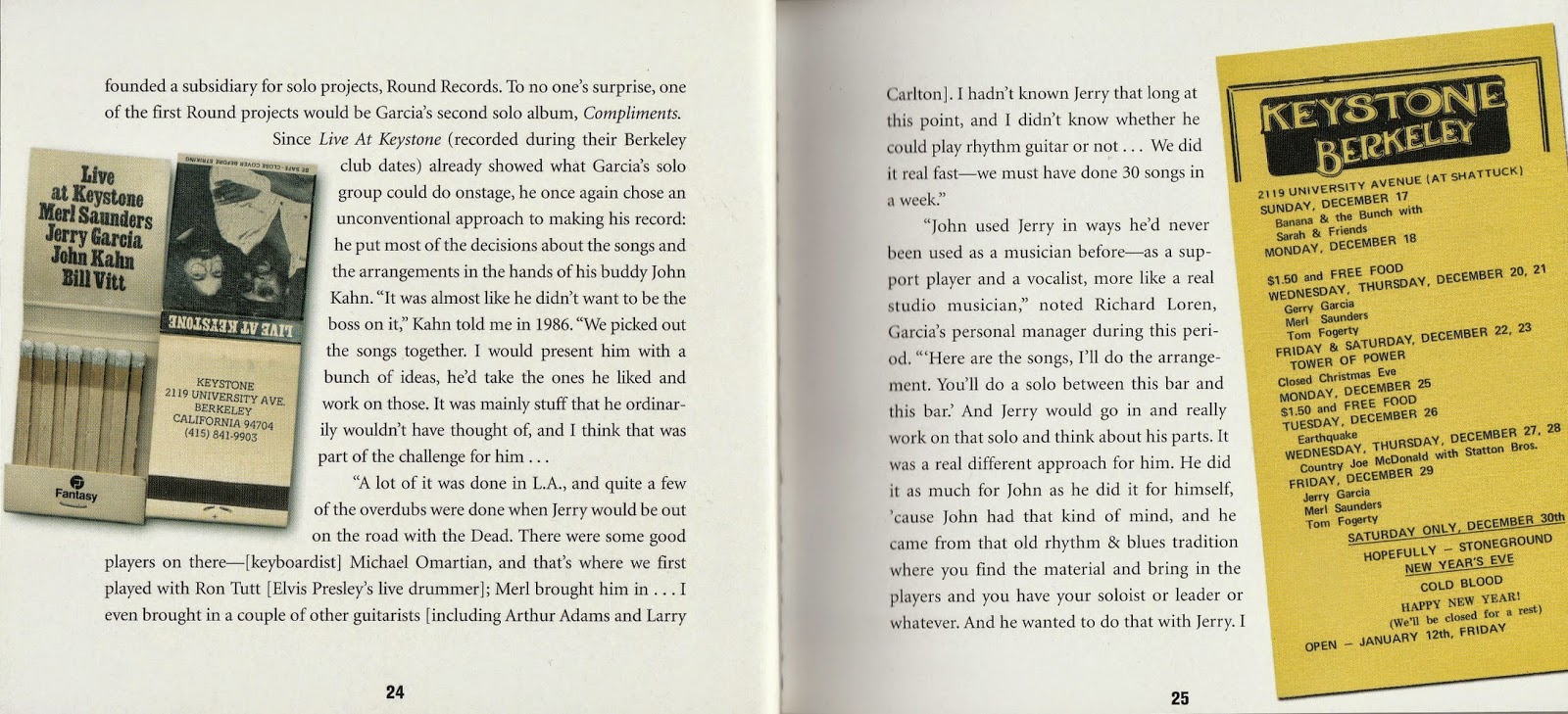
No, I have another, shorter purpose - to note the cross-promotion of Fantasy Records (Berkeley) and Keystone (Berkeley) displayed in the famous matchbook. This is utterly obvious, of course, but I just wanted to put down a marker on it. Win-win, "all good things", indeed! I have one of those matchbooks somewhere around here.

REFERENCES:
! ref: Jackson, Blair. 2004. [liner notes] All Good Things in All Good Time: Revisiting Jerry Garcia's Five Solo Albums. All Good Things: Jerry Garcia Studio Sessions. Rhino Records (R2 78063).

Friday, September 12, 2014

"Jerry Garcia & Merl Saunders & Tom Fogerty Sat-Sun, New Monk"

SFC 7/2/71 p. 52
Last year I spun some 1970 and early 1971 microfilm of the San Francisco Chronicle, and found seven new-to-The-List shows in a three-month span. If you follow the blog or scroll down a bit chronologically, you'll see that I have continued to discover more in the 1971-1972 period, and even as far out as 1974. I hope they are all tagged TJS-addition; that's my code for stuff that's new to The List, newly discovered Garcia shows. So long as there is nothing that fills the function of the much-missed Jerry Site, allowing updates from fan research, first-hand accounts, materials, etc., all in a classic List format, it will be especially important to track the bread crumbs that pop up along the way.

So, obviously I am searching these calendar listings and such because I believe there are still shows out there to discover, hiding in plain site on microfilm.

But, this, I never expected to find.

On Friday, July 2, the Grateful Dead played the Closing of the Fillmore West run, Garcia pulling off the rare trifecta of playing with three bands in the same day - the Rowan Brothers, the New Riders of the Purple Sage (NRPS), and the Dead. I need to think hard about when this might ever have happened again; maybe it never did. This night he played from 8:30 p.m. - 3 a.m. (Wasserman 1971).

The Fillmore West events would continue through the Fourth of July. Yet the 7/2 music listings show that Garcia would be otherwise occupied.

"Jerry Garcia & Merl Saunders & Tom Fogerty Sat-Sun, New Monk"

It would appear that on July 3-4, 1971, while Fillmore West drew most of the eyes and ears, Garcia-Saunders-Kahn-Vitt and new arrival Tom Fogerty, did some tunes. Without elaborating all of the evidence here, I think Fogerty came in only mid-1971, and maybe as recently as the week before this (i.e., around 6/25/71 or 6/26/71). Fogerty lived in a big ol' Tudor or something in Berkeley, and the New Monk specifically, and working for Freddie Herrera generally (i.e., also at Keystone Korner) seemed to be working out really well. Fogerty would inhabit the Garciaverse for 18 months. The New Monk would become Keystone Berkeley, Garcia's musical home base for more than a decade (see also data).

The Sunday night July 4th show, especially, appeals to my aesthetic - a hot summer night (I haven't actually checked that - could have been cold and foggy) in Berkeley, friends and music for the 4th.  There's something very picturesque to me, very resonant with a une certaine idĂ©e de Garcia, about him finding a way, while he could, to take advantage of the fact that the spotlight was elsewhere to just play to the beer and sawdust set. Sign me up!

REFERENCE

Wasserman, John L. 1971. When the Music Finally Stopped. San Francisco Chronicle, July 5, 1971, p. 37. 

Wednesday, July 04, 2012

The Merle [sic] Saunders Experience: Boarding House, January 25, 1973

LN jg1973-01-25.jgms.early-late.sbd.7670.shn2flac1644

Introduction

Not long ago I posted a set of notes on JGMS 1/15/73 at the Inn of the Beginning, the second known date (and the earliest circulating tape) of the Garcia-Saunders-Kahn-Vitt group to include singer Sarah Fulcher. The Sarah Era, as I’ll call it, holds lots of appeal: she’s a mysterious figure about whom little is known; she is a totally distinctive vocalist; she was only around Garcia for nine months or so (1973); she came from Memphis (though she’s a Texan), providing a direct vein to a vast American musical tradition that surely interested Jerry Garcia, even if he hadn’t done much around it; and during her time with The Group they played lots of numbers that they had never played before and would never play again, among them a couple of presumed Fulcher originals (“Go Climb A Mountain” [Allan | TJS] and “Find A Rainbow” [Allan | TJS]).

1/15/73 had left me a little mixed. I enjoyed it, but it didn’t spark much for me. It’s always possible that this is determined to some (possibly large) degree by the particularities of any given listen. But it’s also possible that I was hearing a band that is trying to integrate a new player, trying to figure itself out. And that can be a little bit like work (for the band, if not the listener!). And that’s why one goes up to Cotati to start breaking in a new thing. Having now listened to a show that I confuse in my mind with that one, because of the numeric similarities –1/25/73, Boarding House—I feel more inclined to buy the latter scenario. What I hear on 1/25/73 suggests a unit that is getting itself together. There are many really nice moments, but it still feels like everyone is sort of feeling things out a little bit. One wonders the extent to which album economics are on Jerry’s, and everyone’s mind, as they try to get a vinyl-ready band and repertoire together.

Metadata

There seems little doubt but that the date/location attributions are correct. Merl Saunders, Jr. has shared a handbill image listing Garcia-Saunders-Fogerty at the Boarding House (960 Bush Street, San Francisco, 94109) for special, three-night, midweek engagement. Neither that source nor the other materials I have seen (Scenedrome listing in Berkeley Barb, January 19-25, 1973, p. 28; ad in San Francisco Examiner Datebook, January 21, 1973, p. 25; calendar listing in Hayward Daily Review, January 19, 1973, p. 23) list early-late shows. But two separately-ticketed shows seems perfectly plausible. What’s more, of course, they are supported by these tapes, which have Garcia giving two separate show-closing announcements ("see y'all later").

These tapes were part of the Betty Boards, which is how we came to hear them. I have seen the reels, which are clearly labeled.

While I am in this neck of the woods, let me say again that there is absolutely no evidence for a 1/26/73 listing of JGMS at Boarding House. Old, mislabeled copies of 1/24/73 shouldn't outweigh the absence of JGMS listings and the presence of listings (newspaper and poster) for Harry Chapin on these nights.

Performance

I’d say this is considerably better than 1/15/73, Jerry especially. He is doing a lot of very thoughtful, inventive playing here. There are a number of quite delicate passages and loud, dissonant, wildly-fanning moments. John Kahn plays quite forward, with a number of longish soli/interludes. He doesn’t have a ton of pure string force here, but he’s right on the melody and plays effectively. He  may be out a little more because I find Merl struggling a little bit, leaving some holes where, to my ears, he should have been dropping some heavy swirl. This seems especially true during the early show (@ 7:20 of Summertime, and during I Second That Emotion). I find Vitt to be right on the ball, though again there is a time or two where Jerry had soloed, John had taken a few runs around, and someone needed to step up. Sarah is pretty lowkey and effective this night.

Band and Personnel

Master reels identify the band as "Merle [sic] Saunders Experience", which is super interesting, for those who are into band names and that sort of thing. Tom Fogerty had jokingly suggested this as a possible band name in late 1972 (Selvin 19720927), and apparently The Group and/or or Rex Jackson (who labeled the tape boxes) took him up, with unknown level of seriousness.

Tom Fogerty appeared on the promotional materials, but did not play. In fact, he may never have played with The Group in 1973. We just don’t know.

Sarah Fulcher had been singing at these guys’ gigs for about two weeks at this point. We don’t actually know the precise date on which she first appeared live with The Group. I doubt it was the weekend (Friday-Saturday, January 12-13, 1973) shows in Berkeley. She *could* have sung a number or two, of course. But I find it much more plausible that her first gig would have been a nice, low-key Sunday evening in little Cotati (1/14), than a hot, sweaty run at a packed house of regulars.
On this Thursday night in the city (1/25), Sarah either hasn’t arrived or in any case sits out almost the whole early show, not making her entrance until midway through the last number, and then just singing a few bars. In the late show she first appears singing what I presume to be one of her originals, "Go Climb A Mountain". I’d want to go back and compare with other versions, but the song sounds compositionally fragmentary here, both musically and lyrically. Sounds like she’s workshopping it, you know? She doesn't back or alternate with JG on “That’s Alright Mama”, as she often did. She only comes into “Georgia On My Mind” about six minutes in. She throws a few lyrics into the show-closing “How Sweet It Is (To Be Loved By You)”. What’s striking is how subdued she sounds, and how sparingly she steps out. It’s not a bad vibe at all, I have to say.

Setlist

The main historical interest here (insofar as deviance is more interesting than conformity) lies in the setlist. I summarize it in Table 1, which gives the “official” JGMF title, the number of times played as documented at the Jerry Site as of this writing (N), the song timing on the tape under review, the song credits, and any notes I might have, especially about N.


This is a tremendous setlist from a rarity perspective. If we use a rough-and-ready indicator of song rarity as "fewer than ten known appearances", 6 of the 15 tunes here qualify (40%). Of course, we know very little about these early setlists. It could be that they played "Save Mother Earth" -> "Summertime" every night in 1970 and 1971. Who knows? Dylan's "When I Paint My Masterpiece" appears here for the second-to-last (known) time in the 1970s. "I Know It's A Sin" is a real rarity—Jerry just didn’t play that many blues as straight as this. “Biloxi” is only known to have been played three times, though I have a sneaking suspicion that they played it a lot in the early days.

I judge all of this in the context of January 1973. Whether or not they (or any subset of them) were thinking ahead to a group that could sell records (e.g., on Fantasy, Ă  la Live at the Keystone [F-79002, 1973]), they pretty clearly seemed to be feeling each other out as players and as a potential Group. Tom Fogerty appears to have just left, and Sarah Fulcher appears to have just arrived. Recall that Merl didn’t sing in 1973. It seems plausible to think that Jerry was interested in someone who might shoulder some of the vocal chores, at least a number or two: Tom had done a little and that was clearly what Sarah was all about. A second guitar was another apparent desideratum, witness George Tickner, who would be around for a couple of weeks in April-May. Corry persuades me that this must have been a period strongly colored by album economics (see also my post on JGMS 5/4/73 Homers Warehouse, especially under heading III, “May 1973 and the Commercialization of Garcia On The Side”), i.e., that the choices being made were consequential, far from the structural spontaneity that is portrayed in canonical (and even PR-fueled contemporary) accounts.

We can think of each player as embodying a distinct musical bundle as well, in terms of taste, inclination, knowledge, background, experience, goals for the future, etc. Beyond personality and talent, then, stands a musical repertoire. For a band, or a Group, to work, repertoires need to be made to fit together. That’s practically the definition of society itself, the space in which people conjugate repertoires. So, while January 1973’s setlist variations look striking from the perspective of 25+ years of Garcia On The Side, I think once I listen to everything I can I’ll find that the Sarah Era hangs together, on its own musical terms, pretty well. And while it varies in the specifics of the individual titles, it is perfectly consistent in terms of the basic American musical wellspring from which everything is drawn.

So, what are these repertoires?

Let me start with a few words on the Merl Saunders compositions. Who are these writing partners of his? Does it seem likely that Fantasy had a “stable” and that these compositions were written, arranged, etc., at Fantasy (in the “House That Creedence Built”, at Tenth and Parker in Berkeley [wiki]), by Fantasy, and presumably (at least in Saul Zaentz and Ralph Gleason’s minds), for Fantasy’s benefit? The idea has been floated that, in JGMS (“The Group”), Fantasy might have thought it had a kind of supergroup. That’d be worth investing some songwriters’ time. Anyway, I find both “Save Mother Earth” and “The System” to be first-rate, right up there with Merl’s other compositions played as instrumentals by JGMS, including “Little Bit Of Righteousness”, “She’s Got Charisma” and “Merl’s Tune”. I am not a big fan of “Soul Roach”, generally speaking, so I exclude it from that laundry list. It lacks the dark underbelly that makes the others so deliciously ambivalent.

Lots of R&B hits appear in this setlist, as well. “That’s A Touch I Like” shares some of the steppin’ out vibe of “Hi-Heel Sneakers”, a little more earnest and without the bloodlust, while the other Jessie Winchester number, “Biloxi”, hides a quasi-psychedelic New Orleans voodoo vision (“The air is filled with vapors from the sea / The boy will dig a pool beside the ocean / He sees creatures from his dreams underwater”) inside a sultry tempo, with a real straight vocal delivery. “Summertime”, the Gershwins’ aria from Porgy and Bess, can also make you lose sense, perhaps even memory, of January in San Francisco. Steamy. “How Sweet It Is”, by contrast, is a confection. A couple rockabillies (“Mystery Train”, “That’s Alright Mama”), a couple Dylans, another standard (“Georgia On My Mind”), a straight blues (“I Know It’s A Sin”) and a presumed (by me) Sarah Fulcher original (a protean “Go Climb A Mountain”) mix things up nicely.

Is there a black American musical form unrepresented here? Funk, I suppose. And church music. But, blending various flavors of jazz, blues, soul, R&B and other forms, Garcia and his compatriots grazed over an awful lot of terrain, with Vitt’s Sacramento R&B and Sarah’s Memphis (if only via) contributing influences which would wane in future years.

Summary

Some really nice tape with which to spend a few hours!

Listening Notes

Jerry Garcia and Merl Saunders
Boarding House
January 25, 1973 (Thursday)
161 min Betty Cantor-Jackson sbd of early and late shows

--Early Show (6 tracks, 67:44)--
a-t01. That's A Touch I Like [9:30] [0:28]
a-t02. Save Mother Earth [15:11] ->
a-t03. Summertime [13:50] [0:15]
a-t04. Mystery Train [6:59] [0:18]
a-t05. Biloxi [7:48] [0:03]
a-t06. I Second That Emotion [13:10] (1) [0:10]

--Late Show (9 tracks, 93:25)--
l-t01. It Takes A Lot To Laugh, It Takes A Train To Cry [5:45] [0:06] %
l-t02. //Soul Roach [#7:22] [0:19]
l-t03. Go Climb A Mountain [12:25] [0:21]
l-t04. That's Alright Mama [7:44] [0:15]
l-t05. The System [19:12] ->
l-t06. Georgia On My Mind [15:28] [0:03]
l-t07. When I Paint My Masterpiece [6:02] [1:01]
l-t08. I Know It's //A Sin [8:#49] [0:04]
l-t09. How Sweet It Is (To Be Loved By You) [8:25] (2) [0:03]

! ACT1: Jerry Garcia and Merl Saunders
! lineup: Jerry Garcia - el-g, vocals;
! lineup: Merl Saunders - keyboards;
! lineup: John Kahn - el-bass;
! lineup: Bill Vitt - drums;
! lineup: Sarah Fulcher - vocals.

JGMF:

! Recording: symbols: % = recording discontinuity; / = clipped song; // = cut song; ... = fade in/out; # = truncated timing; [ ] = recorded event time. The recorded event time immediately after the song or item name is an attempt at getting the "real" time of the event. So, a timing of [x:xx] right after a song title is an attempt to say how long the song really was, as represented on this recording.

! db: http://db.etree.org/shn/7670 (this fileset).

! R: Lineage per seeder: "S:R>C>D>CD. Slightly re-tracked using WaveMerge and CDWave,.shn encoding using mkwACT, and proper sector boundaries verified using shntool by jupillej@mediaone.net." Seeded approximately January 15, 2002. This fileset retracked by show, files tagged by jgmf, 7/4/2012. I believe that this came out of the Third Betty Batch, and maybe that these tapes specifically were caked in mud and filth when RE restored them. But it might also be Second Betty Batch, which would seem to me more consistent with the stated sequence of a reel straight to a cassette (for whatever the statement is worth). The back of my mind tells me that this may have come from Katy Miller way back when (ca. 2001).

! date/location: Merl Saunders, Jr. has shared a handbill image listing Garcia-Saunders-Fogerty at the Boarding House (960 Bush Street, San Francisco, 94109) for special, three-night, midweek engagement. Neither that source nor the other materials I have seen (Scenedrome listing in Berkeley Barb, January 19-25, 1973, p. 28; ad in San Francisco Examiner Datebook, January 21, 1973, p. 25) list early-late shows. But two separately-ticketed shows seems perfectly plausible. Of course they are supported by these tapes, which have Garcia giving two separate show-closing announcements ("see y'all later"). While I am at it, there is absolutely no evidence for a 1/26/73 listing of JGMS at Boarding House. Old, mislabeled copies of 1/24/73 shouldn't outweigh the absence of JGMS listings and the presence of listings (newspaper and poster) for Harry Chapin on these nights.

! personnel: Sarah Fulcher doesn't show up until 2 minutes into ISTE, i.e., at the very end of the early show. In the late show she first appears singing what I presume to be one of her originals, which we denote "Go Climb A Mountain". She doesn't back or alternate with JG on TAM, as she often did. She only comes into GOMM about six minutes in. She throws a few lyrics into the show-closing HSII, and it's all good.

! personnel: Tom Fogerty appears on the poster, but he is not present here.

! setlist: This is a tremendous setlist from a rarity perspective. If we use a rough-and-ready indicator of rarity as "fewer than ten known appearances", 6 of the 15 tunes here qualify (40%). Of course, we know very little about these early setlists. It could be that they played "Save Mother Earth" -> "Summertime" every night in 1970 and 1971. Who knows? Dylan's "When I Paint My Masterpiece" appears here for the second-to-last (known) time in the 1970s. "I Know It's A Sin" is a real rarity, as is “Biloxi”. All of that said, it certainly feels like, in January 1973, they are feeling out a repertoire well-suited to the talents and interests of those "in the band", including, apparently, Sarah Fulcher. So we should certainly think of this show in the context of the Sarah Era.

! R: CD splits typically between Biloxi/ISTE and between TAM and The System.

! R: Lots of warts on this, as a result presumably of the deteriorated state of the tapes. "A variety of mostly harmless light snaps, crackles, and pops".

! song: a-t01 That's A Touch I Like. This is commonly referred to in Garcia-world with the definite article ("The" instead of "A)", but I follow Allan and Scofield with this usage (see also TJS).

! R: a-t02 Save Mother Earth two ticks @ 0:01

! R: a-t02 SME lots of static and crackles through ca. 3:00

! P: a-t02 SME ten minutes in, Garcia drops it beautifully into some high register 1, 2-3, 4-5, 6-7, 8 stuff, and they slide very effectively into deep space. Tasty.

! P: a-t03 Summertime interesting that Sarah does not sing here. Summertime is unbelievable at the start. Jerry is playing as delicately, pluckily as you can possibly imagine at the start. Merl setting in deep, too. Two minutes in, Garcia is penning long paragraphs, mournful love letters. High soaring peak at three minutes in. He just surveyed that terrain and proceeded to tear it up. The solo he runs right over the 4-minute mark leaves me breathless. Maybe him, too, because Merl steps in real tasty and Jerry comps behind him. Jerry is running around, ready for bear, and things kind of fall apart in the 7:20 mark, no-one soloing, no-one going anywhere. Ouch! JK does some nice fluttering, symphonic bass in the late 7-minute mark. But there's no reason that giant hole should have opened up in the song. Now, late 8-min mark, Jerry is comping for John, soundfeels like he's nodding and strumming demonstratively and engaging John directly. As they take the descent again first half of 9-min mark, Jerry leads and Merl fills really nicely. JG comping for Merl again, who is doing lots of nice electric piano through 9 and into 10-minute mark. @ 10:34 JG, having seemingly mounted a set of stairs in silence, comes swooping down with some much more aggressive play, Vitt answers with a quick tempo dig, as in "I am on that horse." Every now and then, as in the 12-minute mark, the JGMS version of this song puts me in mind of Pink Floyd's "Shine On You Crazy Diamond" (which I don't think was written yet). Garcia wisely takes the lead in winding them down. It was an interesting take, for sure.

! song: a-t05 "Biloxi". This is commonly referred to in Garcia-world as "Down Around Biloxi", but I follow Allan and Scofield in using "Biloxi".Scofield: “One of three Jesse Winchester songs covered by Jerry Garcia. The others being That's A Touch I Like and Every Word You Say”). This is the last of three known Garcia versions of this song (9/24/71 and 6/30/72 being the other two known instances) (TJS).

! R: a-t05 Biloxi static buzz @ 1:00

! P: a-t06 I don't generally have a lot great to say about any iteration of "I Second That Emotion" other than Smokey Robinson's canonical version. This version is consistent with that general pattern. Merl just never cuts loose with it. Jerry comps behind him a lot, gives him lots of room, and he just doesn't take the bull by the horns. As SteveSw says, "I'm not sure whether the muse gets lost, or something is supposed to happen that doesn't, but it's strange, a bus with no driver." That said, Jerry's playing here is very expressive and measured. He's in complete control. I think Garcia sounds more "on" than Saunders, on this night.

! a-t06 (1) JG: "Thanks a lot. We'll see y'all later."

! P: l-t01 ITALTL, ITATTC is running at an absolutely somnambulant tempo.

! R: l-t02 Soul Roach cuts in, not much missing

! P: l-to3 GCAM early in the 11-minute mark, Jerry and John step forward for a little bit, Kahn doing some unusual percussive stuff.

! P: l-t05 The System starts off a little bit like "My Problems Got Problems". Deep, heavy funk. Merl bringing some synth in the 11-minute mark. Some nice spaceout weirdness in the 14-minute mark, where Jerry goes really clangy and dissonant, a little like what I remember as "Claire de Lune". Really wailing @ 15:23, an ascending run. Nice quiet space @ 15:50. They really let this get out there. It's an exceptionally wide-open space for this band, I'd say.

! R: l-t05 System some skipping/fuckoyage @ 1:36-1:41, 1:51.

! P: l-t06 GOMM John Kahn takes a nice bass lead in the 9-10 minute mark, though I confess the tone here sounds just a little fluttery, not unlike what he'd really do in the 1980s and beyond. He is still leading nicely into the 11-minute mark, and things pick up a little swing for a second, John still thunk-thunking, but with a real nice GOMM melody in the late 11-minute mark. Here's where he was so much better in the 1970s: unlike his soli in the 1980s during Simple Twist of Fate, etc., which often seemed to be orthogonal to the song, here he's not only technically faster and more precise, he's also able to work directly with the melody. 12-min mark Jerry steps in, but things are a little lost without the bass, as John appears to have stepped out, and Merl is not particularly audible. They hold it for a bit and Sarah comes back in for some singing in the second half of the 13-minute mark. She hits the windup to the song absolutely orgasmically, ends with a straightforward "thank ya". Nice!

! P: l-t07 WIPMM: It's great how simple Jerry's playing and singing is here. His guitar is so straightforward, nicely twangy, really stripped down. He doesn't try to guild the lily with his voice. Straight ahead. Nice.

! song: l-t07 WIPMM: NB that there is one more early appearance of this tune, on October 11, 1973 (presumably also with Sarah ... not sure the connection, but there it is). It would then disappear until 1980 before being shelved for good (by Garcia, even as it was appropriated as a Weir vocal into GD setlists) in 1987 (TJS).

! song: l-t08 "I Know It's A Sin": Usually referred to as "It's a Sin" in Garcia-related setlists, I follow Allan and Scofield. This tune appears to be an extreme rarity. As of this writing, only entries at TJS are 10/10/68 (Hartbeats), three shows in the window under examination (1/19/73, 1/23/73 [not in circ] and 1/25/73b), and a one-off reappearance on 3/14/74 (with E.W. Wainwright drumming, not in circulation). It would pop up in a Grateful Dead jam on 6/18/74 at Freedom Hall in Louisville. Anyway, I guess they wanted to try it on with this band, given the concentration in January 1973.

! R: l-t08 IKIAS It's a Sin cut/splice @ 3:03, 6:35.

! P: l-t08 IKIAS JG some pretty wild fanning in the late 4-minute mark, and some significant arcing, stretching, bending in the five minute mark. After a seemingly brief drop-splice @ 6:35, things come in swinging a little harder, Jerry digging in nicely and everyone bringing a little more juice, then back down into slow blues.

! l-t09 HSII does exactly what it's supposed to do, bring things to a tight close.

! l-t09 (2) JG: "See ya later."